


Micro Light Emitting Diode (LED) Market Size
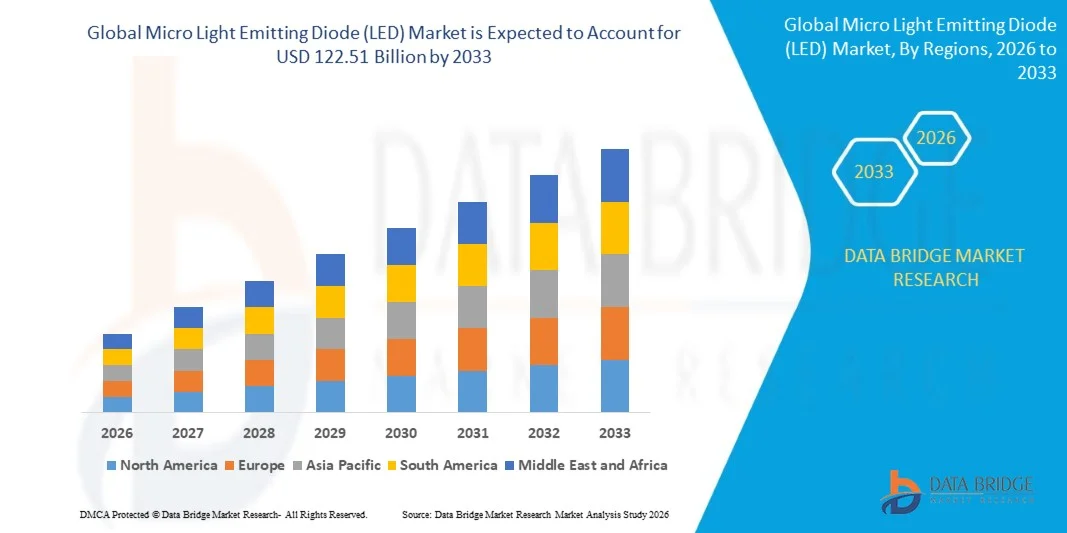
- The global Micro Light Emitting Diode (LED) market size was valued at USD 1.54 billion in 2025 and is expected to reach USD 122.51 billion by 2033, at a CAGR of 86.72% during the forecast period
- The market growth is largely fueled by the increasing adoption of high-resolution displays and advanced visual technologies across consumer electronics, automotive, and commercial sectors, driving demand for energy-efficient and ultra-thin Micro Light Emitting Diode solutions
- Furthermore, rising interest in AR/VR devices, wearable technology, and transparent or flexible display applications is positioning Micro LEDs as the preferred next-generation display technology. These converging factors are accelerating the adoption of Micro Light Emitting Diode solutions, thereby significantly boosting the market’s expansion
Micro Light Emitting Diode (LED) Market Analysis
- Micro LEDs are semiconductor-based light-emitting devices that offer high brightness, low power consumption, and ultra-high resolution. They are used in displays for TVs, smartphones, AR/VR headsets, automotive dashboards, and commercial signage, providing superior image quality and energy efficiency compared to conventional LEDs or OLEDs
- The escalating demand for Micro Light Emitting Diode technology is primarily driven by the need for smaller, high-resolution displays, growing consumer preference for premium visual experiences, and increasing investments by manufacturers in next-generation display technologies
- Asia-Pacific dominated the Micro Light Emitting Diode (LED) market with a share of 66.92% in 2025, due to strong consumer electronics adoption, rapid growth in AR/VR and wearable devices, and increasing investments in display manufacturing hubs
- North America is expected to be the fastest growing region in the Micro Light Emitting Diode (LED) market during the forecast period due to high demand for Micro Light Emitting Diode displays in TVs, AR/VR devices, automotive dashboards, and professional monitors
- Display segment dominated the market with a market share of 82.5% in 2025, due to the increasing demand for high-performance screens in smartphones, TVs, and wearable devices. Display applications benefit from Micro LED’s superior color accuracy, higher brightness, and lower power consumption compared to OLED and LCD technologies. Manufacturers and consumers often prefer Micro Light Emitting Diode displays for premium devices due to their long lifespan and resistance to burn-in issues
Report Scope and Micro Light Emitting Diode (LED) Market Segmentation
|
Attributes |
Micro Light Emitting Diode (LED) Key Market Insights |
|
Segments Covered |
|
|
Countries Covered |
North America
Europe
Asia-Pacific
Middle East and Africa
South America
|
|
Key Market Players |
|
|
Market Opportunities |
|
|
Value Added Data Infosets |
In addition to the insights on market scenarios such as market value, growth rate, segmentation, geographical coverage, and major players, the market reports curated by the Data Bridge Market Research also include in-depth expert analysis, geographically represented company-wise production and capacity, network layouts of distributors and partners, detailed and updated price trend analysis and deficit analysis of supply chain and demand. |
Micro Light Emitting Diode (LED) Market Trends
“Growing Adoption in Consumer Electronics and AR/VR”
- A prominent trend in the Micro Light Emitting Diode (LED) market is the rising adoption of Micro Light Emitting Diode (LED) in consumer electronics and augmented/virtual reality (AR/VR) devices, driven by the demand for brighter, more energy-efficient displays with higher pixel density. This trend is positioning Micro Light Emitting Diode (LED) as key enablers of next-generation display technologies that enhance visual experiences in smartphones, televisions, and wearable devices
- For instance, Samsung and Sony are investing in micro LED-based displays for high-end TVs and AR/VR headsets, enabling superior brightness, color accuracy, and longevity compared to conventional OLED and LCD panels. Such deployments highlight Micro Light Emitting Diode (LED)’s potential to transform premium display applications
- The AR/VR segment is witnessing increased integration of Micro Light Emitting Diode (LED) to overcome limitations of conventional displays, such as lag, pixelation, and low energy efficiency. These advancements are driving adoption in gaming, simulation, and industrial training applications where high resolution and compact form factors are critical
- Consumer electronics manufacturers are increasingly leveraging Micro Light Emitting Diode (LED) for smartwatches, smartphones, and automotive displays, where low power consumption and improved durability are vital. This adoption is accelerating innovation in compact, high-performance screens that support richer multimedia experiences
- The market is witnessing growth in outdoor and digital signage applications, where Micro Light Emitting Diode (LED) offer high brightness, wide viewing angles, and longer operational life compared to traditional display technologies. These factors are encouraging enterprises to replace conventional displays with Micro Light Emitting Diode (LED) solutions
- Industries focusing on next-generation entertainment and immersive experiences are driving demand for Micro Light Emitting Diode (LED) in AR/VR gaming, simulation, and cinema applications. This is strengthening the market’s expansion as Micro Light Emitting Diode (LED) emerge as a preferred technology for high-end, immersive display solutions
Micro Light Emitting Diode (LED) Market Dynamics
Driver
“Rising Demand for High-Resolution, Energy-Efficient Displays”
- The increasing need for displays that offer higher resolution and energy efficiency is driving growth in the Micro Light Emitting Diode (LED) market, as these devices provide superior brightness, contrast, and longevity with lower power consumption. High-resolution Micro Light Emitting Diode (LED) panels are enabling manufacturers to deliver visually richer experiences while reducing operational energy costs
- For instance, Apple is exploring Micro Light Emitting Diode (LED) technology for future Apple Watch and AR headset displays, aiming to achieve enhanced pixel density and power efficiency. Such initiatives reflect the market’s orientation toward devices that combine performance with sustainability
- The shift toward ultra-high-definition televisions, wearable devices, and AR/VR headsets is boosting Micro Light Emitting Diode (LED) adoption, as these applications require compact displays with precise color rendering and minimal energy draw. This rising demand is influencing R&D investments across major display manufacturers
- Micro LEDs are increasingly replacing OLEDs and LCDs in premium display applications due to their superior luminance, durability, and flexibility in design. This trend is driving the market as consumer preference shifts toward longer-lasting, high-performance screens
- The growing focus on next-generation consumer electronics and immersive entertainment solutions continues to strengthen this driver. Manufacturers are investing in Micro Light Emitting Diode (LED) technology to meet evolving user expectations for sharper, more energy-efficient visual experiences
Restraint/Challenge
“High Production Complexity and Cost”
- The Micro Light Emitting Diode (LED) market faces challenges due to the complex manufacturing processes required for producing uniform, high-pixel-density displays, which involve precise wafer transfer, epitaxial growth, and fine-pitch assembly. These complexities contribute to elevated production costs and slow commercialization timelines
- For instance, PlayNitride and VueReal employ advanced transfer and bonding technologies to fabricate Micro Light Emitting Diode (LED) panels, requiring specialized equipment and highly skilled labor. These processes increase production expenses and pose scalability challenges for mass-market adoption
- Achieving consistent brightness, color uniformity, and defect-free Micro Light Emitting Diode (LED) panels involves stringent quality control, further increasing manufacturing timelines and cost structures. This challenge affects both consumer and commercial display segments
- The reliance on advanced semiconductor materials and precise microfabrication techniques elevates the capital intensity of production, making entry and expansion difficult for smaller players. Manufacturers must balance performance goals with economic feasibility to sustain growth
- The market continues to confront constraints related to scaling Micro Light Emitting Diode (LED) production for large-format displays while maintaining reliability and competitive pricing. These challenges collectively pressure companies to innovate manufacturing methods and optimize costs to meet growing demand
Micro Light Emitting Diode (LED) Market Scope
The market is segmented on the basis of application, resolution and brightness, panel size, and vertical.
• By Application
On the basis of application, the Micro Light Emitting Diode market is segmented into display and lighting. The display segment dominated the largest market revenue share of 82.5% in 2025, driven by the increasing demand for high-performance screens in smartphones, TVs, and wearable devices. Display applications benefit from Micro LED’s superior color accuracy, higher brightness, and lower power consumption compared to OLED and LCD technologies. Manufacturers and consumers often prefer Micro Light Emitting Diode displays for premium devices due to their long lifespan and resistance to burn-in issues. The growing adoption of virtual reality (VR) and augmented reality (AR) devices also fuels demand for Micro Light Emitting Diode displays, as the technology enables compact, high-resolution screens. In addition, display applications are supported by continuous innovations in pixel density and miniaturization, enhancing viewing experience and energy efficiency.
The lighting segment is anticipated to witness the fastest growth from 2026 to 2033, fueled by rising adoption in architectural, commercial, and automotive lighting. Micro Light Emitting Diode lighting offers higher luminous efficiency, longer operational life, and precise color rendering, making it attractive for designers and engineers. For instance, companies such as Osram are integrating Micro Light Emitting Diode solutions into adaptive automotive headlights and smart indoor lighting systems, boosting market traction. Lighting applications benefit from increasing energy efficiency regulations and the shift toward sustainable illumination solutions. The compact size and directional light capabilities of Micro LEDs also enable innovative designs in signage, wearable devices, and flexible lighting panels.
• By Resolution and Brightness
On the basis of resolution and brightness, the Micro Light Emitting Diode market is segmented into standard and high resolution, as well as standard and high brightness. The high-resolution segment dominated the market revenue share in 2025 due to rising consumer demand for ultra-high-definition displays in televisions, monitors, and AR/VR devices. High-resolution Micro LEDs enable more precise image rendering and sharper text clarity, enhancing user experience in premium consumer electronics. Manufacturers prefer high-resolution Micro LEDs for professional displays, digital signage, and gaming monitors to deliver lifelike visuals and superior contrast ratios. The segment is supported by advancements in microfabrication and transfer technologies that allow for more dense pixel arrangements. In addition, the increasing trend of large-format displays in entertainment venues, retail spaces, and control rooms contributes to the dominance of high-resolution Micro Light Emitting Diode panels.
The high-brightness segment is expected to witness the fastest growth from 2026 to 2033, driven by applications in outdoor displays, automotive lighting, and AR/VR devices. High-brightness Micro LEDs ensure visibility under direct sunlight and high ambient light conditions, which is crucial for digital signage and outdoor electronic billboards. For instance, Samsung has deployed high-brightness Micro Light Emitting Diode modules in commercial displays and premium home TVs, driving adoption. The technology allows for better energy efficiency while maintaining superior luminance, which appeals to both consumer and industrial applications. Increasing demand for adaptive automotive headlights and specialized lighting solutions also contributes to the growth of this segment.
• By Panel Size
On the basis of panel size, the Micro Light Emitting Diode market is segmented into microdisplay, small and medium-sized panels, and large panels. The microdisplay segment dominated the largest market revenue share in 2025 due to its crucial role in AR/VR headsets, smart glasses, and near-eye devices. Microdisplays provide extremely high pixel density in compact sizes, delivering immersive viewing experiences for augmented and virtual reality applications. Companies and device manufacturers favor microdisplays for their low power consumption, high contrast ratios, and ability to achieve precise color reproduction in compact form factors. The segment’s growth is also supported by rising adoption in military, aerospace, and industrial applications that require portable, high-performance displays. Advancements in mass transfer technologies and microfabrication techniques further enhance the market potential for microdisplays.
The small and medium-sized panel segment is anticipated to witness the fastest growth from 2026 to 2033, driven by the increasing adoption in TVs, monitors, and commercial displays. Small and medium panels offer a balance between cost, performance, and scalability, making them suitable for both consumer electronics and professional displays. For instance, Sony is leveraging small and medium-sized Micro Light Emitting Diode panels in large modular TV displays for premium home and commercial markets. These panels benefit from high brightness, wide color gamut, and long operational life, which appeal to entertainment venues, offices, and high-end residential installations. Rising demand for digital signage and video walls also supports the rapid growth of this segment.
• By Vertical
On the basis of vertical, the Micro Light Emitting Diode market is segmented into consumer electronics, automotive, advertising (digital signage), aerospace and defense, and others. The consumer electronics segment dominated the largest market revenue share in 2025, driven by the adoption of Micro Light Emitting Diode displays in premium TVs, smartphones, and wearables. Consumers and manufacturers prefer Micro Light Emitting Diode technology for its superior image quality, longevity, and energy efficiency, which enhance user experience and device appeal. The segment also benefits from the rising popularity of AR/VR headsets and high-end monitors requiring compact, high-resolution screens. Innovations in mass transfer and microfabrication technologies enable the integration of Micro Light Emitting Diode displays into slim, lightweight devices. In addition, strategic collaborations between display manufacturers and consumer electronics brands further strengthen market dominance.
The automotive segment is expected to witness the fastest growth from 2026 to 2033, driven by the integration of Micro LED technology in automotive displays, lighting, and heads-up displays (HUDs). Micro LEDs provide high brightness, wide color gamut, and long operational life, which are ideal for in-vehicle infotainment and adaptive headlights. For instance, LG Electronics is implementing Micro LED displays in digital dashboards and advanced lighting systems for premium vehicle models. The segment also benefits from increasing adoption of electric vehicles, connected cars, and autonomous driving technologies that demand high-quality, energy-efficient display solutions. Rising focus on safety, aesthetics, and driver experience accelerates the adoption of Micro LED technology in automotive applications.
Micro Light Emitting Diode (LED) Market Regional Analysis
- Asia-Pacific dominated the Micro Light Emitting Diode (LED) market with the largest revenue share of 66.92% in 2025, driven by strong consumer electronics adoption, rapid growth in AR/VR and wearable devices, and increasing investments in display manufacturing hubs
- The region’s cost-effective manufacturing infrastructure, expanding R&D capabilities, and government support for advanced display technologies are accelerating market expansion
- The availability of skilled labor, rising industrialization, and growing consumer demand for high-resolution, energy-efficient displays are contributing to increased Micro Light Emitting Diode (LED) adoption across both consumer and commercial applications
China Micro Light Emitting Diode (LED) Market Insight
China held the largest share in the Asia-Pacific Micro Light Emitting Diode (LED) market in 2025, owing to its position as a global leader in consumer electronics manufacturing and display production. The country’s strong industrial base, favorable government policies promoting advanced display technologies, and extensive export capabilities are major growth drivers. Demand is further supported by investments in AR/VR devices, large-format displays, and next-generation televisions for both domestic and international markets.
India Micro Light Emitting Diode (LED) Market Insight
India is witnessing the fastest growth in the Asia-Pacific region, fueled by expanding consumer electronics demand, increasing investments in display manufacturing, and rising adoption of AR/VR and smart devices. Government initiatives promoting electronics manufacturing and self-reliance in advanced display technologies are strengthening the market. In addition, growing interest in digital signage, automotive displays, and commercial lighting is contributing to robust market expansion.
Europe Micro Light Emitting Diode (LED) Market Insight
The Europe Micro Light Emitting Diode (LED) market is expanding steadily, supported by high demand for premium TVs, professional displays, and automotive infotainment systems. The region emphasizes quality, environmental compliance, and energy-efficient display solutions, particularly for commercial and industrial applications. Increasing adoption of Micro Light Emitting Diode (LED) technology in signage, medical devices, and aerospace displays is further enhancing market growth.
Germany Micro Light Emitting Diode (LED) Market Insight
Germany’s Micro Light Emitting Diode (LED) market is driven by leadership in precision electronics, automotive displays, and high-end commercial screens. The country has well-established R&D networks and collaborations between academic institutions and technology manufacturers, fostering continuous innovation. Demand is particularly strong for premium consumer electronics, automotive dashboards, and industrial-grade display applications.
U.K. Micro Light Emitting Diode (LED) Market Insight
The U.K. market is supported by a mature consumer electronics sector, growing efforts to localize advanced display manufacturing, and rising demand for high-performance digital signage and AR/VR devices. Investments in R&D, academic-industry partnerships, and small- to medium-scale display production are encouraging Micro Light Emitting Diode (LED) adoption in both commercial and industrial sectors.
North America Micro Light Emitting Diode (LED) Market Insight
North America is projected to grow at the fastest CAGR from 2026 to 2033, driven by high demand for Micro Light Emitting Diode (LED) displays in TVs, AR/VR devices, automotive dashboards, and professional monitors. The region’s strong focus on innovation, display R&D, and premium consumer electronics is boosting market expansion. In addition, rising investments by tech giants and collaborations with display manufacturers are supporting faster adoption of Micro Light Emitting Diode (LED) technology.
U.S. Micro Light Emitting Diode (LED) Market Insight
The U.S. accounted for the largest share in the North America Micro Light Emitting Diode (LED) market in 2025, underpinned by its advanced consumer electronics ecosystem, extensive R&D infrastructure, and significant investment in high-end display manufacturing. The country’s emphasis on innovation, energy-efficient displays, and next-generation AR/VR devices is driving adoption. Presence of key technology players, large-scale production facilities, and mature distribution networks further solidify the U.S.'s leading position in the region.
Micro Light Emitting Diode (LED) Market Share
The Micro Light Emitting Diode (LED) industry is primarily led by well-established companies, including:
- Industrial Technology Research Institute (Taiwan)
- Changchun Institute (China)
- III‑V Lab (France)
- CEA Leti (France)
- Hong Kong University of Science and Technology (Hong Kong)
- Fraunhofer‑Gesellschaft (Germany)
- Crystalwise Technology (Taiwan)
- Unimicron (Taiwan)
- Luminit (U.S.)
- Macroblock (Taiwan)
- Aixtron (Germany)
- Aledia (France)
- ALLOS Semiconductors (Germany)
- Max Technologies (Taiwan)
Latest Developments in Global Micro Light Emitting Diode (LED) Market
- In January 2024, Samsung Electronics unveiled its latest collections of QLED, MICRO LED, OLED, and Lifestyle displays, marking a significant milestone in AI-driven screen technology. These new displays feature an advanced AI processor designed to optimize visual and audio output by analyzing content and adjusting settings in real time. The AI-enhanced functionalities include intelligent brightness adjustment, sound optimization, and adaptive picture quality tailored to viewing conditions. In addition, the displays are protected by Samsung Knox, ensuring secure user data management and device integrity. By combining cutting-edge display technology with AI capabilities, Samsung aims to deliver a more immersive and personalized experience, motivating users to integrate these displays into diverse personal and professional environments
- In January 2024, AUO Corporation launched its transparent Micro Light Emitting Diode (LED) display series, showcasing a 60-inch model at the ISE 2024 global professional audiovisual integration event. This technology enables displays to be integrated seamlessly into architectural designs, commercial spaces, corporate meeting rooms, and even residential interiors, providing high transparency without compromising brightness or color accuracy. The transparent Micro Light Emitting Diode (LED) displays are particularly suitable for applications requiring see-through or overlay visual effects, such as retail showcases, museum exhibits, or smart glass windows. By offering advanced visual performance and flexibility in installation, AUO is positioning its transparent Micro Light Emitting Diode (LED) series as a versatile solution for both commercial and high-end residential applications
- In May 2023, Q-Pixel Inc., based in Los Angeles, announced a breakthrough in display technology by introducing the world’s first full-color, ultra-high-resolution Micro Light Emitting Diode (LED) screen with Polychromatic Micro Light Emitting Diode (LED) technology. This innovation achieved a pixel density of 5000 pixels per inch (PPI), offering unprecedented image sharpness and color accuracy. The technology allows for ultra-fine pixel control, resulting in highly detailed visuals suitable for premium monitors, VR/AR devices, and specialized industrial applications. By pushing the limits of pixel density and color fidelity, Q-Pixel is setting a new standard for ultra-high-resolution Micro Light Emitting Diode (LED) displays, catering to both professional and consumer markets seeking cutting-edge visual performance
- In November 2022, Epistar and PlayNitride Display, subsidiaries of Ennostar Inc. and PlayNitride Inc., collaborated to establish a production line dedicated to 6-inch Micro Light Emitting Diode (LED) epi-wafers. This strategic collaboration focused on overcoming key technological challenges in Micro Light Emitting Diode (LED) fabrication, including mass transfer efficiency, wafer yield, and uniformity. The production line was designed to support the development of applications such as see-through displays for wearable devices, automotive dashboards, and transparent display panels for commercial or consumer use. By combining their expertise in Light Emitting Diode (LED) epitaxy and display engineering, both companies aim to accelerate the commercialization of Micro Light Emitting Diode (LED) technology and expand its adoption across multiple high-value applications
- In August 2021, Jade Bird Display partnered with WaveOptics, a UK-based manufacturer of diffractive waveguides for AR wearables, to supply Micro Light Emitting Diode (LED) microdisplays for AR applications. Jade Bird Display integrated its 0.13-inch AmµLight Emitting Diode (LED) panel into WaveOptics’s Leopard development kit, enabling a compact, high-resolution, and energy-efficient display solution. The Leopard development kit showcases advanced augmented reality technology, allowing developers to deploy customizable AR experiences with high visual clarity and minimal form factor. WaveOptics’s patented waveguide technology, combined with Jade Bird’s Micro Light Emitting Diode (LED) microdisplays, provides a robust platform for wearable AR devices in industries such as healthcare, industrial training, and consumer electronics. This partnership highlights the growing role of Micro Light Emitting Diode (LED) microdisplays in enabling next-generation AR and wearable technologies

- Interactive Data Analysis Dashboard
- Company Analysis Dashboard for high growth potential opportunities
- Research Analyst Access for customization & queries
- Competitor Analysis with Interactive dashboard
- Latest News, Updates & Trend analysis
- Harness the Power of Benchmark Analysis for Comprehensive Competitor Tracking
Global Micro Led Market, Supply Chain Analysis and Ecosystem Framework
To support market growth and help clients navigate the impact of geopolitical shifts, DBMR has integrated in-depth supply chain analysis into its Global Micro Led Market research reports. This addition empowers clients to respond effectively to global changes affecting their industries. The supply chain analysis section includes detailed insights such as Global Micro Led Market consumption and production by country, price trend analysis, the impact of tariffs and geopolitical developments, and import and export trends by country and HSN code. It also highlights major suppliers with data on production capacity and company profiles, as well as key importers and exporters. In addition to research, DBMR offers specialized supply chain consulting services backed by over a decade of experience, providing solutions like supplier discovery, supplier risk assessment, price trend analysis, impact evaluation of inflation and trade route changes, and comprehensive market trend analysis.
Data collection and base year analysis are done using data collection modules with large sample sizes. The stage includes obtaining market information or related data through various sources and strategies. It includes examining and planning all the data acquired from the past in advance. It likewise envelops the examination of information inconsistencies seen across different information sources. The market data is analysed and estimated using market statistical and coherent models. Also, market share analysis and key trend analysis are the major success factors in the market report. To know more, please request an analyst call or drop down your inquiry.
The key research methodology used by DBMR research team is data triangulation which involves data mining, analysis of the impact of data variables on the market and primary (industry expert) validation. Data models include Vendor Positioning Grid, Market Time Line Analysis, Market Overview and Guide, Company Positioning Grid, Patent Analysis, Pricing Analysis, Company Market Share Analysis, Standards of Measurement, Global versus Regional and Vendor Share Analysis. To know more about the research methodology, drop in an inquiry to speak to our industry experts.
Data Bridge Market Research is a leader in advanced formative research. We take pride in servicing our existing and new customers with data and analysis that match and suits their goal. The report can be customized to include price trend analysis of target brands understanding the market for additional countries (ask for the list of countries), clinical trial results data, literature review, refurbished market and product base analysis. Market analysis of target competitors can be analyzed from technology-based analysis to market portfolio strategies. We can add as many competitors that you require data about in the format and data style you are looking for. Our team of analysts can also provide you data in crude raw excel files pivot tables (Fact book) or can assist you in creating presentations from the data sets available in the report.













