Global Micro Magnetic Resonance Imaging Market
Market Size in USD Billion
CAGR :
% 
 USD
1.74 Billion
USD
2.34 Billion
2025
2033
USD
1.74 Billion
USD
2.34 Billion
2025
2033
 Forecast Period Forecast Period |
2026 –2033 |
 Market Size (Base Year) Market Size (Base Year) |
USD 1.74 Billion |
 Market Size (Forecast Year) Market Size (Forecast Year) |
USD 2.34 Billion |
 CAGR CAGR |
% |
| Major Markets Players |
|
Micro Magnetic Resonance Imaging Market Size
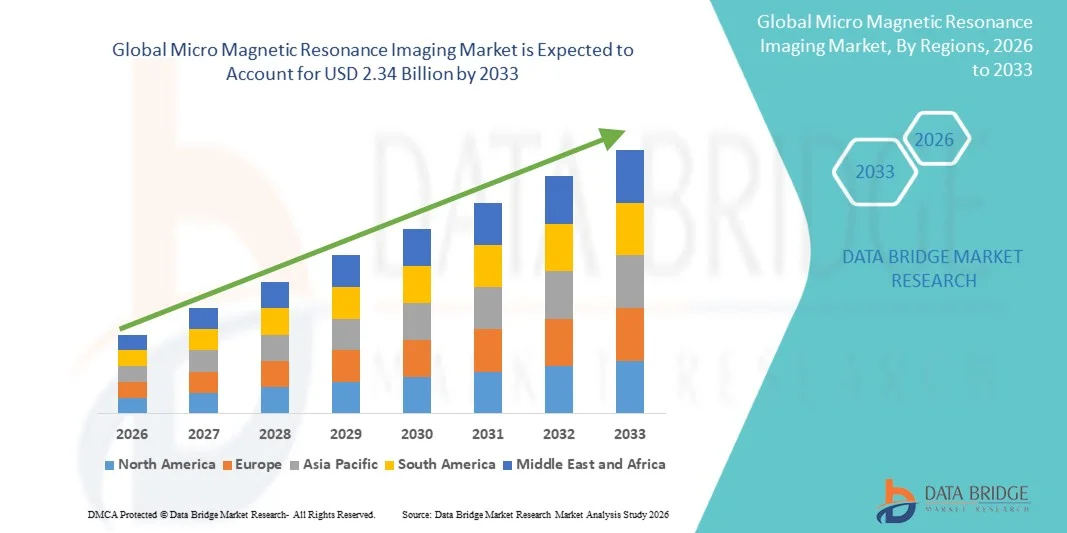
- The global micro magnetic resonance imaging market size was valued at USD 1.74 billion in 2025 and is expected to reach USD 2.34 billion by 2033, at a CAGR of 3.80% during the forecast period
- The market growth is primarily driven by increasing adoption of high-resolution preclinical imaging systems and advancements in biomedical research, enabling more precise visualization of microstructural anatomy in small animals and tissue samples
- Furthermore, rising demand for advanced diagnostic research tools in neuroscience, oncology, and cardiovascular studies, along with expanding investments in life sciences and pharmaceutical R&D, is positioning micro MRI systems as a critical imaging modality. These converging factors are accelerating the uptake of micro MRI solutions, thereby significantly boosting the industry's growth
Micro Magnetic Resonance Imaging Market Analysis
- Micro magnetic resonance imaging systems, enabling ultra-high-resolution visualization of microscopic biological structures, are increasingly critical in preclinical research, disease modeling, and advanced biomedical studies due to their non-invasive imaging capabilities and superior soft-tissue contrast at microstructural levels
- The growing demand for micro magnetic resonance imaging is primarily driven by expanding applications in neuroscience and cardiovascular research, rising investment in precision medicine and drug development, and continuous advancements in high-field and ultra-high-field imaging technologies that enhance spatial resolution and diagnostic accuracy
- North America dominated the micro magnetic resonance imaging market with the largest revenue share of 42.6% in 2025, supported by strong research infrastructure, high healthcare R&D expenditure, and widespread adoption across academic and pharmaceutical institutions, with the U.S. leading in advanced neurology and oncology imaging applications
- Asia-Pacific is expected to be the fastest growing region in the micro magnetic resonance imaging market during the forecast period, driven by increasing healthcare research funding, rapid expansion of biotechnology and life sciences sectors, and growing adoption of advanced imaging modalities in emerging economies
- Neurology segment dominated the micro magnetic resonance imaging market with a significant share of 34.8% in 2025, driven by extensive use in brain structure analysis, neurological disorder research, and functional imaging studies requiring high-resolution micro-level anatomical insights
Report Scope and Micro Magnetic Resonance Imaging Market Segmentation
|
Attributes |
Micro Magnetic Resonance Imaging Key Market Insights |
|
Segments Covered |
|
|
Countries Covered |
North America
Europe
Asia-Pacific
Middle East and Africa
South America
|
|
Key Market Players |
|
|
Market Opportunities |
|
|
Value Added Data Infosets |
In addition to the insights on market scenarios such as market value, growth rate, segmentation, geographical coverage, and major players, the market reports curated by the Data Bridge Market Research also include in-depth expert analysis, patient epidemiology, pipeline analysis, pricing analysis, and regulatory framework |
Micro Magnetic Resonance Imaging Market Trends
“Advancement Toward High-Resolution Preclinical Imaging and AI-Enhanced Reconstruction”
- A significant and accelerating trend in the global micro magnetic resonance imaging market is the growing adoption of ultra-high-field imaging systems combined with advanced AI-based image reconstruction techniques, improving resolution, speed, and quantitative analysis in preclinical research and biomedical applications
- For instance, Bruker BioSpin’s preclinical MRI platforms are widely used in research institutions, offering high-field imaging solutions integrated with advanced software for improved anatomical and functional visualization of small animal models
- AI integration in micro magnetic resonance imaging enables enhanced noise reduction, faster scan reconstruction, and improved tissue segmentation accuracy, allowing researchers to obtain more precise microstructural insights in neuroscience and oncology studies
- Furthermore, seamless integration of micro MRI systems with multimodal imaging platforms such as PET and CT is enabling comprehensive research workflows, supporting centralized data analysis and improved disease modeling in translational research environments
- This trend toward intelligent, high-resolution, and multimodal imaging systems is fundamentally reshaping expectations in biomedical research, with companies such as Siemens Healthineers and Bruker advancing automated imaging protocols and enhanced data analytics capabilities
- Increasing development of compact and cost-optimized micro MRI systems is also expanding accessibility beyond large research centers, supporting wider adoption in mid-sized academic and pharmaceutical laboratories
- The demand for AI-enabled and high-field micro magnetic resonance imaging systems is growing rapidly across academic and pharmaceutical research sectors, as institutions increasingly prioritize precision imaging and advanced preclinical diagnostic capabilities
Micro Magnetic Resonance Imaging Market Dynamics
Driver
“Growing Demand from Preclinical Research and Drug Development Applications”
- The increasing demand for high-resolution imaging in preclinical research and drug development is a major driver for the micro magnetic resonance imaging market, as researchers require precise visualization tools for studying disease mechanisms and evaluating therapeutic efficacy
- For instance, in April 2025, leading research institutions expanded the use of ultra-high-field micro MRI systems for longitudinal studies in neurological and cardiovascular disease models, improving drug testing accuracy and translational outcomes
- As pharmaceutical companies increasingly focus on reducing clinical trial failures, micro magnetic resonance imaging provides non-invasive, high-resolution imaging capabilities that support early-stage toxicity testing and biomarker identification
- Furthermore, growing investments in life sciences research and government-funded biomedical programs are accelerating the adoption of advanced imaging technologies in academic and clinical research institutions
- The ability of micro MRI systems to deliver detailed anatomical, functional, and molecular-level insights is making them an essential tool in modern biomedical research workflows across neurology, oncology, and cardiology applications
- Rising use of micro MRI in personalized medicine research is further strengthening demand, as it enables patient-specific disease modeling and improved therapeutic response prediction in experimental studies
- Expanding collaborations between pharmaceutical companies and academic institutes are also accelerating technology integration, improving innovation cycles in drug discovery and translational research pipelines
Restraint/Challenge
“High Equipment Cost and Operational Complexity”
- Concerns surrounding the high cost of acquisition, maintenance, and operation of micro magnetic resonance imaging systems pose a significant challenge to broader market adoption, particularly among smaller research institutes and emerging economies
- For instance, ultra-high-field micro MRI systems require specialized infrastructure, including advanced shielding, cooling systems, and trained technical personnel, which increases overall operational expenses and limits accessibility
- Addressing these cost-related challenges through technological optimization, shared imaging facilities, and modular system designs is crucial for expanding market penetration across academic and research institutions
- In addition, the complexity of operating and interpreting micro MRI data requires skilled professionals, which creates a dependency on specialized training and limits rapid adoption in less-developed research environments
- While manufacturers such as Bruker and Siemens are introducing more user-friendly interfaces and automation features, the perceived technical complexity and high investment requirement continue to restrict widespread adoption, especially in cost-sensitive research settings
- Limited standardization across imaging protocols and software platforms further complicates interoperability, increasing workflow inefficiencies in multi-center research studies
- Lengthy installation and calibration times also act as operational barriers, delaying deployment and reducing overall system utilization efficiency in high-throughput research environments
Micro Magnetic Resonance Imaging Market Scope
The market is segmented on the basis of design, application, device type, and end user.
- By Design
On the basis of design, the micro magnetic resonance imaging market is segmented into Open MRI, Closed MRI, Standard Bore MRI, and Wide-Bore MRI. The Closed MRI segment dominated the market with the largest revenue share of 46.3% in 2025, driven by its superior image resolution, stronger magnetic field stability, and high suitability for advanced preclinical and neurological research applications. Closed MRI systems are widely preferred in micro MRI studies because they deliver enhanced signal-to-noise ratios, enabling precise imaging of small animal models and microstructural tissues. Research institutes and pharmaceutical laboratories prioritize closed designs for their compatibility with high-field and ultra-high-field configurations. In addition, their ability to support complex imaging sequences makes them essential for oncology and neuroscience studies requiring high accuracy. The established infrastructure support in developed regions further strengthens adoption. Overall, performance reliability and imaging precision are the key factors sustaining dominance of this segment.
The Wide-Bore MRI segment is expected to witness the fastest growth rate of 8.9% from 2026 to 2033, driven by increasing demand for improved accessibility, animal handling efficiency, and integration of advanced imaging equipment in preclinical environments. Wide-bore systems provide greater physical space, making them suitable for longitudinal studies requiring specialized animal positioning and multi-modal imaging setups. These systems are increasingly preferred in research facilities focusing on complex experimental workflows and hybrid imaging applications. The design flexibility also supports integration with PET and CT systems, enhancing research productivity. Furthermore, improved comfort and operational convenience reduce scanning limitations in experimental models. Rising investments in next-generation imaging infrastructure are accelerating adoption globally.
- By Application
On the basis of application, the micro magnetic resonance imaging market is segmented into spine, neurology, orthopedic, cardiovascular, head and neck, abdominal and prostate, and others. The Neurology segment dominated the market with the largest revenue share of 34.8% in 2025, driven by extensive use of micro MRI in brain structure analysis, neurological disorder research, and functional imaging studies. Neurology applications require extremely high-resolution imaging to study microstructural changes in brain tissues, making micro MRI an essential tool in neuroscience research. It is widely used in Alzheimer’s, Parkinson’s, and multiple sclerosis studies for early disease detection and progression monitoring. Academic institutions and pharmaceutical companies heavily invest in neurological imaging for drug discovery and brain mapping research. The segment also benefits from increasing focus on connectomics and brain network studies. High demand for precision imaging continues to reinforce its dominance.
The Cardiovascular segment is expected to witness the fastest growth rate of 9.4% from 2026 to 2033, driven by increasing research into microvascular structures, cardiac tissue characterization, and early detection of cardiovascular diseases. Micro MRI enables detailed visualization of heart tissue at a microscopic level, supporting advanced studies in myocardial fibrosis and ischemic injury. Growing prevalence of cardiovascular diseases globally is accelerating research investments in this segment. In addition, its use in preclinical animal models for drug testing is expanding rapidly. Advancements in motion correction techniques are further improving imaging accuracy. Rising demand for non-invasive cardiac research tools is significantly boosting growth.
- By Device Type
On the basis of device type, the micro magnetic resonance imaging market is segmented into Low-to-Mid Field MRI (below 1.5T), High Field MRI (1.5T - 3.0T), Very High Field (4.0T - 5.0T), and Ultra-High Field MRI (6.0T and Above). The High Field MRI (1.5T - 3.0T) segment dominated the market with the largest revenue share of 41.8% in 2025, driven by its optimal balance between image quality, operational stability, and cost efficiency. High-field systems are widely used in preclinical imaging due to their ability to produce high-resolution anatomical and functional images suitable for most research applications. These systems are extensively deployed in pharmaceutical studies and academic research centers for routine imaging workflows. Their compatibility with various imaging protocols enhances versatility across neurological, cardiovascular, and oncology studies. In addition, lower operational complexity compared to ultra-high-field systems supports wider adoption. Established global infrastructure further strengthens its market leadership.
The Ultra-High Field MRI (6.0T and above) segment is expected to witness the fastest growth rate of 10.2% from 2026 to 2033, driven by increasing demand for extremely high-resolution imaging in advanced biomedical research. These systems enable visualization of microstructural and molecular-level details, making them ideal for cutting-edge neuroscience and oncology studies. Growing investment in precision medicine and translational research is accelerating adoption. Ultra-high-field systems also support advanced functional imaging techniques with superior sensitivity. Continuous technological advancements are improving safety and reducing system limitations. Expanding use in elite research institutions is significantly driving segment growth.
- By End User
On the basis of end user, the micro magnetic resonance imaging market is segmented into hospitals, ambulatory surgical centers, and diagnostic imaging centers. The Hospitals segment dominated the market with the largest revenue share of 39.7% in 2025, driven by strong integration of advanced imaging systems into clinical research, diagnostic workflows, and academic medical centers. Hospitals often collaborate with research institutions, making them key adopters of micro MRI systems for translational studies. They benefit from well-established infrastructure, skilled personnel, and funding support for advanced imaging technologies. Hospitals also utilize micro MRI for specialized neurological and cardiovascular research applications. Increasing adoption of precision diagnostics further strengthens demand. Their ability to support large-scale imaging programs reinforces market dominance.
The Diagnostic Imaging Centers segment is expected to witness the fastest growth rate of 9.1% from 2026 to 2033, driven by rising outsourcing of advanced imaging services and increasing availability of high-end research imaging facilities. These centers are expanding their capabilities to include micro MRI systems for specialized diagnostic and research applications. Growing demand for cost-effective imaging services is encouraging adoption outside traditional hospital settings. Technological advancements are making systems more compact and operationally efficient for standalone centers. Partnerships with research organizations are further boosting utilization. Expanding healthcare infrastructure in emerging markets is accelerating growth in this segment.
Micro Magnetic Resonance Imaging Market Regional Analysis
- North America dominated the micro magnetic resonance imaging market with the largest revenue share of 42.6% in 2025, supported by strong research infrastructure, high healthcare R&D expenditure, and widespread adoption across academic and pharmaceutical institutions
- Researchers and healthcare organizations in the region highly value the ultra-high-resolution imaging capabilities, precision in disease modeling, and integration with advanced analytics platforms offered by micro MRI systems for neuroscience, oncology, and cardiovascular studies
- This widespread adoption is further supported by robust government and private funding for life sciences research, a highly skilled scientific workforce, and the presence of leading imaging technology providers and research universities, establishing micro MRI as a critical tool in translational and experimental biomedical research
U.S. Micro Magnetic Resonance Imaging Market Insight
The U.S. micro magnetic resonance imaging market captured the largest revenue share within North America in 2025, driven by rapid advancements in biomedical imaging research, strong presence of leading pharmaceutical and biotechnology companies, and extensive funding for life sciences innovation. The country is a major hub for preclinical imaging studies, with widespread adoption of ultra-high-field micro MRI systems in neuroscience, oncology, and cardiovascular research. Researchers and institutions in the U.S. highly prioritize high-resolution, AI-integrated imaging systems for drug discovery and disease modeling applications. Furthermore, strong collaboration between academic research centers and imaging technology providers is accelerating innovation and expanding application areas of micro MRI in translational medicine.
Europe Micro Magnetic Resonance Imaging Market Insight
The Europe micro magnetic resonance imaging market is projected to expand at a substantial CAGR throughout the forecast period, primarily driven by strong regulatory support for biomedical research, increasing funding for life sciences, and growing emphasis on advanced diagnostic imaging technologies. The region’s focus on precision medicine and academic research collaboration is accelerating adoption of micro MRI systems across universities and research hospitals. European researchers prioritize high-resolution, non-invasive imaging solutions for neurological and cardiovascular studies, supporting demand for advanced preclinical imaging platforms. In addition, increasing integration of multimodal imaging systems and rising investments in pharmaceutical R&D are further strengthening market growth across the region.
U.K. Micro Magnetic Resonance Imaging Market Insight
The U.K. micro magnetic resonance imaging market is anticipated to grow at a notable CAGR during the forecast period, driven by strong biomedical research initiatives and increasing focus on early disease detection and drug discovery. The country’s advanced healthcare research ecosystem and presence of leading academic institutions are supporting adoption of high-field and ultra-high-field micro MRI systems. Researchers in the U.K. increasingly utilize micro MRI for neuroscience, oncology, and cardiovascular applications requiring detailed tissue-level analysis. In addition, growing government support for innovation in life sciences and increasing collaboration between universities and biotech companies are contributing significantly to market expansion.
Germany Micro Magnetic Resonance Imaging Market Insight
The Germany micro magnetic resonance imaging market is expected to expand at a considerable CAGR during the forecast period, fueled by strong emphasis on technological innovation, precision engineering, and advanced healthcare research infrastructure. Germany’s well-established research institutions and biomedical laboratories are driving adoption of high-performance micro MRI systems for preclinical and translational studies. Researchers in the country prioritize high-quality imaging systems with strong data accuracy and reproducibility for neurological and oncological research. Furthermore, increasing investment in medical technology and strong collaboration between industry and academia are supporting continued market growth in Germany.
Asia-Pacific Micro Magnetic Resonance Imaging Market Insight
The Asia-Pacific micro magnetic resonance imaging market is poised to grow at the fastest CAGR of 10.6% during the forecast period of 2026 to 2033, driven by rising investments in healthcare research, rapid expansion of biotechnology sectors, and increasing adoption of advanced imaging technologies in countries such as China, Japan, and India. The region’s growing focus on precision medicine and drug discovery is significantly boosting demand for high-resolution preclinical imaging systems. Government initiatives supporting healthcare innovation and expanding research infrastructure are further accelerating adoption. In addition, Asia-Pacific is emerging as a key manufacturing hub for imaging components, improving affordability and accessibility of micro MRI systems across research institutions.
Japan Micro Magnetic Resonance Imaging Market Insight
The Japan micro magnetic resonance imaging market is gaining momentum due to its strong technological ecosystem, high investment in medical research, and demand for precision imaging solutions in neuroscience and oncology. Japan’s advanced healthcare infrastructure and emphasis on innovation are supporting the adoption of ultra-high-field micro MRI systems in research institutions. Researchers extensively use micro MRI for brain mapping, cardiovascular studies, and regenerative medicine research. In addition, the country’s aging population is increasing demand for advanced disease modeling and early diagnostic research tools, further driving market growth.
India Micro Magnetic Resonance Imaging Market Insight
The India micro magnetic resonance imaging market accounted for a significant revenue share in Asia-Pacific in 2025, attributed to rapid expansion of biomedical research activities, growing investments in healthcare infrastructure, and increasing adoption of advanced diagnostic technologies. India’s expanding pharmaceutical and biotechnology sectors are driving demand for preclinical imaging systems used in drug discovery and disease research. Government initiatives promoting research and innovation, along with growing collaborations between academic institutions and global companies, are further supporting market expansion. In addition, increasing availability of cost-effective imaging solutions is making micro MRI systems more accessible to research organizations across the country.
Micro Magnetic Resonance Imaging Market Share
The Micro Magnetic Resonance Imaging industry is primarily led by well-established companies, including:
- Bruker Corporation (U.S.)
- Siemens Healthineers AG (Germany)
- GE HealthCare (U.S.)
- Koninklijke Philips N.V. (Netherlands)
- FUJIFILM Holdings Corporation (Japan)
- CANON MEDICAL SYSTEMS CORPORATION (Japan)
- Esaote S.p.A. (Italy)
- MR Solutions Ltd. (U.K.)
- Aspect Imaging Ltd. (Israel)
- Time Medical Holding Company (Hong Kong)
- Shenzhen United Imaging Healthcare Co., Ltd. (China)
- Fonar Corporation (U.S.)
- Nanalysis Scientific Corp. (Canada)
- Analogic Corporation (U.S.)
- IMRIS, Deerfield Imaging, Inc. (U.S.)
- Mediso Ltd. (Hungary)
- MILabs B.V. (Netherlands)
- Neusoft Medical Systems Co., Ltd. (China)
- Synaptive Medical Inc. (Canada)
- NanoMR Inc. (U.S.)
What are the Recent Developments in Global Micro Magnetic Resonance Imaging Market?
- In January 2026, Bruker announced two major multi-year agreements worth approximately USD 500 million for supplying high-performance superconductors used in next-generation MRI magnet systems. These superconductors support advanced MRI, including preclinical MRI and high-field imaging systems, enabling improved image stability, helium-free magnet architectures, and next-generation scanner development. The deal highlights strong demand for advanced MRI hardware components globally
- In December 2025, Washington University School of Medicine (MIR facility) installed a Bruker BioSpec 15.2 Tesla ultra-high-field MRI scanner to advance preclinical imaging research. The system enables unprecedented spatial resolution and metabolic imaging for small animal disease models. It significantly enhances neuroscience, oncology, and cardiovascular research capabilities. The installation was partially funded by an NIH grant and represents one of the most powerful preclinical MRI systems globally
- In November 2025, Siemens Healthineers showcased its latest MRI advancements at RSNA 2025, focusing on improved imaging precision, workflow efficiency, and interventional MRI applications. The innovations emphasized enhanced lesion visibility and more flexible system designs for advanced diagnostic imaging. These developments reflect the ongoing push toward high-performance MRI systems relevant to micro-level imaging research applications
- In November 2025, Siemens Healthineers introduced the Magnetom Free.XL, a 0.55T MRI system designed for interventional radiology with improved soft-tissue visualization and wider bore access. The system supports advanced imaging-guided procedures and integrates ergonomic and helium-free technology. This development strengthens low-field and specialized MRI innovation relevant to micro MRI evolution
- In July 2025, researchers supported by the U.S. National Institutes of Health developed a next-generation ultra-high-resolution MRI system called Connectome 2.0, capable of imaging microscopic brain structures with significantly higher signal-to-noise ratio than conventional MRI systems. The scanner enables near-micron-level mapping of neural connections in living humans, advancing neuroscience research and microstructural imaging capabilities. This represents a major leap in micro MRI innovation for brain research applications
SKU-
Get online access to the report on the World's First Market Intelligence Cloud

- Interactive Data Analysis Dashboard
- Company Analysis Dashboard for high growth potential opportunities
- Research Analyst Access for customization & queries
- Competitor Analysis with Interactive dashboard
- Latest News, Updates & Trend analysis
- Harness the Power of Benchmark Analysis for Comprehensive Competitor Tracking
Research Methodology
Data collection and base year analysis are done using data collection modules with large sample sizes. The stage includes obtaining market information or related data through various sources and strategies. It includes examining and planning all the data acquired from the past in advance. It likewise envelops the examination of information inconsistencies seen across different information sources. The market data is analysed and estimated using market statistical and coherent models. Also, market share analysis and key trend analysis are the major success factors in the market report. To know more, please request an analyst call or drop down your inquiry.
The key research methodology used by DBMR research team is data triangulation which involves data mining, analysis of the impact of data variables on the market and primary (industry expert) validation. Data models include Vendor Positioning Grid, Market Time Line Analysis, Market Overview and Guide, Company Positioning Grid, Patent Analysis, Pricing Analysis, Company Market Share Analysis, Standards of Measurement, Global versus Regional and Vendor Share Analysis. To know more about the research methodology, drop in an inquiry to speak to our industry experts.
Customization Available
Data Bridge Market Research is a leader in advanced formative research. We take pride in servicing our existing and new customers with data and analysis that match and suits their goal. The report can be customized to include price trend analysis of target brands understanding the market for additional countries (ask for the list of countries), clinical trial results data, literature review, refurbished market and product base analysis. Market analysis of target competitors can be analyzed from technology-based analysis to market portfolio strategies. We can add as many competitors that you require data about in the format and data style you are looking for. Our team of analysts can also provide you data in crude raw excel files pivot tables (Fact book) or can assist you in creating presentations from the data sets available in the report.