


Micro-Mobility Battery Market Overview
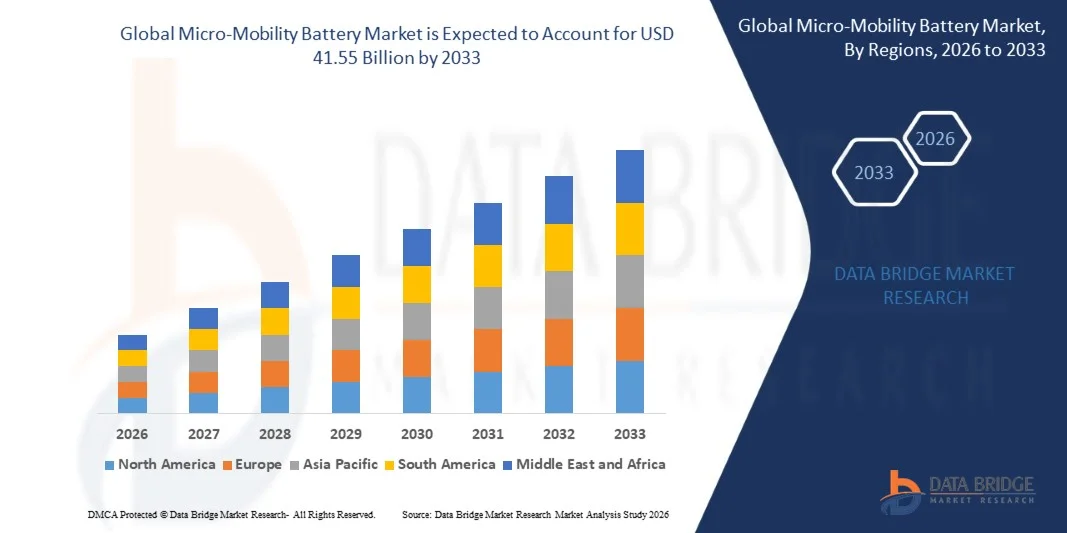
The global micro-mobility battery market was valued at USD 16.37 Billion in 2025 and is projected to reach USD 41.55 Billion by 2033, growing at a CAGR of 12.35% from 2026 to 2033. The market is experiencing consistent growth driven by increasing adoption of electric bicycles and electric scooters, rising demand for sustainable urban transportation, and expanding deployment of shared mobility services across major cities. Growing investments in lithium-ion battery manufacturing and advancements in fast-charging and battery-swapping technologies are further supporting market expansion across developed and emerging economies.
The increasing global focus on reducing carbon emissions and traffic congestion, combined with supportive government incentives for electric mobility adoption, is encouraging consumers and fleet operators to shift toward battery-powered micro-mobility solutions. Advanced battery systems are increasingly improving vehicle range, charging efficiency, and operational reliability, helping manufacturers enhance performance and user convenience. Rising urbanization, growth of last-mile delivery services, and continuous expansion of smart city infrastructure are further accelerating demand for high-performance micro-mobility batteries globally.
Key Market Trends & Insights
- Asia-Pacific dominated the global micro-mobility battery market with the largest revenue share of 44.8% in 2025, supported by large-scale production of electric bicycles and electric scooters, strong battery manufacturing infrastructure, and rising urban mobility adoption across major economies
- The Li-Ion segment led the market with a 59.1% share in 2025, driven by its high energy density, lightweight structure, and superior charging efficiency across electric micro-mobility vehicles
- North America is expected to be the fastest-growing region at a CAGR of 15.7% from 2026 to 2033, fueled by rising adoption of electric mobility solutions, expanding shared transportation services, and increasing investments in battery innovation
- Electric kick scooters are the fastest-growing application type, projected to register a CAGR of 15.4% from 2026 to 2033, supported by the rapid expansion of shared mobility services and increasing demand for compact transportation solutions in densely populated cities
- The electric bicycles segment dominated the application category with a 51.3% revenue share in 2025, led by rising adoption of eco-friendly commuting solutions and growing consumer preference for cost-effective urban transportation
- 48V accounted for 39.7% of the market in 2025, preferred by its widespread usage across high-performance electric bicycles and electric kick scooters requiring balanced power output and energy efficiency
- The greater than 48V segment is the fastest-growing voltage category, with a CAGR of 14.1% from 2026 to 2033, driven by increasing demand for premium and high-speed micro-mobility solutions in commercial and recreational applications
Market Size & Forecast
- Global Market Value (2025): USD 16.37 Billion
- Expected Market Value (2033): USD 41.55 Billion
- Forecast CAGR (2026–2033): 12.35%
- Leading Region in 2025: Asia-Pacific
- Fastest Growing Region: North America
Report Scope and Global Micro-Mobility Battery Market Segmentation
|
Attributes |
Micro-Mobility Battery Key Market Insights |
|
Segments Covered |
|
|
Countries Covered |
North America · U.S. · Canada · Mexico Europe · Germany · France · U.K. · Netherlands · Switzerland · Belgium · Russia · Italy · Spain · Turkey · Rest of Europe Asia-Pacific · China · Japan · India · South Korea · Singapore · Malaysia · Australia · Thailand · Indonesia · Philippines · Rest of Asia-Pacific Middle East and Africa · Saudi Arabia · U.A.E. · South Africa · Egypt · Israel · Rest of Middle East and Africa South America · Brazil · Argentina · Rest of South America |
|
Key Market Players |
· Panasonic Energy Co., Ltd. (Japan) · Exide Industries Ltd. (India) · SEGWAY INC. (U.S.) · EVE Energy Co., Ltd. (China) · LG Energy Solution (South Korea) · DNK Power (China) · CM Batteries (India) · BYD Company Ltd. (China) · ELB Energy Group (South Africa) · Tianjin Lishen Battery Joint-Stock Co., Ltd. (China) · SAMSUNG SDI CO., LTD. (South Korea) · Sunwoda Electronic Co., Ltd. (China) · Maxvolt Energy Industries Limited (India) · Amperex Technology Limited (Hong Kong) · AQUEOUSS (India) · Gotion High-Tech Co., Ltd. (China) · EMBS (South Korea) · Contemporary Amperex Technology Co., Limited (China) |
|
Market Opportunities |
· Expansion of Fast-Charging Battery Technologies · Integration of Smart Battery Management Systems · Growth of Last-Mile Delivery Fleets |
|
Value Added Data Infosets |
In addition to the market insights such as market value, growth rate, market segments, geographical coverage, market players, and market scenario, the market report curated by the Data Bridge Market Research team includes in-depth expert analysis, import/export analysis, pricing analysis, production consumption analysis, and pestle analysis. |
Global Micro-Mobility Battery Market Trends
Trend: Growth of Battery Swapping Networks
Battery swapping networks are gaining strong adoption across the global micro-mobility battery market as fleet operators and urban mobility providers focus on reducing charging downtime and improving operational efficiency. Battery swapping systems are increasingly being integrated into electric scooters, electric bicycles, and delivery fleets to support continuous vehicle operation in high-traffic urban environments. Expanding investments in smart battery infrastructure, connected charging stations, and modular battery technologies are further accelerating market expansion across Asia-Pacific, Europe, and North America.
Companies such as Gogoro have established extensive battery-swapping ecosystems across Taiwan, with more than 12,000 GoStations supporting millions of battery swaps annually for electric two-wheelers, strengthening large-scale adoption of battery-swapping micro-mobility solutions globally.
Global Micro-Mobility Battery Market Dynamics
Key Market Driver: Rising Demand for Sustainable Urban Mobility
The growing global focus on reducing urban carbon emissions and traffic congestion is significantly driving demand for micro-mobility batteries across electric bicycles, electric scooters, and electric skateboards. Consumers and urban transportation providers are increasingly adopting battery-powered mobility solutions as cost-effective and environmentally sustainable alternatives to conventional fuel-powered transportation. Governments across Europe, Asia-Pacific, and North America are implementing incentives, subsidies, and low-emission transportation policies to accelerate electric mobility adoption.
Major companies such as Lime, Bird, and Yadea are continuously expanding electric micro-mobility fleets and investing in advanced lithium-ion battery technologies to improve vehicle range, charging efficiency, and fleet performance across urban transportation networks.
Key Restraint/Challenge: Limited Charging Infrastructure and Battery Safety Issues
A major challenge in the Micro-Mobility Battery market is the limited availability of charging infrastructure and rising concerns regarding battery safety in densely populated urban environments. Many cities continue to face insufficient public charging networks and inadequate battery management infrastructure, which restricts large-scale deployment of electric micro-mobility fleets. In addition, risks associated with battery overheating, thermal runaway, and unsafe charging practices are increasing concerns among regulators, consumers, and fleet operators.
The 2023 battery fire incidents linked to uncertified lithium-ion batteries in New York City led to stricter e-bike battery safety regulations and increased focus on certified charging systems, highlighting the operational and safety challenges associated with rapid micro-mobility battery adoption.
Key Market Opportunity: Integration of Smart Battery Management Systems
The increasing integration of smart battery management systems is creating significant growth opportunities for the Micro-Mobility Battery market. Smart battery technologies enable real-time monitoring of battery health, charging cycles, temperature control, and energy optimization, improving operational safety and battery lifespan across electric micro-mobility vehicles. Advancements in IoT-enabled battery monitoring, AI-based energy management, and predictive maintenance systems are further enhancing performance and reliability for fleet operators and consumers.
Companies such as Segway-Ninebot and Bosch are actively integrating intelligent battery management technologies into electric scooters and e-bike systems to improve energy efficiency, support connected mobility platforms, and strengthen long-term battery performance across urban transportation applications.
Global Micro-Mobility Battery Market Scope
The micro-mobility battery market is segmented on the basis of battery type, voltage, application, and sales channel.
- By Battery Type
On the basis of battery type, the global Micro-Mobility Battery market is segmented into Li-Ion, Sealed Lead Acid, and NiMH. The Li-Ion segment dominated the market with the largest share of 59.1% in 2025, driven by its high energy density, lightweight structure, and superior charging efficiency across electric micro-mobility vehicles. Manufacturers increasingly prefer Li-Ion batteries due to their longer lifecycle and ability to support extended travel range in compact vehicle designs. Rapid adoption of electric bicycles and electric kick scooters in urban transportation networks further strengthens segment demand. Continuous advancements in fast-charging technologies and battery management systems are improving operational reliability and consumer convenience. Growing investments in sustainable battery manufacturing and recycling infrastructure continue to reinforce the leadership position of the segment.
The NiMH segment is projected to register the fastest growth at a CAGR of 12.8% from 2026 to 2033, driven by rising demand for safer and environmentally sustainable battery alternatives in compact mobility applications. NiMH batteries offer improved thermal stability and lower environmental impact compared to conventional chemistries, supporting their adoption across emerging urban mobility solutions. Increasing research activities focused on enhancing charging efficiency and storage capacity are further expanding commercial viability. Growing preference for low-maintenance and recyclable battery technologies among fleet operators is accelerating demand. Expanding government initiatives promoting sustainable urban transportation and battery waste reduction are expected to support long-term segment growth.
- By Voltage
On the basis of voltage, the global Micro-Mobility Battery market is segmented into Below 24V, 36V, 48V, and Greater than 48V. The 48V segment dominated the market with a share of 39.7% in 2025, supported by its widespread usage across high-performance electric bicycles and electric kick scooters requiring balanced power output and energy efficiency. The segment benefits from increasing consumer demand for enhanced speed, longer range, and improved acceleration in personal mobility vehicles. Manufacturers are increasingly integrating 48V battery systems to optimize vehicle performance without significantly increasing overall battery weight. Strong deployment of shared mobility fleets in urban areas is also contributing to segment expansion. Advancements in compact battery pack designs and thermal management systems further strengthen the dominance of the segment.
The Greater than 48V segment is projected to register the fastest growth at a CAGR of 14.1% from 2026 to 2033, driven by increasing demand for premium and high-speed micro-mobility solutions in commercial and recreational applications. Higher voltage systems enable improved torque delivery and extended operational range, making them suitable for advanced electric skateboards and next-generation mobility platforms. Rapid technological improvements in battery safety and power electronics are supporting wider deployment across performance-oriented vehicles. Rising investments in smart urban mobility infrastructure and connected transportation systems are further accelerating adoption. Increasing consumer preference for high-capacity batteries capable of supporting long-distance travel is expected to boost segment growth significantly.
- By Application
On the basis of application, the global Micro-Mobility Battery market is segmented into Electric Bicycles, Electric Kick Scooters, and Electric Skateboards. The Electric Bicycles segment dominated the market with the largest share of 51.3% in 2025, driven by rising adoption of eco-friendly commuting solutions and growing consumer preference for cost-effective urban transportation. Increasing traffic congestion and fuel price volatility are encouraging commuters to shift toward electric bicycles for daily travel needs. The segment is also benefiting from expanding cycling infrastructure and supportive government incentives promoting electric mobility adoption. Manufacturers are continuously introducing advanced battery-powered bicycles with longer range and improved charging efficiency. Strong penetration across Asia-Pacific and European urban mobility markets continues to reinforce segment dominance.
The Electric Kick Scooters segment is projected to register the fastest growth at a CAGR of 15.4% from 2026 to 2033, driven by the rapid expansion of shared mobility services and increasing demand for compact transportation solutions in densely populated cities. Electric kick scooters provide enhanced convenience for short-distance commuting and last-mile connectivity, supporting rising deployment across smart city initiatives. Advancements in lightweight battery systems and portable charging technologies are improving operational flexibility and consumer adoption. Growing integration of app-based rental platforms and fleet management systems is further accelerating market penetration. Rising investments in sustainable urban transportation infrastructure are expected to strengthen future segment growth.
- By Sales Channel
On the basis of sales channel, the global Micro-Mobility Battery market is segmented into OEM and Aftermarket. The OEM segment dominated the market with a share of 50.7% in 2025, supported by increasing production of electric micro-mobility vehicles integrated with factory-installed advanced battery systems. Vehicle manufacturers are focusing on delivering optimized battery performance, safety standards, and warranty-supported solutions, which strengthens OEM battery demand. Growing partnerships between battery manufacturers and mobility companies are enhancing supply chain efficiency and technological innovation. Rising consumer preference for reliable and certified battery systems further contributes to segment expansion. Continuous launch of next-generation electric mobility models with integrated smart battery technologies reinforces segment leadership.
The Aftermarket segment is projected to register the fastest growth at a CAGR of 13.6% from 2026 to 2033, driven by increasing replacement demand for aging batteries and rising customization trends across micro-mobility vehicles. Expanding usage of electric bicycles and scooters in commercial delivery and shared mobility fleets is creating strong demand for battery replacement services. Consumers are increasingly seeking higher-capacity and fast-charging aftermarket batteries to improve vehicle performance and operational lifespan. Growth of online distribution channels and independent service providers is further improving product accessibility across regional markets. Increasing awareness regarding battery maintenance and performance upgrades is expected to accelerate long-term segment growth.
Global Micro-Mobility Battery Market Regional Analysis
Asia-Pacific dominated the micro-mobility battery market and accounted for the largest revenue share of 44.8% in 2025, supported by large-scale production of electric bicycles and electric scooters, strong battery manufacturing infrastructure, and rising urban mobility adoption across major economies. The region benefits from rapid urbanization, increasing traffic congestion, and strong government initiatives promoting electric transportation solutions. Expanding investments in lithium-ion battery production facilities and growing deployment of shared mobility services are accelerating regional market growth. Rising consumer preference for affordable and energy-efficient transportation alternatives is further strengthening market expansion across Asia-Pacific.
China Micro-Mobility Battery Market Insight
China held the largest share in the Asia-Pacific Micro-Mobility Battery market in 2025, supported by its dominant position in lithium-ion battery manufacturing and extensive production of electric bicycles and electric scooters. The country has a well-established electric vehicle supply chain and strong raw material processing capabilities that enable large-scale battery production at competitive costs. Strong domestic demand for electric micro-mobility solutions and expanding urban transportation networks are further supporting market growth. In addition, increasing exports of battery-powered mobility products to Europe and North America are reinforcing China’s leadership in the global micro-mobility battery industry.
India Micro-Mobility Battery Market Insight
India is witnessing the fastest growth in the Asia-Pacific region, driven by rising adoption of electric two-wheelers, increasing fuel prices, and expanding government support for electric mobility infrastructure. Growing utilization of electric bicycles and scooters for last-mile delivery, urban commuting, and shared mobility applications is significantly accelerating battery demand. The country is also benefiting from rising investments in domestic battery manufacturing and charging infrastructure development. In addition, increasing consumer awareness regarding sustainable transportation and supportive subsidy programs are contributing to long-term market growth.
Europe Micro-Mobility Battery Market Insight
The Europe Micro-Mobility Battery market is expanding steadily, supported by rising demand for sustainable urban transportation and increasing adoption of shared mobility services across major cities. Consumers across the region are increasingly shifting toward electric bicycles and electric scooters to reduce carbon emissions and transportation costs. Strong government regulations promoting zero-emission mobility and expanding cycling infrastructure are further supporting market growth. In addition, increasing investments in advanced battery technologies and battery recycling initiatives are strengthening regional market development.
Germany Micro-Mobility Battery Market Insight
Germany accounted for the largest share in the Europe Micro-Mobility Battery market in 2025, driven by strong adoption of electric bicycles, advanced battery manufacturing capabilities, and expanding urban mobility infrastructure. The country benefits from a well-established automotive and energy storage industry that supports continuous innovation in battery technologies. Rising demand for premium electric mobility solutions and high-performance battery systems is further contributing to market expansion. In addition, increasing focus on sustainable transportation and carbon reduction initiatives is reinforcing Germany’s leadership position in the regional market.
U.K. Micro-Mobility Battery Market Insight
The U.K. market is supported by growing deployment of electric scooters and increasing consumer preference for compact urban transportation solutions. Rising investments in smart city infrastructure and shared mobility platforms are driving battery demand across metropolitan areas. The country is also witnessing increasing adoption of electric bicycles for daily commuting and delivery applications due to rising environmental awareness. In addition, supportive government policies promoting low-emission transportation and expanding charging infrastructure are further supporting market growth.
North America Micro-Mobility Battery Market Insight
North America is projected to grow at the fastest CAGR of 15.7from 2026 to 2033, driven by rising adoption of electric mobility solutions, expanding shared transportation services, and increasing investments in battery innovation. Growing consumer preference for environmentally sustainable commuting options is significantly accelerating demand for micro-mobility batteries across the region. Strong utilization of electric bicycles and electric scooters for urban commuting and recreational applications is further supporting market expansion. In addition, advancements in fast-charging battery systems and increasing penetration of connected mobility platforms are boosting regional market growth.
U.S. Micro-Mobility Battery Market Insight
The U.S. accounted for the largest share in the North America Micro-Mobility Battery market in 2025, supported by strong demand for electric bicycles, electric scooters, and advanced urban mobility solutions. The country benefits from increasing investments in battery technology development and expanding deployment of shared mobility fleets across major cities. Rising consumer focus on sustainable transportation, convenience, and fuel cost reduction is further strengthening market demand. In addition, growing availability of high-performance lithium-ion batteries through online and retail distribution channels is reinforcing the U.S. leadership position in the regional market.
Global Micro-Mobility Battery Market Share
The micro-mobility battery industry is primarily led by well-established companies, including:
- Panasonic Energy Co., Ltd. (Japan)
- Exide Industries Ltd. (India)
- SEGWAY INC. (U.S.)
- EVE Energy Co., Ltd. (China)
- LG Energy Solution (South Korea)
- DNK Power (China)
- CM Batteries (India)
- BYD Company Ltd. (China)
- ELB Energy Group (South Africa)
- Tianjin Lishen Battery Joint-Stock Co., Ltd. (China)
- SAMSUNG SDI CO., LTD. (South Korea)
- Sunwoda Electronic Co., Ltd. (China)
- Maxvolt Energy Industries Limited (India)
- Amperex Technology Limited (Hong Kong)
- AQUEOUSS (India)
- Gotion High-Tech Co., Ltd. (China)
- EMBS (South Korea)
- Contemporary Amperex Technology Co., Limited (China)
Latest Developments in Global Micro-Mobility Battery Market
- In March 2026, Swobbee and SINBON announced the expansion of a battery swapping network in New York City to support electric micro-mobility and mitigate risks associated with e-bike battery charging. Swobbee, a provider of charging and battery-swapping infrastructure for electric micromobility fleets, initiated deployment of charging stations across Manhattan and Jersey City following the successful completion of a city-backed pilot program. The expansion is focused on improving charging accessibility, reducing downtime for fleet operators, and supporting safer battery management practices in densely populated urban areas. The initiative is also expected to strengthen adoption of electric bicycles and scooters by enhancing convenience and operational efficiency for commercial mobility providers
- In October 2025, Indofast Energy and e-Sprinto announced plans to deploy 20,000 electric two-wheelers integrated with battery-swapping infrastructure by 2026. The partnership is focused on accelerating electric micro-mobility adoption across delivery, e-commerce, and quick-commerce sectors through rapid battery swap solutions and expanded urban charging corridors. The companies are aiming to improve fleet uptime, reduce charging wait times, and lower operational costs for commercial users. The initiative is also expected to strengthen battery-swapping ecosystem development and support large-scale deployment of electric two-wheelers across major Indian cities
- In August 2025, Wardwizard Innovations & Mobility Ltd. partnered with Battery Smart to introduce battery-swapping infrastructure for Joy e-bike electric two-wheelers in India. The collaboration introduced a battery-as-a-service model designed to reduce vehicle ownership costs and improve accessibility of electric micro-mobility solutions across urban markets. The partnership focuses on expanding swapping station networks and improving energy accessibility for electric two-wheeler users. The initiative is expected to enhance convenience for consumers while supporting faster adoption of sustainable urban transportation solutions in the country
- In March 2025, Greaves Electric Mobility partnered with Indofast Energy to launch the Ampere Magnus SW.S electric scooter integrated with battery swapping technology for gig economy and fleet operators. The collaboration focused on expanding efficient last-mile transportation solutions through Indofast Energy’s growing battery-swapping network across India. The newly launched electric scooter was designed to reduce charging downtime and improve operational productivity for delivery and commercial mobility services. The partnership is further strengthening adoption of battery-swapping-enabled electric mobility solutions in high-demand urban transportation markets
- In March 2025, Lectrix EV partnered with Bike Bazaar and Mooving to expand deployment of battery-swapping electric two-wheelers for last-mile logistics applications. Under the agreement, Bike Bazaar planned to integrate 1,000 new Lectrix electric vehicles with Mooving’s advanced battery-swapping network to improve operational efficiency and fleet scalability. The collaboration is aimed at supporting commercial fleet electrification through reduced charging delays and improved vehicle utilization rates. The initiative is also expected to accelerate adoption of smart battery management systems and strengthen electric mobility infrastructure development across logistics and delivery sectors

- Interactive Data Analysis Dashboard
- Company Analysis Dashboard for high growth potential opportunities
- Research Analyst Access for customization & queries
- Competitor Analysis with Interactive dashboard
- Latest News, Updates & Trend analysis
- Harness the Power of Benchmark Analysis for Comprehensive Competitor Tracking
Data collection and base year analysis are done using data collection modules with large sample sizes. The stage includes obtaining market information or related data through various sources and strategies. It includes examining and planning all the data acquired from the past in advance. It likewise envelops the examination of information inconsistencies seen across different information sources. The market data is analysed and estimated using market statistical and coherent models. Also, market share analysis and key trend analysis are the major success factors in the market report. To know more, please request an analyst call or drop down your inquiry.
The key research methodology used by DBMR research team is data triangulation which involves data mining, analysis of the impact of data variables on the market and primary (industry expert) validation. Data models include Vendor Positioning Grid, Market Time Line Analysis, Market Overview and Guide, Company Positioning Grid, Patent Analysis, Pricing Analysis, Company Market Share Analysis, Standards of Measurement, Global versus Regional and Vendor Share Analysis. To know more about the research methodology, drop in an inquiry to speak to our industry experts.
Data Bridge Market Research is a leader in advanced formative research. We take pride in servicing our existing and new customers with data and analysis that match and suits their goal. The report can be customized to include price trend analysis of target brands understanding the market for additional countries (ask for the list of countries), clinical trial results data, literature review, refurbished market and product base analysis. Market analysis of target competitors can be analyzed from technology-based analysis to market portfolio strategies. We can add as many competitors that you require data about in the format and data style you are looking for. Our team of analysts can also provide you data in crude raw excel files pivot tables (Fact book) or can assist you in creating presentations from the data sets available in the report.













