What is the Microbial Biostimulants Market Size and Growth Rate?
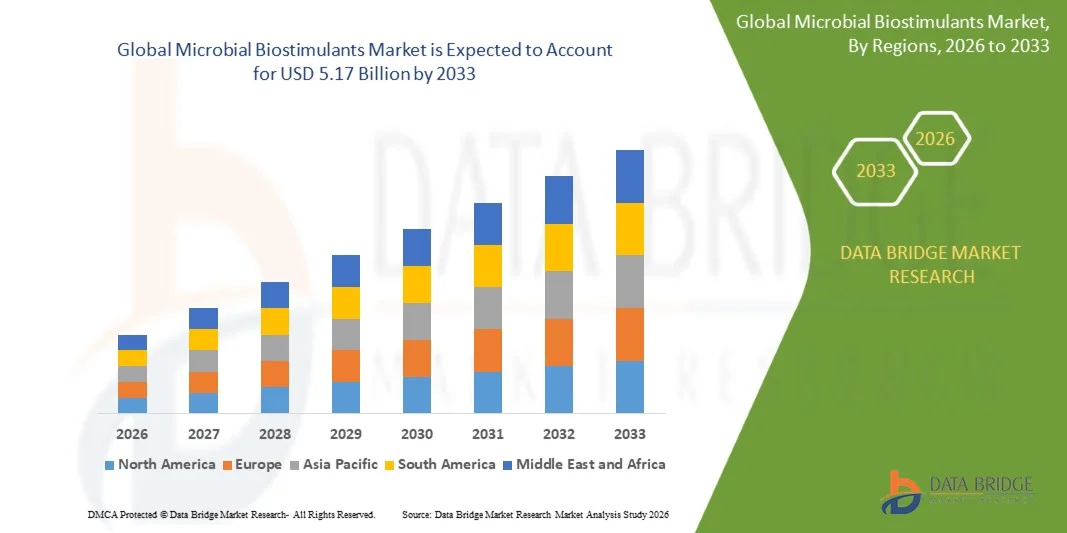
- As per Data Bridge Market Research analysis, the microbial biostimulants market was valued at USD 2.28 billion in 2025 and is projected to reach USD 5.17 billion by 2033, growing at a CAGR of 10.80% from 2026 to 2033.
- The market is experiencing consistent growth driven by the increasing adoption of sustainable agricultural practices, rising demand for biological crop inputs, and growing use of beneficial microorganisms to improve soil health, nutrient uptake, crop productivity, and tolerance to environmental stresses.
- The increasing focus on reducing dependence on synthetic fertilizers and pesticides, combined with growing concerns regarding soil degradation, climate variability, and food security, is encouraging farmers and agricultural producers to adopt microbial biostimulants. Bacterial and fungal formulations are being increasingly integrated into crop production systems, offering biological approaches to nutrient efficiency, plant growth enhancement, and improved resilience under challenging growing conditions.
Market Size & Forecast
- Global Market Value (2025): USD 2.28 Billion
- Expected Market Value (2033): USD 5.17 Billion
- Forecast CAGR (2026–2033): 10.80%
- Leading Region in 2025: North America
- Fastest Growing Region: Asia Pacific
What are the Major Takeaways of the Microbial Biostimulants Market?
- North America dominated the microbial biostimulants market with the largest revenue share of 39.3% in 2025, supported by increasing adoption of sustainable agricultural inputs, precision farming practices, and microbial solutions for major crops.
- Asia-Pacific is expected to be the fastest-growing region at a CAGR of 12.5% from 2026 to 2033, fueled by expanding agricultural production, increasing adoption of sustainable farming practices, and rising demand for microbial and biological crop inputs.
- The fruits and vegetables segment led the market with a 52.7% share in 2025, driven by increasing demand for high-value crops and sustainable cultivation practices
- Cereals and grains are the fastest-growing crope type, projected to register a CAGR of 14.3%, reflecting the surge in extensive cultivation of wheat, rice, maize, and other staple crops.
- The foliar treatment segment dominated the application method category with a 44.6% revenue share in 2025, led by its ability to deliver microbial-based inputs directly to plant foliage and its compatibility with established agricultural spraying practices.
- Liquid accounted for 64.6% of the market share in 2025, preferred by ease of application, compatibility with modern agricultural equipment, and convenient integration with spraying and irrigation systems
- The synthetic biostimulants segment is the fastest-growing origin category, with a CAGR of 10%, driven by continuing development of standardized formulations and targeted crop-management products
Report Scope and Microbial Biostimulants Market Segmentation
|
Attributes |
Microbial Biostimulants Key Market Insights |
|
Segments Covered |
|
|
Countries Covered |
North America
Europe
Asia-Pacific
Middle East and Africa
South America
|
|
Key Market Players |
|
|
Market Opportunities |
|
|
Value Added Data Infosets |
In addition to the insights on market scenarios such as market value, growth rate, segmentation, geographical coverage, and major players, the market reports curated by the Data Bridge Market Research also include import export analysis, production capacity overview, production consumption analysis, price trend analysis, climate change scenario, supply chain analysis, value chain analysis, raw material/consumables overview, vendor selection criteria, PESTLE Analysis, Porter Analysis, and regulatory framework. |
What is the Key Trend in the Microbial Biostimulants Market?
- Microbial biostimulant development is increasingly shifting toward multi-strain formulations and microbial consortia that combine complementary microorganisms to improve nutrient uptake, root development, crop resilience, and performance across variable soil conditions.
- For instance, in January 2025, Syngenta and TraitSeq announced a collaboration using AI and molecular biomarkers to identify plant responses and accelerate development of next-generation biostimulants.
- Artificial intelligence and advanced biological analytics are increasingly being used to identify microbial responses and accelerate the development of more targeted biostimulant formulations for specific crops and environmental stresses.
- Nutrient-use efficiency and climate resilience are becoming important application priorities, as microbial biostimulants are increasingly developed to improve nutrient utilization while helping crops tolerate drought, heat, and other environmental stresses
- For instance, in February 2025, Syngenta and Ceres Biotics announced a global agreement for VIXERAN, a microbial biostimulant containing Azotobacter salinestris, designed to improve nitrogen-use efficiency and complement conventional nitrogen fertilizers.
- As microbial technologies become more targeted, data-driven, and compatible with sustainable farming systems, the integration of microbial consortia, AI-assisted discovery, and nutrient-efficiency solutions is expected to strengthen the commercialization of advanced microbial biostimulants.
What are the Key Drivers of the Microbial Biostimulants Market?
- The growing pressure to reduce dependence on synthetic fertilizers and improve nutrient-use efficiency is increasing demand for microbial biostimulants that support nitrogen fixation, nutrient solubilization, plant growth, and soil health.
- For instance, in February 2025, Syngenta and Ceres Biotics expanded access to VIXERAN, based on Azotobacter salinestris, to help farmers optimize nitrogen fertilizer use through biological nitrogen-use efficiency.
- Increasing climate variability, soil degradation, water scarcity, and pressure to maintain crop productivity are encouraging growers to adopt microbial solutions that can improve plant resilience under drought, heat, and other environmental stresses.
- For instance, in January 2025, Syngenta reported that biostimulants can enhance plant tolerance to abiotic stresses including extreme temperatures, drought, and flooding, while its research with TraitSeq targets molecular indicators of plant stress responses.
- With sustainable agriculture, regenerative farming, and biological nutrient-management practices gaining importance, microbial biostimulants are increasingly being integrated into crop production systems as complementary tools for improving nutrient efficiency, soil health, and crop resilience.
Which Factors are Challenging the Growth of the Microbial Biostimulants Market?
- Microbial biostimulants face formulation and shelf-life challenges because living microorganisms can lose viability during manufacturing, transportation, storage, and field application, affecting product consistency and performance.
- For instance, in May 2025, BioControl reported that microbial biostimulants face different regulatory frameworks across jurisdictions, with the U.S. and Canada having diverse regulatory pathways, creating challenges for commercialization and market access.
- These biological constraints can increase manufacturing complexity and quality-control requirements, particularly for formulations containing multiple microbial strains that must remain viable and compatible throughout the product's intended shelf life.
- For instance, in September 2024, the Journal of Sustainable Agriculture and Environment (Wiley) reported that ineffective formulation technologies can reduce microbial viability during storage, transportation, and field application, contributing to inconsistent efficacy and limiting wider commercialization of microbial biofertilizers.
- Regulatory requirements also remain challenging because definitions, registration pathways, efficacy requirements, and microbial quality standards vary across markets, increasing the complexity and cost of commercializing new microbial biostimulant products.
How is the Microbial Biostimulants Market Segmented?
The microbial biostimulants market is segmented on the basis of crop type, application method, form, end user, origin, and distribution channel.
- By Crop Type
On the basis of crop type, the microbial biostimulants market is segmented into fruits and vegetables, cereals and grains, oilseeds and pulses, turf and ornamentals, and other crops. The fruits and vegetables segment dominated the market with 52.7% share in 2025, supported by increasing demand for high-value crops and sustainable cultivation practices. These crops require intensive nutrient and crop-management programs, creating strong demand for microbial inputs. Microbial biostimulants are increasingly applied to support plant growth, nutrient utilization, crop quality, and tolerance to environmental stresses. Growing consumer demand for high-quality and sustainably produced fruits and vegetables is further supporting adoption. The relatively high economic value of horticultural production also makes growers more willing to adopt biological inputs.
The cereals and grains segment is projected to register the fastest growth at 14.3% CAGR from 2026 to 2033, driven by the extensive cultivation of wheat, rice, maize, and other staple crops. Microbial solutions are increasingly being considered for improving nutrient-use efficiency and supporting crop productivity across large-scale farming systems. The broad cultivation area of cereals and grains creates significant potential for microbial input adoption. Increasing pressure to maintain yields under drought, heat, and soil-quality challenges is further supporting demand. Farmers are also seeking biological approaches that can complement conventional nutrient-management programs.
- By Application Method
On the basis of application method, the microbial biostimulants market is segmented into foliar treatment, soil treatment, and seed treatment. The foliar treatment segment dominated the market with 44.6% share in 2025, supported by its ability to deliver microbial-based inputs directly to plant foliage and its compatibility with established agricultural spraying practices. Foliar application enables growers to incorporate biostimulants into existing crop-management schedules. It is particularly relevant for crops requiring timely interventions during active growth stages. Increasing use of precision spraying technologies is also improving application efficiency. The method can be used across different crop categories and production systems.
The seed treatment segment is projected to register the fastest growth at 10.2% CAGR from 2026 to 2033, driven by increasing focus on early-stage crop establishment and uniform plant development. Microbial seed treatments place beneficial microorganisms close to emerging roots and the developing rhizosphere. This can support nutrient availability and early plant vigor while requiring relatively targeted product application. Advances in microbial coating and formulation technologies are improving the practicality of seed-based delivery. Increasing interest in biological alternatives to conventional seed-treatment inputs is further supporting adoption.
- By Form
On the basis of form, the microbial biostimulants market is segmented into liquid and dry. The liquid segment dominated the market with 64.6% share in 2025, driven by ease of application, compatibility with modern agricultural equipment, and convenient integration with spraying and irrigation systems. Liquid formulations can facilitate relatively uniform distribution of microbial ingredients across treated areas. They are particularly suitable for growers using mechanized application systems and fertigation practices. Improvements in formulation technologies are also helping manufacturers maintain microbial viability and product stability. The convenience of handling and application supports wider adoption among commercial agricultural producers.
The dry segment is projected to register the fastest growth at 15.4% CAGR from 2026 to 2033, supported by developments in microbial stabilization, storage, and delivery technologies. Dry formulations can offer advantages in transportation and storage when microbial viability is adequately maintained. They can also be incorporated into seed-treatment and soil-application systems. Improvements in formulation technology are helping address earlier challenges associated with microbial stability. Growing commercialization of microbial inoculants is expanding the availability of dry products. Demand for convenient and stable biological inputs is further supporting segment development.
- By End User
On the basis of end user, the microbial biostimulants market is segmented into farmers, research organizations, and others. The farmers segment dominated the market with 70% share in 2025, as farmers represent the primary users of microbial biostimulants in commercial crop production. Growing awareness of soil health and biological crop inputs is encouraging farmers to incorporate microbial products into crop-management programs. These products are used to support nutrient efficiency, plant development, and tolerance to environmental stresses. Adoption is also supported by increasing interest in sustainable and regenerative farming practices. Farmers cultivating high-value crops can particularly benefit from biological solutions focused on quality and productivity.
The research organizations segment is projected to register the fastest growth at 12% CAGR from 2026 to 2033, supported by increasing research into beneficial microorganisms, microbial consortia, and plant–microbe interactions. Research organizations play an important role in identifying promising microbial strains and evaluating their agricultural performance. Universities and agricultural institutes are also developing improved formulation and delivery technologies. Growing investment in sustainable agriculture is expanding research activity around biological crop inputs. Collaboration between research institutions and commercial agricultural companies is accelerating the transition of microbial technologies toward commercialization.
- By Origin
On the basis of origin, the microbial biostimulants market is segmented into natural biostimulants and synthetic biostimulants. The natural biostimulants segment dominated the market with 71.94% share in 2025, supported by growing demand for sustainable and environmentally friendly crop-management solutions. Natural biostimulants can include beneficial microorganisms and other biological materials that support plant growth and nutrient utilization. Increasing adoption of sustainable agriculture is strengthening demand for naturally derived agricultural inputs. Farmers are also seeking solutions that can complement conventional fertilizers while supporting soil health. Growing interest in organic and regenerative farming practices further supports the segment.
The synthetic biostimulants segment is projected to register the fastest growth at 10% CAGR from 2026 to 2033, supported by continuing development of standardized formulations and targeted crop-management products. Synthetic approaches can provide manufacturers with greater control over formulation characteristics and product consistency. Research into optimized biological and biochemical formulations is expanding the range of products available to growers. Increasing demand for predictable application performance is encouraging innovation in product development. Manufacturers are also investing in technologies designed to improve stability, compatibility, and field performance.
- By Distribution Channel
On the basis of distribution channel, the microbial biostimulants market is segmented into direct and indirect. The Direct distribution channel dominated the market with 65.2% share in 2025, supported by direct relationships between manufacturers and agricultural producers. Direct sales allow suppliers to provide technical guidance concerning microbial product handling, dosage, and application. This support is particularly important because product performance can depend on application conditions and storage practices. Direct distribution also enables manufacturers to obtain feedback from growers and strengthen customer relationships. Large agricultural enterprises and institutional buyers can be served efficiently through direct sales arrangements.
The indirect distribution channel is projected to register the fastest growth at 9% CAGR from 2026 to 2033, driven by expansion of agricultural retailers, distributors, cooperatives, and specialized input suppliers. Indirect channels allow microbial biostimulants to reach fragmented farming communities and smaller producers. Local distributors can provide product availability closer to agricultural production areas. Agricultural dealers can also support growers with product information and application guidance. Expansion of digital agricultural platforms is creating additional routes for biological products to reach customers. Growing commercialization of microbial inputs across emerging agricultural markets is further expanding the role of intermediary channels.
Which Region Holds the Largest Share of the Microbial Biostimulants Market?
- North America dominated the microbial biostimulants market with the largest revenue share of 39.3% in 2025, supported by increasing adoption of sustainable agricultural inputs, precision farming practices, and microbial solutions for major crops.
- The region also benefits from growing demand for soil-health solutions, increasing use of microbial formulations in crop production, and expanding adoption of precision agriculture and regenerative farming practices. Rising awareness of nutrient-use efficiency, climate-resilient agriculture, and reduced dependence on synthetic agricultural inputs continues to strengthen North America’s position in the global microbial biostimulants market.
U.S. Microbial Biostimulants Market Insight
The U.S. microbial biostimulants market is witnessing strong growth due to rising adoption of sustainable agricultural practices, increasing demand for biological crop inputs, and growing investments in soil-health management technologies. The country’s advanced agricultural ecosystem, along with increasing use of microbial-based solutions for nutrient efficiency, plant growth, and crop resilience, is driving demand across large-scale farming and specialty crop production. In addition, growing emphasis on reducing dependence on synthetic fertilizers and improving agricultural sustainability is accelerating the adoption of microbial biostimulants across the U.S.
Asia-Pacific Microbial Biostimulants Market Insight
The Asia-Pacific microbial biostimulants market is expected to witness rapid growth, driven by expanding agricultural production, increasing adoption of sustainable farming practices, and rising investments in biological crop inputs across countries such as China, India, and Japan. Growing awareness regarding soil health, nutrient-use efficiency, and environmentally sustainable crop production is supporting regional market expansion. In addition, increasing demand for higher agricultural productivity, growing adoption of precision farming technologies, and expanding use of microbial formulations are accelerating market adoption across commercial and smallholder farming sectors.
Japan Microbial Biostimulants Market Insight
The Japan microbial biostimulants market is witnessing consistent growth due to rising investments in sustainable agriculture, soil-health management, and advanced biological crop technologies. Farmers, agricultural organizations, and research institutions are increasingly adopting microbial formulations to support nutrient uptake, plant growth, and crop resilience. Moreover, increasing integration of biological solutions with precision agriculture practices and the country’s focus on efficient and environmentally sustainable food production are further contributing to market growth.
China Microbial Biostimulants Market Insight
The China microbial biostimulants market is growing rapidly, driven by expanding agricultural production, increasing focus on soil health, and rising government emphasis on sustainable agricultural development. Growing adoption of microbial-based solutions for nutrient management, crop productivity, and reduction of synthetic agricultural inputs is significantly boosting market demand. In addition, rising investments in agricultural biotechnology, increasing awareness regarding biological crop solutions, and rapid development of microbial formulations are positioning China as an important growth market for microbial biostimulants globally.
U.K. Microbial Biostimulants Market Insight
The U.K. microbial biostimulants market is experiencing steady growth, supported by rising adoption of sustainable farming practices, biological agricultural inputs, and soil-health management solutions. Increasing investments in microbial technologies and growing demand for environmentally responsible crop production are contributing to market growth. Furthermore, integration of microbial biostimulants with regenerative agriculture, precision farming, and nutrient-efficiency practices is improving their adoption across agricultural producers, positioning the U.K. as an important market for biological crop solutions.
Germany Microbial Biostimulants Market Insight
The Germany microbial biostimulants market is expanding steadily due to the country’s strong agricultural research capabilities, advanced farming practices, and increasing adoption of biological crop technologies. Farmers, agricultural organizations, and research institutions are increasingly utilizing microbial biostimulants for soil health, nutrient management, and improved crop resilience. Continuous advancements in microbial formulation technologies, along with strong emphasis on sustainable agriculture and reducing reliance on synthetic inputs, are further driving market growth in Germany.
Which are the Top Companies in Microbial Biostimulants Market?
The microbial biostimulants industry is primarily led by well-established companies, including:
- Corteva Agriscience, Inc. (U.S.)
- Novonesis A/S (Denmark)
- BASF SE (Germany)
- Syngenta Group (Switzerland)
- UPL Limited (India)
- Valent BioSciences LLC (U.S.)
- Indigo Ag, Inc. (U.S.)
- Pivot Bio, Inc. (U.S.)
- BioWorks, Inc. (U.S.)
- Koppert B.V. (Netherlands)
- Lallemand Inc. (Canada)
- Acadian Plant Health (Canada)
- Plant Health Care plc (U.K.)
- Kimitec Group (Spain)
- Kemin Industries, Inc. (U.S.)
- ICL Group Ltd. (Israel)
- Sumitomo Chemical Co., Ltd. (Japan)
- Coromandel International Limited (India)
- Azotic Technologies Ltd. (U.K.)
- FMC Corporation (U.S.)
What are Latest Developments in Microbial Biostimulants Market?
- In February 2025, Syngenta and Ceres Biotics announced a global biologicals partnership to expand access to VIXERAN, a microbial biostimulant based on the endophytic bacterium Azotobacter salinestris. The solution is designed to improve nitrogen-use efficiency and complement conventional nitrogen fertilization, supporting the development of more sustainable crop-management practices. The agreement followed an earlier collaboration to introduce VIXERAN in the European Union and expanded its planned availability to markets globally.
- In September 2024, Legume Technology highlighted its research and development activities following a grant from the Bill & Melinda Gates Foundation and the U.K. Foreign, Commonwealth and Development Office to identify biological alternatives to synthetic nitrogen for African smallholder farmers. The company develops microbial biostimulants designed to support nitrogen fixation, root development, phosphate solubilization, and crop performance, reinforcing research into microbial solutions for sustainable agriculture.
- In April 2023, Corteva Agriscience showcased BlueN, a microbial biostimulant containing naturally occurring bacteria that enables crops to fix atmospheric nitrogen. The technology was highlighted as part of Corteva’s arable-crop innovations, with applications across cereals, oilseed rape, and maize. The development reflects continued commercialization of microbial technologies aimed at improving nutrient-use efficiency in crop production.
- In June 2022, Nature Scientific Reports published research demonstrating the molecular mechanisms through which microbial biostimulants can enhance plant growth, prime plant responses, and improve drought-stress tolerance in maize. The study examined microbial biostimulant effects on plant metabolic and molecular responses, providing further scientific support for the development of microbial solutions targeting abiotic stress management in agriculture.
- In August 2021, Plants published research examining microbial biostimulants as a response to the challenges of modern agriculture. The study reviewed how beneficial microorganisms can support plant growth, nutrient availability, and crop resilience while contributing to more sustainable agricultural production. The research further strengthened the scientific foundation for microbial biostimulants as biological tools for improving agricultural productivity and reducing reliance on conventional inputs.

- Interactive Data Analysis Dashboard
- Company Analysis Dashboard for high growth potential opportunities
- Research Analyst Access for customization & queries
- Competitor Analysis with Interactive dashboard
- Latest News, Updates & Trend analysis
- Harness the Power of Benchmark Analysis for Comprehensive Competitor Tracking
Data collection and base year analysis are done using data collection modules with large sample sizes. The stage includes obtaining market information or related data through various sources and strategies. It includes examining and planning all the data acquired from the past in advance. It likewise envelops the examination of information inconsistencies seen across different information sources. The market data is analysed and estimated using market statistical and coherent models. Also, market share analysis and key trend analysis are the major success factors in the market report. To know more, please request an analyst call or drop down your inquiry.
The key research methodology used by DBMR research team is data triangulation which involves data mining, analysis of the impact of data variables on the market and primary (industry expert) validation. Data models include Vendor Positioning Grid, Market Time Line Analysis, Market Overview and Guide, Company Positioning Grid, Patent Analysis, Pricing Analysis, Company Market Share Analysis, Standards of Measurement, Global versus Regional and Vendor Share Analysis. To know more about the research methodology, drop in an inquiry to speak to our industry experts.
Data Bridge Market Research is a leader in advanced formative research. We take pride in servicing our existing and new customers with data and analysis that match and suits their goal. The report can be customized to include price trend analysis of target brands understanding the market for additional countries (ask for the list of countries), clinical trial results data, literature review, refurbished market and product base analysis. Market analysis of target competitors can be analyzed from technology-based analysis to market portfolio strategies. We can add as many competitors that you require data about in the format and data style you are looking for. Our team of analysts can also provide you data in crude raw excel files pivot tables (Fact book) or can assist you in creating presentations from the data sets available in the report.