


What is the Global Microbial Rennet Market Size and Growth Rate?
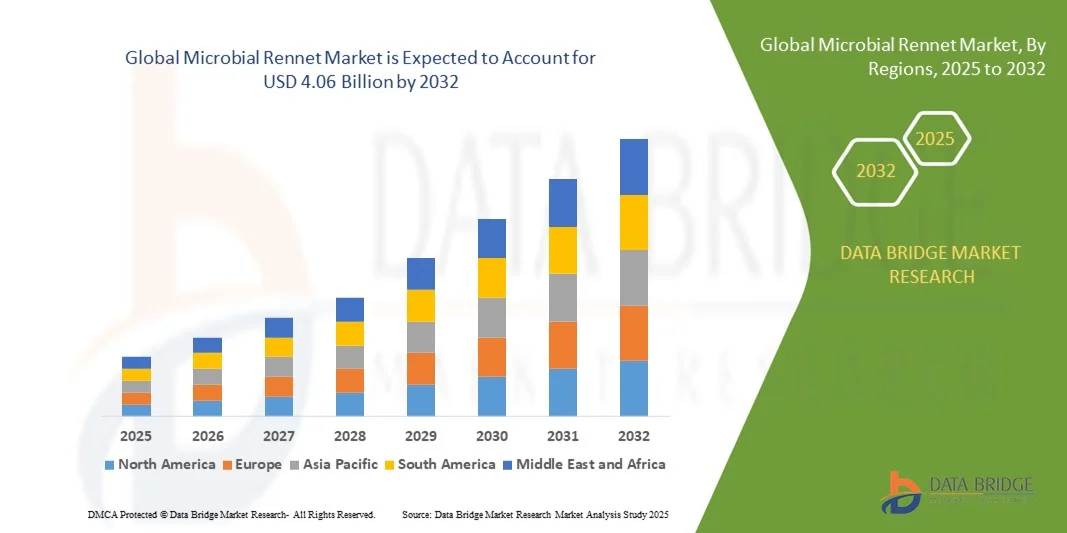
- The global microbial rennet market size was valued at USD 2.35 billion in 2024 and is expected to reach USD 4.06 billion by 2032, at a CAGR of 7.05% during the forecast period
- The increase in vegan population across the globe acts as one of the major factors driving the growth of microbial rennet market. The increase in the use of microbial rennet filtration of milk into solid curds for cheese making and liquid whey, and growing preference among consumers for cheese, as an integral part of their diets accelerate the market growth
- The surge in number of fast food chains and food & beverage MNCs, and advent of improved methods of production of inexpensive rennet further influence the market
What are the Major Takeaways of Microbial Rennet Market?
- Increase in preference for vegan food, increase in various application and rising in awareness among people positively affect the microbial rennet market. Furthermore, advancement in the coagulant extends profitable opportunities to the market players
- Concerns regarding the side-effects of the microbial rennet are expected to obstruct the market growth. The negative impact of COVID-19 is projected to challenge the microbial rennet market
- North America dominated the microbial rennet market with the largest revenue share of 46.35% in 2024, driven by the strong demand for industrial and artisanal cheese production, growing adoption of vegetarian and clean-label products, and increasing awareness of consistent-quality dairy processing solutions
- The Asia-Pacific microbial rennet market is poised to grow at the fastest CAGR of 9.74% during the forecast period of 2025 to 2032, driven by rising urbanization, increasing disposable incomes, and technological advancements in countries such as China, Japan, and India
- The liquid segment dominated the market with the largest revenue share of 52% in 2024, driven by its ease of use, high solubility, and precise dosing capabilities in industrial cheese and dairy production
Report Scope and Microbial Rennet Market Segmentation
|
Attributes |
Microbial Rennet Key Market Insights |
|
Segments Covered |
|
|
Countries Covered |
North America
Europe
Asia-Pacific
Middle East and Africa
South America
|
|
Key Market Players |
|
|
Market Opportunities |
|
|
Value Added Data Infosets |
In addition to the insights on market scenarios such as market value, growth rate, segmentation, geographical coverage, and major players, the market reports curated by the Data Bridge Market Research also include in-depth expert analysis, pricing analysis, brand share analysis, consumer survey, demography analysis, supply chain analysis, value chain analysis, raw material/consumables overview, vendor selection criteria, PESTLE Analysis, Porter Analysis, and regulatory framework. |
What is the Key Trend in the Microbial Rennet Market?
Integration of Advanced Automation and Digital Solutions
- A major trend in the global microbial rennet market is the increasing adoption of automation and digital monitoring technologies in production and processing. This integration enables producers to optimize enzyme extraction, improve yield consistency, and enhance quality control across dairy and food applications
- For instance, advanced bioreactor systems now incorporate sensors and AI-driven analytics to monitor microbial growth and enzyme activity in real time, ensuring precise control over production parameters
- Automation also facilitates predictive maintenance and operational efficiency, reducing downtime and improving overall productivity. Some modern systems even allow remote monitoring via cloud-based platforms, enabling manufacturers to manage multiple production sites from a single interface
- This trend towards smarter, more automated Microbial Rennet production is driving efficiency, reducing costs, and meeting rising demand in the cheese and dairy industries. Companies such as Chr. Hansen and DSM are pioneering innovations in automated microbial fermentation processes
- The shift to digitalized, controlled production is reshaping expectations for reliability and quality in Microbial Rennet, promoting more consistent performance across industrial applications
- Demand for Microbial Rennet produced through advanced automation and digital monitoring is rapidly growing, particularly in regions prioritizing high-quality cheese and dairy products, and this is expected to continue shaping market dynamics
What are the Key Drivers of Microbial Rennet Market?
- The rising demand for cheese, yogurt, and other dairy products worldwide is a major driver for Microbial Rennet, as manufacturers seek scalable, cost-effective, and vegetarian-friendly alternatives to animal rennet
- For instance, increasing consumer awareness about vegetarian diets and clean-label foods is encouraging producers to shift from traditional rennet to microbial-based solutions. Companies such as DSM and Chr. Hansen have expanded their microbial rennet portfolios to meet this demand
- Microbial Rennet offers advantages such as high specificity, consistent enzyme activity, and lower risk of supply variability, making it ideal for industrial cheese production
- Furthermore, advancements in fermentation technology and strain optimization are boosting production efficiency and enzyme yields, supporting wider adoption in dairy and other processed food segments
- The scalability, cost-effectiveness, and vegetarian certification of Microbial Rennet products are key factors encouraging manufacturers to integrate them into mainstream cheese and dairy production lines, while regulatory support for sustainable enzyme production also reinforces market growth
Which Factor is Challenging the Growth of the Microbial Rennet Market?
- High production costs associated with advanced microbial fermentation systems pose a challenge to smaller manufacturers and emerging market players, potentially limiting adoption
- Variability in regional regulations and approvals for enzyme use can slow product launch timelines and create barriers for global expansion. For instance, obtaining approvals for food-grade microbial rennet in multiple jurisdictions requires rigorous testing and certification
- Addressing these challenges involves investment in cost-effective fermentation infrastructure, strain optimization, and compliance management, ensuring consistent quality and regulatory adherence
- Market growth is also hindered by competition from traditional animal rennet in regions with established cheese-making traditions, where consumer preference for conventional methods remains strong
- Overcoming these obstacles through technological innovation, awareness campaigns, and development of cost-efficient microbial rennet solutions will be critical for sustaining long-term growth and expanding adoption across diverse markets
How is the Microbial Rennet Market Segmented?
The market is segmented on the basis of type, communication protocol, unlocking mechanism, and application.
- By Form
On the basis of form, the microbial rennet market is segmented into liquid, powder, and others. The liquid segment dominated the market with the largest revenue share of 52% in 2024, driven by its ease of use, high solubility, and precise dosing capabilities in industrial cheese and dairy production. Liquid Microbial Rennet allows manufacturers to standardize enzyme activity, ensuring consistent coagulation and product quality. Its widespread adoption is also supported by compatibility with automated dosing systems and large-scale production processes.
The powder segment is expected to witness the fastest CAGR of 18% from 2025 to 2032, owing to its longer shelf life, easier storage, and flexibility for small-scale or artisanal cheese production. Powdered forms are particularly favored by specialty cheese producers and regions with limited cold-chain infrastructure. Overall, form-based differentiation allows manufacturers to meet diverse production needs and optimize efficiency across both industrial and artisanal applications.
- By Source
On the basis of source, the microbial rennet market is segmented into microbial and animal sources. The microbial segment dominated with a market revenue share of 65% in 2024, attributed to the rising demand for vegetarian-friendly, consistent-quality, and clean-label cheese products. Microbial Rennet offers standardized enzyme activity, scalability, and regulatory compliance advantages over traditional animal rennet, making it ideal for industrial cheese production and international markets.
The animal segment is expected to witness the fastest CAGR of 15% from 2025 to 2032, primarily driven by consumer preference in regions with strong cheese-making traditions and artisanal production. Despite its limited supply and variability, animal rennet continues to be used for traditional specialty cheeses that emphasize authentic flavor profiles. Source-based segmentation highlights the market’s ability to cater to both modern industrial demands and traditional cheese-making practices globally.
- By Application
On the basis of application, the microbial rennet market is segmented into cheese, yogurt, dessert, and others. The cheese segment dominated the market with the largest revenue share of 70% in 2024, fueled by increasing global cheese consumption, industrial-scale production, and the need for standardized coagulation and flavor consistency. Cheese manufacturers prioritize Microbial Rennet for its efficiency, yield optimization, and vegetarian certification, which meets regulatory and consumer expectations.
The dessert segment is expected to witness the fastest CAGR of 17% from 2025 to 2032, driven by innovations in dairy-based desserts, specialty puddings, and frozen treats that require precise coagulation and texture control. Growing demand in bakery and ready-to-eat dessert applications is supporting this growth. Application-based segmentation demonstrates how Microbial Rennet usage spans traditional cheese-making to modern dairy innovations, catering to both commercial and specialty product requirements.
Which Region Holds the Largest Share of the Microbial Rennet Market?
- North America dominated the microbial rennet market with the largest revenue share of 46.35% in 2024, driven by the strong demand for industrial and artisanal cheese production, growing adoption of vegetarian and clean-label products, and increasing awareness of consistent-quality dairy processing solutions
- Producers in the region highly value the standardized performance, scalability, and regulatory compliance offered by Microbial Rennet, which supports both large-scale cheese manufacturing and specialty dairy products
- The widespread adoption is further supported by advanced dairy infrastructure, high investment in food technology, and increasing preference for plant-based and vegetarian rennet, establishing North America as the leading market for Microbial Rennet globally
U.S. Microbial Rennet Market Insight
The U.S. microbial rennet market captured the largest revenue share of 81% in 2024 within North America, fueled by the expanding cheese industry, rising demand for vegetarian-friendly and clean-label products, and the widespread use of standardized rennet in both commercial and artisanal production. Strong growth in dairy innovation, coupled with adoption of advanced processing technologies, further drives the market. Moreover, consumer preference for high-quality cheese, yogurt, and dairy desserts supports Microbial Rennet consumption across industrial and specialty applications.
Europe Microbial Rennet Market Insight
The Europe microbial rennet market is projected to expand at a substantial CAGR throughout the forecast period, primarily driven by stringent food safety regulations, increasing demand for vegetarian and clean-label products, and rising cheese consumption. Growth is particularly strong across Western Europe, where urbanization and demand for processed dairy products are fostering adoption. European producers are investing in Microbial Rennet for both consistency and scalability, while also aligning with ethical and dietary preferences in the region.
U.K. Microbial Rennet Market Insight
The U.K. microbial rennet market is anticipated to grow at a noteworthy CAGR, driven by increasing consumer preference for vegetarian cheeses, clean-label products, and premium artisanal dairy items. In addition, rising dairy production standards and growing retail demand for processed and specialty cheese products encourage the adoption of Microbial Rennet. The U.K.’s well-developed dairy industry and strong export market further support regional growth.
Germany Microbial Rennet Market Insight
The Germany microbial rennet market is expected to expand at a considerable CAGR, fueled by increasing awareness of food safety, quality control, and sustainable sourcing. Germany’s advanced dairy infrastructure, combined with its focus on innovation, promotes the use of Microbial Rennet in cheese, yogurt, and dessert applications. Integration into both industrial and artisanal production processes is becoming increasingly prevalent, with a preference for vegetarian and clean-label solutions aligning with consumer expectations.
Which Region is the Fastest Growing Region in the Microbial Rennet Market?
The Asia-Pacific microbial rennet market is poised to grow at the fastest CAGR of 9.74% during the forecast period of 2025 to 2032, driven by rising urbanization, increasing disposable incomes, and technological advancements in countries such as China, Japan, and India. The growing dairy and cheese consumption, supported by government initiatives promoting food industry modernization, is accelerating Microbial Rennet adoption. Furthermore, APAC’s emergence as a manufacturing hub for Microbial Rennet components is enhancing affordability and accessibility across the region.
Japan Microbial Rennet Market Insight
The Japan microbial rennet market is gaining momentum due to the country’s high cheese and dairy consumption, focus on quality and safety, and demand for convenient, standardized production solutions. Adoption is driven by specialty cheese and dairy dessert production, with increasing integration of Microbial Rennet in both industrial and artisanal settings.
China Microbial Rennet Market Insight
The China microbial rennet market accounted for the largest revenue share in Asia-Pacific in 2024, attributed to rapid urbanization, an expanding middle class, and rising consumption of processed and specialty dairy products. Government initiatives supporting dairy industry modernization, along with domestic production capabilities, are key factors propelling the market in China, making it a focal point for regional growth.
Which are the Top Companies in Microbial Rennet Market?
The Microbial Rennet industry is primarily led by well-established companies, including:
- DSM (Netherlands)
- Merck KGaA (Germany)
- Vital Source Yeast Co., Ltd. (China)
- The Cheesemaker (U.S.)
- Modernist Pantry, LLC (U.S.)
- PuNature Food Ingredients (China)
- Meito Sangyo Co., Ltd. (Japan)
- WalcoRen (U.S.)
- Iran Industrial Enzymes Company (Iran)
- Chr. Hansen Holding A/S (Denmark)
- DuPont de Nemours, Inc. (U.S.)
- SUDERSHAN BIOTECH PRIVATE LIMITED (India)
- Renco (U.S.)
- Mayasan (Turkey)
- Corbion (Netherlands)
- BASF SE (Germany)
- Dow (U.S.)
- Calza Clemente S. R. L (Italy)
What are the Recent Developments in Global Microbial Rennet Market?
- In March 2023, Daiya, a leading innovator in plant-based cheese products in North America, announced a multi-million-dollar investment in a new fermentation technology, aiming to enhance the production of meltier, tastier, and stretchier plant-based cheese, thereby reinforcing its market leadership and strengthening consumer preference for plant-based dairy alternatives
- In January 2023, Atalanta’s exclusive partner, Coombe Castle International, revealed plans to introduce the world’s only Official GUINNESSTM CHEDDAR at the 2023 Winter Fancy Food Show in Las Vegas, featuring cheddar curds combined with GuinnessTM Stout to deliver complex flavor notes and a distinctive taste, positioning the company as a pioneer in innovative cheese offerings
- In July 2022, Katharos, a Mumbai-based startup, launched a unique range of vegan cheeses made from watermelon seeds, including cheddar and mozzarella, marking the first globally available cheese blocks created from watermelon seeds, and highlighting the brand’s commitment to novel, sustainable dairy alternatives
- In June 2021, New Culture, a startup in the animal-free dairy sector, announced its plan to launch a new range of animal-free Mozzarella by late 2023, leveraging engineered microbes to produce dairy milk proteins without cows, following breakthrough developments in producing animal-free casein protein, and demonstrating innovation in sustainable dairy production

- Interactive Data Analysis Dashboard
- Company Analysis Dashboard for high growth potential opportunities
- Research Analyst Access for customization & queries
- Competitor Analysis with Interactive dashboard
- Latest News, Updates & Trend analysis
- Harness the Power of Benchmark Analysis for Comprehensive Competitor Tracking
Global Microbial Rennet Market, Supply Chain Analysis and Ecosystem Framework
To support market growth and help clients navigate the impact of geopolitical shifts, DBMR has integrated in-depth supply chain analysis into its Global Microbial Rennet Market research reports. This addition empowers clients to respond effectively to global changes affecting their industries. The supply chain analysis section includes detailed insights such as Global Microbial Rennet Market consumption and production by country, price trend analysis, the impact of tariffs and geopolitical developments, and import and export trends by country and HSN code. It also highlights major suppliers with data on production capacity and company profiles, as well as key importers and exporters. In addition to research, DBMR offers specialized supply chain consulting services backed by over a decade of experience, providing solutions like supplier discovery, supplier risk assessment, price trend analysis, impact evaluation of inflation and trade route changes, and comprehensive market trend analysis.
Data collection and base year analysis are done using data collection modules with large sample sizes. The stage includes obtaining market information or related data through various sources and strategies. It includes examining and planning all the data acquired from the past in advance. It likewise envelops the examination of information inconsistencies seen across different information sources. The market data is analysed and estimated using market statistical and coherent models. Also, market share analysis and key trend analysis are the major success factors in the market report. To know more, please request an analyst call or drop down your inquiry.
The key research methodology used by DBMR research team is data triangulation which involves data mining, analysis of the impact of data variables on the market and primary (industry expert) validation. Data models include Vendor Positioning Grid, Market Time Line Analysis, Market Overview and Guide, Company Positioning Grid, Patent Analysis, Pricing Analysis, Company Market Share Analysis, Standards of Measurement, Global versus Regional and Vendor Share Analysis. To know more about the research methodology, drop in an inquiry to speak to our industry experts.
Data Bridge Market Research is a leader in advanced formative research. We take pride in servicing our existing and new customers with data and analysis that match and suits their goal. The report can be customized to include price trend analysis of target brands understanding the market for additional countries (ask for the list of countries), clinical trial results data, literature review, refurbished market and product base analysis. Market analysis of target competitors can be analyzed from technology-based analysis to market portfolio strategies. We can add as many competitors that you require data about in the format and data style you are looking for. Our team of analysts can also provide you data in crude raw excel files pivot tables (Fact book) or can assist you in creating presentations from the data sets available in the report.













