


What is the Microencapsulated Pesticides Market Size and Growth Rate?
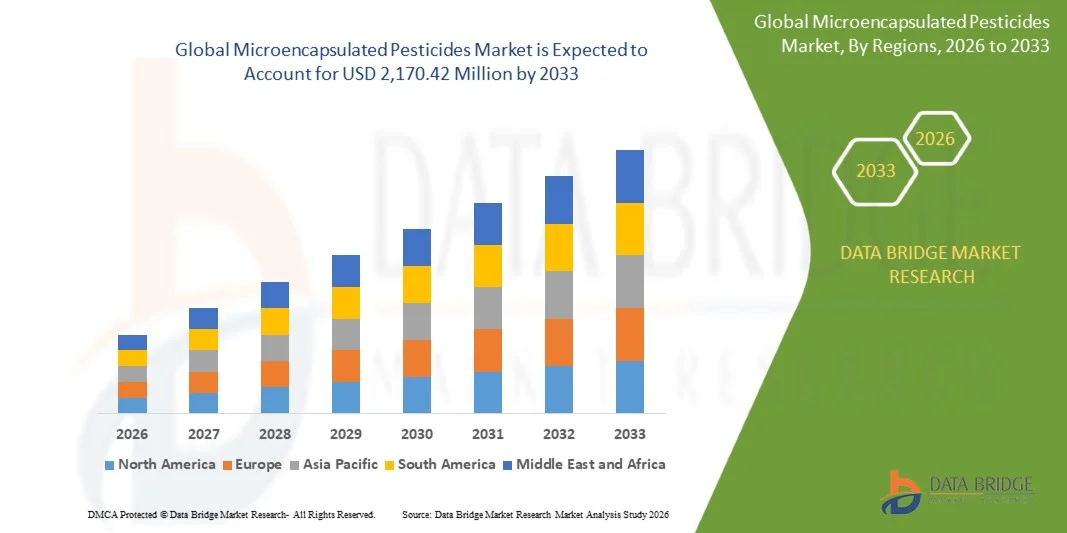
- As per Data Bridge Market Research analysis, the microencapsulated pesticides market was valued at USD 858.04 million in 2025 and is projected to reach USD 2,170.42 million by 2033, growing at a CAGR of 12.30% from 2026 to 2033.
- The market is experiencing consistent growth driven by increasing demand for controlled-release pesticide formulations, enhanced pesticide efficacy, reduced environmental impact, and improved crop protection. Microencapsulation enables the controlled release of active ingredients, helping improve pesticide performance and reduce exposure to the environment.
- The increasing need for efficient pest management and sustainable agricultural practices, combined with growing adoption of advanced pesticide formulations, is compelling agricultural producers to adopt microencapsulated products. Microencapsulation provides controlled and sustained release of active ingredients, improves pesticide stability and application efficiency, and can reduce off-target losses, supporting wider adoption in modern crop protection.
Market Size & Forecast
- Global Market Value (2025): USD 858.04 million
- Expected Market Value (2033): USD 2,170.42 million
- Forecast CAGR (2026–2033): 12.30%
What are the Major Takeaways of the Microencapsulated Pesticides Market?
- North America dominated the microencapsulated pesticides market with a 37.5% market share in 2025, supported by advanced agricultural practices, high awareness of environmental sustainability and increasing adoption of integrated pest management and precision farming techniques.
- Asia-Pacific is expected to be the fastest-growing region at a CAGR of 12.1% from 2026 to 2033, fueled by increasing adoption of microencapsulated pesticide formulations, expanding agricultural activity, and growing demand for controlled-release crop protection solutions.
- The insecticides segment led the market with a 55.0% share in 2025, driven by the extensive use of insecticides for controlling crop-damaging pests and the strong suitability of microencapsulation for controlled-release delivery.
- Fungicides are the fastest-growing type, projected to register a CAGR of 11%, reflecting the surge in incidence of fungal diseases and growing demand for improved disease-management solutions.
- The physico-chemical segment dominated the technology category with a 58% revenue share in 2025, led by the broad application of encapsulation techniques that combine physical and chemical mechanisms to improve pesticide delivery.
- Cereals & grains accounted for 39.4% of the market share in 2025, preferred by the extensive global cultivation of wheat, corn, rice, barley, and other staple crops.
- The granules segment is the fastest-growing formulation type category, with a CAGR of 12.9%, driven by the increasing demand for targeted soil application and controlled pesticide delivery.
Report Scope and Microencapsulated Pesticides Market Segmentation
|
Attributes |
Microencapsulated Pesticides Key Market Insights |
|
Segments Covered |
|
|
Countries Covered |
North America
Europe
Asia-Pacific
Middle East and Africa
South America
|
|
Key Market Players |
|
|
Market Opportunities |
|
|
Value Added Data Infosets |
In addition to the insights on market scenarios such as market value, growth rate, segmentation, geographical coverage, and major players, the market reports curated by the Data Bridge Market Research also include in-depth expert analysis, pricing analysis, brand share analysis, consumer survey, demography analysis, supply chain analysis, value chain analysis, raw material/consumables overview, vendor selection criteria, PESTLE Analysis, Porter Analysis, and regulatory framework. |
What is the Key Trend in the Microencapsulated Pesticides Market?
- Controlled-release formulations are gaining traction because microencapsulation enhances pesticide efficacy, reduces application frequency, limits chemical usage, and improves stability against heat, moisture, and ultraviolet degradation across agricultural applications.
- For instance, in November 2025, researchers developed pH-responsive imidacloprid microcapsules using cellulose nanocrystals, achieving 91.13% encapsulation efficiency and sustained release, while improving leaf adhesion, insecticidal activity, and UV resistance demonstrating the shift toward smart-release formulations for sustainable agriculture.
- Precision delivery is increasingly emphasized as sustainable agriculture expands, with encapsulated formulations supporting targeted application, improved input efficiency, reduced off-target movement, and better integrated pest management practices globally.
- Biodegradable polymer coatings, nano-encapsulation, and targeted delivery systems are expanding formulation opportunities, enabling crop-specific solutions for cereal grains, fruits, vegetables, and commercial cash crops worldwide today and growers.
- For instance, in November 2024, researchers developed chitin nanocrystal-based pesticide microcapsules with enzyme-responsive release and improved leaf adhesion; the formulation achieved 78.7% pesticide loading for lambda-cyhalothrin and significantly prolonged pesticide efficacy in field experiments while improving pesticide safety.
- Microencapsulation is gaining importance as regulatory pressure restricts conventional pesticides, encouraging safer, low-toxicity formulations that minimize environmental impact while maintaining effective crop protection and controlled active release performance.
What are the Key Drivers of the Microencapsulated Pesticides Market?
- The rising demand for sustainable agriculture is accelerating microencapsulated pesticide adoption because controlled release can improve efficacy, reduce application frequency, and decrease overall chemical usage across crop protection programs.
- For instance, in December 2024, researchers developed polylactic acid (PLA) microspheres encapsulating emamectin benzoate to achieve controlled pesticide release; the formulation demonstrated high encapsulation efficiency and sustained release, indicating potential to improve pesticide stability and prolong pest-control effectiveness while reducing the limitations of conventional formulations
- Integrated Pest Management adoption is supporting demand as microencapsulated capsules can release active ingredients on affected crops, helping restrict pesticide usage while improving pest control and application efficiency.
- Stricter regulatory pressure on conventional pesticides is encouraging safer, low-toxicity formulations that reduce environmental exposure and support compliance with evolving pesticide residue and environmental safety requirements globally worldwide.
- For instance, in June 2024, researchers developed thermo-responsive multicore microcapsules using κ-carrageenan and chitosan to encapsulate ammonium glufosinate; the formulation demonstrated controlled and gradual pesticide release in response to heat and simulated sunlight, with lower release than single-layer beads, potentially extending pesticide residual activity while reducing chemical leaching and environmental pollution.
- Advances in encapsulation materials and delivery systems are expanding applications, with biodegradable polymers, nano-encapsulation, and targeted technologies enabling improved stability, controlled release, and crop-specific pesticide formulations for growers.
Which Factors are Challenging the Growth of the Microencapsulated Pesticides Market?
- High development and production costs remain a challenge because microencapsulation requires specialized formulation processes, precise control of particle characteristics, and expertise, increasing costs compared with conventional pesticide formulations.
- For instance, in August 2024, an article of microencapsulation processes highlighted that the energy cost of manufacturing microcapsules is an important limitation, while commonly used polymer shells can also be non-biodegradable and susceptible to undesirable leaching; these production and material constraints can increase the cost and complexity of developing microencapsulated pesticide formulations.
- Regulatory approval requirements can delay commercialization because manufacturers must demonstrate formulation safety, efficacy, environmental fate, and potential effects on non-target organisms before products reach highly regulated agricultural markets.
- Environmental risks remain a concern because encapsulated pesticides may persist, transform, or accumulate in environmental compartments, requiring detailed assessment of release behavior and transformation products during careful use.
- For instance, in November 2024, researchers reported that pesticide microcapsule production commonly faces challenges related to organic-solvent recovery, which requires expensive specialized equipment, as well as the use of surfactants to control microcapsule size and improve leaf adhesion; these factors can increase manufacturing complexity and environmental concerns, potentially restricting large-scale adoption of microencapsulated pesticides.
- Farmer adoption can be constrained by limited awareness and application knowledge, particularly where producers need education and training to understand microencapsulation benefits, handling requirements, and appropriate application techniques.
How is the Microencapsulated Pesticides Market Segmented?
The microencapsulated pesticides market is segmented on the basis of type, technology, crop, formulation type, and application industry.
- By Type
On the basis of type, the microencapsulated pesticides market is segmented into herbicides, insecticides, fungicides, rodenticides, and others. The insecticides segment dominated the market with 55.0% share in 2025, owing to the extensive use of insecticides for controlling crop-damaging pests and the strong suitability of microencapsulation for controlled-release delivery. Microencapsulation can improve the stability of insecticidal active ingredients against sunlight, temperature, and other environmental factors. It can also prolong residual activity and reduce the frequency of pesticide applications. Increasing pest infestations and crop losses are strengthening demand for effective insect-control solutions. The development of microencapsulated active ingredients such as emamectin benzoate, lambda-cyhalothrin, and imidacloprid is further supporting the segment.
The fungicides segment is projected to register the fastest growth at 11% CAGR from 2026 to 2033, supported by increasing incidence of fungal diseases and growing demand for improved disease-management solutions. Microencapsulation can protect fungicidal active ingredients from premature degradation and enable their gradual release at the target site. This can improve the persistence and utilization efficiency of fungicides while potentially reducing repeated applications. Increasing concerns regarding pesticide residues and environmental exposure are also encouraging the development of more targeted fungicide formulations. The expansion of high-value fruits and vegetables is creating additional demand because these crops are particularly vulnerable to fungal diseases. Advances in biodegradable polymers and responsive microcapsules are further improving controlled-release fungicide technologies.
- By Technology
On the basis of technology, the microencapsulated pesticides market is segmented into physico-chemical and chemical. The physico-chemical segment dominated the market with an estimated share of 58% in 2025, supported by the broad application of encapsulation techniques that combine physical and chemical mechanisms to improve pesticide delivery. These technologies allow manufacturers to control capsule size, shell characteristics, encapsulation efficiency, and release rates. Physico-chemical approaches are widely investigated for polymeric, lipid-based, and biopolymer-based pesticide delivery systems. They can improve the stability of active ingredients against environmental degradation and enhance their persistence after application.
The chemical segment is projected to register the fastest growth at 12% CAGR from 2026 to 2033, driven by increasing development of polymer-based microcapsules using chemical encapsulation and polymerization techniques. Chemical technologies can produce stable capsule walls that protect sensitive pesticide active ingredients from environmental conditions. They also allow manufacturers to modify shell thickness and permeability to achieve specific release profiles. Growing demand for longer-lasting pesticide formulations is increasing interest in these systems. Advances in biodegradable polymers are improving the environmental compatibility of chemically produced microcapsules. Researchers are also developing stimuli-responsive systems that release pesticides in response to pH, temperature, moisture, or enzymes.
- By Crop
On the basis of crop, the microencapsulated pesticides market is segmented into cereals & grains, oilseeds & pulses, fruits & vegetables, and turf & ornamental. The cereals & grains segment dominated the market with an estimated share of 39.4% in 2025, supported by the extensive global cultivation of wheat, corn, rice, barley, and other staple crops. These crops require substantial protection against insects, weeds, and fungal diseases. Microencapsulated pesticides can provide prolonged protection and improve active-ingredient utilization across large cultivated areas. Controlled-release technology can also help reduce pesticide losses caused by environmental degradation. Increasing food-production requirements are encouraging farmers to adopt more efficient crop-protection technologies. The large cultivated area and high pesticide consumption associated with cereals and grains therefore continue to support the segment's dominance.
The fruits & vegetables segment is projected to register the fastest growth at 9.5% CAGR from 2026 to 2033, driven by intensive pest and disease-management requirements for high-value crops. Fruits and vegetables are particularly vulnerable to insects and fungal diseases, increasing the need for effective and persistent crop-protection formulations. Microencapsulation can improve pesticide retention on plant surfaces and provide controlled delivery of active ingredients. Increasing concerns about pesticide residues on fresh produce are also encouraging the adoption of targeted formulations. Expansion of greenhouse farming, protected cultivation, and precision agriculture is creating additional opportunities for advanced pesticide delivery technologies. Producers of high-value crops have stronger incentives to invest in formulations that improve crop quality and reduce losses. These factors are expected to make fruits and vegetables the fastest-growing crop segment.
- By Formulation Type
On the basis of formulation type, the microencapsulated pesticides market is segmented into microcapsule suspension, dustable powder, granules, emulsifiable concentrate, suspension concentrate, and wettable powder. The microcapsule suspension segment dominated the market with an estimated share of 34% in 2025, owing to its strong compatibility with controlled-release pesticide delivery systems. Microcapsule suspensions allow encapsulated active ingredients to remain dispersed in a liquid carrier and can be applied using conventional spraying equipment. These formulations can improve pesticide stability while providing gradual release after application. They are particularly suitable for active ingredients requiring prolonged residual activity. Increasing demand for formulations that reduce pesticide losses and improve application efficiency is supporting adoption.
The granules segment is projected to register the fastest growth at 12.9% CAGR from 2026 to 2033, driven by increasing demand for targeted soil application and controlled pesticide delivery. Microencapsulated granules can gradually release active ingredients in response to moisture, temperature, and other environmental conditions. This can extend pesticide activity in soil while reducing losses associated with rapid degradation or runoff. Granular formulations are also useful where direct foliar spraying is difficult or undesirable. Increasing adoption of precision agriculture is supporting more targeted granular application technologies. Demand for formulations that reduce spray drift and improve operator safety is providing an additional growth opportunity. Advances in biodegradable polymers and controlled-release granule technologies are expected to further strengthen this formulation segment.
- By Application Industry
On the basis of application industry, the microencapsulated pesticides market is segmented into agricultural and non-agricultural. The agricultural segment dominated the market with a 71.9% share in 2025, owing to extensive use of pesticides for protecting crops against insects, weeds, fungi, and other pests. Agriculture represents the largest application area because of the substantial global requirement for crop-protection products. Microencapsulation can improve pesticide stability, prolong residual activity, and provide controlled release under agricultural conditions. These characteristics can help farmers improve pesticide-use efficiency while reducing unnecessary applications. Increasing global food demand and the need to improve crop productivity are encouraging adoption of advanced crop-protection technologies. The growing emphasis on sustainable agriculture and reduction of pesticide losses is further supporting microencapsulation.
The non-agricultural segment is projected to register the fastest growth at 12.0% CAGR from 2026 to 2033, driven by expanding applications in public health, turf management, forestry, structural pest control, and residential and commercial pest management. Microencapsulated formulations can provide longer-lasting pest-control effects and reduce the need for frequent reapplication. This is particularly valuable in urban and commercial environments where persistent pest management is required. Increasing urbanization is contributing to greater demand for insect and vector control around residential and commercial areas. Growing concerns regarding vector-borne diseases are also increasing demand for longer-lasting insecticide formulations. Microencapsulation can improve targeted delivery while potentially reducing direct exposure to pesticide active ingredients.
Which Region Holds the Largest Share of the Microencapsulated Pesticides Market?
- North America dominated the microencapsulated pesticides market with a 37.5% market share in 2025, supported by advanced agricultural practices, high awareness of environmental sustainability and increasing adoption of integrated pest management and precision farming techniques.
- The region also benefits from increasing adoption of advanced pesticide formulations, established agricultural infrastructure, and demand for efficient pest-control solutions. The United States is a major contributor to regional demand, supported by extensive agricultural production and the adoption of innovative crop-protection technologies. Increasing focus on sustainable agriculture and improved pesticide-use efficiency is further supporting the regional market.
U.S. Microencapsulated Pesticides Market Insight
The U.S. microencapsulated pesticides market is witnessing strong growth due to increasing adoption of integrated pest management, reduced-risk pesticides, and advanced crop-protection formulations. The U.S. Environmental Protection Agency promotes pesticide approaches that reduce risks to human health, non-target organisms, and water resources, while supporting more effective integrated pest management. In addition, in October 2024, the EPA registered glufosinate-P, a new herbicide active ingredient for use on field corn, sweet corn, soybean, cotton, and canola, with mitigation measures designed to reduce exposure to non-target species. These developments are supporting demand for more targeted and efficient pesticide-delivery technologies, including microencapsulation.
Asia-Pacific Microencapsulated Pesticides Market Insight
The Asia-Pacific microencapsulated pesticides market is expected to witness rapid growth, driven by its large agricultural base, increasing emphasis on sustainable crop protection, and rising adoption of advanced pesticide-delivery technologies. Research on controlled-release pesticide formulations found that China contributed 28% and India 20% of 155 peer-reviewed studies identified in the field, demonstrating the region's strong research activity in advanced pesticide-delivery systems. In addition, Chinese researchers developed a photothermal controlled-release microcapsule system using chitosan and polydopamine to encapsulate avermectin, demonstrating continued innovation in controlled-release pesticide technologies. China is also implementing measures to promote pesticide reduction and efficiency, including a target for green pest-control coverage of more than 60% of major crops by 2030.
Japan Microencapsulated Pesticides Market Insight
The Japan microencapsulated pesticides market is witnessing consistent growth due to increasing investments in smart agriculture, agricultural productivity technologies, and efficient crop-protection practices. Japan's Ministry of Agriculture, Forestry and Fisheries (MAFF) states that smart agriculture using robots, artificial intelligence, and information and communication technologies is expanding to improve agricultural productivity. In 2024, Japan enacted the Smart Agricultural Technology Utilization Promotion Act, which established certification systems and financial support for farmers and businesses adopting smart agricultural technologies. MAFF also reported that agricultural drone pesticide-spraying coverage reached approximately 1.097 million hectares in fiscal 2023, demonstrating the increasing use of technology-enabled pesticide application. These developments support demand for efficient formulations that can complement precision and targeted pesticide application
China Microencapsulated Pesticides Market Insight
The China microencapsulated pesticides market is growing rapidly, driven by strong agricultural research activity, government emphasis on pesticide reduction, and increasing development of green crop-protection technologies. In September 2024, Chinese scientists reported the development of a new biopesticide molecule targeting chitin biological processes, describing it as highly effective with strong biosafety and environmental-friendliness characteristics. China is also implementing measures to reduce pesticide use while improving efficiency, with the government reporting that green pest-control coverage across major crops had reached 54.1%. Furthermore, Chinese researchers have developed microcapsule systems for controlled pesticide release, including chitosan- and polydopamine-based systems for avermectin delivery. These developments demonstrate strong domestic research and policy support for more efficient and environmentally compatible pesticide technologies.
U.K. Microencapsulated Pesticides Market Insight
The U.K. microencapsulated pesticides market is experiencing steady growth, supported by government initiatives promoting integrated pest management, reduced pesticide risks, and more sustainable crop-protection practices. In March 2025, the U.K. Government launched its Pesticides National Action Plan, which aims to encourage integrated pest management, establish pesticide-use reduction targets, and strengthen environmental and safety outcomes. The plan includes a domestic target to reduce the potential environmental pressure from pesticides by at least 10% across each of 20 pesticide-load indicators by 2030. In addition, the Sustainable Farming Incentive introduced support for farmers to assess and implement integrated pest management practices. These initiatives are encouraging the adoption of more targeted and efficient pesticide-delivery technologies that can complement sustainable crop-protection strategies
Germany Microencapsulated Pesticides Market Insight
The Germany microencapsulated pesticides market is expanding steadily due to the country's focus on integrated pest management, pesticide-risk reduction, and technological innovation in crop protection. Germany's National Action Plan for the Sustainable Use of Plant Protection Products emphasizes reducing risks associated with pesticide application while promoting innovation and the further development of integrated pest-management methods. The German government has also supported demonstration projects for integrated pest management involving 67 farms across ten federal states, covering arable crops, apples, vineyards, vegetables, and hops. These initiatives demonstrate the country's emphasis on practical implementation of alternative and more efficient crop-protection approaches. Increasing regulatory focus on reducing pesticide risks and promoting innovative technologies is creating favorable conditions for controlled-release and microencapsulated pesticide formulations.
Which are the Top Companies in Microencapsulated Pesticides Market?
The microencapsulated pesticides industry is primarily led by well-established companies, including:
- BASF SE (Germany)
- Bayer AG (Germany)
- Syngenta (Switzerland)
- Corteva Agriscience (U.S.)
- FMC Corporation (U.S.)
- UPL (India)
- Nufarm (Australia)
- Sumitomo Chemical Co., Ltd. (Japan)
- AMVAC Chemical Corporation (U.S.)
- AVEKA Group (U.S.)
- Reed Pacific (Australia)
- Croda International Plc (U.K.)
- Eastman Chemical Company (U.S.)
- Eden Research plc (U.K.)
- CLARIANT (Switzerland)
- Evonik Industries AG (Germany)
- Nouryon (Netherlands)
- Battelle (U.S.)
- Kapsera (France)
- Avigen (U.S.)
What are Latest Developments in Microencapsulated Pesticides Market?
- In April 2025, Croda Agriculture introduced Atlox CS 200, a multifunctional ingredient blend specifically developed for pesticide capsule suspension (CS) formulations in the Indian market. The formulation combines an emulsifier, dispersant, wetting agent, and protective colloid and is designed to help pesticide formulators develop solvent-free capsule-suspension formulations while maintaining stability and performance. The launch directly supports the development and commercialization of microencapsulated pesticide formulations by simplifying formulation development and enabling large-scale processing.
- In March 2025, the University of Minnesota Extension highlighted new herbicide products for the 2025 growing season, including a capsule-suspension (CS) formulation of saflufenacil. The extension article identified the CS formulation as an advanced formulation designed for agricultural herbicide application, demonstrating continued commercial availability and adoption of capsule-suspension technology in crop protection. The development is relevant to microencapsulated pesticides because CS formulations use pesticide active ingredients contained within polymer microcapsules for controlled release

- Interactive Data Analysis Dashboard
- Company Analysis Dashboard for high growth potential opportunities
- Research Analyst Access for customization & queries
- Competitor Analysis with Interactive dashboard
- Latest News, Updates & Trend analysis
- Harness the Power of Benchmark Analysis for Comprehensive Competitor Tracking
Global Microencapsulated Pesticides Market, Supply Chain Analysis and Ecosystem Framework
To support market growth and help clients navigate the impact of geopolitical shifts, DBMR has integrated in-depth supply chain analysis into its Global Microencapsulated Pesticides Market research reports. This addition empowers clients to respond effectively to global changes affecting their industries. The supply chain analysis section includes detailed insights such as Global Microencapsulated Pesticides Market consumption and production by country, price trend analysis, the impact of tariffs and geopolitical developments, and import and export trends by country and HSN code. It also highlights major suppliers with data on production capacity and company profiles, as well as key importers and exporters. In addition to research, DBMR offers specialized supply chain consulting services backed by over a decade of experience, providing solutions like supplier discovery, supplier risk assessment, price trend analysis, impact evaluation of inflation and trade route changes, and comprehensive market trend analysis.
Data collection and base year analysis are done using data collection modules with large sample sizes. The stage includes obtaining market information or related data through various sources and strategies. It includes examining and planning all the data acquired from the past in advance. It likewise envelops the examination of information inconsistencies seen across different information sources. The market data is analysed and estimated using market statistical and coherent models. Also, market share analysis and key trend analysis are the major success factors in the market report. To know more, please request an analyst call or drop down your inquiry.
The key research methodology used by DBMR research team is data triangulation which involves data mining, analysis of the impact of data variables on the market and primary (industry expert) validation. Data models include Vendor Positioning Grid, Market Time Line Analysis, Market Overview and Guide, Company Positioning Grid, Patent Analysis, Pricing Analysis, Company Market Share Analysis, Standards of Measurement, Global versus Regional and Vendor Share Analysis. To know more about the research methodology, drop in an inquiry to speak to our industry experts.
Data Bridge Market Research is a leader in advanced formative research. We take pride in servicing our existing and new customers with data and analysis that match and suits their goal. The report can be customized to include price trend analysis of target brands understanding the market for additional countries (ask for the list of countries), clinical trial results data, literature review, refurbished market and product base analysis. Market analysis of target competitors can be analyzed from technology-based analysis to market portfolio strategies. We can add as many competitors that you require data about in the format and data style you are looking for. Our team of analysts can also provide you data in crude raw excel files pivot tables (Fact book) or can assist you in creating presentations from the data sets available in the report.













