


Microfluidic Disposable Diagnostic Chips Market Overview
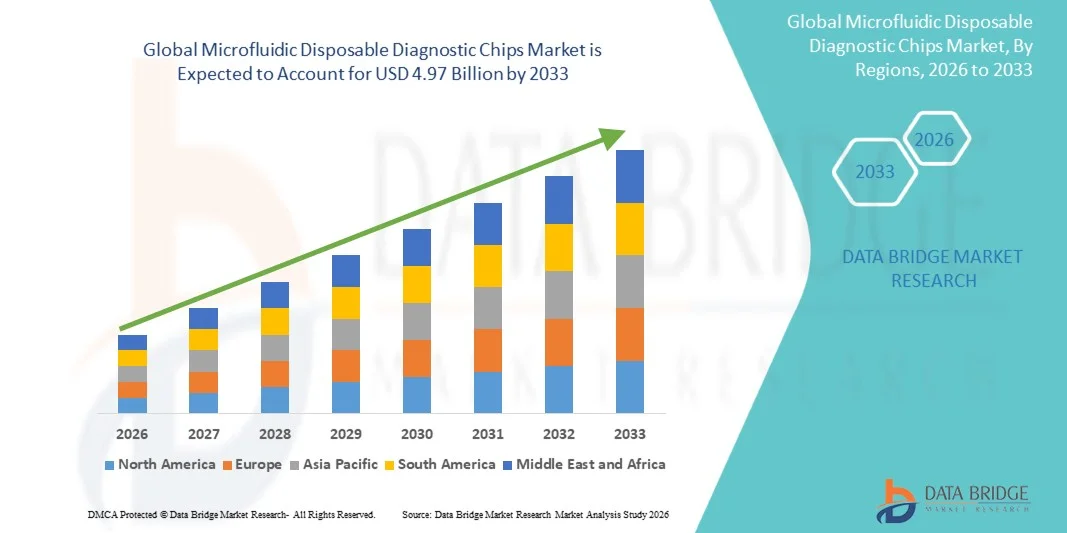
The Microfluidic Disposable Diagnostic Chips Market was valued at USD 1.26 Billion in 2025 and is projected to reach USD 4.97 Billion by 2033, growing at a CAGR of 18.70% from 2026 to 2033. The market is witnessing strong growth driven by the increasing demand for rapid point-of-care diagnostics, rising prevalence of infectious and chronic diseases, and continuous advancements in lab-on-a-chip technologies.
Growing emphasis on early disease detection, decentralized healthcare delivery, and personalized medicine is accelerating the adoption of disposable microfluidic diagnostic chips across hospitals, diagnostic laboratories, and home healthcare settings. Furthermore, increasing investments in miniaturized diagnostic platforms, coupled with expanding applications in molecular diagnostics, oncology, and infectious disease testing, continue to strengthen market growth worldwide.
Key Market Trends & Insights
- North America dominated the Microfluidic Disposable Diagnostic Chips Market with the largest revenue share of 37.18% in 2025, supported by advanced healthcare infrastructure, high adoption of point-of-care diagnostics, and significant investments in biomedical research.
- The Lab-on-a-Chip Devices segment led the market with a 39.84% share in 2025, driven by their widespread use in rapid diagnostics, clinical testing, and biomedical research applications.
- Asia-Pacific is expected to be the fastest-growing region at a CAGR of 18.8% from 2026 to 2033, fueled by expanding healthcare infrastructure, increasing diagnostic awareness, and growing investments in biotechnology across China, India, South Korea, and Japan.
- Digital Microfluidics is the fastest-growing technology segment, projected to register a CAGR of 19.0%, reflecting increasing demand for highly automated, precise, and multiplex diagnostic testing.
- The Infectious Disease Diagnostics segment dominates the application category with a 34.62% revenue share in 2025, supported by increasing demand for rapid pathogen detection and outbreak preparedness.
- Hospitals & Clinics account for 44.27% of the market, driven by rising implementation of point-of-care diagnostic systems for faster clinical decision-making.
- The Polymer-Based Chips segment is the fastest-growing material category, with a CAGR of 19.3%, owing to their low manufacturing cost, high scalability, flexibility, and suitability for mass production of disposable diagnostic devices.
Market Size & Forecast
- Global Market Value (2025): USD 1.26 Billion
- Expected Market Value (2033): USD 4.97 Billion
- Forecast CAGR (2026–2033): 18.70%
- Leading Region in 2025: Europe
- Fastest Growing Region: Asia-Pacific
Report Scope and Microfluidic Disposable Diagnostic Chips Market Segmentation
|
Attributes |
Microfluidic Disposable Diagnostic Chips Key Market Insights |
|
Segments Covered |
|
|
Countries Covered |
North America · U.S. · Canada · Mexico Europe · Germany · France · U.K. · Netherlands · Switzerland · Belgium · Russia · Italy · Spain · Turkey · Rest of Europe Asia-Pacific · China · Japan · India · South Korea · Singapore · Malaysia · Australia · Thailand · Indonesia · Philippines · Rest of Asia-Pacific Middle East and Africa · Saudi Arabia · U.A.E. · South Africa · Egypt · Israel · Rest of Middle East and Africa South America · Brazil · Argentina · Rest of South America |
|
Key Market Players |
· F. Hoffmann-La Roche Ltd. (Switzerland) · Abbott (U.S.) · Danaher Corporation (U.S.) · Thermo Fisher Scientific Inc. (U.S.) · Bio-Rad Laboratories, Inc. (U.S.) · Standard BioTools Inc. (U.S.) · Agilent Technologies, Inc. (U.S.) · Illumina, Inc. (U.S.) · PerkinElmer Inc. (U.S.) · QIAGEN N.V. (Netherlands) · BioMérieux SA (France) · Siemens Healthineers AG (Germany) · Becton, Dickinson and Company (U.S.) · Revvity, Inc. (U.S.) · Dolomite Microfluidics (U.K.) · Micronit B.V. (Netherlands) · Elveflow (France) · ALine, Inc. (U.S.) · Fluigent SA (France) · Sphere Fluidics Limited (U.K.) · Microfluidic ChipShop GmbH (Germany) · Micralyne Inc. (Canada) · uFluidix Inc. (Canada) · Cellix Ltd. (Ireland) · Blacktrace Holdings Ltd. (U.K.) · Biosurfit SA (Portugal) · IMT Masken und Teilungen AG (Switzerland) · QuantuMDx Group Ltd. (U.K.) · Curiox Biosystems Co., Ltd. (South Korea) · NanoCellect Biomedical, Inc. (U.S.) · Fluxergy, Inc. (U.S.) · Micropoint Bioscience Inc. (China) · CapitalBio Technology Co., Ltd. (China) · Shenzhen Mindray Bio-Medical Electronics Co., Ltd. (China) |
|
Market Opportunities |
· Rising adoption of point-of-care diagnostics in decentralized healthcare · Integration of AI-enabled microfluidic diagnostic platforms · Increasing demand for multiplex and personalized diagnostic testing |
|
Value Added Data Infosets |
In addition to the insights on market scenarios such as market value, growth rate, segmentation, geographical coverage, and major players, the market reports curated by the Data Bridge Market Research also include import export analysis, production capacity overview, production consumption analysis, price trend analysis, climate change scenario, supply chain analysis, value chain analysis, raw material/consumables overview, vendor selection criteria, PESTLE Analysis, Porter Analysis, and regulatory framework |
Microfluidic Disposable Diagnostic Chips Market Trends
Trend: Rapid Expansion of Point-of-Care and Lab-on-a-Chip Diagnostics
Healthcare providers are increasingly adopting disposable microfluidic diagnostic chips to deliver rapid, accurate, and cost-effective testing at the point of care. The growing demand for decentralized diagnostics, combined with advances in lab-on-a-chip technology, enables healthcare professionals to perform multiple assays using minimal sample volumes within minutes. Integration with AI-driven data analytics, smartphone connectivity, and portable readers is further enhancing diagnostic efficiency, making microfluidic disposable chips an essential component of next-generation healthcare and home-based testing.
Microfluidic Disposable Diagnostic Chips Market Dynamics
Key Market Driver: Growing Demand for Rapid Point-of-Care Diagnostics
The increasing prevalence of infectious diseases, cancer, cardiovascular disorders, and diabetes has significantly accelerated the demand for rapid diagnostic solutions. Disposable microfluidic diagnostic chips provide highly sensitive, accurate, and fast testing while requiring only small sample volumes and minimal laboratory infrastructure. Hospitals, diagnostic laboratories, and home healthcare providers are increasingly adopting these technologies to improve early disease detection, reduce turnaround time, and support personalized treatment decisions. Continuous advancements in microfluidics, biosensors, and molecular diagnostics are further strengthening market growth.
Key Restraint/Challenge: High Manufacturing Complexity and Regulatory Requirements
A major restraint for the Microfluidic Disposable Diagnostic Chips Market is the complexity associated with large-scale manufacturing and regulatory approval. Producing highly precise disposable chips requires advanced fabrication technologies, strict quality control, and specialized materials, increasing production costs. In addition, manufacturers must comply with stringent regulatory standards for clinical validation, product safety, and quality assurance before commercialization. These challenges can delay product launches and limit market entry for smaller manufacturers, particularly in emerging economies.
Key Market Opportunity: Integration of AI and Multiplex Molecular Diagnostics
The integration of artificial intelligence with microfluidic disposable diagnostic chips presents significant growth opportunities for the market. AI-powered analytical platforms can improve diagnostic accuracy through automated image interpretation, predictive analytics, and real-time clinical decision support. At the same time, advances in multiplex molecular diagnostics enable simultaneous detection of multiple pathogens and biomarkers from a single patient sample, reducing testing time and healthcare costs. Increasing investments in personalized medicine, wearable diagnostics, and digital healthcare ecosystems are expected to further accelerate adoption across hospitals, home care, and decentralized healthcare settings through 2033.
Microfluidic Disposable Diagnostic Chips Market Scope
The microfluidic disposable diagnostic chips market is segmented on the basis of product type, material type, application, technology, end user, distribution channel, usage, detection method, and sample type.
- By Product Type
On the basis of product type, the Microfluidic Disposable Diagnostic Chips Market is segmented into lab-on-a-chip devices, microfluidic cartridges, lateral flow diagnostic chips, organ-on-chip diagnostic platforms, and others. The Lab-on-a-Chip Devices segment dominated the market with a 39.84% share in 2025, owing to its widespread adoption in point-of-care diagnostics, molecular testing, and clinical laboratories. These devices provide rapid analysis, require minimal sample volumes, and integrate multiple laboratory functions into a single disposable chip, making them highly suitable for decentralized healthcare and emergency diagnostics.
The Organ-on-Chip Diagnostic Platforms segment is projected to register the fastest growth at a CAGR of 19.0% from 2026 to 2033, driven by increasing pharmaceutical research, personalized medicine initiatives, and growing use in drug toxicity screening and disease modeling. Continuous advancements in microfluidics and tissue engineering are further accelerating the commercialization of these platforms.
- By Material Type
On the basis of material type, the Microfluidic Disposable Diagnostic Chips Market is segmented into polymer-based chips, glass-based chips, silicon-based chips, and paper-based chips. The Polymer-Based Chips segment led the market with a 46.28% share in 2025, supported by low manufacturing costs, ease of mass production, excellent biocompatibility, and compatibility with disposable diagnostic applications. Their flexibility and scalability make them the preferred choice for commercial manufacturers of point-of-care testing devices.
The Paper-Based Chips segment is expected to experience the fastest growth at a CAGR of 18.8% from 2026 to 2033, driven by rising demand for affordable diagnostics in resource-limited settings, expanding infectious disease screening programs, and increasing adoption in home healthcare applications.
- By Application
On the basis of application, the Microfluidic Disposable Diagnostic Chips Market is segmented into infectious disease diagnostics, oncology diagnostics, cardiovascular disease testing, diabetes monitoring, women's health testing, genetic testing, drug screening, and others. The Infectious Disease Diagnostics segment dominated the market with a share of 34.62% in 2025 due to increasing global prevalence of infectious diseases, growing demand for rapid pathogen detection, and widespread implementation of point-of-care testing in hospitals and diagnostic laboratories. Continuous technological advancements in molecular diagnostics and biosensor integration further support the dominance of this segment.
The Genetic Testing segment is anticipated to witness the fastest CAGR of 19.0% from 2026 to 2033, driven by increasing adoption of precision medicine, expanding genomic research, and growing demand for early disease detection. Advancements in next-generation sequencing and microfluidic technologies are enabling faster, highly accurate, and cost-effective genetic analysis.
- By Technology
On the basis of technology, the Microfluidic Disposable Diagnostic Chips Market is segmented into PCR-based microfluidics, immunoassay-based microfluidics, digital microfluidics, droplet microfluidics, and continuous flow microfluidics. The PCR-Based Microfluidics segment dominated the market with a share of 36.91% in 2025 due to its superior sensitivity, high diagnostic accuracy, and extensive application in molecular diagnostics for infectious diseases and oncology. Increasing adoption of portable PCR systems and rapid nucleic acid testing continues to strengthen this segment.
The Digital Microfluidics segment is expected to witness the fastest CAGR of 18.8% from 2026 to 2033, driven by its ability to automate liquid handling, reduce reagent consumption, and support multiplex diagnostic testing. The growing integration of AI-based image analysis and automated laboratory workflows is further boosting adoption.
- By End User
On the basis of end user, the Microfluidic Disposable Diagnostic Chips Market is segmented into hospitals & clinics, diagnostic laboratories, point-of-care testing centers, academic & research institutes, and pharmaceutical & biotechnology companies. The Hospitals & Clinics segment dominated the market with a share of 44.27% in 2025 due to increasing patient volumes, growing demand for rapid bedside diagnostics, and rising implementation of decentralized testing solutions. The adoption of disposable diagnostic chips improves workflow efficiency, shortens diagnosis time, and enhances clinical decision-making across healthcare facilities.
The Point-of-Care Testing Centers segment is expected to witness the fastest CAGR of 18.8% from 2026 to 2033, driven by increasing healthcare decentralization, expanding home healthcare services, and growing preference for portable diagnostic technologies. Rising awareness regarding early disease detection and the availability of user-friendly diagnostic platforms are further accelerating market growth.
- By Distribution Channel
On the basis of distribution channel, the Microfluidic Disposable Diagnostic Chips Market is segmented into direct sales, distributors, and online procurement. The Direct Sales segment dominated the market with a 52.14% share in 2025 due to strong partnerships between manufacturers and hospitals, diagnostic laboratories, pharmaceutical companies, and research institutes. Direct procurement enables customized product offerings, technical support, regulatory compliance assistance, and long-term supply agreements, making it the preferred distribution model for high-volume healthcare organizations.
The Online Procurement segment is expected to witness the fastest CAGR of 19.3% from 2026 to 2033, driven by increasing digitalization of healthcare procurement, expansion of e-commerce platforms for laboratory products, and growing demand from small diagnostic laboratories and research institutions seeking convenient purchasing options. Enhanced logistics networks and digital inventory management systems are further supporting segment growth.
- By Usage
On the basis of usage, the Microfluidic Disposable Diagnostic Chips Market is segmented into single-use disposable chips and limited multi-use disposable chips. The Single-Use Disposable Chips segment dominated the market with a 71.36% share in 2025 owing to their ability to eliminate cross-contamination, reduce infection risks, and comply with stringent clinical safety standards. Their widespread adoption in hospitals, diagnostic laboratories, and point-of-care testing environments continues to strengthen market demand.
The Limited Multi-Use Disposable Chips segment is expected to witness the fastest CAGR of 19.2% from 2026 to 2033, driven by technological advancements that improve chip durability while maintaining cost efficiency. Increasing adoption in research laboratories and pharmaceutical drug screening applications is further contributing to segment growth.
- By Detection Method
On the basis of detection method, the Microfluidic Disposable Diagnostic Chips Market is segmented into optical detection, electrochemical detection, fluorescence detection, surface plasmon resonance, and others. The Optical Detection segment dominated the market with a 37.45% share in 2025 due to its high analytical accuracy, compatibility with molecular diagnostic assays, and widespread integration into automated laboratory systems. Continuous improvements in optical sensors and imaging technologies are enhancing diagnostic performance across a broad range of clinical applications.
The Electrochemical Detection segment is expected to witness the fastest CAGR of 19.0% from 2026 to 2033, driven by increasing demand for portable, low-cost, and highly sensitive diagnostic platforms. The technology's compatibility with wearable biosensors and point-of-care testing devices is expected to accelerate adoption across decentralized healthcare settings.
- By Sample Type
On the basis of sample type, the Microfluidic Disposable Diagnostic Chips Market is segmented into blood, saliva, urine, tissue samples, and others. The Blood segment dominated the market with a 49.83% share in 2025 due to its extensive use in infectious disease diagnosis, oncology, cardiovascular testing, metabolic disorder screening, and routine clinical diagnostics. Blood-based assays offer high diagnostic reliability and remain the preferred sample type for most laboratory and point-of-care testing applications.
The Saliva segment is expected to witness the fastest CAGR of 18.8% from 2026 to 2033, driven by increasing demand for non-invasive diagnostic procedures, home-based testing solutions, and rapid infectious disease screening. Advances in salivary biomarker research and portable diagnostic technologies are further supporting market expansion.
Microfluidic Disposable Diagnostic Chips Market Regional Analysis
North America dominated the microfluidic disposable diagnostic chips market and accounted for the largest revenue share of 37.18% in 2025, supported by advanced healthcare infrastructure, strong adoption of molecular diagnostics, significant investments in biotechnology research, and the presence of leading diagnostic device manufacturers. The region also benefits from increasing demand for point-of-care testing, favorable reimbursement policies, and rapid commercialization of innovative lab-on-a-chip technologies. Growing focus on precision medicine and decentralized healthcare continues to strengthen North America's leadership in the global market.
U.S. Microfluidic Disposable Diagnostic Chips Market Insight
The U.S. microfluidic disposable diagnostic chips market is witnessing strong growth due to increasing investments in precision medicine, molecular diagnostics, and point-of-care testing technologies. The country's well-established healthcare infrastructure, strong biotechnology ecosystem, and extensive research activities continue to drive demand for advanced disposable diagnostic platforms. Furthermore, rising prevalence of chronic and infectious diseases, combined with continuous innovation in AI-assisted diagnostics and personalized healthcare, is accelerating market expansion across hospitals, laboratories, and home healthcare settings.
Europe Microfluidic Disposable Diagnostic Chips Market Insight
The Europe microfluidic disposable diagnostic chips market remains a major contributor to global revenue, driven by strong government support for healthcare innovation, increasing adoption of laboratory automation, and expanding demand for rapid diagnostic technologies. Healthcare providers and research organizations are increasingly utilizing disposable microfluidic chips for infectious disease detection, oncology diagnostics, and genetic testing. Continuous investments in biotechnology research and stringent quality standards continue to support regional market growth.
U.K. Microfluidic Disposable Diagnostic Chips Market Insight
The U.K. microfluidic disposable diagnostic chips market is experiencing steady growth, supported by rising investments in genomic medicine, expanding point-of-care testing services, and increasing adoption of digital healthcare technologies. Growing collaboration between academic institutions, biotechnology companies, and healthcare providers is accelerating the commercialization of innovative disposable diagnostic platforms. In addition, increasing demand for rapid, portable, and cost-effective testing solutions continues to strengthen market development throughout the country.
Germany Microfluidic Disposable Diagnostic Chips Market Insight
The Germany microfluidic disposable diagnostic chips market is expanding steadily due to the country's strong biotechnology industry, advanced healthcare infrastructure, and increasing investments in molecular diagnostics and personalized medicine. Hospitals, diagnostic laboratories, and research institutes are increasingly adopting disposable microfluidic chips for rapid disease detection, oncology diagnostics, and genetic testing. Continuous advancements in biosensor technologies, laboratory automation, and government support for healthcare innovation are further driving market growth across Germany.
Asia-Pacific Microfluidic Disposable Diagnostic Chips Market Insight
The Asia-Pacific microfluidic disposable diagnostic chips market is expected to witness the fastest growth, driven by expanding healthcare infrastructure, increasing government investments in diagnostics, and rising demand for affordable point-of-care testing across China, India, Japan, South Korea, and Southeast Asia. Growing awareness regarding early disease diagnosis, increasing prevalence of infectious and chronic diseases, and rapid development of biotechnology industries are supporting regional market expansion. In addition, rising manufacturing capabilities and favorable healthcare reforms are accelerating the adoption of disposable microfluidic diagnostic technologies throughout the region.
Japan Microfluidic Disposable Diagnostic Chips Market Insight
The Japan microfluidic disposable diagnostic chips market is witnessing consistent growth due to increasing investments in precision medicine, laboratory automation, and advanced diagnostic technologies. Healthcare providers and biotechnology companies are increasingly utilizing disposable microfluidic chips for molecular diagnostics, cancer screening, and infectious disease detection. Furthermore, the country's aging population, growing focus on preventive healthcare, and strong emphasis on technological innovation continue to support sustained market growth.
China Microfluidic Disposable Diagnostic Chips Market Insight
The China microfluidic disposable diagnostic chips market is growing rapidly, driven by expanding healthcare infrastructure, rising government initiatives supporting domestic biotechnology manufacturing, and increasing demand for rapid diagnostic testing. The widespread adoption of point-of-care diagnostic solutions, growing investments in precision medicine, and continuous advancements in microfluidic technologies are significantly boosting market demand. Moreover, increasing healthcare expenditure, rising prevalence of chronic and infectious diseases, and strong expansion of local diagnostic device manufacturers are positioning China as one of the fastest-growing markets for microfluidic disposable diagnostic chips globally.
Microfluidic Disposable Diagnostic Chips Market Share
The Microfluidic Disposable Diagnostic Chips industry is primarily led by well-established companies, including:
- Hoffmann-La Roche Ltd. (Switzerland)
- Abbott (U.S.)
- Danaher Corporation (U.S.)
- Thermo Fisher Scientific Inc. (U.S.)
- Bio-Rad Laboratories, Inc. (U.S.)
- Standard BioTools Inc. (U.S.)
- Agilent Technologies, Inc. (U.S.)
- Illumina, Inc. (U.S.)
- PerkinElmer Inc. (U.S.)
- QIAGEN N.V. (Netherlands)
- BioMérieux SA (France)
- Siemens Healthineers AG (Germany)
- Becton, Dickinson and Company (U.S.)
- Revvity, Inc. (U.S.)
- Dolomite Microfluidics (U.K.)
- Micronit B.V. (Netherlands)
- Elveflow (France)
- ALine, Inc. (U.S.)
- Fluigent SA (France)
- Sphere Fluidics Limited (U.K.)
- Microfluidic ChipShop GmbH (Germany)
- Micralyne Inc. (Canada)
- uFluidix Inc. (Canada)
- Cellix Ltd. (Ireland)
- Blacktrace Holdings Ltd. (U.K.)
- Biosurfit SA (Portugal)
- IMT Masken und Teilungen AG (Switzerland)
- QuantuMDx Group Ltd. (U.K.)
- Curiox Biosystems Co., Ltd. (South Korea)
- NanoCellect Biomedical, Inc. (U.S.)
- Fluxergy, Inc. (U.S.)
- Micropoint Bioscience Inc. (China)
- CapitalBio Technology Co., Ltd. (China)
- Shenzhen Mindray Bio-Medical Electronics Co., Ltd. (China)
Latest Developments in Microfluidic Disposable Diagnostic Chips Market
- In March 2025, Abbott launched its next-generation disposable microfluidic cartridge platform for rapid point-of-care infectious disease testing. The new platform delivers faster sample processing, improved analytical sensitivity, and seamless integration with portable diagnostic analyzers. Designed to support decentralized healthcare settings, the solution enhances workflow efficiency while reducing turnaround time for clinical diagnosis. This launch strengthens Abbott’s position in the Microfluidic Disposable Diagnostic Chips Market by expanding its portfolio of rapid molecular diagnostic solutions.
- In February 2025, F. Hoffmann-La Roche Ltd. introduced an advanced microfluidic diagnostic chip compatible with its molecular diagnostics portfolio for automated PCR-based testing. The disposable chip enables multiplex detection of multiple biomarkers from a single patient sample while reducing reagent consumption and processing time. The innovation supports precision medicine initiatives and reinforces Roche's leadership in molecular diagnostics through enhanced laboratory automation and improved testing efficiency.
- In October 2024, Standard BioTools Inc. expanded its integrated microfluidics platform with a new generation of disposable integrated fluidic circuits designed for high-throughput genomic and proteomic research. The upgraded technology offers improved sample throughput, enhanced assay reproducibility, and reduced operating costs for research laboratories. This development strengthens the company's position in precision medicine, translational research, and biomarker discovery applications.
- In September 2024, Bio-Rad Laboratories, Inc. launched an enhanced digital PCR microfluidic chip system featuring higher partition density and improved analytical accuracy for oncology and infectious disease testing. The new disposable chip technology enables highly sensitive nucleic acid detection while simplifying laboratory workflows. The product launch expands Bio-Rad's molecular diagnostics portfolio and supports growing demand for precision diagnostic solutions.
- In June 2023, Thermo Fisher Scientific Inc. expanded its collaboration with leading academic research institutions to accelerate the development of next-generation microfluidic diagnostic technologies for clinical research and personalized medicine. The collaboration focuses on integrating advanced biosensors, AI-assisted data analysis, and disposable lab-on-a-chip platforms for rapid disease detection. This initiative demonstrates the increasing role of microfluidic disposable diagnostic chips in next-generation healthcare and translational research.

- Interactive Data Analysis Dashboard
- Company Analysis Dashboard for high growth potential opportunities
- Research Analyst Access for customization & queries
- Competitor Analysis with Interactive dashboard
- Latest News, Updates & Trend analysis
- Harness the Power of Benchmark Analysis for Comprehensive Competitor Tracking
Data collection and base year analysis are done using data collection modules with large sample sizes. The stage includes obtaining market information or related data through various sources and strategies. It includes examining and planning all the data acquired from the past in advance. It likewise envelops the examination of information inconsistencies seen across different information sources. The market data is analysed and estimated using market statistical and coherent models. Also, market share analysis and key trend analysis are the major success factors in the market report. To know more, please request an analyst call or drop down your inquiry.
The key research methodology used by DBMR research team is data triangulation which involves data mining, analysis of the impact of data variables on the market and primary (industry expert) validation. Data models include Vendor Positioning Grid, Market Time Line Analysis, Market Overview and Guide, Company Positioning Grid, Patent Analysis, Pricing Analysis, Company Market Share Analysis, Standards of Measurement, Global versus Regional and Vendor Share Analysis. To know more about the research methodology, drop in an inquiry to speak to our industry experts.
Data Bridge Market Research is a leader in advanced formative research. We take pride in servicing our existing and new customers with data and analysis that match and suits their goal. The report can be customized to include price trend analysis of target brands understanding the market for additional countries (ask for the list of countries), clinical trial results data, literature review, refurbished market and product base analysis. Market analysis of target competitors can be analyzed from technology-based analysis to market portfolio strategies. We can add as many competitors that you require data about in the format and data style you are looking for. Our team of analysts can also provide you data in crude raw excel files pivot tables (Fact book) or can assist you in creating presentations from the data sets available in the report.













