


Global Micromorph (Tandem Cell Using A SiΜc Si) Market Overview
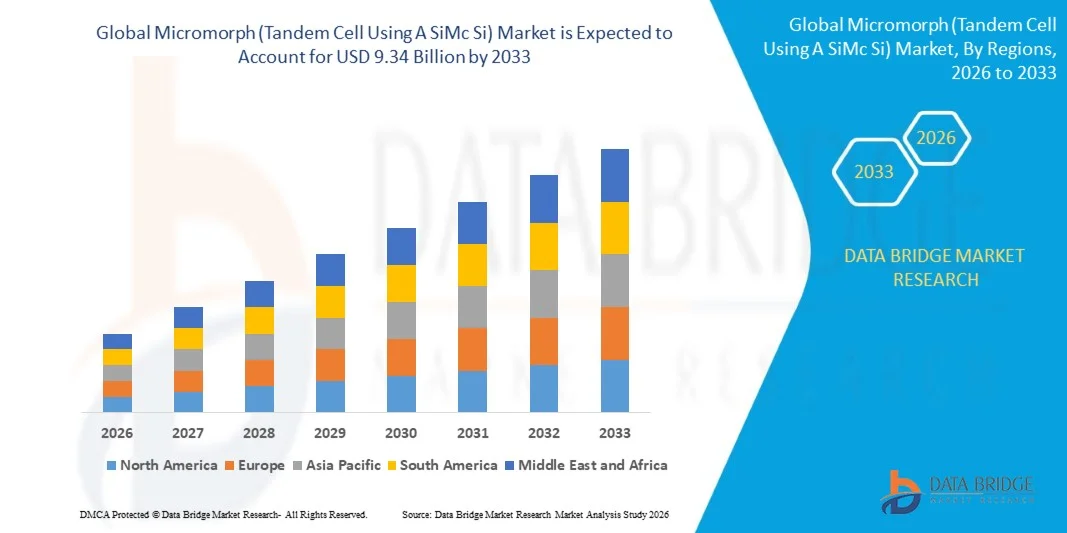
The global micromorph (tandem cell using A SiΜc Si) market was valued at USD 5.56 billion in 2025 and is projected to reach USD 9.34 billion by 2033, growing at a CAGR of 6.70% from 2026 to 2033. The market is experiencing consistent growth driven by rising demand for high-efficiency photovoltaic technologies, increasing adoption of advanced thin-film solar solutions, and growing investments in renewable energy generation and sustainable power infrastructure.
The growing need for improved solar cell efficiency, combined with advancements in silicon-based tandem cell technologies, is encouraging manufacturers and research institutions to adopt micromorph (tandem cell using a Siμc Si) solutions. These technologies enhance light absorption and energy conversion performance by combining different semiconductor layers, enabling higher efficiency compared with conventional solar cells. Increasing focus on clean energy transition, declining solar manufacturing costs, and ongoing innovations in photovoltaic materials are further supporting the adoption of micromorph (tandem cell using a Siμc Si) technologies across residential, commercial, and utility-scale solar applications.
Key Market Trends & Insights
- North America dominated the global micromorph (tandem cell using a-Si/μc-Si) market with the largest revenue share of 35.2% in 2025, supported by strong renewable energy investments, advanced photovoltaic research capabilities, increasing adoption of high-efficiency tandem solar technologies, and government initiatives promoting clean energy transition across the region.
- The solar panels segment dominated the market with a 45.18% share in 2025, supported by increasing global demand for renewable energy generation and high-efficiency photovoltaic modules.
- Asia-Pacific is expected to be the fastest-growing region at a CAGR of 7.5% from 2026 to 2033, supported by expanding solar manufacturing ecosystems, rising renewable energy capacity additions, favorable government policies, and increasing investments in advanced photovoltaic technologies across China, India, and Japan.
- The open-circuit voltage (Voc) segment is projected to be the fastest-growing parameter category with a CAGR of 7.3%, driven by technological improvements focused on enhancing voltage output, reducing efficiency losses, and improving the overall performance of tandem solar cells.
Market Size & Forecast
- Global Market Value (2025): USD 5.56 Billion
- Expected Market Value (2033): USD 9.34 Billion
- Forecast CAGR (2026–2033): 6.70%
- Leading Region in 2025: North America
- Fastest Growing Region: Asia-Pacific
Report Scope and Global Micromorph (Tandem Cell Using A SiΜc Si) Market Segmentation
|
Attributes |
Micromorph (Tandem Cell Using A SiΜc Si) Key Market Insights |
|
Segments Covered |
|
|
Countries Covered |
North America · U.S. · Canada · Mexico Europe · Germany · France · U.K. · Netherlands · Switzerland · Belgium · Russia · Italy · Spain · Turkey · Rest of Europe Asia-Pacific · China · Japan · India · South Korea · Singapore · Malaysia · Australia · Thailand · Indonesia · Philippines · Rest of Asia-Pacific Middle East and Africa · Saudi Arabia · U.A.E. · South Africa · Egypt · Israel · Rest of Middle East and Africa South America · Brazil · Argentina · Rest of South America |
|
Key Market Players |
• First Solar, Inc. (U.S.) |
|
Market Opportunities |
· Growing Demand for High-Efficiency Solar Technologies · Rising Adoption of Tandem Solar Cell Applications · Advancements in Thin-Film and Silicon-Based Photovoltaic Innovations |
|
Value Added Data Infosets |
In addition to the insights on market scenarios such as market value, growth rate, segmentation, geographical coverage, and major players, the market reports curated by the Data Bridge Market Research also include in-depth expert analysis, geographically represented company-wise production and capacity, network layouts of distributors and partners, detailed and updated price trend analysis and deficit analysis of supply chain and demand. |
Global Micromorph (Tandem Cell Using A SiΜc Si) Market Trends
Trend: Rising Adoption of High-Efficiency Tandem Solar Technologies
The global micromorph (Tandem Cell Using a-Si/μc-Si) market is witnessing a major shift toward advanced tandem photovoltaic technologies as manufacturers and research institutions focus on improving solar conversion efficiency beyond conventional silicon-based modules. Micromorph technology, which combines amorphous silicon (a-Si) and microcrystalline silicon (μc-Si) layers, enables broader light absorption and improved performance under varying illumination conditions. The growing focus on next-generation photovoltaic solutions, including hybrid tandem architectures and perovskite integration, is accelerating innovation in thin-film solar technologies. In 2024, research and industrial efforts around tandem solar cells continued to expand, with organizations such as National Renewable Energy Laboratory advancing high-efficiency photovoltaic research aimed at improving multi-junction and tandem cell performance for future clean energy applications.
Global Micromorph (Tandem Cell Using A SiΜc Si) Market Dynamics
Key Market Driver: Increasing Demand for Renewable Energy and High-Efficiency Solar Modules
The rapid global transition toward renewable energy is driving demand for advanced photovoltaic technologies capable of delivering higher power output with improved efficiency. Governments, utilities, and solar manufacturers are increasingly investing in technologies that maximize energy generation from limited installation areas, creating opportunities for Micromorph tandem cells in utility-scale solar projects, building-integrated photovoltaics (BIPV), and distributed energy systems. According to global renewable energy expansion trends, solar photovoltaic capacity has continued to grow significantly, supported by large-scale deployment initiatives in countries such as China, the United States, India, and European markets. The need for improved efficiency, reduced land usage, and better performance in diverse environmental conditions is encouraging adoption of advanced tandem solar technologies.
Key Restraint/Challenge: High Manufacturing Complexity and Production Cost of Tandem Cell Technologies
A major challenge for the global micromorph (Tandem Cell Using a-Si/μc-Si) market is the complexity involved in large-scale manufacturing and commercialization. Producing high-performance tandem structures requires precise layer deposition, advanced fabrication equipment, strict process control, and significant research investment to achieve consistent efficiency levels. Compared with conventional crystalline silicon solar modules, thin-film tandem technologies often face challenges related to manufacturing scalability, material optimization, long-term stability, and cost competitiveness. The requirement for specialized production infrastructure and continuous technological improvements can limit adoption among smaller manufacturers and emerging photovoltaic producers.
Key Market Opportunity: Integration of Micromorph Technology with Next-Generation Tandem and BIPV Applications
The integration of Micromorph technology with advanced photovoltaic applications presents significant growth opportunities for market participants. Increasing demand for energy-efficient buildings, smart infrastructure, and decentralized renewable power systems is creating new opportunities for tandem solar cells in BIPV, portable devices, and specialty energy applications. In addition, advancements in material engineering, improved deposition techniques, and integration with perovskite-based tandem architectures are expected to enhance efficiency and commercial viability. In 2025, the continued expansion of solar manufacturing investments across Asia-Pacific, particularly in China and India, along with growing clean energy targets in North America and Europe, is expected to support wider commercialization of advanced tandem photovoltaic solutions.
Global Micromorph (Tandem Cell Using A SiΜc Si) Market Scope
The global micromorph (tandem cell using A SiΜc Si) Market is segmented on the basis of type, parameter, application, and end user.
· By Type
On the basis of type, the global Micromorph (Tandem Cell Using A SiΜc Si) market is segmented into Hybrid PSCs, Flexible PSCs, and Multi-Junction PSCs. The Hybrid PSCs segment dominated the market with a 42.35% share in 2025, owing to its ability to combine multiple photovoltaic materials to enhance light absorption, efficiency, and overall solar conversion performance. Hybrid structures are increasingly adopted due to their improved stability, compatibility with silicon-based technologies, and potential to overcome efficiency limitations of conventional solar cells. The growing demand for high-performance photovoltaic solutions across utility-scale solar projects, commercial installations, and advanced energy applications is supporting segment growth. In addition, ongoing research and development activities focused on improving material durability, scalability, and manufacturing efficiency are strengthening the adoption of hybrid photovoltaic technologies in the market.
The multi-junction PSCs segment is expected to witness the fastest growth at a CAGR of 8.2% from 2026 to 2033, driven by increasing demand for ultra-high-efficiency solar cells and advanced tandem photovoltaic technologies. Multi-junction structures enable improved energy harvesting by utilizing multiple semiconductor layers designed to capture different wavelengths of sunlight. Rising investments in next-generation solar technologies, aerospace photovoltaic applications, and high-efficiency renewable energy systems are accelerating segment expansion. Furthermore, advancements in semiconductor engineering, improved fabrication processes, and increasing focus on reducing the cost of high-performance solar cells are expected to create significant growth opportunities for multi-junction PSC technologies.
· By Parameter
On the basis of parameter, the global micromorph (Tandem Cell Using A SiΜc Si) market is segmented into short-circuit current density, open-circuit voltage, and Fill Factor (FF). The Open-Circuit Voltage segment dominated the market with a 38.72% share in 2025, due to its critical role in determining photovoltaic conversion efficiency and overall solar cell performance. Higher open-circuit voltage improves energy output and enables better utilization of solar energy, making it a key performance indicator in tandem solar cell development. Increasing research activities focused on improving semiconductor interfaces, reducing energy losses, and enhancing cell architecture are supporting segment adoption. In addition, manufacturers are prioritizing voltage optimization to achieve higher efficiency levels required for commercial and industrial solar applications.
The short-circuit current density segment is projected to register the fastest CAGR of 7.9% from 2026 to 2033, driven by increasing focus on improving photon absorption and maximizing current generation in tandem photovoltaic cells. Advancements in light management technologies, thin-film materials, and silicon-based absorber layers are enhancing current density performance. Growing demand for efficient solar modules with higher power output per unit area is further supporting segment growth. Moreover, increasing adoption of advanced photovoltaic designs in building-integrated photovoltaics, portable energy systems, and utility-scale installations is expected to accelerate demand for improved current density technologies.
· By Application
On the basis of application, the global micromorph (Tandem Cell Using A SiΜc Si) market is segmented into smart glass, solar panels, perovskite in tandem solar cells, portable devices, utilities, and BIPV (Building-Integrated Photovoltaics). The solar panels segment dominated the market with a 45.18% share in 2025, supported by increasing global demand for renewable energy generation and high-efficiency photovoltaic modules. Micromorph tandem cell technologies are gaining importance in solar panels due to their ability to enhance energy conversion efficiency while maintaining compatibility with existing silicon-based manufacturing processes. Rising solar installations, government incentives for renewable energy adoption, and declining photovoltaic production costs are driving market expansion. In addition, increasing investments by solar manufacturers in advanced cell technologies are strengthening the dominance of solar panel applications.
The BIPV (Building-Integrated Photovoltaics) segment is anticipated to witness the fastest CAGR of 9.1% from 2026 to 2033, driven by increasing demand for energy-efficient buildings and integrated renewable energy solutions. Micromorph tandem cell technology offers opportunities for lightweight, flexible, and aesthetically adaptable photovoltaic systems suitable for architectural applications. Growing urbanization, sustainability regulations, and adoption of net-zero energy buildings are accelerating the use of BIPV solutions. Furthermore, advancements in transparent solar technologies, smart glass integration, and flexible photovoltaic materials are creating new opportunities for micromorph tandem cell adoption in modern infrastructure.
· By End User
On the basis of end user, the global Micromorph (Tandem Cell Using A SiΜc Si) market is segmented into manufacturing, energy, industrial automation, aerospace, and consumer electronics. The Energy segment dominated the market with a 39.64% share in 2025, owing to the increasing deployment of advanced photovoltaic technologies for renewable power generation. Energy companies are adopting high-efficiency tandem solar technologies to improve electricity output, optimize land usage, and support clean energy transition initiatives. Growing investments in solar farms, renewable energy infrastructure, and government-led decarbonization programs are driving demand across this segment. In addition, collaborations between photovoltaic manufacturers, research institutions, and energy providers are accelerating commercialization of advanced micromorph solar technologies.
The consumer electronics segment is expected to witness the fastest CAGR of 8.6% from 2026 to 2033, driven by rising demand for compact, lightweight, and efficient energy solutions for portable electronic devices. Micromorph tandem cell technologies offer potential advantages for wearable devices, smart electronics, and low-power applications requiring improved energy harvesting capabilities. Increasing adoption of self-powered electronics, IoT-enabled devices, and flexible photovoltaic solutions is supporting segment growth. Furthermore, continuous innovation in miniaturized solar technologies and advancements in flexible materials are expected to expand the application of micromorph tandem cells across consumer electronics markets.
Global Micromorph (Tandem Cell Using A SiΜc Si) Market Regional Analysis
North America dominated the global micromorph (tandem cell using a-Si/μc-Si) market and accounted for the largest revenue share of 35.2% in 2025, supported by strong renewable energy investments, advanced photovoltaic research capabilities, and increasing adoption of high-efficiency tandem solar technologies. The region benefits from significant government support for clean energy transition, expansion of solar power capacity, and continuous innovation in thin-film and tandem photovoltaic technologies. Growing investments in next-generation solar solutions, including advanced tandem architectures and building-integrated photovoltaic (BIPV) applications, are further strengthening market growth across the U.S. and Canada.
U.S. Micromorph (Tandem Cell Using A SiΜc Si) Market Insight
The U.S. micromorph (tandem cell using a-Si/μc-Si) market is experiencing strong growth due to increasing investments in renewable energy infrastructure, photovoltaic research, and advanced solar manufacturing technologies. The presence of leading research institutions, solar technology developers, and clean energy initiatives is accelerating innovation in tandem solar cells. Rising demand for high-efficiency photovoltaic modules for utility-scale solar projects, commercial installations, and BIPV applications is supporting market expansion. In addition, government programs promoting domestic solar manufacturing and clean energy adoption are encouraging the development and commercialization of advanced photovoltaic technologies.
Europe Micromorph (Tandem Cell Using A SiΜc Si) Market Insight
The Europe micromorph (tandem cell using a-Si/μc-Si) market remains a significant contributor to global growth, driven by strong renewable energy targets, technological advancements, and increasing investments in sustainable power generation. Countries across the region are focusing on improving solar module efficiency and reducing dependence on conventional energy sources, creating demand for advanced tandem photovoltaic solutions. The region’s emphasis on energy transition, carbon reduction initiatives, and adoption of innovative solar technologies is supporting the integration of Micromorph solutions across utility, industrial, and building-integrated solar applications.
U.K. Micromorph (Tandem Cell Using A SiΜc Si) Market Insight
The U.K. micromorph (tandem cell using a-Si/μc-Si) market is witnessing steady growth, supported by increasing investments in renewable energy projects, solar technology innovation, and sustainable infrastructure development. Growing demand for efficient solar solutions across residential, commercial, and industrial applications is driving interest in advanced tandem photovoltaic technologies. Furthermore, government initiatives supporting clean energy expansion and decarbonization targets are encouraging the adoption of high-performance solar technologies, including thin-film and tandem cell solutions.
Germany Micromorph (Tandem Cell Using A SiΜc Si) Market Insight
The Germany micromorph (tandem cell using a-Si/μc-Si) market is expanding due to the country’s strong renewable energy ecosystem, advanced photovoltaic research capabilities, and focus on high-efficiency solar technologies. Germany’s established solar industry, strong R&D infrastructure, and commitment toward increasing renewable energy generation are supporting the development of next-generation tandem solar cells. Increasing adoption of advanced photovoltaic systems in commercial buildings, industrial facilities, and distributed energy projects is further contributing to market growth.
Asia-Pacific Micromorph (Tandem Cell Using A SiΜc Si) Market Insight
The Asia-Pacific micromorph (tandem cell using a-Si/μc-Si) market is expected to witness the fastest growth at a CAGR of 7.5% from 2026 to 2033, driven by expanding solar manufacturing ecosystems, rising renewable energy capacity additions, favorable government policies, and increasing investments in advanced photovoltaic technologies across China, India, and Japan. The region’s strong position in solar module manufacturing, growing energy demand, and large-scale renewable energy deployment are creating significant opportunities for tandem solar technologies. Increasing focus on improving photovoltaic efficiency and reducing land requirements for solar installations is further accelerating adoption across utility-scale and commercial applications.
Japan Micromorph (Tandem Cell Using A SiΜc Si) Market Insight
The Japan micromorph (tandem cell using a-Si/μc-Si) market is growing steadily due to increasing investments in advanced photovoltaic technologies, renewable energy development, and high-efficiency solar solutions. Japan’s focus on energy security, clean power generation, and technological innovation is supporting research and adoption of tandem solar cells. Growing deployment of solar systems in commercial infrastructure, residential applications, and space-constrained environments is creating demand for efficient photovoltaic technologies such as Micromorph tandem cells.
China Micromorph (Tandem Cell Using A SiΜc Si) Market Insight
The China micromorph (tandem cell using a-Si/μc-Si) market is expanding rapidly due to the country’s dominant solar manufacturing ecosystem, large-scale renewable energy investments, and strong government support for photovoltaic innovation. China’s extensive solar capacity additions and focus on improving solar cell efficiency are driving demand for advanced tandem photovoltaic technologies. Increasing investments in photovoltaic research, manufacturing expansion, and development of next-generation solar modules are positioning China as a key growth market for Micromorph (Tandem Cell Using a-Si/μc-Si) technologies globally.
Global Micromorph (Tandem Cell Using A SiΜc Si) Market Share
The Micromorph (Tandem Cell Using A SiΜc Si) industry is primarily led by well-established companies, including:
- First Solar, Inc. (U.S.)
- Meyer Burger Technology AG (Switzerland)
- Hanergy Thin Film Power Group (China)
- Kaneka Corporation (Japan)
- Sharp Corporation (Japan)
- Mitsubishi Electric Corporation (Japan)
- Oxford PV (United Kingdom)
- Saule Technologies (Poland)
- JinkoSolar Holding Co., Ltd. (China)
- LONGi Green Energy Technology Co., Ltd. (China)
- Trina Solar Co., Ltd. (China)
- JA Solar Technology Co., Ltd. (China)
- Canadian Solar Inc. (Canada)
- Qcells (South Korea)
- SunPower Corporation (U.S.)
- REC Group (Norway)
- Panasonic Corporation (Japan)
- LG Electronics (South Korea)
- Toshiba Corporation (Japan)
- Hitachi, Ltd. (Japan)
- Solar Frontier (Japan)
- Midsummer AB (Sweden)
- Applied Materials, Inc. (U.S.)
- ULVAC, Inc. (Japan)
- Oerlikon Balzers (Liechtenstein)
- SENTECH Instruments GmbH (Germany)
- Singulus Technologies AG (Germany)
- Roth & Rau AG (Germany)
- Centrotherm International AG (Germany)
- Manz AG (Germany)
- Huasun Energy (China)
- GCL System Integration Technology Co., Ltd. (China)
- Aiko Solar (China)
- Risen Energy Co., Ltd. (China)
Latest Developments in Global Micromorph (Tandem Cell Using A SiΜc Si) Market
- In November 2021, researchers from the Italian National Agency for New Technologies, Energy and Sustainable Economic Development (ENEA) published a study on monolithic perovskite/silicon tandem solar cells using nanocrystalline silicon/silicon oxide tunnel junction technology. The development focused on improving the electrical connection between tandem sub-cells while reducing optical losses, supporting advancements in silicon-based tandem photovoltaic architectures. This research highlighted the potential of advanced silicon junction engineering to improve efficiency and reliability of next-generation tandem solar technologies
- In January 2024, Oxford PV and Fraunhofer Institute for Solar Energy Systems ISE announced the development of a full-sized perovskite-silicon tandem photovoltaic module with 25% efficiency. The industrial-format module achieved 421 watts output on a 1.68-square-meter area, demonstrating progress toward commercial-scale tandem solar manufacturing. The development emphasized the use of scalable production processes and advanced silicon-based tandem architectures to improve solar module performance beyond conventional silicon technologies
- In June 2024, LONGi announced a certified 34.6% efficiency achievement for a perovskite-silicon tandem solar cell. The breakthrough was validated by the European Solar Test Installation (ESTI) and was achieved through improvements in thin-film deposition processes, defect passivation materials, and interface engineering. This advancement demonstrated the rapid progress of silicon-based tandem photovoltaic technologies toward higher conversion efficiencies and strengthened industry focus on next-generation tandem cell commercialization
- In September 2024, Fraunhofer Institute for Solar Energy Systems ISE developed a scalable perovskite-silicon tandem solar cell achieving 31.6% efficiency. The research demonstrated the successful deposition of a perovskite top layer onto an industrially textured silicon heterojunction bottom cell using a hybrid manufacturing approach. The development improved compatibility between advanced tandem technologies and existing silicon photovoltaic production processes, supporting future large-scale manufacturing opportunities
- In September 2024, researchers published advancements in improving efficiency of a-Si:H/μc-Si micromorph tandem solar cells through advanced light-trapping techniques. The study focused on integrating optical enhancement methods such as anti-reflection coatings, tunnel recombination junction optimization, and distributed Bragg reflector structures to improve light absorption and conversion performance. These developments contributed to ongoing research efforts aimed at increasing the efficiency of micromorph tandem cell architectures based on amorphous and microcrystalline silicon
- In September 2024, CEA-Liten and 3SUN announced a new efficiency record of 29.8% for a perovskite-on-silicon tandem photovoltaic cell. The achievement was obtained on a 9 cm² tandem cell and represented continued progress in two-terminal tandem solar technology development. The milestone demonstrated improvements in photovoltaic interface engineering and reinforced industry efforts to transition silicon-based tandem technologies from laboratory research toward scalable production
- In April 2025, researchers demonstrated progress in flexible perovskite/silicon monolithic tandem solar cells approaching 30% efficiency. The development focused on improving phase uniformity, mechanical stability, and charge transport in flexible tandem photovoltaic structures. These advancements supported the expansion of silicon-based tandem technologies into lightweight and flexible applications such as portable energy systems, wearable electronics, and integrated photovoltaic solutions

- Interactive Data Analysis Dashboard
- Company Analysis Dashboard for high growth potential opportunities
- Research Analyst Access for customization & queries
- Competitor Analysis with Interactive dashboard
- Latest News, Updates & Trend analysis
- Harness the Power of Benchmark Analysis for Comprehensive Competitor Tracking
Global Micromorph Market, Supply Chain Analysis and Ecosystem Framework
To support market growth and help clients navigate the impact of geopolitical shifts, DBMR has integrated in-depth supply chain analysis into its Global Micromorph Market research reports. This addition empowers clients to respond effectively to global changes affecting their industries. The supply chain analysis section includes detailed insights such as Global Micromorph Market consumption and production by country, price trend analysis, the impact of tariffs and geopolitical developments, and import and export trends by country and HSN code. It also highlights major suppliers with data on production capacity and company profiles, as well as key importers and exporters. In addition to research, DBMR offers specialized supply chain consulting services backed by over a decade of experience, providing solutions like supplier discovery, supplier risk assessment, price trend analysis, impact evaluation of inflation and trade route changes, and comprehensive market trend analysis.
Data collection and base year analysis are done using data collection modules with large sample sizes. The stage includes obtaining market information or related data through various sources and strategies. It includes examining and planning all the data acquired from the past in advance. It likewise envelops the examination of information inconsistencies seen across different information sources. The market data is analysed and estimated using market statistical and coherent models. Also, market share analysis and key trend analysis are the major success factors in the market report. To know more, please request an analyst call or drop down your inquiry.
The key research methodology used by DBMR research team is data triangulation which involves data mining, analysis of the impact of data variables on the market and primary (industry expert) validation. Data models include Vendor Positioning Grid, Market Time Line Analysis, Market Overview and Guide, Company Positioning Grid, Patent Analysis, Pricing Analysis, Company Market Share Analysis, Standards of Measurement, Global versus Regional and Vendor Share Analysis. To know more about the research methodology, drop in an inquiry to speak to our industry experts.
Data Bridge Market Research is a leader in advanced formative research. We take pride in servicing our existing and new customers with data and analysis that match and suits their goal. The report can be customized to include price trend analysis of target brands understanding the market for additional countries (ask for the list of countries), clinical trial results data, literature review, refurbished market and product base analysis. Market analysis of target competitors can be analyzed from technology-based analysis to market portfolio strategies. We can add as many competitors that you require data about in the format and data style you are looking for. Our team of analysts can also provide you data in crude raw excel files pivot tables (Fact book) or can assist you in creating presentations from the data sets available in the report.













