


What is the Microneedle Drug Delivery Systems Market Size and Overview?
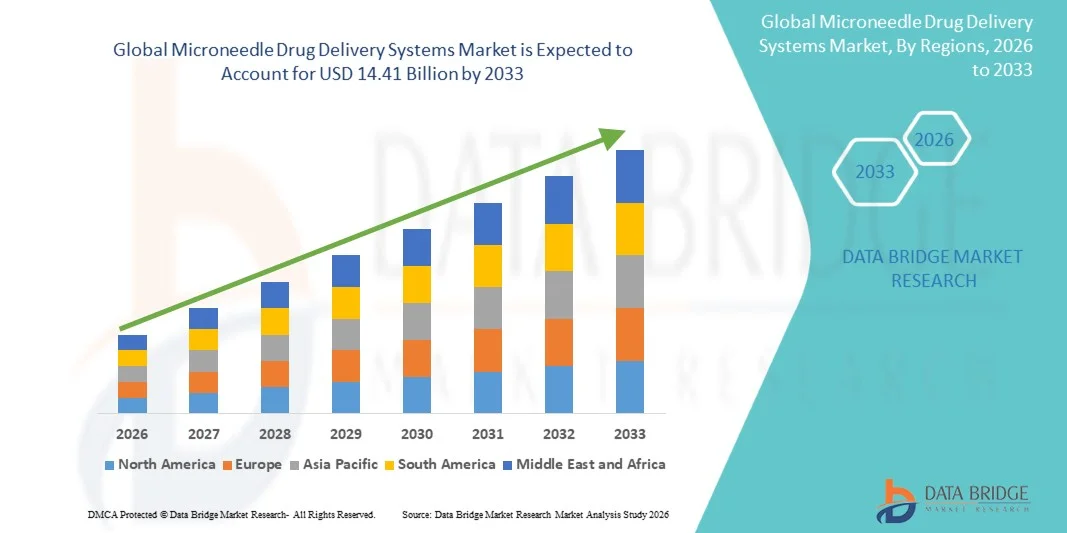
As per Data Bridge Market Research Analysis the Microneedle Drug Delivery Systems Market was valued at USD 8.02 billion in 2025 and is projected to reach USD 14.41 billion by 2033, growing at a CAGR of 7.60% from 2026 to 2033. The market is experiencing steady growth driven by increasing demand for minimally invasive drug administration, rising prevalence of chronic diseases, and continuous advancements in transdermal delivery technologies.
Market Size & Forecast
- Global Market Value (2025): USD 8.02 Billion
- Expected Market Value (2033): USD 14.41 Billion
- Forecast CAGR (2026–2033): 7.60%
The growing need for painless and patient-friendly drug delivery methods, coupled with expanding applications in vaccine delivery, biologics administration, and chronic disease management, is accelerating market adoption. Healthcare providers, pharmaceutical companies, and research institutions are increasingly investing in microneedle-based platforms to improve treatment adherence, enhance therapeutic efficacy, and reduce dependence on conventional hypodermic injections. Dissolving, coated, hollow, and hydrogel-forming microneedle technologies are gaining traction across clinical and commercial settings, offering precise, efficient, and self-administrable drug delivery solutions while supporting the development of next-generation therapeutics and vaccination programs.
What are the Major Takeaways of Microneedle Drug Delivery Systems Market?
- North America dominated the Microneedle Drug Delivery Systems Market with the largest revenue share of 36.12% in 2025, supported by strong pharmaceutical innovation, favorable regulatory pathways, and increasing adoption of advanced drug delivery technologies
- The Hollow segment led the market with a 38.46% share in 2025, driven by their superior capability to deliver precise doses of liquid formulations, vaccines, and biologics directly through the skin.
- Asia-Pacific is expected to be the fastest-growing region at a CAGR of 8.1% from 2026 to 2033, fueled by expanding healthcare infrastructure, rising chronic disease burden, and increasing investments in transdermal drug delivery research across China, India, and South Korea.
- Porous are the fastest-growing technology type, projected to register a CAGR of 8.4%, reflecting the surge in interest in sustained and controlled drug release applications.
- The Polymers segment dominated the source type category with a 42.18% revenue share in 2025, led by their excellent biocompatibility, flexibility, and cost-effective manufacturing characteristics.
- Dermatology accounted for 34.92% of the market, preferred by widespread utilization of microneedle technologies for cosmetic treatments, skin rejuvenation, scar management, and transdermal therapeutic delivery.
- The Oncology segment is the fastest-growing application category, with a CAGR of 8.9%, driven by the increasing research into localized and targeted cancer drug delivery solutions.
Report Scope and Microneedle Drug Delivery Systems Market Segmentation
|
Attributes |
Microneedle Drug Delivery Systems Key Market Insights |
|
Segments Covered |
|
|
Countries Covered |
North America
Europe
Asia-Pacific
Middle East and Africa
South America
|
|
Key Market Players |
|
|
Market Opportunities |
|
|
Value Added Data Infosets |
In addition to the insights on market scenarios such as market value, growth rate, segmentation, geographical coverage, and major players, the market reports curated by the Data Bridge Market Research also include in-depth expert analysis, patient epidemiology, pipeline analysis, pricing analysis, and regulatory framework. |
What is the Key Trend in the Microneedle Drug Delivery Systems Market?
Trend: Rising Adoption of Self-Administered Transdermal Drug Delivery
Healthcare providers and pharmaceutical companies are increasingly adopting microneedle drug delivery systems to improve patient convenience, reduce needle-related anxiety, and support self-administration outside traditional clinical settings. The integration of dissolving and hydrogel-forming microneedle technologies enables efficient delivery of vaccines, biologics, and chronic disease therapies without the discomfort associated with conventional injections. Pharmaceutical manufacturers are similarly leveraging microneedle platforms to enhance treatment adherence through simplified dosing regimens, while advances in materials science create patient-friendly systems that closely replicate the effectiveness of traditional injectable therapies.
For instance, in March 2025, researchers from King's College London reported progress in next-generation microneedle patch technologies designed to improve self-administered delivery of therapeutics and vaccines, highlighting the growing industry focus on convenient transdermal treatment solutions.
Microneedle Drug Delivery Systems Market Dynamics
Key Market Driver: Increasing Demand for Minimally Invasive Delivery of Biologics
The rapid expansion of biologics, peptides, and complex therapeutic molecules has created substantial demand for advanced microneedle systems that can deliver treatments effectively while minimizing pain and improving patient compliance. Pharmaceutical manufacturers, biotechnology companies, and healthcare organizations are deploying microneedle technologies as a core component of next-generation drug delivery strategies, reducing administration barriers, enhancing therapeutic outcomes, and supporting long-term disease management. The ability to bypass conventional injection-related challenges is further accelerating adoption across vaccine delivery, diabetes care, and specialty pharmaceutical applications.
For instance, in 2024, Becton, Dickinson and Company and multiple research collaborators continued advancing microneedle-enabled delivery approaches for biologics and high-value therapeutics, demonstrating increasing commercial interest in minimally invasive administration technologies.
Key Restraint/Challenge: Complex Manufacturing and Regulatory Approval Requirements
A significant restraint in the Microneedle Drug Delivery Systems Market is the complexity associated with large-scale manufacturing, product standardization, and regulatory approval processes. Modern microneedle platforms require specialized fabrication techniques, biocompatible materials, and stringent quality control measures, demanding substantial investment in production capabilities, validation studies, and compliance activities. The overall commercialization process extends to clinical evaluations, regulatory documentation, and long-term safety assessments, making market entry challenging for smaller developers, startups, and emerging biotechnology companies.
For instance, ongoing regulatory evaluation requirements for combination products that integrate both drug formulations and microneedle delivery devices illustrate the complexity of obtaining approvals, reflecting the broader challenge of commercializing innovative transdermal delivery technologies across global markets.
Key Market Opportunity: Expansion of Microneedle-Based Vaccine and Personalized Therapy Platforms
The integration of microneedle technologies into vaccine delivery and personalized medicine presents a significant market opportunity. Advanced platforms can enable precise dosing, improve treatment adherence, and support efficient administration of temperature-sensitive therapeutics while reducing healthcare resource requirements. The development of smart microneedle patches and next-generation transdermal systems is further expanding access to innovative drug delivery solutions, opening growth opportunities across preventive healthcare, chronic disease management, and emerging pharmaceutical markets in Asia-Pacific, Latin America, and the Middle East.
For instance, several biotechnology companies and academic institutions are actively developing microneedle vaccine patches for infectious disease prevention, demonstrating the strong commercial potential of scalable, patient-friendly transdermal delivery platforms.
How is the Microneedle Drug Delivery Systems Market Segmented?
The microneedle drug delivery systems market is segmented on the basis of technology, source type, application, and end users.
- By Technology
On the basis of technology, the Microneedle Drug Delivery Systems Market is segmented into hollow, porous, solid, and others. The Hollow Microneedles segment dominated the market with a 38.46% share in 2025, owing to their superior capability to deliver precise doses of liquid formulations, vaccines, and biologics directly through the skin. These systems offer controlled drug administration and are widely utilized in clinical and research settings. Pharmaceutical companies increasingly prefer hollow microneedles for delivering complex therapeutics that require accurate dosing and rapid absorption. Their compatibility with a broad range of drug formulations further strengthens market adoption. Continuous advancements in microfabrication technologies are improving reliability and scalability. Strong demand for efficient transdermal delivery of high-value therapeutics continues to support segment leadership.
The Porous Microneedles segment is projected to register the fastest growth at a CAGR of 8.4% from 2026 to 2033, driven by increasing interest in sustained and controlled drug release applications. These microneedles enable efficient transport of therapeutic molecules through interconnected pore structures. Growing research into advanced biomaterials and drug-loading techniques is enhancing their performance and commercial viability. They are gaining attention for vaccine delivery and chronic disease management applications. Rising demand for minimally invasive and patient-friendly delivery technologies is accelerating development activities. Expanding investments in next-generation transdermal platforms are expected to further fuel segment growth over the forecast period.
- By Source Type
On the basis of source type, the Microneedle Drug Delivery Systems Market is segmented into silicon, metals, polymers, polysaccharides, and others. The Polymers segment dominated the market with a 42.18% share in 2025, driven by their excellent biocompatibility, flexibility, and cost-effective manufacturing characteristics. Polymeric microneedles are extensively used in dissolving and biodegradable delivery systems that eliminate sharps waste concerns. Their ability to encapsulate a wide variety of drugs and vaccines makes them highly attractive for pharmaceutical applications. Increasing commercialization of self-administered microneedle patches is further supporting adoption. Continuous innovation in biodegradable materials is improving safety and therapeutic efficiency. These advantages have positioned polymers as the preferred material category across multiple healthcare applications.
The Polysaccharides segment is expected to witness the fastest growth at a CAGR of 8.7% from 2026 to 2033, supported by growing demand for natural, biodegradable, and environmentally sustainable materials. Polysaccharide-based microneedles offer favorable mechanical properties and excellent compatibility with biological tissues. Researchers are increasingly exploring materials such as hyaluronic acid and chitosan for advanced drug delivery systems. Rising emphasis on patient safety and reduced toxicity is encouraging their adoption. Expanding applications in vaccine delivery and cosmetic treatments are also contributing to market growth. Continued advancements in bio-based materials are expected to strengthen the segment's future prospects.
- By Application
On the basis of application, the Microneedle Drug Delivery Systems Market is segmented into cardiovascular, oncology, dermatology, neurology, and others. The Dermatology segment led the market with a 34.92% share in 2025, driven by widespread utilization of microneedle technologies for cosmetic treatments, skin rejuvenation, scar management, and transdermal therapeutic delivery. The increasing popularity of minimally invasive aesthetic procedures has significantly boosted demand. Microneedle-based systems improve penetration of active ingredients while minimizing patient discomfort. Growing consumer awareness regarding advanced skincare solutions is further supporting market expansion. Continuous product innovation and rising investments in dermatological research are strengthening segment growth. The segment also benefits from increasing acceptance among both healthcare professionals and consumers.
The Oncology segment is anticipated to register the fastest growth at a CAGR of 8.9% from 2026 to 2033, owing to increasing research into localized and targeted cancer drug delivery solutions. Microneedle platforms offer opportunities to improve therapeutic effectiveness while reducing systemic side effects associated with conventional treatments. Growing development of immunotherapies and biologics is creating demand for innovative administration technologies. Researchers are exploring microneedles for delivering anticancer agents directly to affected tissues. Rising global cancer prevalence is further driving investment in advanced treatment approaches. Expanding clinical studies and technological advancements are expected to accelerate adoption throughout the forecast period.
- By End Users
On the basis of end users, the Microneedle Drug Delivery Systems Market is segmented into diagnostic laboratories, life sciences and research laboratories, hospitals, ambulatory surgical centers, and others. The Hospitals segment dominated the market with a 45.37% share in 2025, supported by high patient volumes, strong clinical infrastructure, and increasing adoption of innovative drug delivery technologies. Hospitals serve as primary centers for administration of advanced therapeutics, vaccines, and specialized treatments. The availability of skilled healthcare professionals facilitates integration of emerging microneedle platforms into patient care. Growing demand for improved treatment outcomes and patient comfort is encouraging adoption. Continuous investment in healthcare modernization is further strengthening segment growth. The segment remains the largest end-user category due to its broad clinical application base.
The Life Sciences and Research Laboratories segment is projected to experience the fastest growth at a CAGR of 8.5% from 2026 to 2033, driven by expanding research activities focused on next-generation drug delivery systems. Academic institutions and biotechnology companies are investing heavily in the development and validation of innovative microneedle technologies. Increasing funding for pharmaceutical research is supporting exploration of new therapeutic applications. These laboratories play a critical role in preclinical evaluation and product optimization. Rising collaboration between industry and research organizations is accelerating technological advancements. Growing emphasis on biologics, vaccines, and personalized medicine is expected to sustain strong segment growth in the coming years.
Which Region Holds the Largest Share of the Microneedle Drug Delivery Systems Market?
North America dominated the Microneedle Drug Delivery Systems Market with the largest revenue share of 36.12% in 2025, supported by strong pharmaceutical innovation, favorable regulatory pathways, and increasing adoption of advanced drug delivery technologies. The region also benefits from increasing investments in transdermal drug delivery technologies, favorable regulatory support for novel therapeutics, and growing adoption of microneedle platforms across vaccine delivery, chronic disease management, and biologics administration applications. Rising focus on patient-centric treatment solutions and expanding development of self-administered drug delivery systems continues to strengthen North America’s leadership position in the global market.
U.S. Microneedle Drug Delivery Systems Market Insight
The U.S. microneedle drug delivery systems market is witnessing strong growth due to rising investments in advanced drug delivery technologies, increasing prevalence of chronic diseases, and expanding development of biologics and vaccines. The country’s mature pharmaceutical and biotechnology ecosystem, along with increasing adoption of minimally invasive and self-administered treatment solutions, is driving demand across clinical, research, and commercial applications. In addition, growing emphasis on patient compliance and improving therapeutic outcomes is accelerating microneedle technology adoption across healthcare providers and pharmaceutical manufacturers.
Europe Microneedle Drug Delivery Systems Market Insight
The Europe microneedle drug delivery systems market remains a major contributor to global revenue, driven by strong regulatory support, technological innovation, and high demand for advanced transdermal delivery solutions. The widespread use of microneedle technologies in vaccine delivery, dermatology, and chronic disease management programs is supporting market expansion across the region. Increasing investments in novel drug delivery platforms, coupled with growing focus on patient-centric healthcare and a highly developed healthcare infrastructure, continue to enhance the adoption of microneedle systems throughout Europe.
U.K. Microneedle Drug Delivery Systems Market Insight
The U.K. microneedle drug delivery systems market is experiencing steady growth, supported by rising adoption of innovative transdermal delivery technologies in healthcare, pharmaceutical research, and vaccine administration applications. Increasing investments in advanced microneedle development programs and growing demand for convenient, minimally invasive treatment solutions are contributing to market growth. Furthermore, integration of novel biomaterials, drug formulation technologies, and precision delivery systems is improving therapeutic efficiency, positioning the U.K. as a key innovation hub in the microneedle drug delivery systems industry.
Germany Microneedle Drug Delivery Systems Market Insight
The Germany microneedle drug delivery systems market is expanding steadily due to the country’s strong pharmaceutical manufacturing base, advanced research capabilities, and increasing adoption of next-generation drug delivery technologies. Pharmaceutical companies, biotechnology organizations, and research institutes are increasingly utilizing microneedle platforms for vaccine delivery, biologics administration, and therapeutic development activities. Continuous advancements in biomaterials, microfabrication technologies, and transdermal delivery systems, along with strong government focus on healthcare innovation, are further driving market growth in Germany.
Asia-Pacific Microneedle Drug Delivery Systems Market Insight
The Asia-Pacific microneedle drug delivery systems market is expected to witness rapid growth, driven by expanding healthcare infrastructure, increasing pharmaceutical production, and rising investments in advanced drug delivery technologies across countries such as China, India, and Japan. Growing awareness regarding patient-friendly treatment methods, rising adoption of innovative transdermal delivery platforms, and increasing demand for cost-effective healthcare solutions are supporting regional market expansion. In addition, the growing presence of biotechnology research centers and pharmaceutical manufacturing facilities is accelerating microneedle technology adoption across clinical and commercial sectors.
Japan Microneedle Drug Delivery Systems Market Insight
The Japan microneedle drug delivery systems market is witnessing consistent growth due to rising investments in advanced healthcare technologies, pharmaceutical innovation, and preventive healthcare initiatives. Pharmaceutical manufacturers, research institutions, and healthcare organizations are increasingly adopting microneedle systems for vaccine delivery, chronic disease treatment, and therapeutic research purposes. Moreover, increasing integration of advanced biomaterials and the country’s focus on efficient and patient-centric healthcare solutions are further contributing to market growth.
China Microneedle Drug Delivery Systems Market Insight
The China microneedle drug delivery systems market is growing rapidly, driven by expanding healthcare infrastructure, increasing pharmaceutical manufacturing activities, and rising government focus on innovative healthcare technologies. Growing adoption of advanced transdermal delivery platforms across pharmaceutical, biotechnology, and healthcare sectors is significantly boosting market demand. In addition, rising investments in drug development, increasing awareness regarding minimally invasive treatment approaches, and rapid technological advancements are positioning China as one of the fastest-growing markets for microneedle drug delivery systems globally.
Which are the Top Companies in Microneedle Drug Delivery Systems Market?
The microneedle drug delivery systems industry is primarily led by well-established companies, including:
- Micron Biomedical, Inc. (U.S.)
- NanoPass Technologies Ltd. (Israel)
- LTS Lohmann Therapie-Systeme AG (Germany)
- Raphas Co., Ltd. (South Korea)
- TheraJect, Inc. (U.S.)
- Microneedle Solutions Ltd (U.K.)
- QuadMedicine, Inc. (U.S.)
- Vaxess Technologies, Inc. (U.S.)
- Nemaura Medical Inc. (U.K.)
- SNvia Co., Ltd. (South Korea)
- CosMED Pharmaceutical Co., Ltd. (South Korea)
- Zhejiang Hisun Pharmaceutical Co., Ltd. (China)
- BD (U.S.)
- 3M (U.S.)
- Corium, LLC (U.S.)
- Debiotech S.A. (Switzerland)
- NanoSkin Group Ltd. (U.K.)
- Microdermics, Inc. (U.S.)
- PharmaTher Holdings Ltd. (Canada)
- Valeritas, Inc. (U.S.)
What are Latest Developments in Microneedle Drug Delivery Systems Market?
- In April 2024, Micron Biomedical reported positive clinical trial results demonstrating that its measles-rubella vaccine microarray patch achieved immune protection comparable to conventional injections. The study highlighted the potential of dissolvable microneedle patches to simplify vaccine administration, improve patient acceptance, and expand immunization access in resource-limited settings
- In December 2024, Medicus Pharma Ltd. announced that the U.S. FDA granted Minor Use in Major Species (MUMS) designation for its Doxorubicin-Containing Microneedle Array (D-MNA) Patch for the treatment of external squamous cell carcinoma in horses. The designation provides regulatory incentives and supports further development of dissolvable microneedle-based therapeutic delivery platforms, highlighting the growing acceptance of microneedle technologies in advanced drug delivery applications
- In December 2023, LTS Lohmann Therapie-Systeme AG received a USD 4.3 million grant from the Gates Foundation to support the development of contraceptive Microneedle Array Patches (MAPs). The project focuses on self-administered contraceptive delivery solutions for women in low- and middle-income countries, demonstrating the expanding role of microneedle technology in long-acting and patient-friendly drug delivery systems
- In December 2023, LTS Lohmann Therapie-Systeme AG announced the receipt of a USD 1.2 million Gates Foundation grant to develop thermostable mRNA formulations for dissolvable microneedle array patches. The initiative aims to improve the storage stability and accessibility of mRNA-based vaccines, particularly in regions with limited cold-chain infrastructure, reinforcing the growing importance of microneedle platforms in vaccine delivery
- In December 2023, Emergex Vaccines Holding Ltd. announced that the U.S. FDA acknowledged the transfer of ownership of Zosano Pharma’s Microneedle Array Patch (MAP) epidermal drug delivery platform to Emergex. The company also received acknowledgment of its request for an NDA extension, enabling continued development of microneedle-based delivery systems for vaccine and therapeutic applications

- Interactive Data Analysis Dashboard
- Company Analysis Dashboard for high growth potential opportunities
- Research Analyst Access for customization & queries
- Competitor Analysis with Interactive dashboard
- Latest News, Updates & Trend analysis
- Harness the Power of Benchmark Analysis for Comprehensive Competitor Tracking
Data collection and base year analysis are done using data collection modules with large sample sizes. The stage includes obtaining market information or related data through various sources and strategies. It includes examining and planning all the data acquired from the past in advance. It likewise envelops the examination of information inconsistencies seen across different information sources. The market data is analysed and estimated using market statistical and coherent models. Also, market share analysis and key trend analysis are the major success factors in the market report. To know more, please request an analyst call or drop down your inquiry.
The key research methodology used by DBMR research team is data triangulation which involves data mining, analysis of the impact of data variables on the market and primary (industry expert) validation. Data models include Vendor Positioning Grid, Market Time Line Analysis, Market Overview and Guide, Company Positioning Grid, Patent Analysis, Pricing Analysis, Company Market Share Analysis, Standards of Measurement, Global versus Regional and Vendor Share Analysis. To know more about the research methodology, drop in an inquiry to speak to our industry experts.
Data Bridge Market Research is a leader in advanced formative research. We take pride in servicing our existing and new customers with data and analysis that match and suits their goal. The report can be customized to include price trend analysis of target brands understanding the market for additional countries (ask for the list of countries), clinical trial results data, literature review, refurbished market and product base analysis. Market analysis of target competitors can be analyzed from technology-based analysis to market portfolio strategies. We can add as many competitors that you require data about in the format and data style you are looking for. Our team of analysts can also provide you data in crude raw excel files pivot tables (Fact book) or can assist you in creating presentations from the data sets available in the report.













