


What is the Midstream Oil and Gas Filtration Market Size and Growth Rate?
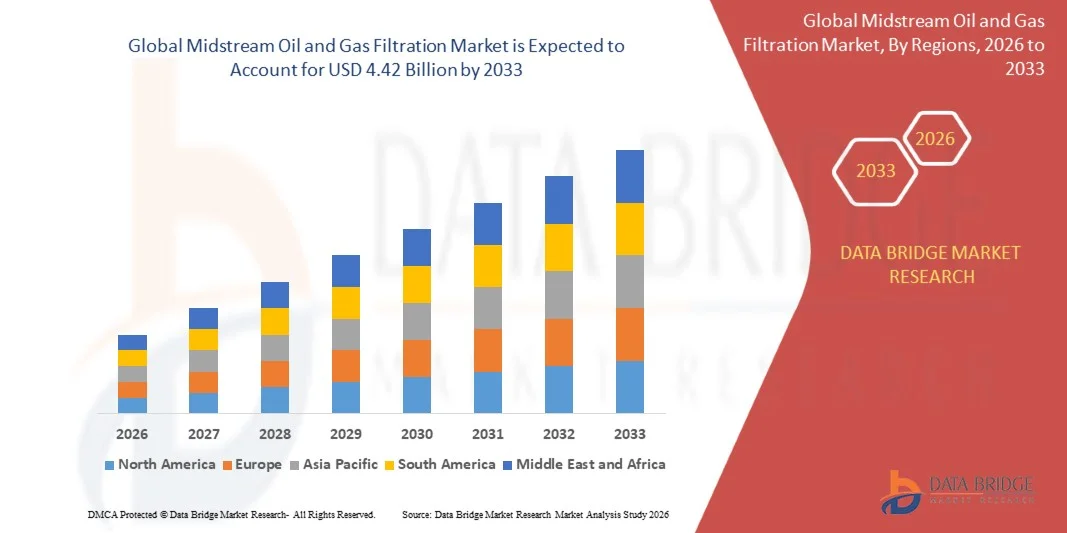
- As per Data Bridge Market Research analysis the midstream oil and gas filtration market was valued at USD 2.80 billion in 2025 and is projected to reach USD 4.42 billion by 2033, growing at a CAGR of 5.90% from 2026 to 2033.
- The market is experiencing consistent growth driven by rising investments in oil and gas transportation infrastructure, increasing demand for efficient filtration in pipelines and processing facilities, and growing emphasis on protecting midstream equipment from contaminants and operational damage.
- The expansion of pipeline networks, compression stations, storage facilities, and LNG infrastructure, combined with stricter requirements for operational efficiency and equipment reliability, is compelling midstream operators to adopt advanced filtration technologies for oil and gas processing and transportation.
Market Size & Forecast
- Global Market Value (2025): USD 2.80 Billion
- Expected Market Value (2033): USD 4.42 Billion
- Forecast CAGR (2026–2033): 5.90%
- Leading Region in 2025: North America
- Fastest Growing Region: Asia-Pacific
What are the Major Takeaways of the Midstream Oil and Gas Filtration Market?
- North America dominated the midstream oil and gas filtration market with the largest revenue share in 2025, supported by extensive pipeline networks, expanding natural gas processing infrastructure, and increasing investments in LNG-related transportation systems.
- Asia-Pacific midstream oil and gas filtration market is expected to witness the fastest growth rate from 2026 to 2033, supported by increasing energy demand, expanding natural gas pipeline networks, LNG infrastructure development, and investments in gas processing facilities.
- The coalescer filter segment held the largest market revenue share in 2025, driven by its widespread use in gas pipelines, gas processing, glycol dehydration, and compressor protection applications. Coalescer filters are preferred for their ability to efficiently remove liquid aerosols, hydrocarbons, and fine particulate contaminants from gas streams, helping improve equipment reliability and downstream process performance.
- The coalescer filter segment is also projected to register the fastest growth during 2026 to 2033, supported by increasing requirements for high-efficiency liquid and gas separation across expanding natural gas transportation and processing infrastructure. Rising adoption of advanced coalescing technologies for compressor protection, pipeline transportation, and dehydration systems is accelerating segment expansion.
- The metallic segment held the largest market revenue share in 2025, driven by its high mechanical strength, durability, temperature resistance, and suitability for demanding oil and gas filtration environments. Metallic media are widely utilized in applications requiring robust particulate removal and long service life under high-pressure operating conditions.
- The synthetic polymer segment is projected to register the fastest growth from 2026 to 2033, driven by increasing adoption of lightweight, high-efficiency filtration media capable of achieving fine contaminant removal. Advancements in polymer membrane and filter-media technologies are supporting their use across gas processing, pipeline transportation, and liquid filtration applications.
Report Scope and Midstream Oil and Gas Filtration Market Segmentation
|
Attributes |
Midstream Oil and Gas Filtration Key Market Insights |
|
Segments Covered |
|
|
Countries Covered |
North America
Europe
Asia-Pacific
Middle East and Africa
South America
|
|
Key Market Players |
|
|
Market Opportunities |
|
|
Value Added Data Infosets |
In addition to the insights on market scenarios such as market value, growth rate, segmentation, geographical coverage, and major players, the market reports curated by the Data Bridge Market Research also include import export analysis, production capacity overview, production consumption analysis, price trend analysis, climate change scenario, supply chain analysis, value chain analysis, raw material/consumables overview, vendor selection criteria, PESTLE Analysis, Porter Analysis, and regulatory framework. |
What is the Key Trend in the Midstream Oil and Gas Filtration Market?
- Midstream oil and gas operators are increasingly adopting high-efficiency filtration and separation systems to protect pipelines, compressors, processing equipment, and downstream assets from solids, liquids, aerosols, and other contaminants while improving operational reliability.
- For instance, in February 2026, Pall Corporation launched the SepraSol Plus Horizontal Liquid/Gas Coalescer and High Flow Gas filtration solution, designed to provide high-performance filtration for large-flow process gas streams while reducing vessel size, capital expenditure, and lifecycle operating costs.
- Advanced coalescer and particulate filtration technologies are increasingly being deployed for gas transmission, glycol dehydration, condensate pipeline dewatering, and black powder removal to minimize corrosion, fouling, equipment wear, and unplanned maintenance.
- Midstream operators are also focusing on filtration solutions capable of handling higher flow rates and demanding contamination loads while maintaining longer service intervals and consistent separation performance.
- For instance, Pall's midstream filtration portfolio includes liquid/gas coalescers, liquid/liquid coalescers, and high-flow particulate filters designed for pipeline transportation, gas processing, NGL purification, and LNG-related applications.
- As pipeline networks and gas processing infrastructure continue to prioritize equipment protection, throughput, and operating efficiency, demand for advanced filtration and separation technologies is expected to increase across midstream oil and gas operations.
What are the Key Drivers of the Midstream Oil and Gas Filtration Market?
- Increasing investments in natural gas pipelines, gas processing facilities, LNG infrastructure, and hydrocarbon transportation networks are significantly increasing demand for filtration systems that protect critical midstream equipment and maintain the quality of transported fluids.
- For instance, Pall identifies pipeline transportation, gas processing, glycol dehydration, condensate stabilization, NGL separation, and LNG processing among the midstream applications requiring filtration and separation to remove contaminants and protect downstream equipment.
- The growing need to reduce pipeline corrosion, compressor fouling, equipment downtime, and maintenance costs is encouraging operators to install high-efficiency coalescers and particulate filters throughout midstream processing and transportation systems.
- For instance, Pall reports that its SepraSol Plus and Medallion HP liquid/gas coalescers can provide 99.999% removal at 0.3 microns in glycol dehydration applications, helping protect dehydration systems from hydrocarbon aerosols and fine solids.
- With midstream operators increasingly prioritizing asset reliability, pipeline integrity, process efficiency, and contamination control, advanced filtration technologies will remain essential for supporting safe and efficient oil and gas transportation and processing.
Which Factors are Challenging the Growth of the Midstream Oil and Gas Filtration Market?
- Advanced midstream filtration systems can require significant capital investment because of the need for specialized coalescers, high-flow filter vessels, filtration media, monitoring systems, and customized equipment for demanding oil and gas operating conditions.
- These investment requirements can limit adoption among smaller operators and projects with constrained capital budgets, particularly when filtration systems must be integrated into existing pipeline and processing infrastructure.
- For instance, in February 2026, Pall Corporation stated that capital constraints across the oil and gas industry were increasing pressure on operators to achieve higher throughput while minimizing capital investment, prompting the company to introduce filtration solutions designed to reduce vessel size and lifecycle operating costs.
- In addition, filtration systems require regular maintenance and replacement of filter elements, while complex contamination profiles such as black powder, water, corrosion products, and fine aerosols can increase operating requirements. Pall notes that contaminants can contribute to compressor fouling, blocked meters, contaminated control valves, and pipeline wall buildup when not effectively removed.
- The high initial investment, maintenance requirements, and need for application-specific filtration technologies continue to challenge market expansion, particularly among cost-sensitive operators and projects where capital expenditure and operating costs are tightly controlled.
How is the Midstream Oil and Gas Filtration Market Segmented?
The market is segmented on the basis of filter technology, filter media, application, and filtration phase.
- By Filter Technology
On the basis of filter technology, the midstream oil and gas filtration market is segmented into coalescer filter, cartridge filter, and mechanical filter. The coalescer filter segment held the largest market revenue share in 2025, driven by its widespread use in gas pipelines, gas processing, glycol dehydration, and compressor protection applications. Coalescer filters are preferred for their ability to efficiently remove liquid aerosols, hydrocarbons, and fine particulate contaminants from gas streams, helping improve equipment reliability and downstream process performance.
The coalescer filter segment is also projected to register the fastest growth during 2026 to 2033, supported by increasing requirements for high-efficiency liquid and gas separation across expanding natural gas transportation and processing infrastructure. Rising adoption of advanced coalescing technologies for compressor protection, pipeline transportation, and dehydration systems is accelerating segment expansion.
- By Filter Media
On the basis of filter media, the midstream oil and gas filtration market is segmented into activated carbon, metallic, and synthetic polymer. The metallic segment held the largest market revenue share in 2025, driven by its high mechanical strength, durability, temperature resistance, and suitability for demanding oil and gas filtration environments. Metallic media are widely utilized in applications requiring robust particulate removal and long service life under high-pressure operating conditions.
The synthetic polymer segment is projected to register the fastest growth from 2026 to 2033, driven by increasing adoption of lightweight, high-efficiency filtration media capable of achieving fine contaminant removal. Advancements in polymer membrane and filter-media technologies are supporting their use across gas processing, pipeline transportation, and liquid filtration applications.
- By Application
On the basis of application, the midstream oil and gas filtration market is segmented into gas processing plants, compression stations, storage and distribution, pipeline transportation, LNG processing, and others. The pipeline transportation segment held the largest market revenue share in 2025, driven by the extensive use of filtration systems for removing solids, liquids, black powder, corrosion products, and other contaminants from transported hydrocarbons. Pipeline filtration helps protect compressors, meters, valves, and other critical equipment while supporting reliable transportation operations.
The LNG processing segment is projected to register the fastest growth from 2026 to 2033, supported by increasing investments in LNG liquefaction, storage, and transportation infrastructure. The growing requirement for high-purity gas streams and protection of cryogenic equipment is increasing demand for advanced filtration and separation systems in LNG facilities.
- By Filtration Phase
On the basis of filtration phase, the midstream oil and gas filtration market is segmented into oil filtration and gas filtration. The gas filtration segment held the largest market revenue share in 2025, driven by increasing natural gas transportation, processing, compression, and dehydration activities. Gas filtration systems are essential for removing liquid aerosols, solids, hydrocarbons, and other contaminants that can cause compressor fouling, corrosion, valve damage, and pipeline operational issues.
The gas filtration segment is projected to register the fastest growth from 2026 to 2033, supported by expanding natural gas infrastructure, LNG development, and rising demand for efficient gas processing and transportation. Increasing deployment of high-efficiency coalescers and particulate filtration technologies for compressor protection and gas dehydration is further accelerating segment expansion.
Which Region Holds the Largest Share of the Midstream Oil and Gas Filtration Market?
- North America dominated the midstream oil and gas filtration market with the largest revenue share in 2025, supported by extensive pipeline networks, expanding natural gas processing infrastructure, and increasing investments in LNG-related transportation systems.
- The region's established oil and gas infrastructure generates continuous demand for filtration systems that remove solids, water, corrosion products, condensates, and other contaminants to protect pipelines, compressors, and processing equipment. In the U.S., approximately 6.3 billion cubic feet per day of new natural gas pipeline capacity was completed in 2025, with 85% dedicated to the South Central region, highlighting continued expansion of midstream infrastructure.
U.S. Midstream Oil and Gas Filtration Market Insight
U.S. midstream oil and gas filtration market captured the largest revenue share in North America in 2025, fueled by extensive natural gas production, pipeline expansion, LNG exports, and investments in gas processing and compression infrastructure. The increasing movement of natural gas from producing regions toward Gulf Coast LNG terminals is creating demand for advanced filtration and separation systems to maintain pipeline-quality gas and protect critical equipment. For instance, U.S. natural gas pipeline projects completed in 2025 added approximately 6.3 Bcf/d of capacity, while new gathering projects in Louisiana connected Haynesville production with the wider transmission network. ([U.S. Energy Information Administration][1])
Europe Midstream Oil and Gas Filtration Market Insight
Europe midstream oil and gas filtration market is expected to witness significant growth from 2026 to 2033, driven by investments in gas transportation, storage, LNG infrastructure, and modernization of existing energy networks. The region's emphasis on energy security and reliable gas supply is encouraging operators to improve pipeline and processing infrastructure, increasing demand for filtration systems that support equipment protection, gas quality, and operational reliability. The need to maintain aging pipeline infrastructure while developing alternative gas supply routes is further supporting the adoption of advanced filtration technologies.
U.K. Midstream Oil and Gas Filtration Market Insight
U.K. midstream oil and gas filtration market is expected to witness strong growth from 2026 to 2033, supported by the country's extensive gas transmission and storage infrastructure and continued importance of LNG and natural gas in the energy system. Increasing requirements for pipeline integrity, contamination control, and efficient gas transportation are encouraging the deployment of filtration and separation systems across processing, compression, and storage facilities. The modernization of existing infrastructure is also expected to create opportunities for replacement and retrofit filtration systems.
Germany Midstream Oil and Gas Filtration Market Insight
Germany midstream oil and gas filtration market is expected to witness significant growth from 2026 to 2033, fueled by investments in gas storage, LNG import infrastructure, and modernization of energy transportation networks. Germany's position as a major European gas market and its development of LNG receiving infrastructure are increasing requirements for reliable gas processing, transportation, and contamination control. Filtration systems are increasingly important for removing particulates, liquids, and other contaminants and protecting compressors, pipelines, valves, and downstream equipment.
Asia-Pacific Midstream Oil and Gas Filtration Market Insight
The Asia-Pacific midstream oil and gas filtration market is expected to witness the fastest growth rate from 2026 to 2033, supported by increasing energy demand, expanding natural gas pipeline networks, LNG infrastructure development, and investments in gas processing facilities. China, India, Japan, Australia, and other regional markets are expanding gas transportation and storage infrastructure to meet rising energy requirements. The increasing development of pipelines, processing plants, LNG terminals, and compression facilities is creating demand for advanced filtration systems that improve equipment protection and operational efficiency.
Japan Midstream Oil and Gas Filtration Market Insight
Japan midstream oil and gas filtration market is expected to witness strong growth from 2026 to 2033, driven by the country's dependence on imported LNG, extensive LNG receiving infrastructure, and emphasis on reliable energy supply. The increasing need to maintain high operational standards across LNG terminals, storage facilities, pipelines, and gas processing systems is supporting demand for advanced filtration and separation technologies. Filtration systems that protect critical equipment from particulate and liquid contamination are particularly important for maintaining reliable LNG and natural gas operations.
China Midstream Oil and Gas Filtration Market Insight
China midstream oil and gas filtration market is expected to account for a significant revenue share in Asia-Pacific in 2025, attributed to rapid expansion of natural gas consumption, pipeline infrastructure, gas processing capacity, and LNG facilities. The country's growing pipeline network and investment in natural gas transportation are increasing demand for filtration technologies that remove contaminants and protect compressors, valves, meters, and pipelines. China's continued expansion of gas infrastructure is expected to create sustained opportunities for coalescers, cartridge filters, mechanical filters, and other advanced filtration systems.
Which are the Top Companies in Midstream Oil and Gas Filtration Market?
The midstream oil and gas filtration industry is primarily led by well-established companies, including:
- Pall Corporation (U.S.)
- Jonell Systems (U.S.)
- Parker Hannifin Corporation (U.S.)
- Eaton Corporation plc (Ireland)
- Pentair plc (U.S.)
- Graver Technologies, LLC (U.S.)
- 3M Company (U.S.)
- CECO Environmental Corp. (U.S.)
- FTC Filters (U.S.)
- Clark-Reliance Corporation (U.S.)
- Hilliard Corporation (U.S.)
- EnerWells (U.S.)
- Saifilter (China)
- TM Filtration (U.S.)
- Donaldson Company, Inc. (U.S.)
What are Latest Developments in Midstream Oil and Gas Filtration Market?
- In February 2026, Pall Corporation launched its SepraSol Plus Horizontal Liquid/Gas Coalescer and High Flow Gas filtration solution for large-flow process gas streams. The new systems are designed to provide high-performance liquid and gas filtration using smaller vessels and optimized filter-element configurations, helping midstream operators reduce capital and lifecycle operating costs.
- In July 2025, Eaton introduced its TOPCART HF filter cartridge housings for demanding high-flow industrial applications, including oil and gas. The systems accommodate high-performance filter cartridges and are designed to provide efficient filtration at high flow rates, supporting applications where conventional cartridge systems would require larger numbers of filters.
- In 2025, Jonell Systems highlighted the implementation of stricter fuel-gas filtration requirements under the upcoming API 560 standard. The proposed Annex Q specifies coalescer performance requiring removal of 99.98 wt% of solid particulates and liquid aerosols at particle sizes of 0.3 microns or larger, increasing the emphasis on high-efficiency filtration in oil and gas operations.
- In February 2025, Pall Corporation and MTR Carbon Capture announced a collaboration integrating Pall's flue-gas filtration and coalescer technologies with MTR's Polaris membrane system. The partnership is focused on developing modular and scalable carbon-capture solutions, expanding the role of advanced filtration and separation technologies in emissions-management applications associated with energy infrastructure.
- In November 2025, Parker Hannifin announced an agreement to acquire Filtration Group Corporation for USD 9.25 billion, significantly expanding Parker's filtration portfolio and aftermarket capabilities. The transaction is expected to create one of the largest global industrial filtration businesses, strengthening consolidation and technology capabilities across filtration applications.

- Interactive Data Analysis Dashboard
- Company Analysis Dashboard for high growth potential opportunities
- Research Analyst Access for customization & queries
- Competitor Analysis with Interactive dashboard
- Latest News, Updates & Trend analysis
- Harness the Power of Benchmark Analysis for Comprehensive Competitor Tracking
Global Midstream Oil And Gas Filtration Market, Supply Chain Analysis and Ecosystem Framework
To support market growth and help clients navigate the impact of geopolitical shifts, DBMR has integrated in-depth supply chain analysis into its Global Midstream Oil And Gas Filtration Market research reports. This addition empowers clients to respond effectively to global changes affecting their industries. The supply chain analysis section includes detailed insights such as Global Midstream Oil And Gas Filtration Market consumption and production by country, price trend analysis, the impact of tariffs and geopolitical developments, and import and export trends by country and HSN code. It also highlights major suppliers with data on production capacity and company profiles, as well as key importers and exporters. In addition to research, DBMR offers specialized supply chain consulting services backed by over a decade of experience, providing solutions like supplier discovery, supplier risk assessment, price trend analysis, impact evaluation of inflation and trade route changes, and comprehensive market trend analysis.
Data collection and base year analysis are done using data collection modules with large sample sizes. The stage includes obtaining market information or related data through various sources and strategies. It includes examining and planning all the data acquired from the past in advance. It likewise envelops the examination of information inconsistencies seen across different information sources. The market data is analysed and estimated using market statistical and coherent models. Also, market share analysis and key trend analysis are the major success factors in the market report. To know more, please request an analyst call or drop down your inquiry.
The key research methodology used by DBMR research team is data triangulation which involves data mining, analysis of the impact of data variables on the market and primary (industry expert) validation. Data models include Vendor Positioning Grid, Market Time Line Analysis, Market Overview and Guide, Company Positioning Grid, Patent Analysis, Pricing Analysis, Company Market Share Analysis, Standards of Measurement, Global versus Regional and Vendor Share Analysis. To know more about the research methodology, drop in an inquiry to speak to our industry experts.
Data Bridge Market Research is a leader in advanced formative research. We take pride in servicing our existing and new customers with data and analysis that match and suits their goal. The report can be customized to include price trend analysis of target brands understanding the market for additional countries (ask for the list of countries), clinical trial results data, literature review, refurbished market and product base analysis. Market analysis of target competitors can be analyzed from technology-based analysis to market portfolio strategies. We can add as many competitors that you require data about in the format and data style you are looking for. Our team of analysts can also provide you data in crude raw excel files pivot tables (Fact book) or can assist you in creating presentations from the data sets available in the report.













