


What is the Military Composite Materials Market Size and Growth Rate?
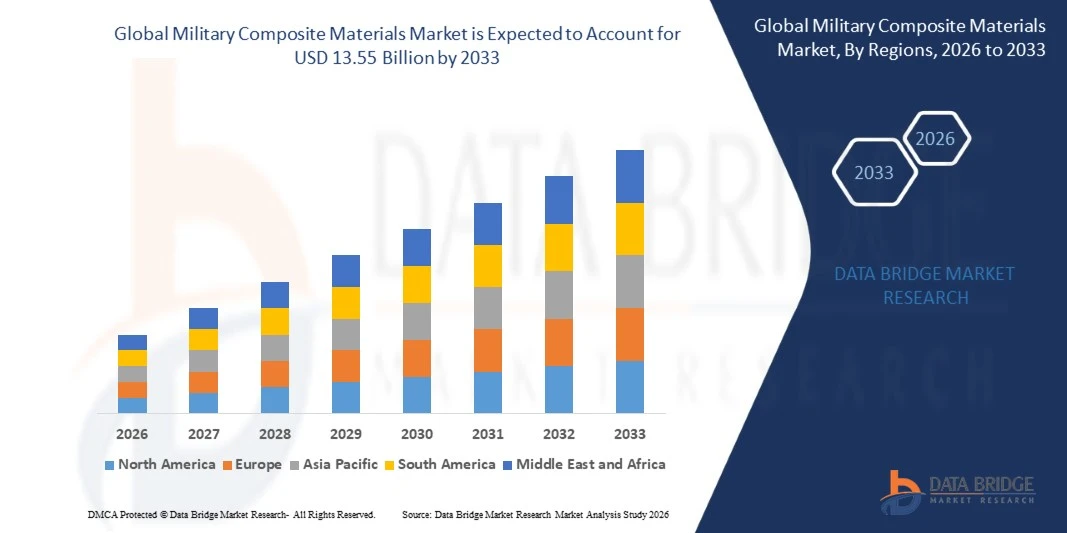
- As per Data Bridge Market Research analysis, the military composite materials market was valued at USD 8.63 Billion in 2025 and is projected to reach USD 13.55 Billion by 2033, growing at a CAGR of 5.80% from 2026 to 2033.
- The market is expanding due to increasing demand for lightweight and high-strength materials in military platforms, rising defense spending, growing modernization of aircraft and naval systems, and increasing adoption of advanced materials to improve fuel efficiency, durability, ballistic protection, and operational performance across defense applications.
- Military composite materials combine high strength-to-weight ratios, corrosion resistance, thermal stability, and enhanced durability, enabling their use across military aircraft, naval vessels, armored vehicles, missiles, unmanned systems, and protective equipment. Their adoption is increasing as defense manufacturers integrate advanced composites, carbon fiber, glass fiber, aramid fiber, and other high-performance materials into next-generation military platforms to reduce weight, enhance survivability, and improve mission performance.
Market Size & Forecast
- Global Market Value (2025): USD 8.63 Billion
- Expected Market Value (2033): USD 13.55 Billion
- Forecast CAGR (2026–2033): 5.80%
- Leading Region in 2025: North America
- Fastest Growing Region: Asia-Pacific
What are the Major Takeaways of the Military Composite Materials Market?
- North America dominated the global military composite materials market with the largest revenue share of 55.1% in 2025, supported by high defense expenditure, the strong presence of major aerospace and defense OEMs, and continuous investments in advanced military platforms and high-performance material technologies.
- Asia-Pacific is expected to be the fastest-growing region, registering a CAGR of 7.0% from 2026 to 2033, driven by increasing defense modernization programs, rising military aircraft procurement, expanding indigenous aerospace manufacturing capabilities, and growing investments in advanced defense technologies across China, India, Japan, and South Korea.
- The Carbon Fiber Composites segment dominated the fiber type category with a market share of 48.5% in 2025, supported by its high strength-to-weight ratio, stiffness, fatigue resistance, and extensive use in military aircraft, UAVs, missile structures, and naval platforms.
- The Thermoset Composites segment dominated the resin type category with a revenue share of 62.0% in 2025, owing to its established use in military aircraft structures, naval systems, armored platforms, and other demanding defense applications.
- the lay-up process segment accounted for the largest share of the manufacturing process category, with a market share of 38.5% in 2025, supported by its flexibility in producing large and complex composite structures for military aircraft, helicopters, naval platforms, and defense equipment.
- The military aircraft segment dominated the application category with a share of 32.8% in 2025, supported by extensive utilization of composites in aircraft fuselage structures, wings, control surfaces, engine components, and other lightweight structural applications.
- The defense OEMs segment dominated the end user category with an market share of 58.0% in 2025, supported by increasing procurement of advanced military aircraft, naval vessels, armored vehicles, missile systems, and UAVs.
Report Scope and Military Composite Materials Market Segmentation
|
Attributes |
Military Composite Materials Key Market Insights |
|
Segments Covered |
|
|
Countries Covered |
North America
Europe
Asia-Pacific
Middle East and Africa
South America
|
|
Key Market Players |
|
|
Market Opportunities |
|
|
Value Added Data Infosets |
In addition to the market insights such as market value, growth rate, market segments, geographical coverage, market players, and market scenario, the market report curated by the Data Bridge Market Research team includes in-depth expert analysis, import/export analysis, pricing analysis, production consumption analysis, and pestle analysis. |
What is the Key Trend in the Military Composite Materials Market?
- Increasing adoption of advanced lightweight composite materials is becoming a major trend in the Military Composite Materials market, as defense manufacturers increasingly seek to reduce the weight of aircraft, UAVs, missiles, vehicles, and protective equipment while maintaining structural strength and durability. Carbon fiber composites, aramid composites, and other high-performance materials are increasingly used to improve payload capacity, fuel efficiency, range, maneuverability, and operational endurance.
- Stealth and radar-absorbing composite materials are gaining importance, particularly as military forces develop fifth- and sixth-generation aircraft and advanced missile systems. Composite materials can contribute to reduced radar signatures while also providing structural lightweighting.
- For instacne, In June 2025, Continuous composites received a U.S. Army SBIR phase two contract with aurora flight sciences to develop next-generation fuselage structures for launched-effect systems using its cf3d composite manufacturing technology, demonstrating increasing defense interest in advanced composite manufacturing.
- Overall, the military composite materials market is increasingly shaped by lightweighting, stealth requirements, high-temperature performance, unmanned systems, advanced manufacturing, ballistic protection, and supply-chain localization. Defense manufacturers are therefore moving beyond the conventional use of composites for weight reduction and increasingly adopting engineered composite systems that provide multiple performance advantages, including radar signature reduction, thermal resistance, impact protection, structural durability, and improved platform endurance.
What are the Key Drivers of the Military Composite Materials Market?
- Increasing demand for lightweight and high-strength materials in next-generation military platforms is a major driver of the global military composite materials market. Defense manufacturers are increasingly incorporating carbon fiber, glass fiber, aramid, ceramic matrix, and other advanced composites into aircraft, UAVs, missiles, military vehicles, and naval platforms.
- For instance, in January 2025, the Defence Research and Development Organisation (DRDO) highlighted the strategic importance of composite materials for fifth-generation fighter aircraft, hypersonic missiles, and protective equipment. DRDO stated that composites account for around 45% of the Tejas aircraft's airframe by weight and around 90% of its visible surface area, demonstrating the importance of composites in modern military aircraft.
- Growing requirements for stealth and radar signature reduction are further driving the adoption of advanced composite materials. Composites can be engineered for specific electromagnetic, structural, and thermal characteristics, making them increasingly relevant for stealth aircraft, missiles, UAVs, and other platforms where reduced detectability and high structural performance are required.
- Overall, the global military composite materials market is increasingly shaped by defense modernization, platform lightweighting, stealth requirements, UAV and missile development, hypersonic technologies, advanced manufacturing, and supply-chain localization. Military organizations and defense OEMs are therefore increasing their focus on materials that provide high strength-to-weight ratios, thermal resistance, durability, radar-signature management, and manufacturing flexibility.
What Factors are Challenging the Growth of the Military Composite Materials Market?
- High manufacturing and material costs are a major challenge in the military composite materials market, as advanced carbon fiber, aramid fiber, ceramic matrix composites, specialized resins, and prepreg materials require expensive raw materials, tooling, controlled processing environments, and skilled labor. The overall cost is further increased by inspection, certification, scrap, rework, and lifecycle maintenance requirements.
- Complex qualification, testing, and certification requirements are limiting the rapid adoption of advanced military composites, particularly for safety-critical aircraft, missile, propulsion, and structural applications. Composite materials require extensive testing to understand damage initiation, damage propagation, fatigue behavior, and long-term structural performance.
- For instance, in June 2026, Hexcel highlighted the importance of sovereign composite solutions for defense applications across aircraft, rotorcraft, missiles, drones, and other military systems, reflecting the growing emphasis on secure domestic and regional supply chains.
- Overall, the military composite materials market is challenged by high material and processing costs, complex certification requirements, limited skilled manufacturing capabilities, supply-chain concentration, testing infrastructure gaps, difficult damage assessment, and challenges in scaling production. At the same time, defense organizations are investing in automated manufacturing, digital engineering, advanced testing, sovereign material supply chains, and next-generation composite technologies to overcome these barriers. Recent developments in aircraft structural testing, ceramic matrix composite manufacturing, and high-rate drone production demonstrate the industry's movement toward scalable and domestically controlled composite manufacturing capabilities.
How is the Military Composite Materials Market Segmented?
The global military composite materials market is segmented on the basis of fiber type, resin type, manufacturing process, application, and end user.
- By Fiber Type
On the basis of fiber type, the global military composite materials market is segmented into carbon fiber composites, glass fiber composites, aramid fiber composites, ceramic matrix composites, boron fiber composites, and others. The carbon fiber composites segment dominated the market with an 48.5% share in 2025, driven by its high strength-to-weight ratio, stiffness, fatigue resistance, corrosion resistance, and extensive utilization in military aircraft, UAVs, missile systems, and other lightweight defense platforms.
The ceramic matrix composites segment is projected to register the fastest growth at an CAGR of 8.2% from 2026 to 2033, supported by increasing demand for high-temperature and lightweight materials in advanced propulsion systems, hypersonic platforms, next-generation fighter aircraft, and other high-performance military applications. Growing investments in advanced aerospace materials are further supporting the development of ceramic-based composite technologies.
- By Resin Type
On the basis of resin type, the global military composite materials market is segmented into thermoset composites, thermoplastic composites, and ceramic matrix composites. The thermoset composites segment dominated the market with an 62.0% share in 2025, supported by its established use in military aircraft, helicopters, naval vessels, armored vehicles, and other structural defense applications. Thermoset materials provide high structural strength, dimensional stability, chemical resistance, and established manufacturing compatibility.
The thermoplastic composites segment is projected to register the fastest growth at an CAGR of 7.1% from 2026 to 2033, driven by shorter processing cycles, high impact resistance, weldability, recyclability, and increasing adoption of automated manufacturing technologies. The growing requirement for lightweight and rapidly manufacturable components is further supporting the adoption of thermoplastic composite materials.
- By Manufacturing Process
On the basis of manufacturing process, the global military composite materials market is segmented into Lay-up Process, Filament Winding, Resin Transfer Molding (RTM), Compression Molding, Pultrusion, Injection Molding, and Others. The Lay-up Process segment dominated the market with an 38.5% share in 2025, owing to its flexibility, suitability for complex geometries, and extensive application in large structural components used in military aircraft, helicopters, naval vessels, and defense platforms.
The resin transfer molding (RTM) segment is projected to register the fastest growth at an CAGR of 7.4% from 2026 to 2033, supported by increasing demand for repeatable and cost-efficient production of complex composite components. RTM enables improved dimensional consistency, reduced material waste, and greater process automation, making it increasingly suitable for defense applications requiring consistent component quality.
- By Application
On the basis of application, the global military composite materials market is segmented into military aircraft, helicopters, unmanned aerial vehicles (UAVs), military vehicles, naval vessels, body armor & personal protection, weapons & ammunition, missile systems, military shelters, and others. The military aircraft segment dominated the market with an 32.8% share in 2025, driven by the extensive utilization of composite materials in aircraft wings, fuselage structures, control surfaces, engine components, and other lightweight structural applications.
The unmanned aerial vehicles (UAVs) segment is projected to register the fastest growth at an CAGR of 8.5% from 2026 to 2033, supported by increasing procurement of military drones, growing adoption of intelligence, surveillance and reconnaissance systems, and rising demand for lightweight structures that improve UAV endurance, maneuverability, payload capacity, and operational efficiency.
- By End User
On the basis of end user, the global military composite materials market is segmented into defense OEMs, military organizations, and maintenance, repair & overhaul (MRO). the defense OEMs segment dominated the market with an 58.0% share in 2025, supported by increasing production of military aircraft, helicopters, UAVs, naval vessels, armored vehicles, missile systems, and other advanced defense platforms. The integration of composite materials during original equipment manufacturing enables defense manufacturers to reduce structural weight while improving durability, performance, and operational efficiency.
The maintenance, repair & overhaul (MRO) segment is projected to register the fastest growth at an CAGR of 7.3% from 2026 to 2033, driven by the expanding installed base of composite-intensive military platforms, fleet modernization programs, lifecycle-extension initiatives, and increasing demand for specialized composite inspection, repair, and maintenance capabilities.
Which Region Holds the Largest Share of the Military Composite Materials Market?
- North America accounted for the largest share of the global military composite materials market, with a 55.1% revenue share in 2025, supported by high defense spending, strong aerospace and defense manufacturing capabilities, the presence of leading military aircraft and defense equipment manufacturers, and increasing adoption of advanced composite materials across military platforms.
- The region also benefits from significant investments in next-generation military aircraft, unmanned aerial vehicles (UAVs), helicopters, naval vessels, armored vehicles, and personal protection systems. Increasing demand for lightweight, high-strength, corrosion-resistant, and radar-signature-reducing materials is further supporting the use of carbon fiber composites, aramid fiber composites, ceramic matrix composites, and other advanced materials across defense applications.
U.S. Military Composite Materials Market Insight
The U.S. military composite materials market is supported by substantial defense spending, advanced aerospace and defense manufacturing capabilities, and continuous modernization of military platforms. Increasing adoption of lightweight and high-strength composite materials across military aircraft, helicopters, UAVs, armored vehicles, naval vessels, and personal protection systems is contributing to market growth. The presence of leading defense OEMs and composite material manufacturers further strengthens domestic capabilities. Growing investments in next-generation aircraft, unmanned systems, missile technologies, and advanced protective equipment are expected to increase demand for carbon fiber, aramid, ceramic matrix, and other high-performance composite materials.
Canada Military Composite Materials Market Insight
The Canada military composite materials market is supported by increasing defense modernization, aerospace manufacturing capabilities, and growing demand for lightweight and high-performance materials across military platforms. Composite materials are increasingly utilized in military aircraft, helicopters, UAVs, armored vehicles, naval systems, and protective equipment because of their high strength-to-weight ratio, durability, corrosion resistance, and design flexibility. Investments in advanced aerospace and defense technologies are further supporting composite material adoption. The presence of established aerospace manufacturers and Canada's participation in defense procurement and modernization programs are expected to create opportunities for advanced carbon fiber, aramid, and ceramic matrix composites.
Asia-Pacific Military Composite Materials Market Insight
The Asia-Pacific military composite materials market is expected to witness significant growth during the forecast period, supported by increasing defense modernization programs, rising military expenditure, and expanding aerospace and defense manufacturing capabilities across countries such as China, India, Japan, South Korea, and Australia. Growing investments in military aircraft, unmanned aerial vehicles, naval vessels, armored vehicles, and advanced personal protection systems are increasing demand for lightweight and high-strength composite materials. The region is also benefiting from efforts to strengthen domestic defense manufacturing, develop indigenous military platforms, and improve operational capabilities through advanced materials and technologies.
China Military Composite Materials Market Insight
The China military composite materials market is being supported by increasing defense modernization, expansion of domestic aerospace and defense manufacturing, and rising demand for lightweight and high-performance materials. Composite materials are increasingly being incorporated into military aircraft, unmanned aerial vehicles (UAVs), helicopters, missiles, naval vessels, armored vehicles, and personal protection systems to reduce weight and enhance structural performance. Growing investments in indigenous defense technologies, advanced manufacturing capabilities, and next-generation military platforms are further supporting market development. Increasing focus on domestic supply chains and advanced carbon fiber, aramid, and ceramic matrix composite technologies is also expected to strengthen adoption across defense applications.
Japan Military Composite Materials Market Insight
The Japan military composite materials market is supported by increasing investments in defense modernization, aerospace capabilities, unmanned systems, and advanced military platforms. Demand for lightweight and high-strength materials is increasing across military aircraft, helicopters, UAVs, naval vessels, and protective equipment, where composites can support weight reduction, durability, and performance requirements. The development of next-generation defense technologies and growing emphasis on domestic defense manufacturing are further supporting market opportunities. Increasing adoption of carbon fiber composites, aramid fiber composites, and other advanced materials is expected to strengthen the role of composite technologies in Japan’s evolving defense ecosystem.
Germany Military Composite Materials Market Insight
The Germany military composite materials market is supported by increasing defense modernization, rising demand for lightweight military platforms, and growing investments in advanced aerospace and defense technologies. Composite materials are increasingly utilized in military aircraft, helicopters, unmanned aerial vehicles (UAVs), armored vehicles, naval systems, and protective equipment due to their high strength-to-weight ratio, durability, and corrosion resistance. Germany’s established aerospace and defense manufacturing ecosystem further supports market development, while investments in next-generation defense platforms and domestic manufacturing capabilities are expected to create opportunities for advanced carbon fiber, aramid, and ceramic matrix composite applications.
U.K. Military Composite Materials Market Insight
The U.K. military composite materials market is being supported by increasing defense modernization, advanced aerospace manufacturing, and rising demand for lightweight and high-performance materials across military platforms. Composite materials are increasingly utilized in military aircraft, UAVs, helicopters, naval vessels, armored vehicles, and personal protection systems due to their high strength-to-weight ratio, durability, and corrosion resistance. The U.K.’s focus on strengthening domestic defense capabilities and developing next-generation military technologies is further supporting market expansion. Growing investments in advanced composite manufacturing, unmanned systems, and survivability technologies are expected to create additional opportunities for composite material suppliers.
Which are the Top Companies in Military Composite Materials Market?
The military composite materials industry is primarily led by well-established companies, including:
- Hexcel Corporation (U.S.)
- TORAY INDUSTRIES, INC. (Japan)
- Solvay (Belgium)
- TEIJIN LIMITED (Japan)
- SGL Carbon (Germany)
- Syensqo (Belgium)
- Gurit Services AG (Switzerland)
- Mitsubishi Chemical Group Corporation (Japan)
- Owens Corning (U.S.)
- Huntsman International LLC (U.S.)
- Kordsa Teknik Tekstil A.Ş. (Türkiye)
- Toray Advanced Composites (Netherlands)
- ACP COMPOSITES, INC. (U.S.)
- Globe Composite Solutions LLC (U.S.)
- SMI Composites, LLC (U.S.)
- Composhield A/S (Denmark)
- Integris (Netherlands)
- Defence Composites Ltd (U.K.)
- Merlinhawk Aerospace (India)
- Ebert Composites Corporation (U.S.)
What are Latest Developments in Military Composite Materials Market?
- In January 2025, DRDO highlighted the increasing importance of advanced composite materials in the development of next-generation defense platforms, including fifth-generation fighter aircraft, hypersonic missiles, and bulletproof jackets. The organization also noted the significant use of composites in India’s Tejas fighter aircraft and their potential role in the Advanced Medium Combat Aircraft (AMCA).
- In October 2025, PTC Industries and Bharat Dynamics Limited signed an MoU to collaborate on the design, development, and manufacturing of propulsion systems, guided bombs, and small aeroengines for missiles, UAVs, and loitering munitions, supporting the broader indigenization of advanced defense technologies in India.
- In January 2026, Syensqo and Toray began a five-year strategic supply agreement to strengthen the availability of high-strength and intermediate-modulus carbon fibers for aerospace applications. The agreement is intended to support existing and future commercial and defense aerospace programs while improving supply-chain resilience.
- In June 2026, NASA’s Hi-Rate Composite Aircraft Manufacturing (HiCAM) project advanced into its demonstration phase, bringing together a 22-member public-private consortium to scale advanced composite manufacturing technologies. The program is targeting large-scale demonstrations of composite aircraft fuselage and wing structures in 2028 and 2029.
- In June 2026, Hexcel showcased advanced composite solutions for defense applications at Eurosatory 2026, including materials for fixed-wing aircraft, rotorcraft, missiles, drones, and other defense platforms. The company also highlighted vertically integrated European composite-material supply chains to support regional defense manufacturing capabilities.

- Interactive Data Analysis Dashboard
- Company Analysis Dashboard for high growth potential opportunities
- Research Analyst Access for customization & queries
- Competitor Analysis with Interactive dashboard
- Latest News, Updates & Trend analysis
- Harness the Power of Benchmark Analysis for Comprehensive Competitor Tracking
Data collection and base year analysis are done using data collection modules with large sample sizes. The stage includes obtaining market information or related data through various sources and strategies. It includes examining and planning all the data acquired from the past in advance. It likewise envelops the examination of information inconsistencies seen across different information sources. The market data is analysed and estimated using market statistical and coherent models. Also, market share analysis and key trend analysis are the major success factors in the market report. To know more, please request an analyst call or drop down your inquiry.
The key research methodology used by DBMR research team is data triangulation which involves data mining, analysis of the impact of data variables on the market and primary (industry expert) validation. Data models include Vendor Positioning Grid, Market Time Line Analysis, Market Overview and Guide, Company Positioning Grid, Patent Analysis, Pricing Analysis, Company Market Share Analysis, Standards of Measurement, Global versus Regional and Vendor Share Analysis. To know more about the research methodology, drop in an inquiry to speak to our industry experts.
Data Bridge Market Research is a leader in advanced formative research. We take pride in servicing our existing and new customers with data and analysis that match and suits their goal. The report can be customized to include price trend analysis of target brands understanding the market for additional countries (ask for the list of countries), clinical trial results data, literature review, refurbished market and product base analysis. Market analysis of target competitors can be analyzed from technology-based analysis to market portfolio strategies. We can add as many competitors that you require data about in the format and data style you are looking for. Our team of analysts can also provide you data in crude raw excel files pivot tables (Fact book) or can assist you in creating presentations from the data sets available in the report.












