


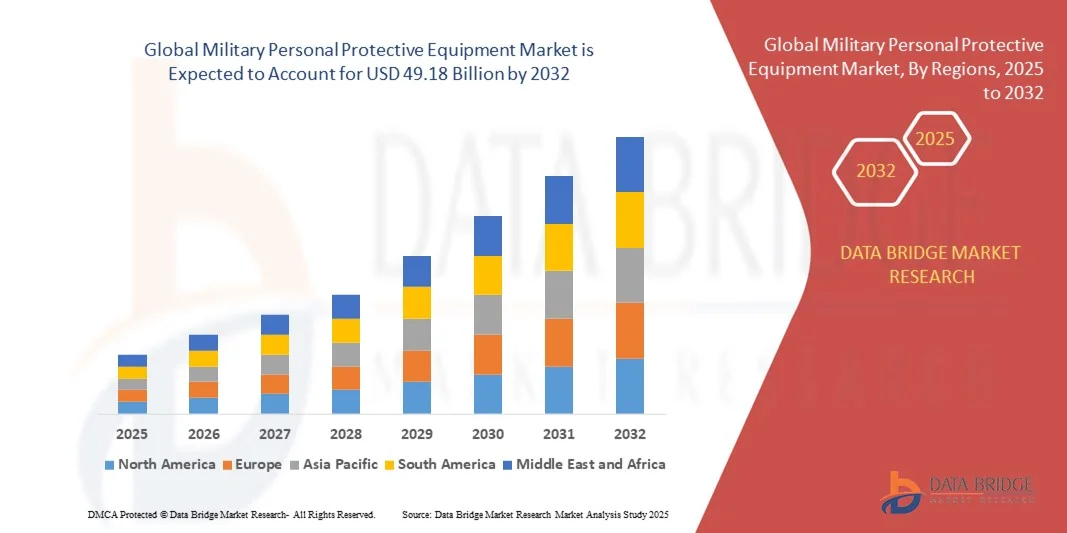
Global Military Personal Protective Equipment Market Size
- The global Military Personal Protective Equipment Market size was valued at USD 20.73 billion in 2024 and is expected to reach USD 49.18 billion by 2032, at a CAGR of 11.40% during the forecast period.
- The market growth is primarily driven by increasing investments in defense modernization programs, rising geopolitical tensions, and the need for enhanced soldier safety and survivability in combat operations.
- Additionally, advancements in lightweight, high-strength materials, wearable sensors, and multifunctional protective gear are creating demand for next-generation military PPE. These factors are collectively propelling the adoption of advanced protective equipment, thereby significantly boosting the market’s growth.
Global Military Personal Protective Equipment Market Analysis
- Military personal protective equipment (PPE), including ballistic vests, helmets, gloves, and eye protection, is increasingly critical for enhancing soldier safety and operational effectiveness in both combat and peacekeeping missions due to advancements in material science, modular designs, and integration with wearable technology.
- The escalating demand for military PPE is primarily driven by rising defense budgets, increasing geopolitical tensions, and the growing need to protect personnel against ballistic, chemical, and biological threats in modern warfare.
- North America dominated the Global Military Personal Protective Equipment Market with the largest revenue share of 36.4% in 2024, supported by strong defense spending, early adoption of advanced protective technologies, and the presence of major defense contractors, with the U.S. witnessing substantial growth in next-generation PPE solutions, particularly in modular body armor systems and smart wearable protective gear.
- Asia-Pacific is expected to be the fastest-growing region in the Global Military Personal Protective Equipment Market during the forecast period due to rising defense investments, increasing military modernization programs, and expanding manufacturing capabilities.
- The Body Armor segment dominated the market with the largest revenue share of 41.8% in 2024, driven by its critical role in providing ballistic protection and survivability to soldiers in combat scenarios.
Report Scope and Global Military Personal Protective Equipment Market Segmentation
|
Attributes |
Military Personal Protective Equipment Key Market Insights |
|
Segments Covered |
|
|
Countries Covered |
North America
Europe
Asia-Pacific
Middle East and Africa
South America
|
|
Key Market Players |
|
|
Market Opportunities |
|
|
Value Added Data Infosets |
In addition to the insights on market scenarios such as market value, growth rate, segmentation, geographical coverage, and major players, the market reports curated by the Data Bridge Market Research also include import export analysis, production capacity overview, production consumption analysis, price trend analysis, climate change scenario, supply chain analysis, value chain analysis, raw material/consumables overview, vendor selection criteria, PESTLE Analysis, Porter Analysis, and regulatory framework. |
Global Military Personal Protective Equipment Market Trends
Enhanced Soldier Protection Through AI and Smart Wearable Integration
- A significant and accelerating trend in the global Military Personal Protective Equipment Market is the deepening integration of artificial intelligence (AI) and smart wearable technologies into protective gear. This fusion of technologies is significantly enhancing situational awareness, threat detection, and overall operational efficiency for military personnel.
- For instance, AI-enabled helmets can provide real-time threat assessment, navigation support, and communication management, while smart body armor can monitor vital signs and detect ballistic impacts to inform medics immediately. Similarly, some advanced gloves and exoskeleton systems incorporate sensors that adapt to movement and load, improving soldier endurance and reducing fatigue.
- AI integration in military PPE enables features such as predictive threat analytics, adaptive load distribution, and real-time health monitoring. For example, certain smart helmets utilize AI to enhance night vision imaging and automatically highlight potential hazards, while body armor systems can alert commanders if a soldier has sustained a critical injury. Furthermore, wearable tech provides hands-free access to battlefield data, allowing soldiers to stay focused on mission-critical tasks.
- The seamless integration of PPE with battlefield communication networks and smart wearable systems facilitates centralized monitoring and control over troop movements, health status, and threat detection. Through a unified interface, commanders can manage multiple soldiers’ protective systems and equipment in real-time, enhancing mission coordination and response efficiency.
- This trend toward more intelligent, responsive, and interconnected military PPE is fundamentally reshaping expectations for soldier safety and operational capability. Consequently, companies such as Revision Military, Crye Precision, and Team Wendy are developing AI-enabled protective gear with features such as automatic injury alerts, adaptive armor adjustment, and integration with battlefield management systems.
- The demand for AI-integrated and smart wearable military PPE is growing rapidly across global defense forces, as militaries increasingly prioritize soldier survivability, situational awareness, and operational effectiveness.
Global Military Personal Protective Equipment Market Dynamics
Driver
Growing Need Due to Rising Security Concerns and Defense Modernization
- The increasing prevalence of global security threats, geopolitical tensions, and asymmetric warfare is a significant driver for the heightened demand for advanced military personal protective equipment (PPE).
- For instance, in 2024, the U.S. Department of Defense announced new investments in next-generation body armor and smart helmet programs, aiming to integrate advanced sensors and AI-driven threat detection systems into frontline protective gear. Such initiatives by key defense agencies and contractors are expected to drive military PPE market growth during the forecast period.
- As armed forces face increasingly complex operational environments, modern PPE offers advanced features such as blast-resistant materials, integrated communication systems, and biometric health monitoring, providing critical protection and operational support beyond traditional armor.
- Furthermore, the modernization of military forces and the adoption of networked battlefield systems are making smart PPE an integral component of soldier systems, enabling seamless integration with situational awareness tools, communication networks, and wearable devices.
- The need for enhanced mobility, lightweight yet high-strength protection, and real-time monitoring of soldier health and environmental hazards are key factors propelling the adoption of advanced military PPE. Ongoing innovations in modular and customizable equipment further contribute to market growth across global defense forces.
Restraint/Challenge
Concerns Regarding High Costs and Technology Integration
- High costs associated with advanced military PPE, including smart body armor and wearable sensor systems, pose a significant challenge to broader adoption, especially for developing countries or smaller defense budgets.
- For instance, sophisticated exoskeletons and AI-enabled helmets involve substantial R&D and production costs, making procurement expensive compared to conventional protective gear.
- Ensuring seamless integration of new technologies into existing soldier systems and maintaining interoperability with legacy equipment is crucial to avoid operational disruptions. Companies such as Revision Military and Crye Precision emphasize modular designs and compatibility in their offerings to address these challenges.
- Additionally, the complexity of advanced PPE requires extensive training for soldiers, which can increase implementation time and costs. While ongoing innovations are improving usability and affordability, the perceived premium for cutting-edge technology can still hinder rapid adoption.
- Overcoming these challenges through cost optimization, scalable solutions, and comprehensive training programs will be vital for sustained growth in the global military PPE market.
Global Military Personal Protective Equipment Market Scope
Military personal protective equipment market is segmented on the basis of product type, application, and usage.
- By Product Type
On the basis of product type, the Global Military Personal Protective Equipment Market is segmented into Advanced Combat Helmet, Pelvic Protection Systems, Life Safety Jacket, Body Armor, Improved Outer Tactical Vest, and Military Combat Eye Protection. The Body Armor segment dominated the market with the largest revenue share of 41.8% in 2024, driven by its critical role in providing ballistic protection and survivability to soldiers in combat scenarios. Increasing focus on modular, lightweight, and high-strength materials further enhances its demand across defense forces worldwide.
Advanced Combat Helmets are expected to witness the fastest CAGR of 18.5% from 2025 to 2032, fueled by growing adoption of helmets integrated with communication systems, night vision, and AI-enabled sensors. Technological innovations in helmet design, such as improved ballistic resistance and augmented situational awareness, are driving the expansion of this segment in both developed and emerging military markets.
- By Application
On the basis of application, the Global Military Personal Protective Equipment Market is segmented into Army, Air Force, Navy, and Others. The Army segment accounted for the largest market revenue share of 45.6% in 2024, reflecting the highest demand for personal protective equipment among ground forces engaged in high-risk operations and peacekeeping missions. Rising defense budgets and modernization programs across key countries are driving adoption of advanced PPE solutions tailored to soldiers’ operational needs.
The Air Force segment is anticipated to witness the fastest CAGR of 17.9% from 2025 to 2032, driven by the increasing deployment of pilots and aircrew requiring specialized protective gear such as life safety jackets, helmets, and respiratory protection. Technological advancements, including lightweight and multi-functional PPE, are enabling air forces to enhance crew safety while maintaining mobility and performance, propelling market growth in this segment.
- By Usage
On the basis of usage, the Global Military Personal Protective Equipment Market is segmented into Detection Solutions, Fall Protection, Head & Face Protection, Hearing Protection, Protective Apparel, Protective Communications, Protective Eyewear, Respiratory Protection, and Welding Safety. The Protective Apparel segment dominated the market with the largest revenue share of 38.9% in 2024, driven by the widespread adoption of body armor, tactical vests, and other garments providing ballistic and blast protection. Protective apparel remains essential for frontline personnel operating in hostile environments, making it a high-priority investment for defense organizations.
The Head & Face Protection segment is expected to witness the fastest CAGR of 19.2% from 2025 to 2032, fueled by the increasing adoption of advanced helmets, goggles, and modular face shields integrated with sensors and communication tools. Innovations in lightweight, impact-resistant materials and multifunctional designs are driving growth, particularly for soldiers in combat and training operations.
Global Military Personal Protective Equipment Market Regional Analysis
- North America dominated the Global Military Personal Protective Equipment Market with the largest revenue share of 36.4% in 2024, driven by rising defense budgets, advanced military modernization programs, and growing investments in soldier safety and survivability.
- Military organizations in the region prioritize the adoption of advanced PPE, including body armor, helmets, and smart wearable protection systems, to enhance operational effectiveness and reduce casualties in diverse operational environments.
- This widespread adoption is further supported by the presence of leading defense contractors, advanced research and development capabilities, and a strong focus on integrating cutting-edge technologies such as AI, sensors, and communication systems into protective equipment, establishing North America as a key hub for innovation and deployment in the military PPE sector.
U.S. Military PPE Market Insight
The U.S. military PPE market captured the largest revenue share of 81% in 2024 within North America, fueled by substantial defense spending, modernization programs, and increasing focus on soldier safety and survivability. Military forces are prioritizing advanced protective gear such as body armor, helmets, and smart wearable systems that integrate sensors and communication tools. The growing emphasis on rapid deployment and battlefield readiness, combined with investments in AI-enabled PPE and lightweight, high-strength materials, further propels market growth. Additionally, government initiatives and defense contracts supporting research and development of next-generation protective equipment are significantly contributing to the market’s expansion.
Europe Military PPE Market Insight
The Europe military PPE market is projected to expand at a substantial CAGR throughout the forecast period, primarily driven by modernization programs and stringent safety regulations for armed forces. Increasing urban defense initiatives and defense modernization efforts are fostering the adoption of advanced PPE. European military organizations are increasingly focused on modular, multifunctional protective gear, including helmets with communication integration and body armor with blast protection. The region is witnessing notable growth across army, navy, and air force applications, with PPE being incorporated into both frontline deployments and training operations.
U.K. Military PPE Market Insight
The U.K. military PPE market is anticipated to grow at a noteworthy CAGR during the forecast period, driven by heightened defense spending, modernization of armed forces, and a focus on soldier safety in combat operations. Additionally, the U.K.’s participation in international missions and peacekeeping operations encourages the adoption of advanced PPE solutions, including tactical vests, helmets, and integrated communication systems. Government-funded research initiatives and collaboration with domestic defense manufacturers further stimulate market growth.
Germany Military PPE Market Insight
The Germany military PPE market is expected to expand at a considerable CAGR during the forecast period, fueled by technological innovation and a strong emphasis on soldier safety. Germany’s well-established defense infrastructure, combined with initiatives to modernize protective gear and enhance operational efficiency, promotes the adoption of advanced PPE, including body armor, combat helmets, and ballistic eyewear. Integration with communication and situational awareness systems is also becoming increasingly prevalent, meeting the operational needs of modern European armed forces.
Asia-Pacific Military PPE Market Insight
The Asia-Pacific military PPE market is poised to grow at the fastest CAGR of 24% during the forecast period of 2025 to 2032, driven by rising defense budgets, increasing regional security concerns, and modernization of armed forces in countries such as China, India, Japan, and South Korea. Growing investments in research and development of next-generation protective solutions, combined with rising adoption of smart, lightweight, and modular PPE, are driving market expansion. Moreover, APAC’s emerging manufacturing capabilities for advanced protective gear are improving accessibility and affordability of military PPE across the region.
Japan Military PPE Market Insight
The Japan military PPE market is gaining momentum due to growing investments in defense modernization, increasing focus on soldier protection, and rising regional security threats. Advanced protective solutions such as smart helmets, body armor, and integrated wearable systems are seeing higher adoption among Japanese armed forces. Integration with communication tools and situational awareness systems is driving innovation. Additionally, Japan’s focus on technological advancement and research in lightweight, multifunctional PPE supports market growth in both army and maritime operations.
China Military PPE Market Insight
The China military PPE market accounted for the largest revenue share in Asia-Pacific in 2024, attributed to increased defense spending, rapid modernization of armed forces, and adoption of advanced protective solutions. China’s initiatives in smart soldier systems, combined with domestic manufacturing capabilities for body armor, helmets, and protective apparel, are accelerating market growth. Moreover, rising investments in research for next-generation PPE, including AI-enabled monitoring systems and modular gear, support adoption across army, navy, and air force operations.
Global Military Personal Protective Equipment Market Share
The Military Personal Protective Equipment industry is primarily led by well-established companies, including:
• 3M Company (U.S.)
• BAE Systems (U.K.)
• Ceradyne Inc. (U.S.)
• DuPont (U.S.)
• Honeywell International Inc. (U.S.)
• Lockheed Martin Corporation (U.S.)
• Rheinmetall AG (Germany)
• MSA Safety Incorporated (U.S.)
• Teijin Limited (Japan)
• ArmorSource LLC (U.S.)
• Propper International (U.S.)
• Revision Military (U.S.)
• Safariland Group (U.S.)
• Globe Manufacturing Co., Inc. (U.S.)
• PT. Pindad (Indonesia)
• NFM Group (Sweden)
• PPSS Group (U.K.)
• Textron Systems (U.S.)
• Alban EBG (France)
• Vestguard (Israel)
What are the Recent Developments in Global Military Personal Protective Equipment Market?
- In April 2023, BAE Systems, a global defense and aerospace leader, launched a new line of advanced ballistic helmets and modular body armor in the Asia-Pacific region, aimed at enhancing soldier survivability in diverse operational environments. This initiative underscores the company's commitment to delivering innovative, high-performance protective equipment tailored to the evolving needs of military forces, reinforcing its position in the rapidly growing global Military PPE Market.
- In March 2023, Ceradyne Inc., a U.S.-based manufacturer of advanced ceramic armor solutions, introduced its next-generation Improved Outer Tactical Vest (IOTV) featuring enhanced ballistic protection and lighter weight for frontline personnel. This development highlights Ceradyne’s dedication to integrating cutting-edge materials and ergonomic design, providing greater safety, mobility, and operational effectiveness for military personnel in combat scenarios.
- In March 2023, Honeywell International Inc. successfully deployed its integrated Protective Communications and Head Protection systems for a major Indian defense modernization project. The initiative leverages advanced PPE technologies to improve soldier situational awareness and reduce injury risk in high-intensity operational environments, showcasing Honeywell’s commitment to smart and resilient protective solutions for armed forces.
- In February 2023, 3M Occupational Health & Safety, a leader in personal protective equipment, announced a strategic partnership with the Australian Department of Defense to supply advanced respiratory protection and hearing protection equipment for military training programs. This collaboration is designed to enhance safety, operational efficiency, and compliance with stringent defense standards, emphasizing 3M’s focus on innovation and mission-critical protection.
- In January 2023, DuPont, a pioneer in high-performance materials, unveiled its new line of Kevlar-based military combat gloves and protective apparel at the International Defence Exhibition & Conference (IDEX) 2023. These lightweight, cut-resistant solutions enable soldiers to operate safely and efficiently in demanding environments, highlighting DuPont’s commitment to integrating advanced materials into personal protective equipment to enhance soldier safety, comfort, and operational readiness.

- Interactive Data Analysis Dashboard
- Company Analysis Dashboard for high growth potential opportunities
- Research Analyst Access for customization & queries
- Competitor Analysis with Interactive dashboard
- Latest News, Updates & Trend analysis
- Harness the Power of Benchmark Analysis for Comprehensive Competitor Tracking
Global Military Personal Protective Equipment Market, Supply Chain Analysis and Ecosystem Framework
To support market growth and help clients navigate the impact of geopolitical shifts, DBMR has integrated in-depth supply chain analysis into its Global Military Personal Protective Equipment Market research reports. This addition empowers clients to respond effectively to global changes affecting their industries. The supply chain analysis section includes detailed insights such as Global Military Personal Protective Equipment Market consumption and production by country, price trend analysis, the impact of tariffs and geopolitical developments, and import and export trends by country and HSN code. It also highlights major suppliers with data on production capacity and company profiles, as well as key importers and exporters. In addition to research, DBMR offers specialized supply chain consulting services backed by over a decade of experience, providing solutions like supplier discovery, supplier risk assessment, price trend analysis, impact evaluation of inflation and trade route changes, and comprehensive market trend analysis.
Data collection and base year analysis are done using data collection modules with large sample sizes. The stage includes obtaining market information or related data through various sources and strategies. It includes examining and planning all the data acquired from the past in advance. It likewise envelops the examination of information inconsistencies seen across different information sources. The market data is analysed and estimated using market statistical and coherent models. Also, market share analysis and key trend analysis are the major success factors in the market report. To know more, please request an analyst call or drop down your inquiry.
The key research methodology used by DBMR research team is data triangulation which involves data mining, analysis of the impact of data variables on the market and primary (industry expert) validation. Data models include Vendor Positioning Grid, Market Time Line Analysis, Market Overview and Guide, Company Positioning Grid, Patent Analysis, Pricing Analysis, Company Market Share Analysis, Standards of Measurement, Global versus Regional and Vendor Share Analysis. To know more about the research methodology, drop in an inquiry to speak to our industry experts.
Data Bridge Market Research is a leader in advanced formative research. We take pride in servicing our existing and new customers with data and analysis that match and suits their goal. The report can be customized to include price trend analysis of target brands understanding the market for additional countries (ask for the list of countries), clinical trial results data, literature review, refurbished market and product base analysis. Market analysis of target competitors can be analyzed from technology-based analysis to market portfolio strategies. We can add as many competitors that you require data about in the format and data style you are looking for. Our team of analysts can also provide you data in crude raw excel files pivot tables (Fact book) or can assist you in creating presentations from the data sets available in the report.













