


What is the Military Stealth Materials Market Size and Growth Rate?
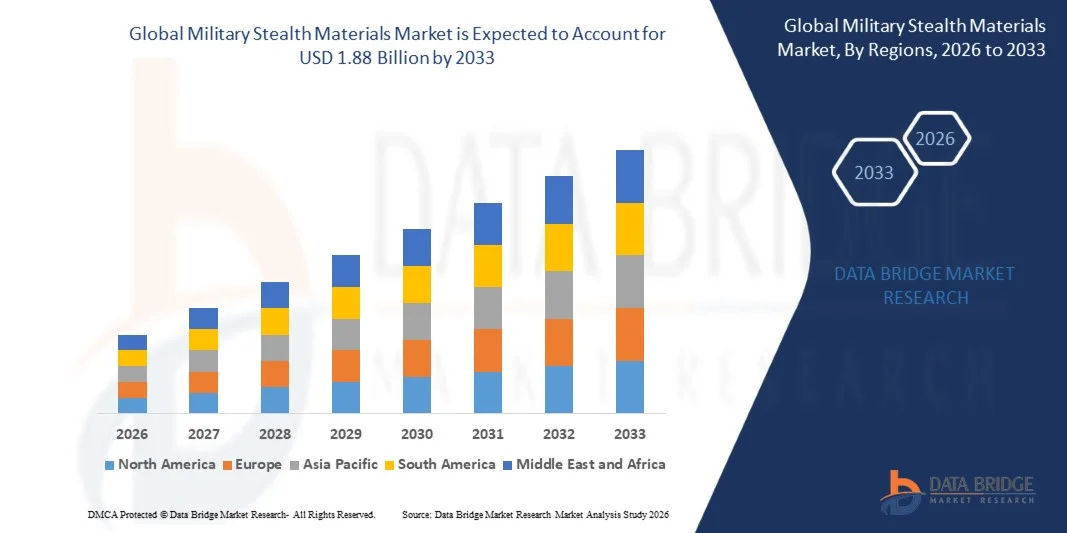
- As per Data Bridge Market Research analysis, the military stealth materials market was valued at USD 1.20 billion in 2025 and is projected to reach USD 1.88 billion by 2033, growing at a CAGR of 5.8% from 2026 to 2033.
- The market is witnessing steady growth driven by increasing defense modernization programs, rising procurement of next-generation stealth aircraft, naval platforms, unmanned systems, and continuous investments in advanced radar-absorbing materials, infrared suppression coatings, and multi-spectral camouflage technologies.
- The growing emphasis on reducing radar, infrared, acoustic, and electromagnetic signatures, coupled with escalating geopolitical tensions and higher military spending, is encouraging defense agencies and OEMs to integrate advanced low-observable materials into aircraft, naval vessels, missiles, and combat vehicles. Radar-absorbing composites, metamaterials, and multifunctional stealth coatings are increasingly replacing conventional materials, providing enhanced survivability, improved mission effectiveness, and greater operational superiority in modern warfare.
Market Size & Forecast
- Global Market Value (2025): USD 1.20 Billion
- Expected Market Value (2033): USD 1.88 Billion
- Forecast CAGR (2026–2033): 5.8%
- Leading Region in 2025: North America
- Fastest Growing Region: Asia-Pacific
What are the Major Takeaways of the Military Stealth Materials Market?
- North America dominated the military stealth materials market with the largest revenue share in 2025, supported by high defense expenditure, extensive investments in stealth aircraft, missile defense systems, naval modernization programs, and the strong presence of leading defense manufacturers
- Asia-Pacific is expected to be the fastest-growing region from 2026 to 2033, fueled by rising defense modernization programs, increasing military budgets, and expanding stealth aircraft, missile, and naval platform development across China, India, Japan, and South Korea.
- The radar-absorbing materials (RAM) segment led the market in 2025, driven by extensive adoption in military aircraft, naval vessels, missiles, and unmanned platforms for reducing radar cross-section and improving battlefield survivability.
- Structural low-observability composites are the fastest-growing material type, reflecting the surge in demand for lightweight, multifunctional materials integrated directly into military platform structures.
- The airborne platforms segment dominated the platform category with a largest revenue share in 2025, led by increasing procurement of stealth fighter aircraft, unmanned aerial vehicles, strategic bombers, and advanced combat aircraft.
- External surface signature treatment accounted for largest market share in 2025, preferred by widespread use of stealth coatings and radar-absorbing materials on aircraft, naval vessels, and military vehicles
- The films, foils and tapes segment is the fastest-growing form category, driven by the increasing demand for lightweight, flexible, and easily deployable stealth solutions.
Report Scope and Military Stealth Materials Market Segmentation
|
Attributes |
Military Stealth Materials Key Market Insights |
|
Segments Covered |
|
|
Countries Covered |
North America
Europe
Asia-Pacific
Middle East and Africa
South America
|
|
Key Market Players |
|
|
Market Opportunities |
|
|
Value Added Data Infosets |
In addition to the market insights such as market value, growth rate, market segments, geographical coverage, market players, and market scenario, the market report curated by the Data Bridge Market Research team includes in-depth expert analysis, import/export analysis, pricing analysis, production consumption analysis, and pestle analysis. |
What is the Key Trend in the Military Stealth Materials Market?
- Defense organizations are increasingly adopting multi-spectral stealth materials capable of simultaneously reducing radar, infrared, and electromagnetic signatures to improve survivability against next-generation detection systems.
- For instance, in May 2025, Lockheed Martin announced plans to incorporate sixth-generation stealth technologies into the F-35, including modifications to coatings and outer mold line refinements designed to improve radar and infrared signature reduction.
- Advanced radar-absorbing composites and metamaterial architectures enable broader frequency absorption while maintaining lightweight structural performance for modern military platforms.
- Defense research organizations and material developers are accelerating the commercialization of multifunctional stealth materials supporting aircraft, naval platforms, missiles, and unmanned systems.
- For instance, in April 2025, researchers developed a transparent radar-infrared bi-stealth metamaterial that achieved broadband microwave absorption and reduced infrared emissivity, supporting potential applications in aircraft optical windows and multispectral stealth systems.
- The development of artificial intelligence-assisted material design and advanced manufacturing techniques is enabling faster discovery of lightweight, durable, and high-performance stealth materials for defense applications.
- As modern defense platforms increasingly require multi-domain signature management and enhanced battlefield survivability, adoption of advanced stealth materials is expected to accelerate, reinforcing their role as a critical component of next-generation military systems
What are the Key Drivers of the Military Stealth Materials Market?
- The rapid modernization of military aircraft, naval vessels, missiles, and unmanned systems has significantly increased demand for advanced radar-absorbing materials and multi-spectral stealth technologies.
- For instance, in January 2025, DRDO Chairman Dr. Samir V. Kamat announced that the organization is developing Radiation Absorbent Materials (RAM), a special composite material, for the Advanced Medium Combat Aircraft (AMCA) program to meet its stealth requirements.
- Defense manufacturers are integrating lightweight composites, conductive polymers, and metamaterials into next-generation platforms to reduce radar cross-section while improving operational performance.
- For instance, in May 2025, Lockheed Martin announced that it plans to incorporate sixth-generation technologies into the F-35, including upgraded stealth coatings and airframe refinements to further reduce radar and infrared signatures.
- Increasing investments in unmanned combat aerial vehicles (UCAVs), autonomous defense systems, and advanced missile programs are creating strong demand for lightweight and multifunctional stealth materials.
- With defense agencies increasingly prioritizing survivability against advanced surveillance and precision-guided threats, stealth materials will remain indispensable for the development of future low-observable military platforms.
Which Factors are Challenging the Growth of the Military Stealth Materials Market?
- Advanced stealth materials require complex manufacturing processes, specialized raw materials, and stringent qualification standards that significantly increase production and lifecycle costs.
- These technical complexities limit large-scale deployment across legacy military platforms and create long qualification cycles for new defense programs.
- For instance, in August 2025, researchers highlighted that developing radar-infrared compatible stealth materials remains constrained by spectral incompatibility, thermal stability, thickness and weight limitations, and multifunctional material integration challenges
- High research, testing, certification, and maintenance requirements continue to increase ownership costs for defense agencies and aerospace manufacturers.
- Limited availability of specialized manufacturing capabilities and dependence on advanced material technologies create supply chain challenges for large-scale stealth material production.
- The substantial investment required for developing durable, broadband, and multi-spectral stealth materials continues to slow commercialization, particularly for cost-sensitive defense modernization programs despite growing operational demand.
How is the Military Stealth Materials Market Segmented?
The military stealth materials market is segmented on the basis of material type, platform, application, form, and distribution channel.
- By Material Type
On the basis of material type, the military stealth materials market is segmented into radar-absorbing materials (RAM), infrared and thermal signature-management materials, visual and multispectral camouflage materials, structural low-observability composites, radar-transparent and radome materials, electromagnetic interference shielding materials, and other specialized stealth materials. The radar-absorbing materials (RAM) segment dominated the market with largest revenue share in 2025, owing to extensive adoption in military aircraft, naval vessels, missiles, and unmanned platforms for reducing radar cross-section and improving battlefield survivability. RAM technologies absorb electromagnetic waves and minimize radar detection, making them a critical component of low-observable defense systems. Increasing procurement of stealth fighter aircraft, advanced UAVs, and missile systems is strengthening demand for radar absorption technologies. Continuous development of carbon-based composites, conductive polymers, and metamaterial-based absorbers is improving absorption efficiency across multiple frequency ranges. Defense manufacturers are increasingly integrating RAM into coatings, composite structures, and external platform surfaces. Growing investments in next-generation stealth platforms continue to reinforce the dominance of radar-absorbing materials in military applications.
The structural low-observability composites segment is projected to register the fastest growth from 2026 to 2033, driven by increasing demand for lightweight, multifunctional materials integrated directly into military platform structures. These composites provide both structural strength and signature reduction capabilities, reducing the requirement for additional stealth coatings. Growing adoption of advanced composite materials in sixth-generation aircraft, unmanned combat aerial vehicles, and hypersonic platforms is accelerating segment growth. Developments in carbon fiber composites, ceramic composites, and nanomaterial-enhanced structures are improving durability and stealth performance. Defense organizations are focusing on reducing platform weight while maintaining low radar and infrared visibility. Increasing integration of stealth capabilities during platform design rather than post-production modification is expected to support rapid adoption.
- By Platform
On the basis of platform, the military stealth materials market is segmented into airborne platforms, naval platforms, land platforms, missile, space platforms, and fixed defense installations. The airborne platforms segment dominated the market with largest revenue share in 2025, supported by increasing procurement of stealth fighter aircraft, unmanned aerial vehicles, strategic bombers, and advanced combat aircraft. Aircraft require extensive use of radar-absorbing materials, infrared suppression coatings, and low-observable composites to reduce detection from enemy radar and infrared sensors. Major defense programs involving fifth-generation and sixth-generation aircraft are significantly increasing demand for stealth material technologies. The integration of stealth materials improves mission effectiveness by enhancing survivability in contested environments. Increasing investments in advanced combat aircraft programs across the U.S., China, India, and Europe are supporting market expansion. Continuous upgrades of existing aircraft fleets with advanced low-observable technologies further strengthen this segment.
The missile segment is expected to witness the fastest growth from 2026 to 2033, driven by increasing development of precision-guided missiles, hypersonic weapons, and advanced strike systems. Modern missile programs increasingly require stealth materials to reduce radar visibility and improve penetration capabilities against advanced defense systems. Lightweight radar-absorbing composites and thermal management materials are being incorporated to withstand extreme operating conditions. Rising geopolitical tensions and increasing defense investments in strategic weapons systems are accelerating demand. Countries are expanding missile capabilities to enhance long-range strike and deterrence capabilities. Growing adoption of hypersonic missile technologies is expected to create significant opportunities for advanced stealth material manufacturers.
- By Application
On the basis of application, the military stealth materials market is segmented into external surface signature treatment, structural low-observability integration, engine and exhaust signature treatment, inlet and duct signature treatment, acoustic and vibration damping, underwater hull signature treatment, maintenance and restoration of low-observable surfaces, and other functional applications. The external surface signature treatment segment dominated the market with largest revenue share in 2025, due to widespread use of stealth coatings and radar-absorbing materials on aircraft, naval vessels, and military vehicles. External treatments provide an effective method to reduce radar, infrared, and electromagnetic signatures without major structural modifications. These solutions are extensively used during manufacturing and modernization programs for defense platforms. Continuous improvements in coating durability, weather resistance, and broadband absorption performance are increasing adoption. Military organizations are investing in surface treatment technologies to extend the operational life of existing stealth platforms. Increasing maintenance requirements of low-observable fleets are further supporting demand for advanced external signature management solutions.
The structural low-observability integration segment is projected to grow at the fastest growth from 2026 to 2033, driven by increasing preference for integrated stealth designs in next-generation defense platforms. Manufacturers are increasingly embedding stealth materials into airframes, hull structures, and vehicle components during initial design stages. This approach improves weight efficiency and provides long-term signature reduction performance. Growing development of advanced combat aircraft, autonomous platforms, and naval stealth vessels is accelerating adoption. Integration of composite materials and metamaterial structures is improving multifunctional capabilities. Increasing focus on lifecycle cost reduction is encouraging defense agencies to adopt integrated low-observable solutions.
- By Form
On the basis of form, the military stealth materials market is segmented into liquid coatings and paints, powder and paste materials, films, foils and tapes, yarns and fabrics, nets, meshes and screens, foams and cellular materials, inks and printable material formulations, and other forms. The liquid coatings and paints segment dominated the market with largest revenue share in 2025, owing to their extensive application in radar signature reduction and infrared suppression across military platforms. These coatings provide flexible application methods and can be applied to aircraft, naval vessels, vehicles, and defense equipment. Increasing demand for maintenance and restoration of stealth surfaces is supporting segment growth. Advanced formulations incorporating nanoparticles and conductive materials are improving absorption performance. Liquid coatings are preferred due to easier deployment compared with structural modifications. Their compatibility with existing military platforms continues to drive widespread adoption.
The films, foils and tapes segment is expected to register the fastest growth from 2026 to 2033, driven by increasing demand for lightweight, flexible, and easily deployable stealth solutions. These materials offer advantages such as reduced thickness, improved adaptability, and efficient electromagnetic shielding performance. Growing adoption in UAVs, electronic warfare systems, and advanced military electronics is creating new opportunities. Flexible stealth materials are particularly suitable for platforms requiring weight optimization. Advancements in nanotechnology and printable electronics are improving material performance. Increasing demand for modular stealth upgrades is expected to accelerate segment expansion.
- By Distribution Channel
On the basis of distribution channel, the military stealth materials market is segmented into direct sales, defense contractors and system integrators, strategic distribution partners, online tender platforms, and third-party logistics providers. The defense contractors and system integrators segment dominated the market with largest revenue share in 2025, due to the critical role of major defense companies in developing, integrating, and supplying stealth material solutions for military platforms. Defense contractors collaborate with material manufacturers to integrate stealth technologies into aircraft, naval systems, missiles, and combat vehicles. Large-scale military procurement programs are typically executed through established defense suppliers and system integrators. These companies provide engineering support, testing, certification, and lifecycle maintenance services. Increasing defense modernization programs worldwide are strengthening partnerships between material suppliers and defense contractors. Their ability to deliver complete low-observable solutions continues to drive segment dominance.
The strategic distribution partners segment is projected to witness the fastest growth at a CAGR of from 2026 to 2033, supported by increasing global defense supply chain expansion and international military collaborations. Strategic distributors help manufacturers reach regional defense organizations and specialized military contractors. Growing defense procurement activities in emerging markets are increasing demand for efficient supply networks. These partnerships improve accessibility to advanced stealth materials and related technologies. Rising cross-border defense agreements are encouraging collaboration among suppliers, distributors, and military organizations. Expansion of regional defense manufacturing capabilities is expected to further support segment growth.
Which Region Holds the Largest Share of the Military Stealth Materials Market?
- North America dominated the military stealth materials market with the largest revenue share of in 2025, supported by high defense expenditure, extensive investments in stealth aircraft, missile defense systems, naval modernization programs, and the strong presence of leading defense manufacturers
- The region also benefits from continuous modernization of military platforms, strong adoption of radar-absorbing materials, infrared signature management technologies, and advanced low-observable composites across aerospace, naval, and missile applications. Increasing focus on next-generation defense systems, unmanned platforms, and multi-domain warfare capabilities continues to strengthen North America’s leadership position in the global market.
U.S. Military Stealth Materials Market Insight
The U.S. military stealth materials market is witnessing strong growth due to high defense expenditure, continuous modernization of military platforms, and increasing investments in next-generation low-observable technologies. The country’s advanced aerospace and defense ecosystem, along with the presence of major defense manufacturers such as Lockheed Martin, Northrop Grumman, and RTX, is driving demand for radar-absorbing materials, infrared signature management coatings, and stealth composites across aircraft, naval, and missile applications. In addition, the U.S. Department of Defense continues to prioritize advanced stealth capabilities for fifth-generation aircraft, unmanned systems, and future combat platforms, accelerating adoption of advanced signature-reduction materials. The U.S. Air Force continued development of the B-21 Raider stealth bomber program, which incorporates advanced low-observable materials and coatings to reduce radar signatures and improve survivability.
Asia-Pacific Military Stealth Materials Market Insight
The Asia-Pacific military stealth materials market is expected to witness rapid growth, driven by increasing defense budgets, indigenous fighter aircraft programs, and rising investments in advanced military technologies across China, India, Japan, and South Korea. Growing focus on stealth aircraft development, unmanned combat systems, and naval modernization is supporting regional demand for radar-absorbing materials, thermal signature-management materials, and low-observable composites. In addition, increasing geopolitical tensions and government initiatives to strengthen defense manufacturing capabilities are accelerating adoption of advanced stealth materials across aerospace and defense sectors. In January 2025, India’s Defence Research and Development Organisation (DRDO) announced the development of radiation-absorbing materials for the Advanced Medium Combat Aircraft (AMCA) program to enhance indigenous stealth capabilities.
Japan Military Stealth Materials Market Insight
The Japan military stealth materials market is witnessing consistent growth due to rising investments in advanced defense technologies, next-generation aircraft development, and modernization of naval capabilities. Japan’s increasing focus on developing low-observable platforms, advanced sensors, and electromagnetic signature management technologies is driving demand for radar-absorbing composites and stealth coatings. Moreover, collaboration with international defense companies and domestic aerospace manufacturers is supporting innovation in advanced materials for fighter aircraft and defense systems. Japan’s Mitsubishi X-2 Shinshin demonstrator aircraft incorporated radar-absorbing materials and low-observable design technologies to support the country’s future stealth fighter development programs.
China Military Stealth Materials Market Insight
The China military stealth materials market is growing rapidly, driven by increasing defense modernization programs, expansion of stealth aircraft capabilities, and rising investments in indigenous military technology development. The country’s development of advanced platforms such as the J-20 stealth fighter and next-generation unmanned systems is significantly increasing demand for radar-absorbing materials, infrared suppression technologies, and composite structures. In addition, China’s focus on military aerospace innovation and domestic production of advanced materials is strengthening its position as a major market for stealth technologies. For instance, China’s J-20 stealth fighter program uses advanced composite materials and low-observable technologies designed to reduce radar detectability and improve operational capability.
U.K. Military Stealth Materials Market Insight
The U.K. military stealth materials market is experiencing steady growth, supported by increasing defense modernization initiatives, advanced aerospace research capabilities, and participation in next-generation combat aircraft programs. The country’s strong defense industrial base, including companies involved in aerospace composites, radar systems, and signature management technologies, is driving demand for advanced stealth materials. Furthermore, investments in future combat air systems and unmanned defense platforms are increasing the requirement for lightweight, multifunctional low-observable materials. In December 2024, the U.K. Ministry of Defence continued investment in the Global Combat Air Programme (GCAP), which focuses on developing next-generation combat aircraft incorporating advanced stealth and low-observable technologies.
Germany Military Stealth Materials Market Insight
The Germany military stealth materials market is expanding steadily due to increasing defense investments, advanced aerospace manufacturing capabilities, and growing adoption of next-generation military technologies. German defense companies and research organizations are increasingly focusing on advanced composites, electromagnetic signature reduction, and lightweight materials for aircraft and defense applications. Continuous modernization of European defense capabilities and Germany’s participation in multinational aircraft programs are further supporting market growth. Germany’s participation in the Future Combat Air System (FCAS) program with France and Spain is driving research into next-generation combat aircraft technologies, including low-observable structures and advanced materials.
Which are the Top Companies in Military Stealth Materials Market?
The military stealth materials industry is primarily led by well-established companies, including:
- 3M (U.S.)
- AEM, Inc (U.S.)
- Akzo Nobel N.V. (Netherlands)
- Saint-Gobain Group (France)
- ESCO Technologies Inc. (U.S.)
- Fibotex (Israel)
- Glenair, Inc. (U.S.)
- Grupo Oesía S.A. (Spain)
- HEICO Corporation (U.S.)
- Hexcel Corporation (U.S.)
- Holland Shielding Systems B.V. (Netherlands)
- Infinite Technologies RCS, Inc. (U.S.)
- MAST Technologies (U.S.)
- MWT Materials, Inc. (U.S.)
- Nitto Denko Corporation (Japan)
- NITTO KOGYO CORPORATION (Japan)
- PARKER-HANNIFIN CORP (U.S.)
- Rheinmetall AG (Germany)
- Saab AB (Sweden)
What are Latest Developments in Military Stealth Materials Market?
- In November 2025, FibreCoat’s radar-absorbing material technology gained recognition for aerospace and defense applications, highlighting advances in lightweight electromagnetic stealth composites. The company developed radar-absorbing materials based on metal-coated fibers combined with polymer matrices to create lightweight and customizable composite solutions. These materials are designed to provide electromagnetic absorption while maintaining structural flexibility, supporting potential applications in aerospace and defense systems.
- In July 2025, Veera Dynamics and Binford Labs launched Project RAMA (Radar Absorption & Multispectral Adaptive), a next-generation stealth material designed to reduce radar and thermal visibility for military platforms. The newly introduced stealth material is engineered as a modular, platform-agnostic coating capable of reducing electromagnetic and infrared signatures across air, land, and naval applications. The technology is being developed for integration into autonomous defense platforms, including military drones, to improve survivability in contested environments.
- In March 2025, CSIR-National Aerospace Laboratories (CSIR-NAL) developed radar-absorbing materials including NiRaLa Radar Absorbing Laminate and ADRISHYA-RAM Paint for aerospace stealth applications. The developed materials are designed to reduce radar cross-section (RCS) of aircraft structures through advanced radar-absorbing composite technologies. NiRaLa laminate uses aerospace-grade composite structures, while ADRISHYA-RAM Paint focuses on radar signature reduction through coating-based applications.
- In November 2024, IIT Kanpur launched the Anālakṣhya Metamaterial Surface Cloaking System (MSCS), a multispectral stealth technology developed for defense applications. The launched system uses metamaterial-based technology to provide advanced signature management capabilities by reducing detectability across multiple electromagnetic spectrums. The technology is designed for defense applications requiring enhanced camouflage and low-observable performance.
- In February 2023, researchers at the Indian Institute of Technology (IIT) Mandi developed a new radar-invisible metamaterial-based technology capable of absorbing electromagnetic waves across multiple radar frequency bands for stealth applications. The developed technology uses a Frequency Selective Surface (FSS)-based absorber structure designed to reduce radar detectability of military assets, including stealth vehicles and critical defense installations. The material demonstrated broadband electromagnetic absorption across C, X, and Ku radar bands, achieving more than 90% absorption of radar waves.

- Interactive Data Analysis Dashboard
- Company Analysis Dashboard for high growth potential opportunities
- Research Analyst Access for customization & queries
- Competitor Analysis with Interactive dashboard
- Latest News, Updates & Trend analysis
- Harness the Power of Benchmark Analysis for Comprehensive Competitor Tracking
Data collection and base year analysis are done using data collection modules with large sample sizes. The stage includes obtaining market information or related data through various sources and strategies. It includes examining and planning all the data acquired from the past in advance. It likewise envelops the examination of information inconsistencies seen across different information sources. The market data is analysed and estimated using market statistical and coherent models. Also, market share analysis and key trend analysis are the major success factors in the market report. To know more, please request an analyst call or drop down your inquiry.
The key research methodology used by DBMR research team is data triangulation which involves data mining, analysis of the impact of data variables on the market and primary (industry expert) validation. Data models include Vendor Positioning Grid, Market Time Line Analysis, Market Overview and Guide, Company Positioning Grid, Patent Analysis, Pricing Analysis, Company Market Share Analysis, Standards of Measurement, Global versus Regional and Vendor Share Analysis. To know more about the research methodology, drop in an inquiry to speak to our industry experts.
Data Bridge Market Research is a leader in advanced formative research. We take pride in servicing our existing and new customers with data and analysis that match and suits their goal. The report can be customized to include price trend analysis of target brands understanding the market for additional countries (ask for the list of countries), clinical trial results data, literature review, refurbished market and product base analysis. Market analysis of target competitors can be analyzed from technology-based analysis to market portfolio strategies. We can add as many competitors that you require data about in the format and data style you are looking for. Our team of analysts can also provide you data in crude raw excel files pivot tables (Fact book) or can assist you in creating presentations from the data sets available in the report.












