


Military Truck Market Size
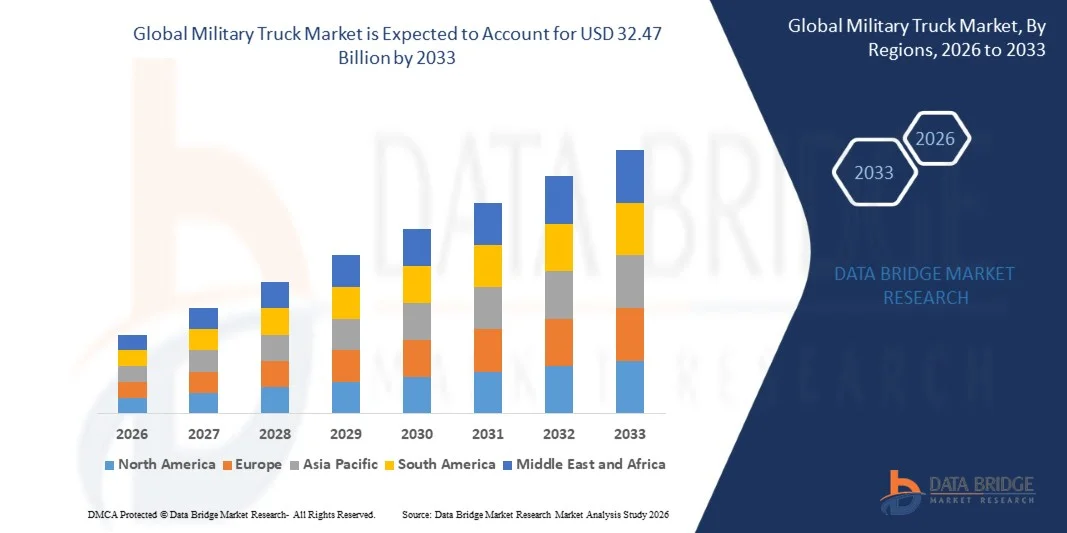
- The global military truck market size was valued at USD 25.60 billion in 2025 and is expected to reach USD 32.47 billion by 2033, at a CAGR of 3.02% during the forecast period
- The market growth is largely fueled by increasing defense budgets and continuous military modernization programs, leading to rising procurement of advanced logistics and tactical vehicles across global armed forces
- Furthermore, growing demand for high-mobility, durable, and mission-adaptable transport solutions for troop movement, equipment hauling, and battlefield support is establishing military trucks as a critical component of defense infrastructure. These converging factors are accelerating fleet replacement and upgrade cycles, thereby significantly boosting the market growth
Military Truck Market Analysis
- Military trucks, designed for transportation of troops, equipment, and supplies across diverse and challenging terrains, are essential components of defense logistics and operational mobility due to their reliability, payload capacity, and adaptability to multiple mission requirements
- The escalating demand for military trucks is primarily fueled by increasing geopolitical tensions, rising need for rapid deployment capabilities, and continuous advancements in vehicle technologies such as improved propulsion systems, enhanced protection features, and integrated communication systems
- North America dominated the military truck market with a share of around 40% in 2025, due to high defense spending, advanced military infrastructure, and continuous fleet modernization programs
- Asia-Pacific is expected to be the fastest growing region in the military truck market during the forecast period due to rising defense budgets, regional security concerns, and rapid military modernization in countries such as China, India, and Japan
- Diesel segment dominated the market with a market share of 63.55% in 2025, due to its superior fuel efficiency, high torque output, and reliability in harsh operating conditions. Diesel-powered military trucks are widely preferred due to their ability to handle heavy loads and long-distance missions with consistent performance. Established fueling infrastructure and ease of maintenance further strengthen their widespread adoption across defense forces globally
Report Scope and Military Truck Market Segmentation
|
Attributes |
Military Truck Key Market Insights |
|
Segments Covered |
|
|
Countries Covered |
North America · U.S. · Canada · Mexico Europe · Germany · France · U.K. · Netherlands · Switzerland · Belgium · Russia · Italy · Spain · Turkey · Rest of Europe Asia-Pacific · China · Japan · India · South Korea · Singapore · Malaysia · Australia · Thailand · Indonesia · Philippines · Rest of Asia-Pacific Middle East and Africa · Saudi Arabia · U.A.E. · South Africa · Egypt · Israel · Rest of Middle East and Africa South America · Brazil · Argentina · Rest of South America |
|
Key Market Players |
· Oshkosh Corporation (U.S.) · General Dynamics Corporation (U.S.) · Rheinmetall AG (Germany) · Textron Inc. (U.S.) · Tata Motors (India) · Krauss-Maffei Wegmann (Germany) · Arquus (France) · IVECO (Italy) · Mitsubishi Heavy Industries (Japan) · Hyundai Rotem (South Korea) · TATRA TRUCKS A.S. (Czech Republic) · RBA Automotive Holding PLC. (U.K.) · The Kalyani Group (India) · Daimler (Germany) |
|
Market Opportunities |
· Growing Demand for Autonomous and Unmanned Military Vehicles · Expansion of Defense Procurement in Emerging Economies |
|
Value Added Data Infosets |
In addition to the market insights such as market value, growth rate, market segments, geographical coverage, market players, and market scenario, the market report curated by the Data Bridge Market Research team includes in-depth expert analysis, import/export analysis, pricing analysis, production consumption analysis, and pestle analysis. |
Military Truck Market Trends
“Increasing Adoption of Electric and Hybrid Military Trucks”
- A significant trend in the military truck market is the increasing adoption of electric and hybrid propulsion systems, driven by the need to reduce fuel dependency and enhance operational efficiency in modern defense missions. This transition is positioning advanced propulsion technologies as key enablers of next-generation military mobility and sustainability initiatives
- For instance, Oshkosh Corporation has developed hybrid-electric variants under its tactical vehicle programs to improve fuel efficiency and reduce logistical burden during operations. Such developments strengthen operational endurance and support reduced reliance on conventional fuel supply chains in remote combat environments
- The demand for low acoustic and thermal signature vehicles is increasing as military forces prioritize stealth capabilities in reconnaissance and special operations missions. Electric and hybrid trucks offer quieter operation, which enhances survivability and mission effectiveness in sensitive operational zones
- Defense organizations are focusing on energy diversification strategies to reduce vulnerability associated with fuel supply disruptions. This is accelerating investments in alternative propulsion technologies that can operate efficiently in varied and extreme environments
- Technological advancements in battery systems, power management, and energy storage are improving the performance and feasibility of electric military trucks. These innovations are enabling better range, durability, and adaptability for mission-critical applications
- The market is witnessing a gradual transition toward sustainable mobility solutions as governments emphasize reducing emissions and improving energy efficiency within defense operations. This trend is reinforcing long-term adoption of hybrid and electric platforms across military fleets
Military Truck Market Dynamics
Driver
“Rising Defense Budgets and Military Modernization Programs”
- The increasing allocation of defense budgets across major economies is driving the procurement of advanced military trucks to enhance logistics, mobility, and operational readiness. Governments are prioritizing modernization programs to replace aging vehicle fleets with technologically advanced platforms capable of supporting diverse mission requirements
- For instance, U.S. Department of Defense continues to invest heavily in tactical vehicle programs such as the Family of Medium Tactical Vehicles to strengthen logistics capabilities. These investments ensure improved mobility, reliability, and mission efficiency across various military operations
- The growing focus on rapid deployment and battlefield responsiveness is increasing demand for high-performance trucks capable of operating across complex terrains. This is encouraging defense agencies to procure vehicles with enhanced mobility, protection, and communication systems
- Military forces are integrating advanced technologies such as telematics, navigation systems, and real-time monitoring into transport vehicles to improve coordination and operational efficiency. This digital transformation is strengthening the role of military trucks in modern warfare
- The continuous need to enhance defense readiness and operational flexibility is reinforcing this driver. Increasing investments in modernization and procurement programs are significantly contributing to the sustained growth of the military truck market
Restraint/Challenge
“High Maintenance and Lifecycle Costs of Military Trucks”
- The military truck market faces challenges due to the high maintenance and lifecycle costs associated with operating advanced and heavy-duty vehicles in demanding environments. These costs include regular servicing, spare parts replacement, and upgrades required to maintain operational readiness
- For instance, Rheinmetall AG provides lifecycle support and maintenance services for military logistics vehicles, which involve significant long-term expenditure for defense organizations. These ongoing costs increase the financial burden on governments managing large fleets
- Military trucks are often deployed in extreme terrains and harsh climates, leading to higher wear and tear and increasing the frequency of maintenance requirements. This impacts operational efficiency and raises overall lifecycle expenses
- The integration of advanced technologies and electronic systems in modern military trucks adds complexity to maintenance processes. Specialized skills, tools, and infrastructure are required for repairs, increasing service costs and limiting quick turnaround in field conditions
- The need to balance performance, durability, and cost efficiency continues to challenge manufacturers and end users. High lifecycle costs remain a critical factor influencing procurement decisions and long-term sustainability of military vehicle fleets
Military Truck Market Scope
The market is segmented on the basis of truck type, application, propulsion type, transmission type, and axle configuration.
- By Truck Type
On the basis of truck type, the military truck market is segmented into light, medium, and heavy. The heavy truck segment dominated the market with the largest market revenue share in 2025, driven by its critical role in transporting heavy equipment, artillery, and armored vehicles across challenging terrains. Armed forces prioritize heavy military trucks due to their high payload capacity, durability, and ability to operate in extreme environments, making them essential for large-scale defense logistics and combat support operations. These trucks are extensively used in long-distance supply missions and battlefield mobility, supported by continuous upgrades in engine performance and protection systems. Increasing defense budgets and the need for advanced logistics infrastructure further strengthen the dominance of this segment. The integration of advanced navigation and communication systems in heavy trucks also enhances operational efficiency and mission coordination.
The light truck segment is anticipated to witness the fastest growth rate from 2026 to 2033, fueled by rising demand for rapid mobility, reconnaissance, and urban warfare operations. Light military trucks offer high maneuverability, lower fuel consumption, and ease of deployment in confined or complex terrains, making them suitable for modern combat scenarios. Their adaptability for multiple roles such as patrol, medical evacuation, and command operations increases their adoption across defense forces. Technological advancements in lightweight materials and modular vehicle design further support their growing usage. Increasing emphasis on agile and flexible military operations is expected to accelerate demand for light trucks over the forecast period.
- By Application
On the basis of application, the military truck market is segmented into cargo/logistics, troop, and utility. The cargo/logistics segment dominated the market with the largest market revenue share in 2025, driven by the continuous need for efficient transportation of supplies, ammunition, fuel, and equipment across military bases and operational zones. Logistics trucks form the backbone of military operations, ensuring timely delivery and sustained battlefield readiness. The increasing complexity of defense supply chains and the need for reliable transport solutions contribute to the strong demand for cargo vehicles. These trucks are designed to handle diverse terrains and heavy loads, supported by advancements in durability and load management systems. Growing investments in military infrastructure and global deployment capabilities further boost the segment’s dominance. Enhanced fleet management and tracking technologies also improve logistics efficiency.
The troop segment is expected to witness the fastest growth rate from 2026 to 2033, driven by rising focus on soldier mobility, safety, and rapid deployment capabilities. Troop carrier trucks are increasingly equipped with armored protection, ergonomic seating, and advanced communication systems to enhance operational effectiveness and personnel safety. The growing importance of quick response missions and peacekeeping operations contributes to the increased adoption of troop transport vehicles. Modern military strategies emphasize mobility and flexibility, further supporting the demand for this segment. Continuous upgrades in vehicle protection and comfort features are expected to drive growth in troop carrier applications.
- By Propulsion Type
On the basis of propulsion type, the military truck market is segmented into electric/hybrid, gasoline, and diesel. The diesel segment dominated the market with the largest market revenue share of 63.55% in 2025, driven by its superior fuel efficiency, high torque output, and reliability in harsh operating conditions. Diesel-powered military trucks are widely preferred due to their ability to handle heavy loads and long-distance missions with consistent performance. Established fueling infrastructure and ease of maintenance further strengthen their widespread adoption across defense forces globally. These trucks are capable of operating in extreme temperatures and rugged terrains, ensuring mission continuity. Continuous improvements in diesel engine technology enhance fuel efficiency and reduce emissions, supporting sustained demand. The segment remains integral to military logistics and combat operations.
The electric/hybrid segment is anticipated to witness the fastest growth rate from 2026 to 2033, fueled by increasing focus on reducing fuel dependency, enhancing energy efficiency, and lowering operational emissions. Electric and hybrid military trucks offer advantages such as silent operation, reduced thermal signature, and improved energy management, making them suitable for stealth and surveillance missions. Governments are investing in advanced propulsion technologies to modernize defense fleets and align with sustainability goals. Technological advancements in battery systems and hybrid powertrains further accelerate adoption. The growing emphasis on energy security and operational efficiency is expected to drive rapid growth in this segment.
- By Transmission Type
On the basis of transmission type, the military truck market is segmented into automatic, semi-automatic, and manual. The manual segment dominated the market with the largest market revenue share in 2025, driven by its reliability, simplicity, and ease of maintenance in challenging field conditions. Manual transmission systems are widely used in military trucks due to their robustness and ability to function effectively in extreme environments without complex electronic dependencies. These systems provide better control in off-road and rugged terrains, which is critical for military operations. Lower cost and ease of repair in remote locations further contribute to their dominance. Military personnel are also extensively trained in handling manual vehicles, supporting continued adoption. The segment remains a preferred choice for traditional and legacy fleets.
The automatic segment is expected to witness the fastest growth rate from 2026 to 2033, driven by increasing demand for ease of operation, reduced driver fatigue, and improved vehicle performance. Automatic transmissions enhance driving efficiency, particularly in complex terrains and urban combat environments, enabling faster response times. The integration of advanced control systems and electronic components improves gear shifting and fuel efficiency. Modern military vehicles are increasingly adopting automatic systems to enhance operational effectiveness and reduce training requirements. The shift toward technologically advanced fleets is expected to accelerate growth in this segment.
- By Axle Configuration
On the basis of axle configuration, the military truck market is segmented into 4x4, 6x6, 8x8, and others. The 6x6 segment dominated the market with the largest market revenue share in 2025, driven by its optimal balance between payload capacity, mobility, and off-road performance. 6x6 military trucks are widely used for logistics, troop transport, and tactical operations due to their ability to navigate diverse terrains while carrying substantial loads. These vehicles offer enhanced traction and stability, making them suitable for both on-road and off-road missions. Their versatility across multiple applications contributes to strong demand among defense forces. Continuous upgrades in suspension and drivetrain technologies further improve performance and reliability. The segment remains a key component of modern military vehicle fleets.
The 8x8 segment is anticipated to witness the fastest growth rate from 2026 to 2033, fueled by increasing demand for high-mobility vehicles capable of carrying heavy payloads in extreme conditions. 8x8 trucks provide superior traction, load distribution, and stability, making them ideal for transporting heavy equipment and operating in difficult terrains. The growing focus on advanced military logistics and heavy-duty operations supports the adoption of this configuration. Technological advancements in vehicle design and mobility systems further enhance their capabilities. Rising defense investments and modernization programs are expected to drive strong growth in the 8x8 segment over the forecast period.
Military Truck Market Regional Analysis
- North America dominated the military truck market with the largest revenue share of around 40% in 2025, driven by high defense spending, advanced military infrastructure, and continuous fleet modernization programs
- The region benefits from strong demand for tactical and logistics vehicles, supported by increasing investments in mobility, armored transport, and advanced battlefield support systems
- This widespread adoption is further supported by the presence of leading defense manufacturers, technological advancements in vehicle systems, and the growing focus on enhancing operational efficiency and rapid deployment capabilities across military forces
U.S. Military Truck Market Insight
The U.S. military truck market captured the largest revenue share within North America in 2025, fueled by significant defense budgets and ongoing modernization of military vehicle fleets. The country emphasizes the development of advanced logistics and tactical vehicles to support diverse military operations across global regions. Increasing investments in next-generation mobility platforms, integration of autonomous and connected technologies, and the need for high-performance vehicles further drive market growth. The strong presence of established defense contractors and continuous innovation in military transportation systems contribute to the expansion of the market.
Europe Military Truck Market Insight
The Europe military truck market is projected to expand at a substantial CAGR throughout the forecast period, primarily driven by rising geopolitical tensions and increasing defense expenditure across the region. The demand for modern, high-mobility trucks is growing as countries focus on strengthening their defense logistics and rapid response capabilities. Advancements in vehicle protection systems and mobility technologies are supporting adoption. The market is also benefiting from collaborative defense programs and the replacement of aging vehicle fleets with technologically advanced alternatives.
U.K. Military Truck Market Insight
The U.K. military truck market is anticipated to grow at a noteworthy CAGR during the forecast period, driven by increasing investments in defense modernization and mobility enhancement programs. The country is focusing on upgrading its logistics and support vehicle fleets to improve operational readiness and efficiency. Demand for versatile and high-performance military trucks is rising due to evolving mission requirements and global deployment needs. The integration of advanced communication and navigation systems further supports market growth.
Germany Military Truck Market Insight
The Germany military truck market is expected to expand at a considerable CAGR during the forecast period, fueled by strong emphasis on defense capability enhancement and technological innovation. Germany’s well-established automotive and defense manufacturing base supports the development of advanced military vehicles. The increasing focus on sustainable and efficient transport solutions is driving the adoption of modern propulsion technologies. Ongoing investments in defense infrastructure and modernization programs further contribute to market expansion.
Asia-Pacific Military Truck Market Insight
The Asia-Pacific military truck market is poised to grow at the fastest CAGR during the forecast period of 2026 to 2033, driven by rising defense budgets, regional security concerns, and rapid military modernization in countries such as China, India, and Japan. The region is witnessing increasing demand for logistics and tactical vehicles to support expanding military operations. Government initiatives aimed at strengthening defense capabilities and domestic manufacturing are accelerating adoption. The growing need for high-mobility and versatile vehicles further supports market growth.
Japan Military Truck Market Insight
The Japan military truck market is gaining momentum due to increasing focus on defense preparedness and technological advancement. The country is investing in modern military transport vehicles to enhance mobility and disaster response capabilities. Demand for efficient and reliable trucks is rising with the need for rapid deployment and logistics support. Integration of advanced technologies and emphasis on operational efficiency are key factors driving growth in the Japanese market.
China Military Truck Market Insight
The China military truck market accounted for the largest market revenue share in Asia Pacific in 2025, attributed to rapid expansion of defense capabilities and strong domestic manufacturing capacity. The country is heavily investing in modern military logistics and transportation systems to support its growing armed forces. Increasing production of advanced military vehicles and focus on self-reliance in defense manufacturing are driving market growth. The adoption of technologically advanced and high-performance trucks across various military applications further strengthens China’s position in the region.
Military Truck Market Share
The military truck industry is primarily led by well-established companies, including:
- Oshkosh Corporation (U.S.)
- General Dynamics Corporation (U.S.)
- Rheinmetall AG (Germany)
- Textron Inc. (U.S.)
- Tata Motors (India)
- Krauss-Maffei Wegmann (Germany)
- Arquus (France)
- IVECO (Italy)
- Mitsubishi Heavy Industries (Japan)
- Hyundai Rotem (South Korea)
- TATRA TRUCKS A.S. (Czech Republic)
- RBA Automotive Holding PLC. (U.K.)
- The Kalyani Group (India)
- Daimler (Germany)
Latest Developments in Global Military Truck Market
- In June 2025, Oshkosh Defense secured a three-year extension for the FMTV A2 program to supply medium tactical vehicles to the U.S. Army and allied forces through 2028, reinforcing long-term contract stability and ensuring continuous production pipeline visibility for the company. This development strengthens its leadership in the tactical vehicle segment while accelerating the replacement of aging fleets with upgraded platforms featuring enhanced mobility, survivability, and digital integration capabilities across defense forces
- In May 2025, SFC Energy partnered with Polaris Government and Defense to integrate EMILY 3000 fuel-cell systems into special operations vehicles for NATO forces, marking a significant step toward electrification and alternative energy adoption in military mobility. This collaboration supports reduced fuel dependency, quieter operations, and improved energy efficiency, thereby influencing broader market trends toward sustainable and stealth-capable military vehicle solutions
- In February 2025, Oshkosh Defense received a USD 214.8 million contract to deliver 240 FMTV trucks for U.S. Army and Air Force modernization programs, reflecting strong procurement momentum and continued investment in tactical logistics capabilities. The order contributes to enhancing operational readiness and mobility while driving demand for technologically advanced and mission-adaptable vehicle platforms within the global military truck market
- In January 2025, Rheinmetall secured a EUR 330 million contract to supply 568 logistics trucks to the German Bundeswehr, including advanced swap-body systems, strengthening Europe’s military transport infrastructure and operational flexibility. This contract supports modular logistics operations and improves rapid deployment capabilities, thereby boosting demand for versatile and high-capacity military trucks across regional defense programs
- In December 2024, BAE Systems was awarded a contract to upgrade and support a fleet of tactical military trucks for NATO operations, emphasizing the growing importance of fleet modernization and lifecycle extension strategies. This initiative enhances vehicle durability, performance, and mission readiness while driving market growth through increased focus on retrofitting existing platforms with advanced technologies instead of full fleet replacement

- Interactive Data Analysis Dashboard
- Company Analysis Dashboard for high growth potential opportunities
- Research Analyst Access for customization & queries
- Competitor Analysis with Interactive dashboard
- Latest News, Updates & Trend analysis
- Harness the Power of Benchmark Analysis for Comprehensive Competitor Tracking
Data collection and base year analysis are done using data collection modules with large sample sizes. The stage includes obtaining market information or related data through various sources and strategies. It includes examining and planning all the data acquired from the past in advance. It likewise envelops the examination of information inconsistencies seen across different information sources. The market data is analysed and estimated using market statistical and coherent models. Also, market share analysis and key trend analysis are the major success factors in the market report. To know more, please request an analyst call or drop down your inquiry.
The key research methodology used by DBMR research team is data triangulation which involves data mining, analysis of the impact of data variables on the market and primary (industry expert) validation. Data models include Vendor Positioning Grid, Market Time Line Analysis, Market Overview and Guide, Company Positioning Grid, Patent Analysis, Pricing Analysis, Company Market Share Analysis, Standards of Measurement, Global versus Regional and Vendor Share Analysis. To know more about the research methodology, drop in an inquiry to speak to our industry experts.
Data Bridge Market Research is a leader in advanced formative research. We take pride in servicing our existing and new customers with data and analysis that match and suits their goal. The report can be customized to include price trend analysis of target brands understanding the market for additional countries (ask for the list of countries), clinical trial results data, literature review, refurbished market and product base analysis. Market analysis of target competitors can be analyzed from technology-based analysis to market portfolio strategies. We can add as many competitors that you require data about in the format and data style you are looking for. Our team of analysts can also provide you data in crude raw excel files pivot tables (Fact book) or can assist you in creating presentations from the data sets available in the report.













