


What is the Millet Flour Market Size and Overview?
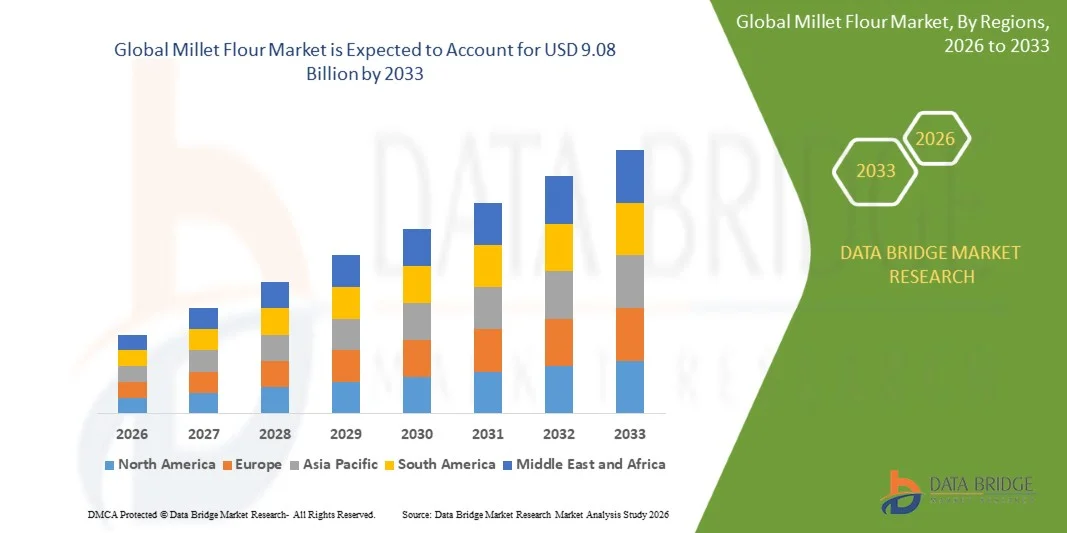
As per Data Bridge Market Research Analysis, the millet flour market was valued at USD 5.79 billion in 2025 and is projected to reach USD 9.08 billion by 2033, growing at a CAGR of 5.80% from 2026 to 2033. Market growth is supported by rising demand for gluten-free foods, whole-grain nutrition, clean-label ingredients, packaged health foods, organic products, and millet-based bakery, snack, baby-food, and household cooking applications. The 2025 and 2033 values are standardized projections derived by applying the source's published 5.80% CAGR to its historical market baseline.
Millet flour is produced by cleaning and milling grains such as pearl millet, finger millet, sorghum, foxtail millet, proso millet, barnyard millet, and little millet. It is used in flatbreads, cakes, cookies, breads, porridge, snacks, infant foods, mixes, and blended flour formulations. The market is moving from mainly local and unbranded consumption toward packaged retail products, certified organic flour, ready-to-use baking mixes, and industrial ingredients. However, differences in taste, colour, particle size, dough behaviour, shelf stability, and supply quality can make large-scale standardization more difficult than it is for wheat flour.
Market Size & Forecast
- Market Value (2025): USD 5.79 Billion
- Expected Market Value (2033): USD 9.08 Billion
- Forecast CAGR (2026-2033): 5.80%
- Leading Region: Asia-Pacific
- Fastest-Growing Region: North America
What are the Major Takeaways of Millet Flour Market?
- Asia-Pacific dominated the millet flour market with the largest revenue share of 35.5% in 2025, supported by strong traditional consumption, extensive cultivation, a large processing base, public promotion programs, and expanding packaged-food demand across India, China, Japan, and Southeast Asia.
- North America is expected to be the fastest-growing region from 2026 to 2033. Growth is driven by increasing gluten-free product adoption, consumer interest in ancient grains, strong specialty retail and e-commerce networks, and wider use of millet flour in bakery mixes and health-focused formulations.
- The pearl millet flour segment held the largest market revenue share of approximately 34.3% in 2026 driven by its broad cultivation base, affordable pricing, and established use in household cooking, flatbreads, porridges, blended flour, and processed foods. Pearl millet flour is preferred due to its supply availability and compatibility with both traditional recipes and modern product formulations.
- The finger millet flour segment is projected to register the fastest growth from 2026 to 2033, driven by increasing demand for calcium-focused nutrition, infant cereals, porridges, bakery products, and premium health foods. Rising product availability through packaged retail and e-commerce channels is accelerating segment expansion.
- The conventional segment held the largest market revenue share of approximately 62.9% in 2026 driven by its wider availability, established agricultural and milling networks, and lower cost compared with certified organic alternatives. Conventional flour is preferred for household consumption and large-volume food processing where supply consistency and price competitiveness are critical.
- The organic segment is projected to register the fastest growth from 2026 to 2033, driven by increasing demand for traceable sourcing, reduced synthetic-input use, clean-label products, and premium whole-food ingredients. Expansion of organic retail, specialist e-commerce, and direct-to-consumer brands is accelerating segment growth.
Report Scope and Millet Flour Market Segmentation
|
Attributes |
Millet Flour Key Market Insights |
|
Segments Covered |
|
|
Countries Covered |
North America
Europe
Asia-Pacific
Middle East and Africa
South America
|
|
Key Market Players |
|
|
Market Opportunities |
|
|
Value Added Data Infosets |
In addition to the insights on market scenarios such as market value, growth rate, segmentation, geographical coverage, and major players, the market reports curated by the Data Bridge Market Research also include in-depth expert analysis, pricing analysis, brand share analysis, consumer survey, demography analysis, supply chain analysis, value chain analysis, raw material/consumables overview, vendor selection criteria, PESTLE Analysis, Porter Analysis, and regulatory framework. |
What is the Key Trend in the Millet Flour Market?
Trend: Accelerating Adoption Of Gluten-Free, Clean-Label, And Ready-To-Use Millet Flour Products
Growing consumer preference for naturally gluten-free grains, whole-grain nutrition, recognizable ingredients, and convenient food preparation is accelerating the adoption of millet flour across the global food and beverage industry. Food manufacturers are increasingly incorporating millet flour into bakery products, breakfast cereals, snacks, infant nutrition products, and health-focused food formulations to address rising demand for nutritious and functional grain alternatives. The nutritional profile of millet, including its fiber content, plant-based protein, and micronutrient composition, coupled with growing consumer interest in clean-label foods, is further strengthening demand for millet flour products. The expansion of specialty bakery and patisserie applications is creating sustained demand for ready-to-use millet flour blends that offer improved processing consistency, baking performance, and consumer convenience.
For instance, Puratos introduced Easy Puravita Millet Bread Mix and Tegral Satin Millet Cake Mix, incorporating millet-based grain blends designed to provide standardized and convenient solutions for commercial bread and cake production. This development reflects increasing industry investment in value-added millet-based ingredients that support broader adoption across professional bakery applications.
The growing shift toward gluten-free nutrition and continued investments in convenient millet-based food solutions are expected to reinforce long-term demand for millet flour, positioning manufacturers to benefit from increasing consumer interest in healthier grain alternatives and functional food products.
Millet Flour Market Dynamics
Key Market Driver: Rising Demand For Nutritious, Gluten-Free, And Functional Grain Products
The global food industry continues to experience rising demand for naturally gluten-free grains due to increasing consumer awareness of digestive health, plant-based nutrition, dietary fiber, and clean-label food ingredients. Consumers are increasingly seeking alternatives to conventional wheat-based products, encouraging food manufacturers to expand millet-based product portfolios across bakery, snack, cereal, infant nutrition, and foodservice applications. Government initiatives supporting millet cultivation, food security programs, and investments in agricultural value chains continue to strengthen market development.
According to APEDA, India accounted for approximately 42.75% of global millet production based on FAO 2023 data, supported by government programs promoting millet processing, value-added products, and domestic consumption. This strong production base is encouraging manufacturers to launch millet flour products, baking mixes, snacks, and nutritional foods that cater to growing health-conscious consumer demand.
As consumer preference for functional and nutrient-rich food products continues to expand, millet flour manufacturers are expected to benefit from sustained demand driven by gluten-free food trends, nutritional awareness, and increasing investments in millet-based product innovation.
Key Restraint/Challenge: Variability In Processing Performance And Consumer Adoption
Millet flour manufacturers remain challenged by variability in grain quality, milling characteristics, storage conditions, and functional performance across different millet varieties. Differences in flavor, color, particle size, fat content, water absorption, and baking behavior can affect product consistency and consumer acceptance. In addition, natural lipid content may contribute to rancidity and shelf-life limitations, requiring specialized processing, packaging, and stabilization techniques.
For instance, Puratos specifies a shelf life of approximately 183 days for its Easy Puravita Millet Bread Mix, highlighting the importance of controlled formulation, ingredient stabilization, packaging technology, and storage management in maintaining product quality and commercial viability. These factors continue to create operational challenges for manufacturers seeking to expand millet flour adoption across new consumer markets.
Despite growing consumer interest, processing variability, shelf-life management requirements, and limited familiarity with millet-based products are expected to remain significant restraints, influencing product consistency, consumer acceptance, and market expansion throughout the forecast period.
Key Market Opportunity: Expansion Of Value-Added Millet Foods And Nutrition Products
Food manufacturers, nutrition companies, and consumer brands are increasingly investing in value-added millet-based products to capitalize on growing demand for healthy, convenient, and functional foods. Millet flour offers significant opportunities across bread mixes, cake mixes, pancakes, porridges, snacks, infant cereals, fortified foods, and direct-to-consumer nutrition products. Premium product categories such as organic, sprouted, fortified, and single-origin millet flour are also creating new opportunities for market differentiation.
For instance, in February 2026, Reliance Consumer Products acquired Southern Health Foods, adding the Manna brand and its portfolio of millet-based foods, nutrition products, baby foods, beverage mixes, and millet flour products. The acquisition demonstrates growing industry confidence in organized millet-based food categories and highlights the commercial potential of expanding millet product distribution through large-scale consumer goods networks.
As food manufacturers accelerate investments in functional nutrition, value-added grain products, and consumer health solutions, increasing adoption of millet-based foods and convenient product formats is expected to create substantial long-term growth opportunities for the global millet flour market.
How is the Millet Flour Market Segmented?
The millet flour market is segmented on the basis of source type, nature, application, and distribution channel.
- By Source Type
On the basis of source type, the market includes pearl millet flour, finger millet flour, sorghum millet flour, foxtail millet flour, proso millet flour, barnyard millet flour, little millet flour, and other millet flours. The pearl millet flour segment held the largest market revenue share of approximately 34.3% in 2026 driven by its broad cultivation base, affordable pricing, and established use in household cooking, flatbreads, porridges, blended flour, and processed foods. Pearl millet flour is preferred due to its supply availability and compatibility with both traditional recipes and modern product formulations.
The finger millet flour segment is projected to register the fastest growth from 2026 to 2033, driven by increasing demand for calcium-focused nutrition, infant cereals, porridges, bakery products, and premium health foods. Rising product availability through packaged retail and e-commerce channels is accelerating segment expansion.
- By Nature
On the basis of nature, the market is divided into conventional and organic millet flour. The conventional segment held the largest market revenue share of approximately 62.9% in 2026 driven by its wider availability, established agricultural and milling networks, and lower cost compared with certified organic alternatives. Conventional flour is preferred for household consumption and large-volume food processing where supply consistency and price competitiveness are critical.
The organic segment is projected to register the fastest growth from 2026 to 2033, driven by increasing demand for traceable sourcing, reduced synthetic-input use, clean-label products, and premium whole-food ingredients. Expansion of organic retail, specialist e-commerce, and direct-to-consumer brands is accelerating segment growth.
- By Application
On the basis of application, the market is segmented into bakery and confectionery, snacks, baby food, dietary supplements, sauces and dressings and condiments, and other applications. The bakery and confectionery segment held the largest market revenue share of approximately 36.8% in 2026 driven by the growing use of millet flour in breads, cakes, biscuits, cookies, muffins, pancakes, and gluten-free blends. The segment benefits from continuous product innovation and compatibility with multigrain formulations.
The baby food segment is projected to register the fastest growth from 2026 to 2033, driven by increasing demand for nutrient-dense porridges, complementary foods, and age-appropriate cereal formulations. Growing parental interest in whole grains and the launch of millet-based infant and family nutrition products are accelerating segment expansion.
- By Distribution Channel
On the basis of distribution channel, the market is divided into direct sales and indirect sales. The indirect sales segment held the largest market revenue share of approximately 71.8% in 2026 driven by the extensive reach of supermarkets, specialty stores, wholesalers, distributors, regional grocery chains, and e-commerce marketplaces. Indirect channels are preferred because they provide broad consumer access, multiple pack sizes, and convenient product comparison.
The direct sales segment is projected to register the fastest growth from 2026 to 2033, driven by increasing industrial supply to bakeries and food manufacturers and the expansion of digital-first consumer brands. Direct engagement allows suppliers to provide recipes, product education, subscriptions, and specialty varieties while obtaining faster feedback on consumer preferences.
Which Region Holds the Largest Share of the Millet Flour Market?
Asia-Pacific Millet Flour Market Insight
Asia-Pacific dominated the millet flour market with the largest revenue share of 35.5% in 2025, supported by strong traditional consumption, large-scale millet production, government promotion, organised food processing, and expanding retail distribution across India, China, Japan, and Southeast Asia. The region benefits from both household demand and a growing packaged-food sector that is introducing millet flour in bakery, snack, breakfast, infant-nutrition, and health-food products.
China Millet Flour Market Insight
China dominated the millet flour market with the largest revenue share in 2025 an important Asia-Pacific market, supported by traditional millet consumption, a large food-processing industry, e-commerce penetration, and increasing interest in whole grains and health-focused diets. Millet flour is being incorporated into porridges, bakery products, noodles, cereal blends, infant foods, and convenience meals, while local agricultural production and milling capacity support commercial availability.
Japan Millet Flour Market Insight
Japan is expected to witness the fastest growth rate from 2026 to 2033 a quality-focused market where demand is supported by allergy-aware foods, gluten-free baking ingredients, convenient small packs, and carefully processed health products. Suppliers compete through traceability, fine milling, consistent flavour, clear nutrition information, and product formats suited to bakery products, noodles, snacks, cereal blends, and traditional grain preparations.
North America Millet Flour Market Insight
North America is expected to witness the fastest growth rate from 2026 to 2033, primarily driven by rising gluten-free product adoption, consumer interest in ancient grains, expanding specialty retail, and increased availability through supermarkets and online channels. The region also benefits from strong home-baking culture and demand from bakeries, snack manufacturers, and natural-food brands.
U.S. Millet Flour Market Insight
The U.S. is expected to witness the fastest growth rate from 2026 to 2033, supported by established gluten-free brands, specialty flour distribution, online retail, and broad use of alternative grains in breads, cookies, pancakes, cereals, and flour blends. Product growth is linked to certified gluten-free handling, recipe guidance, organic positioning, and wider availability from companies such as Bob's Red Mill, Arrowhead Mills, and Azure Standard.
Europe Millet Flour Market Insight
Europe is expected to witness the fastest growth rate from 2026 to 2033 an established specialty market supported by organic food demand, gluten-free bakery, natural ingredients, and interest in climate-resilient grains. Food manufacturers are evaluating millet flour in bread, biscuits, crackers, cereals, and baby foods, while regional food-safety, allergen-management, traceability, and organic-certification requirements create strong demand for documented processing quality.
Germany Millet Flour Market Insight
Germany is expected to witness the fastest growth rate from 2026 to 2033an important European market because of its mature organic-food sector, strong bakery culture, and increasing demand for gluten-free and whole-grain alternatives. Millet flour is used in artisan breads, multigrain mixes, cookies, porridges, and baby-food products, while ingredient transparency, certification, consistent particle size, and reliable labelling influence supplier selection.
U.K. Millet Flour Market Insight
The U.K. market is expected to witness the fastest growth rate from 2026 to 2033 supported by a developed gluten-free bakery sector, organic retail, multicultural food demand, and extensive online grocery use. Millet flour is used in home baking, flatbreads, pancakes, cakes, and blended flour products, while smaller pack sizes, recipe support, and multipurpose mixes help suppliers introduce the product to consumers who are less familiar with millet-based cooking.
Which are the Top Companies in Millet Flour Market?
The millet flour market is led by following established companies:
- Bob's Red Mill Natural Foods, Inc. (U.S.)
- Southern Health Foods Pvt. Ltd.(India)
- Great River Organic Milling (U.S.)
- Ardent Mills LLC (U.S.)
- King Arthur Baking Company, Inc. (U.S.)
- ITC Limited (India)
- Arrowhead Mills (U.S.)
- Pristine Organics Pvt. Ltd. (India)
- Azure Standard (U.S.)
- Southern Health Foods Pvt. Ltd.
- Doves Farm Foods Ltd. (United Kingdom)
- Jiwa Foods Pvt. Ltd. (India)
- Rani Foods, Inc. (U.S.)
What are Latest Developments in Millet Flour Market?
- In February 2026, Reliance Consumer Products Limited acquired Southern Health Foods Private Limited, owner of the Manna brand. The transaction added millet flour, millet-based staples, mixes, drinks, baby foods, and multigrain products to Reliance's food portfolio and is intended to support wider national distribution through the group's research, supply-chain, and market capabilities.
- In November 2025, ICAR-Indian Institute of Millets Research launched Girijana Bazar, a mobile millet-market initiative designed to strengthen market access for tribal Farmer Producer Organizations. The platform showcases millet flours, cookies, muffins, pasta, flakes, and other products while supporting direct consumer engagement and millet-based entrepreneurship.

- Interactive Data Analysis Dashboard
- Company Analysis Dashboard for high growth potential opportunities
- Research Analyst Access for customization & queries
- Competitor Analysis with Interactive dashboard
- Latest News, Updates & Trend analysis
- Harness the Power of Benchmark Analysis for Comprehensive Competitor Tracking
Global Millet Flour Market, Supply Chain Analysis and Ecosystem Framework
To support market growth and help clients navigate the impact of geopolitical shifts, DBMR has integrated in-depth supply chain analysis into its Global Millet Flour Market research reports. This addition empowers clients to respond effectively to global changes affecting their industries. The supply chain analysis section includes detailed insights such as Global Millet Flour Market consumption and production by country, price trend analysis, the impact of tariffs and geopolitical developments, and import and export trends by country and HSN code. It also highlights major suppliers with data on production capacity and company profiles, as well as key importers and exporters. In addition to research, DBMR offers specialized supply chain consulting services backed by over a decade of experience, providing solutions like supplier discovery, supplier risk assessment, price trend analysis, impact evaluation of inflation and trade route changes, and comprehensive market trend analysis.
Data collection and base year analysis are done using data collection modules with large sample sizes. The stage includes obtaining market information or related data through various sources and strategies. It includes examining and planning all the data acquired from the past in advance. It likewise envelops the examination of information inconsistencies seen across different information sources. The market data is analysed and estimated using market statistical and coherent models. Also, market share analysis and key trend analysis are the major success factors in the market report. To know more, please request an analyst call or drop down your inquiry.
The key research methodology used by DBMR research team is data triangulation which involves data mining, analysis of the impact of data variables on the market and primary (industry expert) validation. Data models include Vendor Positioning Grid, Market Time Line Analysis, Market Overview and Guide, Company Positioning Grid, Patent Analysis, Pricing Analysis, Company Market Share Analysis, Standards of Measurement, Global versus Regional and Vendor Share Analysis. To know more about the research methodology, drop in an inquiry to speak to our industry experts.
Data Bridge Market Research is a leader in advanced formative research. We take pride in servicing our existing and new customers with data and analysis that match and suits their goal. The report can be customized to include price trend analysis of target brands understanding the market for additional countries (ask for the list of countries), clinical trial results data, literature review, refurbished market and product base analysis. Market analysis of target competitors can be analyzed from technology-based analysis to market portfolio strategies. We can add as many competitors that you require data about in the format and data style you are looking for. Our team of analysts can also provide you data in crude raw excel files pivot tables (Fact book) or can assist you in creating presentations from the data sets available in the report.













