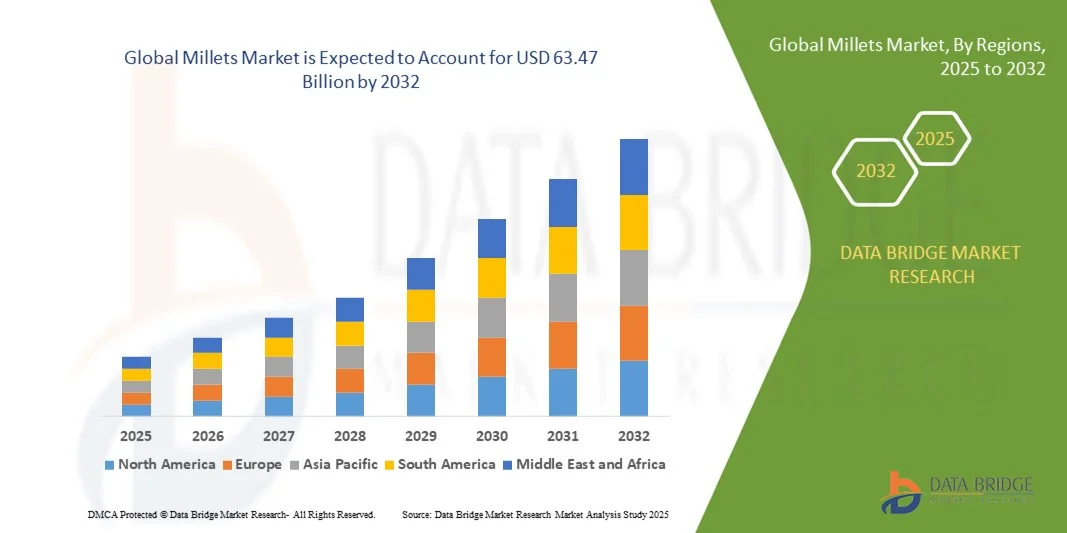
Global Millets Market Size
- The global Millets Market size was valued at USD 39.23 billion in 2024 and is expected to reach USD 63.47 billion by 2032, growing at a CAGR of 6.20% during the forecast period
- The market growth is primarily driven by increasing consumer awareness of millets’ health benefits, including their high nutritional value and gluten-free properties, which are fueling demand globally
- Additionally, the rising trend towards sustainable and climate-resilient crops, along with government initiatives promoting millet cultivation and consumption, is further accelerating market expansion and adoption across various regions
Global Millets Market Analysis
- Millets, a group of small-seeded cereal grains, are gaining prominence as nutritious and climate-resilient crops, increasingly valued for their high fiber, protein content, and gluten-free properties, making them a preferred choice in health-conscious diets globally
- The growing demand for millets is primarily driven by rising consumer awareness about their health benefits, increasing adoption of gluten-free and sustainable food products, and expanding applications in both traditional and innovative food products
- Asia-Pacific dominated the millets market with the largest revenue share of 45.3% in 2024, supported by strong agricultural production, government initiatives promoting millet consumption, and growing consumer preference for healthy and organic foods, especially in countries like India and China
- North America is expected to be the fastest-growing region in the millets market during the forecast period, driven by rising health awareness, increasing vegan and gluten-free populations, and expanding availability of millet-based products in retail and foodservice sectors
- The pearl millet segment dominated the market with the largest revenue share of 38.7% in 2024, owing to its widespread cultivation, high nutritional value, and versatility across various food applications
Report Scope and Global Millets Market Segmentation
|
Attributes |
Millets Key Market Insights |
|
Segments Covered |
|
|
Countries Covered |
North America
Europe
Asia-Pacific
Middle East and Africa
South America
|
|
Key Market Players |
|
|
Market Opportunities |
|
|
Value Added Data Infosets |
In addition to the insights on market scenarios such as market value, growth rate, segmentation, geographical coverage, and major players, the market reports curated by the Data Bridge Market Research also include in-depth expert analysis, pricing analysis, brand share analysis, consumer survey, demography analysis, supply chain analysis, value chain analysis, raw material/consumables overview, vendor selection criteria, PESTLE Analysis, Porter Analysis, and regulatory framework. |
Global Millets Market Trends
Enhanced Convenience Through AI and Voice Integration
- A significant and accelerating trend in the global Millets Market is the increasing incorporation of advanced technologies such as AI-driven agricultural tools and digital platforms that help farmers optimize millet cultivation, improve yield prediction, and manage supply chains more efficiently. This technological integration is enhancing overall productivity and sustainability in millet farming.
- For instance, AI-powered apps and platforms are being used to analyze soil health, weather patterns, and crop diseases, enabling millet farmers to make data-driven decisions. Companies like CropIn and Taranis are pioneering these solutions, providing actionable insights that improve millet farming outcomes.
- AI integration in millet agriculture enables features such as predictive analytics for pest control, optimized irrigation scheduling, and personalized crop management advice. This not only reduces crop losses but also enhances resource efficiency. Additionally, digital platforms are improving market access by connecting millet producers directly with buyers, fostering transparency and better pricing.
- The seamless integration of AI with mobile and cloud-based applications facilitates centralized monitoring of farming activities, allowing farmers and stakeholders to manage multiple aspects of millet production through a single interface. This creates a more streamlined and automated agricultural ecosystem.
- This trend towards smarter, technology-driven millet farming is fundamentally transforming traditional agriculture practices. Consequently, agritech companies and startups are developing AI-enabled tools tailored specifically for millet cultivation, supporting farmers in achieving higher yields and sustainability goals.
- The demand for AI-powered solutions and digital platforms in the millets sector is growing rapidly, driven by farmers’ increasing focus on efficiency, sustainability, and better market connectivity across both small-scale and commercial farming operations.
Global Millets Market Dynamics
Driver
Growing Need Due to Rising Health Awareness and Sustainable Agriculture Adoption
- The increasing awareness among consumers about the health benefits of millets, along with the rising focus on sustainable and climate-resilient agriculture practices, is a significant driver for the growing demand for millets globally.
- For instance, in 2024, several government initiatives and NGOs across countries like India and Kenya launched campaigns promoting millet consumption as a nutritious, drought-resistant crop. Such efforts by key stakeholders are expected to accelerate market growth during the forecast period.
- As consumers become more health-conscious and seek gluten-free, high-fiber, and nutrient-rich food options, millets offer a compelling alternative to conventional cereals, boosting their adoption in both traditional and modern food products.
- Furthermore, the growing emphasis on environmentally sustainable farming and food security is positioning millets as an important crop for future food systems, encouraging farmers and policymakers to support millet cultivation.
- The rising demand for millet-based products in bakery, snacks, and ready-to-eat segments, alongside increasing availability in supermarkets and online platforms, is also propelling the market growth across both urban and rural
Restraint/Challenge
Challenges Related to Limited Awareness and Supply Chain Constraints
- Limited consumer awareness in certain regions about millet’s nutritional benefits and culinary uses poses a challenge to wider market penetration. Despite growing interest, many consumers still lack familiarity with millets compared to staple grains like rice and wheat.
- For instance, in many Western countries, millets remain niche products with limited shelf presence and minimal consumer education, restricting broader adoption.
- Additionally, supply chain constraints such as inconsistent production volumes, lack of standardized processing facilities, and inadequate cold storage infrastructure affect the availability and quality of millet products. Small-scale farmers often face challenges in accessing modern agricultural inputs and markets, limiting scalability.
- Addressing these challenges through government support programs, consumer awareness campaigns, improved supply chain logistics, and partnerships between agribusinesses and farmers will be critical to overcoming market barriers.
- While prices for millets are competitive, fluctuating yields and limited large-scale commercial farming can result in price volatility, which may deter some buyers, especially in price-sensitive markets.
- Overcoming these issues through enhanced farmer training, infrastructure development, and stronger market linkages will be vital for sustained growth and mainstream adoption of millets globally.
Global Millets Market Scope
The market is segmented on the basis of product, application, and distribution channel.
- By Product
On the basis of product type, the global millets market is segmented into pearl millet, finger millet, foxtail millet, and proso millet. The pearl millet segment dominated the market with the largest revenue share of 38.7% in 2024, owing to its widespread cultivation, high nutritional value, and versatility across various food applications. Pearl millet is favored in many regions due to its drought resistance and role as a staple cereal, especially in Asia and Africa.
The Finger millet is anticipated to witness the fastest growth rate with a CAGR of approximately 22.3% from 2025 to 2032, driven by its increasing use in infant nutrition and health-conscious food products due to its rich calcium content. Additionally, finger millet’s adoption in gluten-free and functional foods is contributing to its rapid market expansion. Foxtail and proso millets are also gaining traction for their suitability in processed foods and animal fodder, supporting diverse end-use applications.
- By Application
On the basis of application, global millets market is segmented based on application into infant food, bakery products, beverages, breakfast food, and fodder. The bakery products segment accounted for the largest market revenue share of 34.5% in 2024, driven by the rising incorporation of millets in gluten-free and healthy baked goods such as bread, cookies, and snacks. Increasing consumer demand for nutritious alternatives is pushing bakery manufacturers to innovate with millet-based flours.
The infant food segment is expected to witness the fastest CAGR of 23.1% from 2025 to 2032, fueled by growing awareness of millet’s nutritional benefits for infants and toddlers, including high fiber and mineral content that supports healthy growth. Millets are also increasingly used in beverages and breakfast cereals, expanding their reach among health-conscious consumers. The fodder segment, although smaller, plays a crucial role in supporting sustainable livestock farming.
- By Distribution Channel
On the basis of distribution channel, global millets market is categorized into trade associations, supermarkets, traditional grocery stores, online stores, and others. Supermarkets dominated the market with the largest revenue share of 42.8% in 2024, benefiting from increased consumer access to organized retail formats and the growing trend of health food shopping in urban areas. Supermarkets offer convenience, variety, and product information that boost millet purchases.
The Online stores are projected to be the fastest growing channel with a CAGR of 25.4% from 2025 to 2032, driven by the rise of e-commerce, wider product availability, and the convenience of doorstep delivery, especially in metropolitan and health-conscious consumer segments. Traditional grocery stores and trade associations continue to hold significant shares, particularly in rural and semi-urban regions where millet consumption remains high. The growing penetration of digital platforms is rapidly transforming the millet distribution landscape.
Global Millets Market Regional Analysis
- Asia-Pacific dominated the global millets market with the largest revenue share of 45.3% in 2024, driven by strong traditional consumption, high millet production, and increasing government initiatives promoting millet cultivation and awareness
- Consumers in the region increasingly recognize millets for their nutritional benefits, sustainability, and role in food security, leading to growing demand in both rural and urban areas, especially in countries like India, China, and Nigeria
- This widespread adoption is further supported by rising health consciousness, expanding organic and gluten-free food markets, and favorable agricultural policies, establishing millets as a preferred grain for various food applications across households and food industries
Japan Millets Market Insight
The Japan millets market is gaining momentum due to the country’s emphasis on health, longevity, and functional foods. Millets are increasingly viewed as an ideal fit for Japan’s aging population, offering digestive and cardiovascular benefits. Traditional food formats such as millet porridge are being reintroduced in modern, convenient versions, while innovative millet-based snacks and beverages are capturing consumer interest. Additionally, Japan’s commitment to sustainability and local farming supports the cultivation and use of millets in both domestic cuisine and health product development.
China Millets Market Insight
The China millets market accounted for the largest market revenue share in Asia Pacific in 2024, attributed to the country’s long-standing agricultural history with millet cultivation and the modern revival of ancient grains in health-conscious diets. Millets are widely consumed in both rural and urban areas, with increasing application in cereals, baby food, and functional food categories. Government initiatives promoting rural revitalization and sustainable agriculture are reinforcing millet production, while the presence of strong domestic brands and e-commerce platforms is improving accessibility. Rising health concerns and lifestyle-related diseases are also pushing Chinese consumers toward millet-based diets.
U.S. Millets Market Insight
The U.S. millets market captured the largest revenue share of 79% in North America in 2024, fueled by rising demand for functional foods and gluten-free alternatives. The increasing consumer focus on gut health, clean-label products, and plant-based diets is encouraging food manufacturers to incorporate millets into cereals, snacks, and baked goods. Millets are gaining traction in both retail and food service sectors, particularly among health-conscious consumers and specialty diet followers. The growing trend of ancient grains, along with robust distribution through organic and natural food channels, continues to drive market expansion in the U.S.
Europe Millets Market Insight
The Europe millets market is projected to expand at a substantial CAGR throughout the forecast period, primarily driven by increasing demand for sustainable, high-fiber grains and an evolving interest in traditional, nutrient-rich crops. Urban consumers are gravitating toward healthier, natural food options, with millets being increasingly used in breakfast products, vegan recipes, and gluten-free formulations. Supportive agricultural policies, coupled with a strong organic food movement across countries like Germany, France, and the U.K., are further promoting the regional millet market. Both retail and foodservice segments are witnessing growing adoption of millet-based products across Europe.
U.K. Millets Market Insight
The U.K. millets market is anticipated to grow at a noteworthy CAGR during the forecast period, driven by a rising inclination towards plant-based eating and the increased popularity of ancient grains. With consumers prioritizing health and sustainability, millets are emerging as a preferred choice in the gluten-free and organic product categories. The presence of diverse ethnic cuisines and the growing demand for alternative grains in baking and snacking are further stimulating market growth. Retailers are expanding millet-based product offerings in response to shifting dietary trends and a heightened focus on food transparency and nutritional value.
Germany Millets Market Insight
The Germany millets market is expected to expand at a considerable CAGR during the forecast period, fueled by growing health awareness, environmental sustainability concerns, and a strong demand for organic food products. German consumers are embracing millets for their ecological benefits and nutritional profile, particularly in plant-based diets. The country’s well-developed health food and bio markets are supporting increased availability and innovation in millet-based foods, ranging from flours and cereals to ready meals. Additionally, the rising interest in climate-resilient crops is aligning well with Germany’s sustainability goals, encouraging wider adoption of millets.
Global Millets Market Share
The Millets industry is primarily led by well-established companies, including:
- Cargill (U.S.)
- Archer Daniels Midland Company (U.S.)
- Seedway, LLC. (U.S.)
- Ernst Conservation Seeds (U.S.)
- Eastern Colorado Seeds, LLC (U.S.)
- Roundstone Native Seed Company (U.S.)
- Allied Seed, LLC (U.S.)
- Janadhanya Farmers Producer Company Limited (India)
- Sresta Natural Bioproducts Pvt Ltd (India)
- Just Organik (India)
- Earthon Products Pvt Ltd (India)
- Shimla Hills Offerings Pvt. Ltd. (India)
- Pristine Organics Pvt Ltd. (India)
- Sahaja Samrudha Organic Producer Company Ltd (SSOPCL) (India)
- Viruthai Millets Farmer Producer Company Ltd. (India)
- Crystal Crop Protection Pvt. Ltd. (India)
- DUGAD Agro Foods (India)
- Croda International Plc (U.K.)
- Nestlé S.A. (Switzerland)
- NH Foods Ltd (Japan)
- Bayer Crop Science AG (Germany)
- BASF SE (Germany)
- Mirfak Pty Ltd, Nuts in Bulk (Australia)
- RR Agroflorestal LTDA (Brazil)
- Kerry Group plc (Ireland)
- BrettYoung (Canada)
What are the Recent Developments in Global Millets Market?
- In April 2023, Karnataka State Agricultural Marketing Board (KSAMB) launched a strategic initiative in India aimed at boosting millet cultivation and promoting millet-based products to enhance nutrition and farmer incomes. This program focuses on providing advanced farming techniques, supply chain improvements, and market linkages tailored to regional agricultural practices. By leveraging local expertise and government support, KSAMB is addressing food security challenges while reinforcing India’s position as a leading player in the global millets market.
- In March 2023, Sresta Natural Bioproducts Pvt Ltd, an Indian organic food company, introduced a new range of millet-based infant cereals targeting health-conscious parents. The innovative product line emphasizes organic sourcing, nutrient density, and ease of digestion, positioning millets as an essential component of infant nutrition. This launch highlights Sresta’s commitment to expanding millet consumption across diverse consumer segments and promoting millet-based healthy eating habits.
- In March 2023, BASF SE, a global leader in agricultural solutions, announced its partnership with millet farmers in Africa to improve crop yields through sustainable seed treatments and bio-fertilizers. This initiative aims to enhance millet productivity, ensure resilience to climate change, and support local economies. BASF’s involvement underscores the growing importance of millets in addressing food security while promoting sustainable farming practices in emerging markets.
- In February 2023, Earthon Products Pvt Ltd, a notable player in organic and natural foods in India, announced a strategic collaboration with regional trade associations to expand millet product distribution through supermarkets and online platforms. This partnership is designed to increase consumer access to diverse millet-based foods and promote awareness of millets’ nutritional benefits. The initiative reinforces Earthon’s dedication to innovation and operational growth within the millet supply chain.
- In January 2023, Nestlé S.A., a global food and beverage giant, launched a pilot program incorporating millets into its breakfast cereals in select European markets. This initiative reflects growing consumer demand for ancient grains and gluten-free options. Nestlé’s integration of millets into mainstream food products demonstrates its commitment to health trends and sustainability, supporting the global expansion of millet-based foods.

- Interactive Data Analysis Dashboard
- Company Analysis Dashboard for high growth potential opportunities
- Research Analyst Access for customization & queries
- Competitor Analysis with Interactive dashboard
- Latest News, Updates & Trend analysis
- Harness the Power of Benchmark Analysis for Comprehensive Competitor Tracking
Table of Content
1 INTRODUCTION
1.1 OBJECTIVES OF THE STUDY
1.2 MARKET DEFINITION
1.3 OVERVIEW OF GLOBAL MILLETS MARKET
1.4 CURRENCY AND PRICING
1.5 LIMITATION
1.6 MARKETS COVERED
2 MARKET SEGMENTATION
2.1 KEY TAKEAWAYS
2.2 ARRIVING AT THE GLOBAL MILLETS MARKETSIZE
2.2.1 VENDOR POSITIONING GRID
2.2.2 TECHNOLOGY LIFE LINE CURVE
2.2.3 MARKET GUIDE
2.2.4 COMPANY POSITIONING GRID
2.2.5 COMAPANY MARKET SHARE ANALYSIS
2.2.6 MULTIVARIATE MODELLING
2.2.7 DEMAND AND SUPPLY-SIDE VARIABLES
2.2.8 TOP TO BOTTOM ANALYSIS
2.2.9 STANDARDS OF MEASUREMENT
2.2.10 VENDOR SHARE ANALYSIS
2.2.11 DATA POINTS FROM KEY PRIMARY INTERVIEWS
2.2.12 DATA POINTS FROM KEY SECONDARY DATABASES
2.3 GLOBAL MILLETS MARKET: RESEARCH SNAPSHOT
2.4 ASSUMPTIONS
3 MARKET OVERVIEW
3.1 DRIVERS
3.2 RESTRAINTS
3.3 OPPORTUNITIES
3.4 CHALLENGES
4 EXECUTIVE SUMMARY
5 PREMIUM INSIGHTS
5.1 VALUE CHAIN ANALYSIS
5.2 SUPPLY CHAIN ANALYSIS
5.3 PORTER’S FIVE FORCES ANALYSIS
5.3.1 BARGAINING POWER OF SUPPLIERS
5.3.2 BARGAINING POWER OF BUYERS/CONSUMERS
5.3.3 THREAT OF NEW ENTRANTS
5.3.4 THREAT OF SUBSTITUTE PRODUCTS
5.3.5 INTENSITY OF COMPETITIVE RIVALRY
5.4 GROWTH STRATEGIES ADOPTED BY KEY MARKET PLAYERS
5.5 REGULATION COVERAGES
5.6 OVERVIEW OF TECHNOLOGICAL INNOVATIONS
5.7 NEW PRODUCT LAUNCHES
5.8 INDUSTRY TRENDS AND FUTURE PERSPECTIVE
5.9 FACTOR INFLUENCING PURCHASE DECISION OF END-USERS
6 REGULATORY FRAMEWORK AND GUIDELINES
7 ANNUAL PRODUCTION HISTORY BY COUNTRY AND 5-10 YEAR ESTIMATE
8 ANNUAL DEMAND HISTORY BY COUNTRY AND 5-10 YEAR ESTIMATE.
9 PURCHASE PRICE HISTORY BY COUNTRY AND 5-10 YEAR ESTIMATE
10 SALES PRICE HISTORY BY COUNTRY AND 5-10 YEAR ESTIMATE
11 OVERVIEW ON PHOSPHATE, CHEMICAL, FERTILIZER, IRON, PETROLEUM, COCOA, COFFEE, COTTON, PALM OIL, MILLET SORGHUM, CORN, SUGAR, RICE, CASHEW AND NUTS
12 GLOBAL MILLETS MARKET, BY CATEGORY, 2022-2031, (USD MILLION)
12.1 OVERVIEW
12.2 NAKED VARIETY
12.3 HUSKED VARIETY
13 GLOBAL MILLETS MARKET, BY PRODUCT TYPE, 2022-2031, (USD MILLION)
13.1 OVERVIEW
13.2 SORGHUM
13.2.1 SORGHUM, BY COLOR
13.2.1.1. YELLOW
13.2.1.2. CREAM
13.2.1.3. WHITE
13.2.1.4. HETERO-WHITE
13.2.1.5. BRONZE
13.2.1.6. LEMON YELLOW
13.2.1.7. ORANGE
13.2.1.8. REDDISH-BROWN
13.2.1.9. HETERO-YELLOW
13.2.1.10. DARK-RED
13.2.1.11. WHITE-BROWN
13.2.1.12. PEARLY-WHITE
13.2.1.13. CHALKY-WHITE
13.3 PEARL MILLET
13.3.1 PEARL MILLET, BY COLOR
13.3.1.1. PALE YELLOW
13.3.1.2. BROWN
13.3.1.3. GREY
13.3.1.4. SLATE BLUE
13.3.1.5. WHITE
13.3.1.6. PURPLE.
13.4 FINGER MILLET
13.4.1 FINGER MILLET, BY COLOR
13.4.1.1. WHITE
13.4.1.2. BROWN
13.5 LITTLE MILLET
13.5.1 LITTLE MILLET, BY COLOR
13.5.1.1. STRAW WHITE
13.5.1.2. GREY
13.6 PORSO MILLET
13.7 KODO MILLET
13.7.1 KODO MILLET, BY COLOR
13.7.1.1. LIGHT BROWN
13.7.1.2. DARK GREY.
13.8 FOXTAIL MILLET
13.8.1 FOXTAIL MILLET, BY COLOR
13.8.1.1. PALE YELLOW TO ORANGE
13.8.1.2. RED
13.8.1.3. BROWN
13.8.1.4. BLACK
13.9 BARNYARD MILLET
13.9.1 BARNYARD MILLET, BY COLOR
13.9.1.1. WHITE
13.9.1.2. YELLOW
14 GLOBAL MILLETS MARKET, BY END USE, 2022-2031, (USD MILLION)
14.1 OVERVIEW
14.2 FOOD AND BEVERAGE
14.2.1 FOOD AND BEVERAGE, BY CATEGORY
14.2.1.1. FOOD
14.2.1.1.1. READY-TO-EAT CEREALS
14.2.1.1.2. SNACKS
14.2.1.1.3. BAKERY PRODUCTS
14.2.1.1.3.1 MILLET BREAD
14.2.1.1.3.2 COOKIES
14.2.1.1.3.3 CAKES
14.2.1.1.4. PASTA
14.2.1.1.5. BABY FOOD
14.2.1.1.6. OTHERS
14.2.1.2. BEVERAGE
14.2.1.2.1. NON-ALCOHOLIC BEVERAGES
14.2.1.2.1.1 MILLET-BASED HEALTH DRINKS
14.2.1.2.1.2 SMOOTHIES AND SHAKES
14.2.1.2.1.3 FUNCTIONAL BEVERAGES
14.2.1.2.2. ALCOHOLIC BEVERAGES
14.2.1.2.2.1 MILLET BEER
14.2.1.2.2.2 MILLET-BASED SPIRITS
14.2.1.2.2.3 OTHERS
14.3 ANIMAL FEED
14.4 NUTRACEUTICALS AND HEALTH SUPPLEMENTS
14.5 OTHERS
15 GLOBAL MILLETS MARKET, BY DISTRIBUTION CHANNEL, 2022-2031, (USD MILLION)
15.1 OVERVIEW
15.2 TRADE ASSOCIATIONS
15.3 SUPERMARKET
15.4 TRADITIONAL GROCERY STORES
15.5 ONLINE STORES
15.6 OTHERS
16 GLOBAL MILLETS MARKET, BY GEOGRAPHY, 2022-2031, (USD MILLION)
OVERVIEW (ALL SEGMENTATION PROVIDED ABOVE IS REPRESENTED IN THIS CHAPTER BY COUNTRY)
16.1 NORTH AMERICA
16.1.1 U.S.
16.1.2 CANADA
16.1.3 MEXICO
16.2 EUROPE
16.2.1 GERMANY
16.2.2 U.K.
16.2.3 ITALY
16.2.4 FRANCE
16.2.5 SPAIN
16.2.6 SWITZERLAND
16.2.7 NETHERLANDS
16.2.8 BELGIUM
16.2.9 FINLAND
16.2.10 TURKEY
16.2.11 PORTUGAL
16.2.12 RUSSIA
16.2.13 REST OF EUROPE
16.3 ASIA-PACIFIC
16.3.1 JAPAN
16.3.2 CHINA
16.3.3 SOUTH KOREA
16.3.4 INDIA
16.3.5 AUSTRALIA
16.3.6 SINGAPORE
16.3.7 THAILAND
16.3.8 INDONESIA
16.3.9 MALAYSIA
16.3.10 PHILIPPINES
16.3.11 REST OF ASIA-PACIFIC
16.4 SOUTH AMERICA
16.4.1 BRAZIL
16.4.2 ARGENTINA
16.4.3 REST OF SOUTH AMERICA
16.5 MIDDLE EAST AND AFRICA
16.5.1 SOUTH AFRICA
16.5.2 UAE
16.5.3 SAUDI ARABIA
16.5.4 KUWAIT
16.5.5 REST OF MIDDLE EAST AND AFRICA
17 GLOBAL MILLETS MARKET, COMPANY LANDSCAPE
17.1 COMPANY SHARE ANALYSIS: GLOBAL
17.2 COMPANY SHARE ANALYSIS: NORTH AMERICA
17.3 COMPANY SHARE ANALYSIS: EUROPE
17.4 COMPANY SHARE ANALYSIS: ASIA-PACIFIC
17.5 MERGERS & ACQUISITIONS
17.6 NEW PRODUCT DEVELOPMENT & APPROVALS
17.7 EXPANSIONS & PARTNERSHIP
17.8 REGULATORY CHANGES
18 GLOBAL MILLETS MARKET, SWOT & DBMR ANALYSIS
19 GLOBAL MILLETS MARKET, COMPANY PROFILE
19.1 NAVANA FOODS
19.1.1 COMPANY OVERVIEW
19.1.2 REVENUE ANALYSIS
19.1.3 GEOGRAPHICAL PRESENCE
19.1.4 PRODUCT PORTFOLIO
19.1.5 RECENT DEVELOPMENTS
19.2 DEEPANMILLS
19.2.1 COMPANY OVERVIEW
19.2.2 REVENUE ANALYSIS
19.2.3 GEOGRAPHICAL PRESENCE
19.2.4 PRODUCT PORTFOLIO
19.2.5 RECENT DEVELOPMENTS
19.3 AGROPRODSERVICE
19.3.1 COMPANY OVERVIEW
19.3.2 REVENUE ANALYSIS
19.3.3 GEOGRAPHICAL PRESENCE
19.3.4 PRODUCT PORTFOLIO
19.3.5 RECENT DEVELOPMENTS
19.4 PRIVATE PRODUCTION AND
19.4.1 COMPANY OVERVIEW
19.4.2 REVENUE ANALYSIS
19.4.3 GEOGRAPHICAL PRESENCE
19.4.4 PRODUCT PORTFOLIO
19.4.5 RECENT DEVELOPMENTS
19.5 TRADING ENTERPRISE “JNL”
19.5.1 COMPANY OVERVIEW
19.5.2 REVENUE ANALYSIS
19.5.3 GEOGRAPHICAL PRESENCE
19.5.4 PRODUCT PORTFOLIO
19.5.5 RECENT DEVELOPMENTS
19.6 JV SYRINA
19.6.1 COMPANY OVERVIEW
19.6.2 REVENUE ANALYSIS
19.6.3 GEOGRAPHICAL PRESENCE
19.6.4 PRODUCT PORTFOLIO
19.6.5 RECENT DEVELOPMENTS
19.7 "AGROCHIMINVEST" LLC
19.7.1 COMPANY OVERVIEW
19.7.2 REVENUE ANALYSIS
19.7.3 GEOGRAPHICAL PRESENCE
19.7.4 PRODUCT PORTFOLIO
19.7.5 RECENT DEVELOPMENTS
19.8 AGROS LTD (AGROS 98 OOD)
19.8.1 COMPANY OVERVIEW
19.8.2 REVENUE ANALYSIS
19.8.3 GEOGRAPHICAL PRESENCE
19.8.4 PRODUCT PORTFOLIO
19.8.5 RECENT DEVELOPMENTS
NOTE: THE COMPANIES PROFILED IS NOT EXHAUSTIVE LIST AND IS AS PER OUR PREVIOUS CLIENT REQUIREMENT. WE PROFILE MORE THAN 100 COMPANIES IN OUR STUDY AND HENCE THE LIST OF COMPANIES CAN BE MODIFIED OR REPLACED ON REQUEST
20 RELATED REPORTS
21 CONCLUSION
22 QUESTIONNAIRE
23 ABOUT DATA BRIDGE MARKET RESEARCH

Global Millets Market, Supply Chain Analysis and Ecosystem Framework
To support market growth and help clients navigate the impact of geopolitical shifts, DBMR has integrated in-depth supply chain analysis into its Global Millets Market research reports. This addition empowers clients to respond effectively to global changes affecting their industries. The supply chain analysis section includes detailed insights such as Global Millets Market consumption and production by country, price trend analysis, the impact of tariffs and geopolitical developments, and import and export trends by country and HSN code. It also highlights major suppliers with data on production capacity and company profiles, as well as key importers and exporters. In addition to research, DBMR offers specialized supply chain consulting services backed by over a decade of experience, providing solutions like supplier discovery, supplier risk assessment, price trend analysis, impact evaluation of inflation and trade route changes, and comprehensive market trend analysis.
Data collection and base year analysis are done using data collection modules with large sample sizes. The stage includes obtaining market information or related data through various sources and strategies. It includes examining and planning all the data acquired from the past in advance. It likewise envelops the examination of information inconsistencies seen across different information sources. The market data is analysed and estimated using market statistical and coherent models. Also, market share analysis and key trend analysis are the major success factors in the market report. To know more, please request an analyst call or drop down your inquiry.
The key research methodology used by DBMR research team is data triangulation which involves data mining, analysis of the impact of data variables on the market and primary (industry expert) validation. Data models include Vendor Positioning Grid, Market Time Line Analysis, Market Overview and Guide, Company Positioning Grid, Patent Analysis, Pricing Analysis, Company Market Share Analysis, Standards of Measurement, Global versus Regional and Vendor Share Analysis. To know more about the research methodology, drop in an inquiry to speak to our industry experts.
Data Bridge Market Research is a leader in advanced formative research. We take pride in servicing our existing and new customers with data and analysis that match and suits their goal. The report can be customized to include price trend analysis of target brands understanding the market for additional countries (ask for the list of countries), clinical trial results data, literature review, refurbished market and product base analysis. Market analysis of target competitors can be analyzed from technology-based analysis to market portfolio strategies. We can add as many competitors that you require data about in the format and data style you are looking for. Our team of analysts can also provide you data in crude raw excel files pivot tables (Fact book) or can assist you in creating presentations from the data sets available in the report.