


What is the Mini PCs Market Size and Growth Rate?
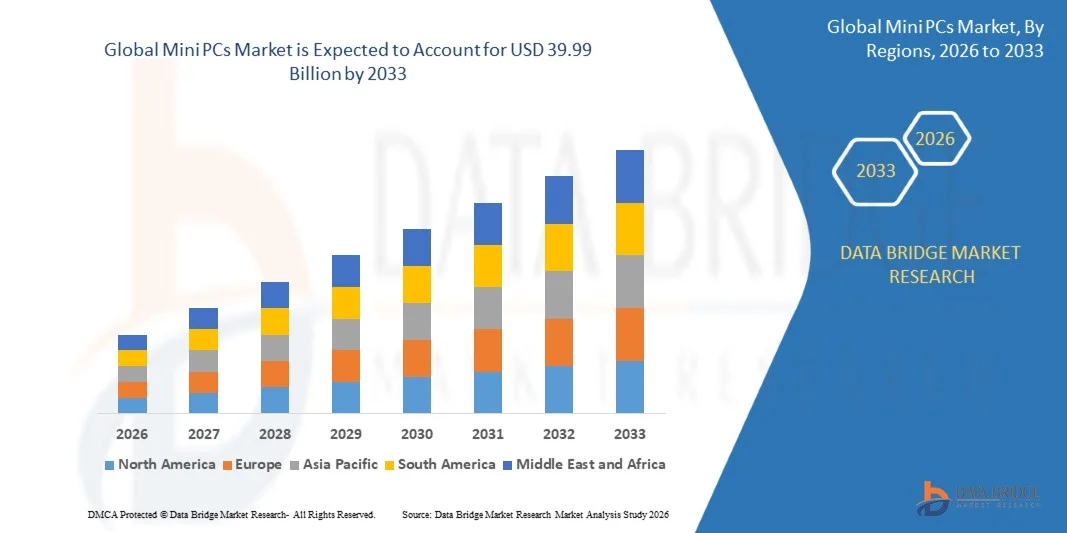
- As per Data Bridge Market Research analysis, the mini PCs market was valued at USD 24.35 billion in 2025 and is projected to reach USD 39.99 billion by 2033, growing at a CAGR of 6.40% from 2026 to 2033.
- The market is experiencing robust growth driven by the increasing demand for compact, energy-efficient computing devices across diverse sectors such as enterprise, education, and consumer electronics. The mini PC market has rapidly progressed from a niche product to a mainstream solution, reflecting a convergence of compact design, versatile performance, and cost efficiency.
- The rising adoption of edge computing, the proliferation of IoT infrastructure, and the continued shift toward hybrid work environments are further propelling demand. Continuous advancements in processor performance and thermal management are enabling these compact systems to handle increasingly demanding workloads, from office productivity and content creation to AI inference and industrial automation
Market Size & Forecast
- Market Value (2025): USD 24.35 Billion
- Expected Market Value (2033): USD 39.99 Billion
- Forecast CAGR (2026–2033): 6.40%
- Leading Region in 2025: North America
- Fastest Growing Region: Asia-Pacific
What are the Major Takeaways of the Mini PCs Market?
- North America dominated the mini PCs market with the largest revenue share of 45.5% in 2025, supported by strong adoption of compact computing solutions across commercial offices, educational institutions, healthcare facilities, and home entertainment applications.
- Asia-Pacific mini PCs market is expected to witness the fastest growth rate from 2026 to 2033, supported by rapid urbanization, expanding digital infrastructure, and increasing adoption of affordable computing solutions across emerging economies.
- The processor segment dominated the market in 2025, owing to its critical role in determining overall system performance, power efficiency, and multitasking capabilities in mini PCs. Processors are central to enabling compact systems to handle enterprise workloads, edge computing, and everyday productivity applications. Continuous advancements in chip architecture and integratison by companies such as Intel Corporation and Advanced Micro Devices are further driving demand, as modern processors offer higher core counts, integrated graphics, and AI acceleration within smaller thermal envelopes.
- The storage segment is anticipated to witness significant growth from 2026 to 2033, driven by increasing demand for high-speed and compact storage solutions such as SSDs, which enhance boot times, data access speed, and overall system responsiveness in mini PCs. With rising adoption of data-intensive applications, edge analytics, and content streaming, there is a strong shift toward NVMe-based storage solutions.
- The x86-based Mini PCs segment dominated the market in 2025 as it is extensively adopted across enterprise, commercial, and industrial applications due to its high performance, compatibility with a wide range of software, and established ecosystem. Businesses rely on x86 architecture for workloads such as office productivity, virtualization, and edge computing. The segment benefits from strong support by companies such as Intel Corporation and Advanced Micro Devices, ensuring continuous innovation, backward compatibility, and robust processing capabilities.
- The ARM-based mini PCs segment is expected to witness the fastest CAGR from 2026 to 2033, driven by increasing demand for energy-efficient and low-power computing solutions, particularly in edge devices, IoT applications, and lightweight consumer use cases. ARM architecture enables longer operational efficiency with reduced heat generation, making it suitable for compact and fanless designs. Advancements by companies such as Apple Inc. in ARM-based chipsets are enhancing performance, accelerating adoption across both consumer and enterprise segments.
Report Scope and Mini PCs Market Segmentation
Attributes |
Mini PCs Key Market Insights |
|
Segments Covered |
|
|
Countries Covered |
North America
Europe
Asia-Pacific
Middle East and Africa
South America
|
|
Key Market Players |
|
|
Market Opportunities |
|
|
Value Added Data Infosets |
In addition to the market insights such as market value, growth rate, market segments, geographical coverage, market players, and market scenario, the market report curated by the Data Bridge Market Research team includes in-depth expert analysis, import/export analysis, pricing analysis, production consumption analysis, and pestle analysis. |
What is the Key Trend in the Mini PCs Market?
- The mini PCs market is witnessing a strong shift toward AI-enabled computing and high-performance compact systems, as enterprises, content creators, gamers, and developers increasingly demand powerful computing capabilities in space-efficient form factors. Manufacturers are integrating AI accelerators, next-generation processors, advanced connectivity, and enterprise-grade management features to support AI workloads, edge computing, and professional applications.
- For instance, in January 2026, MINISFORUM introduced the AI X1 Pro 470 and MS-02 Ultra at CES 2026, featuring AMD Ryzen AI 9 HX470 and Intel Arrow Lake-HX Refresh processors, respectively. Both mini PCs were designed to deliver enterprise-grade performance, advanced AI capabilities, high-speed connectivity, and expanded storage options for creators, gamers, and AI developers.
- Leading PC manufacturers are increasingly incorporating AI-enabled processors, enhanced security technologies, and enterprise management capabilities into mini PCs to improve productivity, simplify IT administration, and support hybrid work environments.
- As organizations continue adopting AI-powered applications, edge computing, and space-efficient computing infrastructure, demand for intelligent, high-performance mini PCs is expected to accelerate, reinforcing their role in enterprise IT, creative workflows, software development, and next-generation AI computing.
What are the Key Drivers of the Mini PCs Market?
- The growing adoption of AI applications, hybrid work environments, edge computing, and high-performance compact computing devices has significantly increased demand for mini PCs. Organizations and professionals are increasingly choosing mini PCs for their ability to deliver desktop-class performance, energy efficiency, and advanced connectivity while minimizing workspace requirements.
- For instance, in February 2026, Apple expanded its U.S. manufacturing operations by bringing Mac mini production to its Houston facility for the first time while increasing AI server manufacturing capacity. The initiative, part of Apple's broader USD 600 billion U.S. investment program, highlights the company's commitment to meeting rising demand for AI-enabled compact computing systems and strengthening domestic manufacturing capabilities.
- Technology companies are continuously introducing next-generation mini PCs equipped with AI-enabled processors, high-speed memory, advanced graphics, and enterprise-grade features to support content creation, software development, AI workloads, gaming, and professional productivity.
- For instance, in October 2024, Apple launched the updated Mac mini featuring M4 and M4 Pro processors, offering up to three times higher CPU performance than the previous generation, along with Thunderbolt 5 connectivity and 16 GB of base memory. The enhanced performance strengthens the device's suitability for creative professionals, developers, and AI and machine learning applications.
- As enterprises, developers, and consumers continue to prioritize compact, energy-efficient, and AI-capable computing solutions, mini PCs are expected to witness sustained demand, driving innovation across business, education, edge computing, and high-performance workstation applications.
Which Factors are Challenging the Growth of the Mini PCs Market?
- Mini PCs require significant investment in advanced semiconductor technologies, compact motherboard designs, custom cooling systems, AI-enabled processors, and high-density component integration to deliver desktop-class performance within a small form factor. These engineering and manufacturing complexities substantially increase product development and production costs.
- The higher manufacturing costs and premium component requirements result in higher product prices, limiting adoption among budget-conscious consumers, educational institutions, and small and medium-sized enterprises (SMEs), particularly in price-sensitive and emerging markets.
- For instance, in February 2025, Apple announced plans to invest more than USD 500 billion in the U.S. over the next four years, including expanding advanced server manufacturing in Houston and establishing the Apple Manufacturing Academy in Detroit. The investment reflects the substantial capital required for advanced semiconductor integration, precision manufacturing, and production of next-generation compact computing systems, highlighting the high manufacturing costs associated with premium mini PCs and AI-enabled hardware.
- The high research and development costs, advanced manufacturing requirements, and thermal engineering challenges associated with mini PCs continue to restrain market growth. These factors particularly affect affordability in cost-sensitive markets, slowing adoption despite the increasing demand for compact, AI-powered, and high-performance computing solutions.
How is the Mini PCs Market Segmented?
The mini PCs market is segmented on the basis of component, processor architecture, application, industry vertical, and type, processor type, and storage type.
- By Component
On the basis of component, the mini PCs market is segmented into processor, memory, storage, GPU, and others. The processor segment dominated the market in 2025, owing to its critical role in determining overall system performance, power efficiency, and multitasking capabilities in mini PCs. Processors are central to enabling compact systems to handle enterprise workloads, edge computing, and everyday productivity applications. Continuous advancements in chip architecture and integratison by companies such as Intel Corporation and Advanced Micro Devices are further driving demand, as modern processors offer higher core counts, integrated graphics, and AI acceleration within smaller thermal envelopes.
The storage segment is anticipated to witness significant growth from 2026 to 2033, driven by increasing demand for high-speed and compact storage solutions such as SSDs, which enhance boot times, data access speed, and overall system responsiveness in mini PCs. With rising adoption of data-intensive applications, edge analytics, and content streaming, there is a strong shift toward NVMe-based storage solutions.
- By Processor Architecture
On the basis of processor architecture, the mini PCs market is segmented into x86-based mini PCs and ARM-based mini PCs. The x86-based Mini PCs segment dominated the market in 2025 as it is extensively adopted across enterprise, commercial, and industrial applications due to its high performance, compatibility with a wide range of software, and established ecosystem. Businesses rely on x86 architecture for workloads such as office productivity, virtualization, and edge computing. The segment benefits from strong support by companies such as Intel Corporation and Advanced Micro Devices, ensuring continuous innovation, backward compatibility, and robust processing capabilities.
The ARM-based mini PCs segment is expected to witness the fastest CAGR from 2026 to 2033, driven by increasing demand for energy-efficient and low-power computing solutions, particularly in edge devices, IoT applications, and lightweight consumer use cases. ARM architecture enables longer operational efficiency with reduced heat generation, making it suitable for compact and fanless designs. Advancements by companies such as Apple Inc. in ARM-based chipsets are enhancing performance, accelerating adoption across both consumer and enterprise segments.
- By Application
On the basis of application, the mini PCs market is segmented into personal / home computing, home entertainment & media, digital signage & kiosks, gaming & content creation, business / office, industrial & edge computing, and others. The home entertainment segment dominated the market in 2025 due to the trend of streaming services and digital media consumption, making mini PCs a sought-after choice for compact media hubs. These devices allow users to easily stream movies, TV shows, music, and online content straight to their TVs or monitors. As the demand for versatile and cost-effective home entertainment solutions grows, mini PCs are able to meet these needs efficiently.
The digital signage & kiosks segment is anticipated to witness the fastest CAGR from 2026 to 2033, driven by the surge in usage of digital signage solutions across various sectors. Companies are capitalizing on dynamic displays to improve customer interaction and elevate brand exposure. Mini PCs provide the necessary processing capabilities to operate high-quality screens and facilitate multimedia content, leading to increasing demand in retail, hospitality, healthcare, and transportation.
- By Industry Vertical
On the basis of industry vertical, the mini PCs market is segmented into consumer electronics, retail, manufacturing, education, and others. The consumer electronics segment dominated the market in 2025, accounting for the largest share due to widespread adoption of mini PCs for personal computing, home entertainment, and everyday productivity applications. The segment benefits from increasing consumer preference for compact, aesthetically appealing, and energy-efficient devices that support streaming, browsing, and light content creation. Product innovations by companies such as Apple Inc. and ASUSTeK Computer Inc. are enhancing performance and user experience, further driving adoption in the consumer segment.
The manufacturing segment is expected to witness growth at a significant CAGR from 2026 to 2033, driven by increasing adoption of mini PCs in industrial automation, smart factories, and edge computing applications. Mini PCs are widely used for real-time monitoring, machine control, and data processing in production environments due to their compact size, durability, and ability to operate in space-constrained settings. The rise of Industry 4.0 initiatives and integration of IoT and AI technologies are further accelerating demand for mini PCs in the manufacturing sector.
- By Type
On the basis of type, the mini PCs market is segmented into entry-level mini PCs, mid-range mini PCs, and high-end mini PCs. The mid-range mini PCs segment held the largest market revenue share in 2025, driven by strong adoption among small businesses, home offices, educational institutions, and mainstream consumers seeking a balance between performance and affordability. These systems are widely used for productivity applications, digital signage, content consumption, and hybrid work environments due to their compact design and cost efficiency.
The high-end mini PCs segment is projected to register the fastest growth at a CAGR from 2026 to 2033, driven by increasing demand for AI-enabled computing, edge processing, gaming, content creation, and professional workstation applications. Rising deployment of advanced processors, dedicated graphics capabilities, and enterprise-grade performance features is accelerating segment growth.
- By Processor Type
On the basis of processor type, the mini PCs market is segmented into Intel processors, AMD processors, and ARM processors. The Intel processors segment accounted for the largest market revenue share in 2025, supported by its established ecosystem, broad software compatibility, and strong presence across commercial, industrial, and consumer mini PC deployments. Intel-powered mini PCs remain the preferred choice for enterprise productivity, virtualization, and business computing workloads.
The ARM processors segment is expected to witness the fastest growth at a CAGR from 2026 to 2033, driven by growing demand for energy-efficient computing, AI-enabled edge devices, fanless systems, and compact enterprise solutions. Continuous advancements in ARM-based chip architectures and increasing adoption of low-power computing platforms are supporting rapid segment expansion.
- By Storage Type
On the basis of storage type, the mini PCs market is segmented into HDD, SSD, and hybrid drive. The SSD segment dominated the market with a revenue share in 2025, driven by rising demand for faster boot times, improved system responsiveness, lower power consumption, and enhanced reliability. The widespread adoption of NVMe and PCIe-based SSD technologies across consumer and commercial mini PCs has further strengthened segment leadership.
The hybrid drive segment is anticipated to register the fastest growth at a CAGR from 2026 to 2033, supported by increasing demand for cost-effective storage solutions that combine the speed advantages of SSDs with the higher storage capacities of HDDs. Growing adoption in multimedia applications, small business deployments, and budget-conscious computing environments is contributing to segment growth.
Which Region Holds the Largest Share of the Mini PCs Market?
- North America dominated the mini PCs market with the largest revenue share of 45.5% in 2025, supported by strong adoption of compact computing solutions across commercial offices, educational institutions, healthcare facilities, and home entertainment applications.
- The growing demand for energy-efficient devices, space-saving computing systems, and advanced edge computing infrastructure has accelerated market growth. Furthermore, increasing investments in digital transformation, cloud-connected workplaces, and smart retail deployments continue to strengthen the region’s leadership in the mini PCs market.
U.S. Mini PCs Market Insight
The U.S. mini PCs market captured the largest revenue share in 2025 within North America, fueled by the rapid adoption of remote and hybrid work models, rising demand for compact enterprise computing solutions, and increasing deployment of digital signage systems. Businesses are increasingly utilizing mini PCs for office productivity, data processing, and edge computing applications. In addition, growing demand for AI-enabled computing devices, media streaming solutions, and smart home ecosystems is contributing significantly to market expansion across the country.
Europe Mini PCs Market Insight
The Europe mini PCs market is expected to witness the fastest growth rate from 2026 to 2033, primarily driven by increasing digitalization across enterprises, rising adoption of industrial automation technologies, and growing demand for energy-efficient computing systems. The region’s focus on sustainability and reduced energy consumption is encouraging organizations to replace conventional desktop systems with compact mini PCs. Moreover, expanding smart manufacturing initiatives and growing deployment of IoT-connected devices are supporting market growth across Europe.
U.K. Mini PCs Market Insight
The U.K. mini PCs market is expected to witness the fastest growth rate from 2026 to 2033, driven by increasing demand for flexible workplace infrastructure, growing adoption of cloud-based business operations, and rising investments in digital education platforms. Organizations are increasingly implementing compact computing devices to optimize office space and reduce energy costs. Furthermore, the growing popularity of home entertainment systems, media centers, and remote workstations is expected to sustain market growth throughout the forecast period.
Germany Mini PCs Market Insight
The Germany mini PCs market is expected to witness the fastest growth rate from 2026 to 2033, fueled by the country’s strong industrial base, increasing adoption of Industry 4.0 technologies, and growing demand for embedded computing systems. Mini PCs are increasingly utilized in manufacturing automation, industrial control systems, and smart factory environments due to their reliability and compact form factor. The country’s focus on technological innovation and efficient computing infrastructure further supports market expansion.
Asia-Pacific Mini PCs Market Insight
The Asia-Pacific mini PCs market is expected to witness the fastest growth rate from 2026 to 2033, supported by rapid urbanization, expanding digital infrastructure, and increasing adoption of affordable computing solutions across emerging economies. Rising demand for compact PCs in educational institutions, small businesses, retail establishments, and smart city projects is driving market growth. In addition, the region’s strong electronics manufacturing ecosystem and growing investments in AI and IoT technologies are accelerating adoption across various end-use sectors.
Japan Mini PCs Market Insight
The Japan mini PCs market is expected to witness the fastest growth rate from 2026 to 2033 due to the country’s advanced technology ecosystem, strong demand for compact electronic devices, and increasing adoption of smart automation systems. Businesses and consumers are increasingly utilizing mini PCs for office productivity, digital signage, and home entertainment applications. Moreover, the growing integration of AI-enabled computing solutions and edge processing technologies is creating significant opportunities for market growth in Japan.
China Mini PCs Market Insight
The China mini PCs market accounted for the largest market revenue share in Asia-Pacific in 2025, attributed to the country’s massive electronics manufacturing industry, rapid digital transformation, and growing demand for affordable computing devices. China remains one of the largest markets for consumer electronics and smart computing solutions, with mini PCs gaining widespread adoption across residential, commercial, educational, and industrial applications. Government initiatives supporting digital infrastructure development and the presence of major domestic manufacturers continue to propel market growth in the country.
Which are the Top Companies in Mini PCs Market?
The Mini PCs industry is primarily led by well-established companies, including:
- Apple Inc. (U.S.)
- Intel Corporation (U.S.)
- Lenovo Group Limited (Beijing,China)
- Dell Technologies Inc. (U.S.)
- ASUSTeK Computer Inc. (Taiwan)
- HP Inc. (U.S.)
- Acer Inc. (Taiwan)
- ASRock Inc. (Taiwan)
- GIGA-BYTE Technology Co., Ltd. (Taiwan)
- Zotac Technology Limited (Hong Kong)
- Micro-Star International Co., Ltd. (Taiwan)
- Elitegroup Computer Systems Co., Ltd. (Taiwan)
- Minisforum (Hong Kong)
- Beelink (China)
- Shenzhen Hasee Innovation Co., Ltd. (China)
What are Latest Developments in Mini PCs Market?
- In February 2026, Apple announced the expansion of its U.S. manufacturing operations by introducing Mac mini production at its Houston facility for the first time. The company also expanded its AI server manufacturing capabilities and revealed plans to establish a 20,000-square-foot Advanced Manufacturing Center dedicated to workforce training. The initiative forms part of Apple's broader USD 600 billion U.S. investment program, aimed at strengthening domestic manufacturing, advancing semiconductor and chip production, and creating thousands of new jobs.
- In January 2026, MINISFORUM introduced two next-generation high-performance mini PCs at CES 2026: the AI X1 Pro 470, powered by the AMD Ryzen AI 9 HX470 processor, and the MS-02 Ultra, equipped with Intel Arrow Lake-HX Refresh technology. Designed for content creators, gamers, and AI developers, both systems deliver enterprise-grade performance in compact form factors while offering advanced AI capabilities, high-speed connectivity, and expanded storage options through collaborations with AMD and Intel. The products were launched for global availability via MINISFORUM’s official sales channels.
- In October 2025, Lenovo launched the ThinkCentre Neo Ultra Mini, a compact commercial mini PC powered by Intel Core Ultra processors with Intel vPro enterprise management technology. Designed for business environments, the system delivers centralized IT management, hardware-level security, and AI-accelerated computing capabilities in a space-saving form factor, making it well suited for modern enterprise deployments.
- In March 2025, Apple introduced an upgraded Mac mini featuring M4 and M4 Pro chip options, offering up to three times higher CPU performance compared to the previous M2 generation. The latest model also incorporates Thunderbolt 5 connectivity and a 16 GB base memory configuration, enhancing its performance for content creation, software development, and AI and machine learning applications.

- Interactive Data Analysis Dashboard
- Company Analysis Dashboard for high growth potential opportunities
- Research Analyst Access for customization & queries
- Competitor Analysis with Interactive dashboard
- Latest News, Updates & Trend analysis
- Harness the Power of Benchmark Analysis for Comprehensive Competitor Tracking
Data collection and base year analysis are done using data collection modules with large sample sizes. The stage includes obtaining market information or related data through various sources and strategies. It includes examining and planning all the data acquired from the past in advance. It likewise envelops the examination of information inconsistencies seen across different information sources. The market data is analysed and estimated using market statistical and coherent models. Also, market share analysis and key trend analysis are the major success factors in the market report. To know more, please request an analyst call or drop down your inquiry.
The key research methodology used by DBMR research team is data triangulation which involves data mining, analysis of the impact of data variables on the market and primary (industry expert) validation. Data models include Vendor Positioning Grid, Market Time Line Analysis, Market Overview and Guide, Company Positioning Grid, Patent Analysis, Pricing Analysis, Company Market Share Analysis, Standards of Measurement, Global versus Regional and Vendor Share Analysis. To know more about the research methodology, drop in an inquiry to speak to our industry experts.
Data Bridge Market Research is a leader in advanced formative research. We take pride in servicing our existing and new customers with data and analysis that match and suits their goal. The report can be customized to include price trend analysis of target brands understanding the market for additional countries (ask for the list of countries), clinical trial results data, literature review, refurbished market and product base analysis. Market analysis of target competitors can be analyzed from technology-based analysis to market portfolio strategies. We can add as many competitors that you require data about in the format and data style you are looking for. Our team of analysts can also provide you data in crude raw excel files pivot tables (Fact book) or can assist you in creating presentations from the data sets available in the report.













