


Miniaturized Robotic Endoluminal Devices Market Size
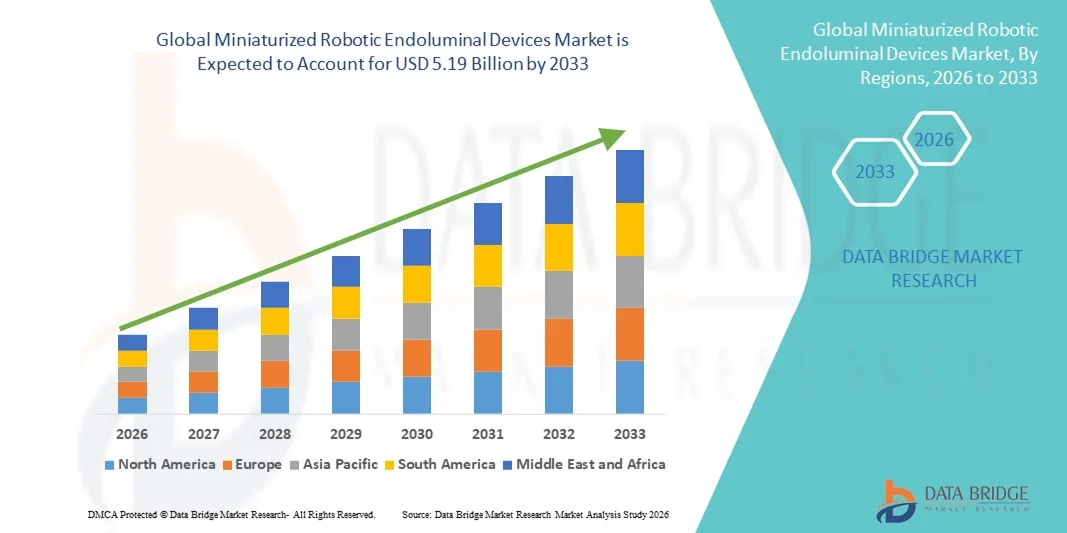
- The global miniaturized robotic endoluminal devices market size was valued at USD 1.16 billion in 2025 and is expected to reach USD 5.19 billion by 2033, at a CAGR of 20.60% during the forecast period
- The market growth is largely fueled by the increasing prevalence of gastrointestinal disorders, rising demand for minimally invasive procedures, and growing adoption of advanced robotic-assisted surgical technologies in hospitals and specialized surgical centers, leading to improved precision, reduced recovery time, and enhanced patient outcomes
- Furthermore, rising investments in medical robotics, technological advancements in miniaturized endoluminal navigation systems, and increasing awareness among healthcare providers about the benefits of robotic-assisted interventions are establishing Miniaturized Robotic Endoluminal Devices solutions as essential tools in modern minimally invasive surgeries. These converging factors are accelerating the uptake of these devices, thereby significantly boosting the industry’s growth
Miniaturized Robotic Endoluminal Devices Market Analysis
- Miniaturized Robotic Endoluminal Devices, offering advanced robotic-assisted navigation and intervention within the gastrointestinal and other luminal tracts, are increasingly vital components of minimally invasive surgical procedures in both hospitals and specialized surgical centers due to their enhanced precision, maneuverability, and integration with real-time imaging systems
- The escalating demand for miniaturized robotic endoluminal devices is primarily fueled by the growing preference for minimally invasive procedures, rising prevalence of gastrointestinal disorders, and increasing adoption of robotic-assisted surgical technologies that improve patient outcomes and reduce recovery time
- North America dominated the miniaturized robotic endoluminal devices market with the largest revenue share of approximately 41.8% in 2025, supported by advanced healthcare infrastructure, high adoption of minimally invasive surgical technologies, and the presence of key industry players. The U.S. accounts for a major share due to extensive use of robotic-assisted endoluminal procedures, rising prevalence of gastrointestinal disorders, and innovations in robotic navigation systems
- Asia-Pacific is expected to be the fastest-growing region in the miniaturized robotic endoluminal devices market during the forecast period, with a CAGR driven by improving healthcare infrastructure, rising adoption of minimally invasive surgeries, growing geriatric population, and increasing investments in robotic surgical technologies, particularly in countries such as India, China, and Japan
- The single-port robotics segment dominated the market with a revenue share of approximately 51.3% in 2025, driven by its ability to perform complex endoluminal procedures through a single insertion site, reducing patient trauma and recovery time
Report Scope and Miniaturized Robotic Endoluminal Devices Market Segmentation
|
Attributes |
Miniaturized Robotic Endoluminal Devices Key Market Insights |
|
Segments Covered |
|
|
Countries Covered |
North America
Europe
Asia-Pacific
Middle East and Africa
South America
|
|
Key Market Players |
|
|
Market Opportunities |
|
|
Value Added Data Infosets |
In addition to the insights on market scenarios such as market value, growth rate, segmentation, geographical coverage, and major players, the market reports curated by the Data Bridge Market Research also include in-depth expert analysis, patient epidemiology, pipeline analysis, pricing analysis, and regulatory framework. |
Miniaturized Robotic Endoluminal Devices Market Trends
Rising Demand for Minimally Invasive Procedures
- The growing preference for minimally invasive surgical and diagnostic procedures is a primary driver of the Miniaturized Robotic Endoluminal Devices market. These devices allow physicians to perform complex interventions with enhanced precision, reduced patient trauma, and shorter recovery times
- For instance, in 2024, Mount Sinai Hospital in New York reported successful clinical adoption of a new robotic capsule device for endoluminal diagnostics, which reduced procedure time for upper GI tract examinations by 25% compared to conventional endoscopy
- Increasing patient awareness regarding the benefits of minimally invasive treatments is boosting demand for these devices across hospitals, outpatient clinics, and specialized surgical centers
- Technological advancements in miniaturization, flexible robotic arms, and imaging sensors are enabling broader adoption of robotic endoluminal solutions in gastroenterology, pulmonology, and urology
- Healthcare providers are increasingly incorporating robotic endoluminal devices into routine diagnostic and therapeutic protocols, particularly for high-risk patients who may not tolerate conventional surgery
Miniaturized Robotic Endoluminal Devices Market Dynamics
Driver
Technological Advancements and Integration with Imaging Systems
- Miniaturized Robotic Endoluminal Devices are witnessing rapid innovation in imaging-guided navigation and real-time visualization. These advancements are enhancing procedural accuracy, improving lesion targeting, and enabling complex interventions in previously inaccessible regions
- For instance, in 2025, Medtronic launched a new capsule-based robotic device with integrated high-definition imaging and wireless data transmission, allowing gastroenterologists to detect early-stage lesions more accurately and reduce the need for repeat procedures
- The integration of robotic devices with advanced imaging platforms such as 3D fluoroscopy, CT overlays, and MRI-guided navigation is gaining momentum, providing physicians with a more comprehensive view during interventions
- Trends toward outpatient minimally invasive treatments and same-day procedures are driving the design of compact, portable, and cost-effective robotic endoluminal systems
- Manufacturers are also focusing on device interoperability, allowing robotic endoluminal systems to integrate with hospital information systems for real-time monitoring and procedural documentation
Restraint/Challenge
High Costs and Regulatory Hurdles
- The relatively high cost of miniaturized robotic endoluminal devices remains a significant barrier to widespread adoption, particularly for smaller hospitals and developing regions. These devices often require specialized training and maintenance, increasing overall operational expenditure
- For instance, a 2025 survey of mid-sized hospitals in Europe highlighted that budget constraints and high capital investment for robotic endoluminal suites limited their acquisition despite clinical benefits
- Stringent regulatory requirements for medical device approvals in North America, Europe, and Asia-Pacific can delay product launches and increase compliance costs for manufacturers
- Limited clinical awareness and the need for specialized physician training are additional challenges, as adoption rates are slower in regions with fewer minimally invasive procedural experts
- Device reliability, safety concerns, and potential complications during early-stage adoption may also hinder market growth, prompting hospitals to carefully evaluate clinical outcomes before large-scale deployment
- Addressing these challenges through cost-effective device development, comprehensive physician training programs, and streamlined regulatory pathways is essential to sustaining long-term market growth
Miniaturized Robotic Endoluminal Devices Market Scope
The Miniaturized Robotic Endoluminal Devices market is segmented on the basis of application and technology.
- By Application
On the basis of application, the market is segmented into gastrointestinal and urology procedures. The gastrointestinal segment dominated the largest market revenue share of around 46.8% in 2025, driven by the high prevalence of gastrointestinal disorders and the increasing adoption of minimally invasive endoluminal procedures. These devices are widely used for diagnostic and therapeutic interventions in the esophagus, stomach, intestines, and colon, including polyp removal, biopsies, and hemostasis procedures. Hospitals and specialized endoscopy centers prefer miniaturized robotic devices due to their precision, flexibility, and ability to navigate complex GI anatomy. The segment benefits from growing awareness of early detection of gastrointestinal cancers and disorders, as well as rising patient preference for less invasive treatment options. Technological advancements, such as improved robotic articulation, high-resolution imaging, and enhanced navigation systems, further drive adoption. The recurring use of these devices for routine and advanced endoscopic procedures ensures steady revenue streams. Additionally, integration with imaging guidance systems and training programs in hospitals accelerates uptake. The segment also benefits from favorable reimbursement policies in developed regions, boosting adoption in clinical settings. Increasing prevalence of GI bleeding, polyps, and inflammatory bowel disease further supports market growth.
The urology segment is expected to witness the fastest CAGR of 10.2% from 2026 to 2033, fueled by rising adoption of minimally invasive robotic interventions for conditions such as kidney stones, ureteral strictures, and bladder tumors. Miniaturized robotic devices offer precision, reduced tissue trauma, and faster patient recovery compared to conventional endoscopic tools. Hospitals and urology centers increasingly adopt these devices to improve procedural outcomes and reduce complications. Technological advancements, including high-definition optics, magnetic-assisted navigation, and improved endoluminal dexterity, enhance device performance. The growing prevalence of urological disorders, coupled with patient preference for outpatient and less invasive procedures, drives segment growth. Additionally, clinical guidelines recommending robotic-assisted interventions in urology further support adoption. Emerging markets are witnessing increased uptake due to expanding healthcare infrastructure and rising awareness of advanced urology treatments. The segment also benefits from training programs for surgeons and integration with hospital robotic platforms, accelerating usage across multiple clinical settings.
- By Technology
On the basis of technology, the market is segmented into single-port robotics and magnetic navigation systems. The single-port robotics segment dominated the market with a revenue share of approximately 51.3% in 2025, driven by its ability to perform complex endoluminal procedures through a single insertion site, reducing patient trauma and recovery time. Single-port systems offer enhanced maneuverability, high-precision control, and compatibility with a wide range of gastrointestinal and urological interventions. Hospitals and ambulatory surgical centers increasingly prefer these systems due to reduced procedure time, improved safety, and better clinical outcomes. The segment benefits from technological advancements such as articulating instruments, high-definition 3D visualization, and integration with robotic surgical platforms. Growing awareness of minimally invasive procedures and patient demand for faster recovery also support adoption. Recurrent use in diagnostic and therapeutic endoluminal procedures ensures continuous market revenue. Regulatory approvals and clinical guideline recommendations for robotic-assisted interventions reinforce segment dominance. Hospitals in developed regions are increasingly adopting single-port robotic devices for both GI and urology applications.
The magnetic navigation segment is expected to witness the fastest CAGR of 9.8% from 2026 to 2033, driven by its non-invasive guidance capabilities and precise device manipulation within luminal pathways. Magnetic navigation allows operators to steer miniaturized robots accurately without relying on direct manual insertion, reducing procedure complexity and patient discomfort. This technology is increasingly applied in complex gastrointestinal and urological interventions where precision is critical. The adoption of magnetic navigation is rising in hospitals and research centers due to improved clinical outcomes and reduced procedure time. Technological advancements, including enhanced magnetic field control and integration with imaging systems, accelerate adoption. Growing interest in minimally invasive, outpatient procedures, coupled with rising investment in robotic endoscopy platforms, supports rapid market expansion. Emerging markets are expected to see significant growth in this segment due to increased healthcare infrastructure and awareness of advanced endoluminal technologies.
Miniaturized Robotic Endoluminal Devices Market Regional Analysis
- North America dominated the miniaturized robotic endoluminal devices market with the largest revenue share of approximately 41.8% in 2025, supported by advanced healthcare infrastructure, high adoption of minimally invasive surgical technologies, and the presence of key industry players
- The market accounts for a major share due to the extensive use of robotic-assisted endoluminal procedures, rising prevalence of gastrointestinal and colorectal disorders, and continuous innovations in robotic navigation and imaging systems
- Hospitals and specialized surgical centers are increasingly integrating these devices to improve procedural accuracy, reduce patient recovery times, and expand the range of complex endoluminal interventions
U.S. Miniaturized Robotic Endoluminal Devices Market Insight
The U.S. miniaturized robotic endoluminal devices market captured the largest revenue share within North America in 2025, driven by widespread adoption of robotic-assisted procedures in gastroenterology and pulmonary interventions. For example, in 2024, Mayo Clinic implemented a new capsule-based robotic endoluminal system for minimally invasive diagnostics, resulting in reduced procedure times and improved lesion detection accuracy. Moreover, strong government support for advanced surgical technologies, coupled with rising patient awareness and healthcare expenditure, is further propelling market expansion. The availability of specialized training programs for surgeons and increasing integration of robotic systems in academic and private hospitals also support adoption.
Europe Miniaturized Robotic Endoluminal Devices Market Insight
Europe miniaturized robotic endoluminal devices market is projected to witness substantial growth over the forecast period, primarily driven by increasing healthcare expenditure, adoption of minimally invasive procedures, and rising prevalence of gastrointestinal and colorectal disorders. Countries such as Germany, France, and Italy are investing in modern endoscopy suites equipped with robotic navigation systems. Hospitals are prioritizing precision-driven technologies to enhance surgical outcomes, shorten hospitalization periods, and reduce procedural complications.
U.K. Miniaturized Robotic Endoluminal Devices Market Insight
The U.K. miniaturized robotic endoluminal devices market is anticipated to grow at a noteworthy CAGR, supported by rising awareness of early disease detection and minimally invasive treatments. For instance, in 2025, St. George’s University Hospitals NHS Foundation Trust adopted a new robotic-assisted endoluminal device for colonoscopy procedures, significantly improving polyp detection rates. The country’s well-established healthcare infrastructure, coupled with public and private investments in robotic surgical systems, drives market expansion.
Germany Miniaturized Robotic Endoluminal Devices Market Insight
Germany miniaturized robotic endoluminal devices market is expected to expand at a considerable CAGR due to robust hospital infrastructure, a strong focus on innovative surgical technologies, and increasing preference for minimally invasive diagnostics. Robotic endoluminal systems are widely adopted in specialized centers for gastrointestinal, pulmonary, and urological procedures. Clinical studies in 2024 demonstrated that robotic navigation improved lesion localization accuracy by over 20% compared to traditional endoscopy, reinforcing adoption in German hospitals.
Asia Pacific Miniaturized Robotic Endoluminal Devices Market Insight
Asia-Pacific miniaturized robotic endoluminal devices market is expected to be the fastest-growing region during the forecast period, driven by improving healthcare infrastructure, rising adoption of minimally invasive surgeries, a growing geriatric population, and increasing investments in robotic surgical technologies, particularly in countries such as India, China, and Japan.
Japan Miniaturized Robotic Endoluminal Devices Market Insight
The Japanese miniaturized robotic endoluminal devices market is gaining momentum due to a high demand for advanced diagnostic tools, rapid urbanization, and emphasis on minimally invasive procedures for an aging population. For example, in 2025, Osaka University Hospital incorporated robotic-assisted endoluminal devices for routine gastrointestinal diagnostics, which improved procedure efficiency and reduced patient recovery times. Japan’s advanced healthcare facilities and technological expertise support further adoption.
China Miniaturized Robotic Endoluminal Devices Market Insight
China miniaturized robotic endoluminal devices market accounted for the largest market revenue share in Asia-Pacific in 2025, attributed to a rising patient population, growing awareness of minimally invasive procedures, and government-led investments in advanced surgical infrastructure. For instance, Shanghai General Hospital deployed robotic endoluminal devices for upper GI tract diagnostics in 2024, enhancing early detection of lesions in high-risk patients. Expanding manufacturing capabilities and increasing affordability of these devices are also accelerating market penetration across hospitals and specialized centers in the country.
Miniaturized Robotic Endoluminal Devices Market Share
The Miniaturized Robotic Endoluminal Devices industry is primarily led by well-established companies, including:
- Medrobotics Corporation (U.S.)
- Intuitive Surgical, Inc. (U.S.)
- Auris Health, Inc. (U.S.)
- Titan Medical, Inc. (Canada)
- Avateramedical, Inc. (U.S.)
- Medtronic plc (Ireland)
- TransEnterix, Inc. (U.S.)
- Aurora Medical Robotics (Germany)
- EndoMaster Pte Ltd (Singapore)
- FlexRobotics (China)
- Medrobotics Europe (Switzerland)
- Titan Medical Europe (Austria)
- Intuitive Surgical Europe (Germany)
- Aurora Medical Robotics Europe (Italy)
- Medrobotics APAC (Japan)
- Auris Health APAC (China)
- TransEnterix APAC (South Korea)
- EndoMaster APAC (Singapore)
- FlexRobotics Europe (Germany)
- Medtronic Asia Pacific (China)
Latest Developments in Global Miniaturized Robotic Endoluminal Devices Market
- In November 2023, Agilis Robotics unveiled significant advancements in its miniaturized robotic endoluminal surgery platform, focusing on highly flexible, compact robotic instruments that integrate with standard endoscopes to perform complex procedures through natural orifices, such as in the gastrointestinal and urinary tracts. The technology aims to improve surgical precision and reduce invasiveness while lowering the cost barrier for robotic endoluminal systems
- In December 2024, EndoQuest Robotics received an Investigational Device Exemption (IDE) from the U.S. Food and Drug Administration (FDA) to commence a pivotal clinical trial in colorectal indications using its Endoluminal Surgical (ELS) System. This regulatory milestone allowed the company to begin evaluating safety and performance for robot‑assisted endoscopic submucosal dissection procedures in the lower gastrointestinal tract
- In December 2024, AIG Hospitals in Hyderabad, India launched the PillBotT robotic capsule endoscopy system developed by Endiatx, a miniaturized ingestible robot designed to navigate the gastrointestinal tract and transmit real‑time high‑resolution images to physicians. Although still under clinical evaluation, the technology is positioned to transform noninvasive diagnostics and reduce the need for conventional endoscopic interventions
- In October 2025, a surgeon at the Mayo Clinic successfully completed the first fully robotic endoscopic submucosal dissection (ESD) using EndoQuest’s Endoluminal Surgical (ELS) System during the PARADIGM Trial, marking a major procedural milestone in robot‑assisted endoluminal surgery and demonstrating clinical feasibility in gastrointestinal procedures
- In October 2025, EndoQuest Robotics announced a strategic collaboration with NVIDIA to integrate advanced computing, visualization, and AI capabilities into its ELS platform. This partnership aims to unify robotic control, imaging, and cloud functionality to enhance real‑time procedural guidance and overall system performance as commercialization efforts continue

- Interactive Data Analysis Dashboard
- Company Analysis Dashboard for high growth potential opportunities
- Research Analyst Access for customization & queries
- Competitor Analysis with Interactive dashboard
- Latest News, Updates & Trend analysis
- Harness the Power of Benchmark Analysis for Comprehensive Competitor Tracking
Data collection and base year analysis are done using data collection modules with large sample sizes. The stage includes obtaining market information or related data through various sources and strategies. It includes examining and planning all the data acquired from the past in advance. It likewise envelops the examination of information inconsistencies seen across different information sources. The market data is analysed and estimated using market statistical and coherent models. Also, market share analysis and key trend analysis are the major success factors in the market report. To know more, please request an analyst call or drop down your inquiry.
The key research methodology used by DBMR research team is data triangulation which involves data mining, analysis of the impact of data variables on the market and primary (industry expert) validation. Data models include Vendor Positioning Grid, Market Time Line Analysis, Market Overview and Guide, Company Positioning Grid, Patent Analysis, Pricing Analysis, Company Market Share Analysis, Standards of Measurement, Global versus Regional and Vendor Share Analysis. To know more about the research methodology, drop in an inquiry to speak to our industry experts.
Data Bridge Market Research is a leader in advanced formative research. We take pride in servicing our existing and new customers with data and analysis that match and suits their goal. The report can be customized to include price trend analysis of target brands understanding the market for additional countries (ask for the list of countries), clinical trial results data, literature review, refurbished market and product base analysis. Market analysis of target competitors can be analyzed from technology-based analysis to market portfolio strategies. We can add as many competitors that you require data about in the format and data style you are looking for. Our team of analysts can also provide you data in crude raw excel files pivot tables (Fact book) or can assist you in creating presentations from the data sets available in the report.













