


Miracast Wireless Display Market Overview
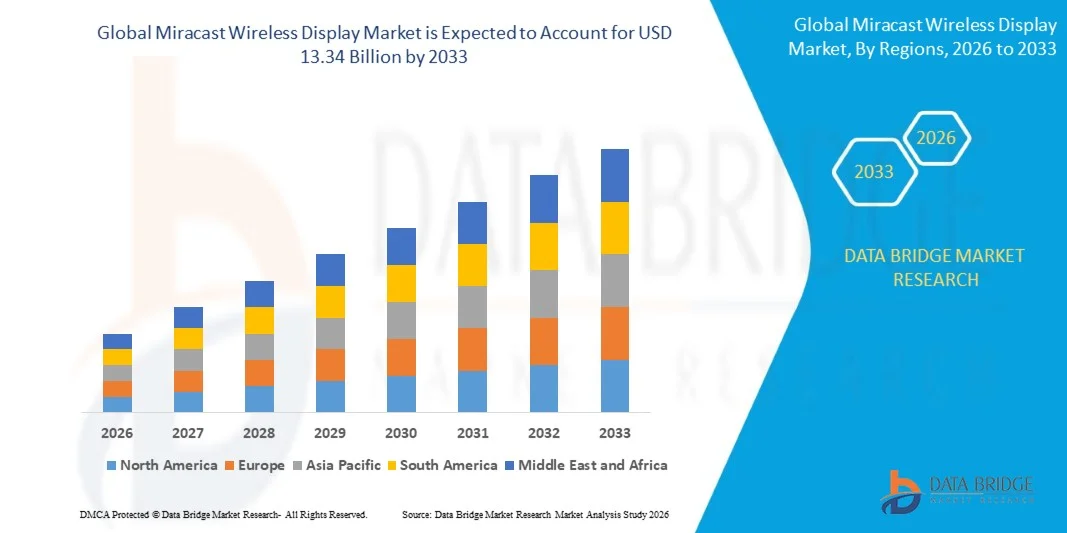
As per Data Bridge Market Research analysis, the miracast wireless display market was valued at USD 5.79 billion in 2025 and is projected to reach USD 13.34 billion by 2033, growing at a CAGR of 11.00% from 2026 to 2033. The market is experiencing consistent growth driven by increasing adoption of wireless screen mirroring technologies, rising demand for cable-free collaboration solutions across enterprise and education sectors, and expanding deployment of smart TVs, laptops, and mobile devices supporting Miracast connectivity.
The growing preference for seamless content sharing in corporate meeting rooms, classrooms, and home entertainment environments, combined with continuous advancements in Wi-Fi Direct technology and display interoperability, is accelerating the adoption of Miracast-enabled wireless display solutions. Organizations are increasingly replacing conventional wired presentation systems with wireless display platforms to improve mobility, productivity, and user convenience while supporting hybrid work and digital collaboration initiatives.
Market Size & Forecast
- Global Market Value (2025): USD 5.79 Billion
- Expected Market Value (2033): USD 13.34 Billion
- Forecast CAGR (2026–2033): 11.00%
- Leading Region in 2025: North America
- Fastest Growing Region: Asia Pacific
Key Market Trends & Insights
- North America dominated the miracast wireless display market with the largest revenue share of 34.26% in 2025, supported by widespread enterprise adoption, high penetration of smart devices, and strong demand for wireless collaboration and presentation solutions
- The smartphones & tablets segment led the market with a 39.8% share in 2025, driven by the widespread adoption of mobile devices as primary tools for content consumption, communication, and productivity
- Asia-Pacific is expected to be the fastest-growing region at a CAGR of 6.59% from 2026 to 2033, fueled by rapid expansion of consumer electronics manufacturing, increasing smartphone penetration, 5G deployment, and growing adoption of smart display technologies across China, India, Japan, and South Korea
- Smart TVs are the fastest-growing device type, projected to register a CAGR of 8.2%, reflecting the surge in consumer demand for connected home entertainment ecosystems
- The built-in solutions segment dominated the product type category with a 58.5% revenue share in 2025, led by increasing integration of Miracast functionality directly into smartphones, laptops, smart TVs, and enterprise display systems
- Consumer electronics accounted for 44.7% of the market, preferred by increasing adoption of wireless display technologies across smartphones, tablets, smart TVs, laptops, and gaming devices
- The education segment is the fastest-growing application category, with a CAGR of 9.1%, driven by rapid digitalization of classrooms and increasing adoption of interactive learning technologies
Report Scope and Miracast Wireless Display Market Segmentation
|
Attributes |
Miracast Wireless Display Key Market Insights |
|
Segments Covered |
|
|
Countries Covered |
North America
Europe
Asia-Pacific
Middle East and Africa
South America
|
|
Key Market Players |
|
|
Market Opportunities |
|
|
Value Added Data Infosets |
In addition to the insights on market scenarios such as market value, growth rate, segmentation, geographical coverage, and major players, the market reports curated by the Data Bridge Market Research also include in-depth expert analysis, geographically represented company-wise production and capacity, network layouts of distributors and partners, detailed and updated price trend analysis and deficit analysis of supply chain and demand. |
Miracast Wireless Display Market Trends
Trend: Rising Adoption of Wireless Collaboration and Screen-Sharing Ecosystems
Organizations across enterprise, education, and government sectors are increasingly adopting Miracast-enabled wireless display solutions to eliminate cable dependency and support seamless content sharing across multiple devices. The growing prevalence of hybrid work environments, flexible meeting spaces, and bring-your-own-device (BYOD) policies is accelerating demand for interoperable wireless presentation technologies. Improvements in Wi-Fi Direct performance, low-latency transmission, and support for high-definition content are further enhancing user experiences, while integration with smart displays and collaboration platforms enables more efficient communication and productivity workflows. For instance, in January 2025, Microsoft announced that Teams Rooms on Windows, including Surface Hub 3, would add support for Miracast wireless projection for the first time, enabling users to wirelessly share content, interact using touch and pen input, and enhance collaboration in enterprise meeting spaces.
The shift toward hybrid collaboration environments and device-agnostic content sharing continues to strengthen long-term demand for Miracast wireless display technologies.
Miracast Wireless Display Market Dynamics
Key Market Driver: Expanding Deployment of Smart Devices and Connected Displays
The rapid proliferation of smartphones, tablets, laptops, smart televisions, and interactive displays has created substantial demand for wireless screen-mirroring technologies that enable seamless content sharing without additional network infrastructure. Enterprises, educational institutions, and consumers are increasingly seeking low-cost display connectivity solutions that improve convenience while supporting real-time collaboration and multimedia consumption. As device manufacturers continue integrating Miracast compatibility into operating systems and display hardware, wireless display functionality is becoming a standard feature across connected ecosystems, accelerating market adoption globally. For instance, in April 2024, Microsoft released Version 6.0 of the Miracast over Infrastructure Connection Establishment Protocol (MS-MICE), introducing a major revision to support improved connection negotiation and interoperability for Miracast over enterprise network infrastructure, reinforcing continued investment in enterprise wireless display technologies.
Increasing penetration of connected consumer and enterprise devices remains a primary growth catalyst for the global Miracast wireless display market.
Key Restraint/Challenge: Competition from Proprietary Casting and Collaboration Platforms
A significant challenge for the miracast wireless display market is growing competition from proprietary ecosystems such as Apple AirPlay, Google Cast, and integrated collaboration platforms that offer additional cloud-based features and cross-device synchronization capabilities. Differences in operating system support, device compatibility, and enterprise security requirements can create interoperability limitations that affect user adoption. Organizations evaluating wireless presentation technologies often prioritize broader ecosystem integration, application sharing capabilities, and centralized device management features, which can reduce preference for standalone Miracast implementations in certain deployment environments. For instance, in January 2024, Google announced expanded Google Cast capabilities at CES 2024, including support for additional TVs, new casting experiences, and broader Chromecast built-in integration across device categories, reinforcing the competitive position of proprietary casting ecosystems against Miracast-based wireless display solutions.
Increasing competition from proprietary wireless casting ecosystems remains a key factor limiting broader Miracast adoption across some commercial and consumer environments.
Key Market Opportunity: Integration with Smart Classrooms and Hybrid Workplace Infrastructure
The expansion of digital classrooms, smart meeting rooms, and hybrid workplace environments presents a significant opportunity for Miracast wireless display vendors. Educational institutions and enterprises are investing in interactive displays, collaborative workspaces, and wireless presentation infrastructure that enables instant content sharing from multiple devices. Advancements in Wi-Fi 6, Wi-Fi 6E, and low-latency display technologies are further improving performance and reliability, while increasing investments in digital transformation initiatives are creating new deployment opportunities across emerging and developed markets. For instance, in January 2025, Samsung Electronics America introduced the new WAF Interactive Display Series at FETC 2025 and TCEA 2025, expanding its interactive display portfolio with Google EDLA-certified solutions to enhance wireless collaboration and classroom screen sharing,
Growing investments in smart learning and hybrid collaboration infrastructure are expected to create substantial long-term growth opportunities for Miracast wireless display solutions.
Miracast Wireless Display Market Scope
The miracast wireless display market is segmented on the basis of device type, product type, application, and end user.
- By Device Type
On the basis of device type, the miracast wireless display market is segmented into smartphones & tablets, laptops & PCs, smart TVs, projectors, and others. The smartphones & tablets segment dominated the market with an estimated 39.8% share in 2025, owing to the widespread adoption of mobile devices as primary tools for content consumption, communication, and productivity. Miracast technology is extensively integrated into Android smartphones and tablets, enabling seamless wireless screen mirroring without requiring additional network infrastructure. The increasing use of mobile devices for video streaming, gaming, remote learning, and business presentations continues to drive demand. Growing smartphone penetration in emerging economies is further strengthening segment growth. The proliferation of high-resolution displays and 5G-enabled devices is improving wireless display experiences. Continuous innovation in mobile operating systems and connectivity technologies is expected to sustain the segment’s leadership position throughout the forecast period.
The smart TVs segment is projected to register the fastest growth at an estimated CAGR of 8.2% from 2026 to 2033, driven by increasing consumer demand for connected home entertainment ecosystems. Smart TVs with built-in Miracast functionality allow users to stream content directly from compatible devices without cables or external hardware. Rising adoption of OTT platforms and high-definition streaming services is accelerating demand for wireless display capabilities. Manufacturers are increasingly integrating advanced wireless connectivity features to enhance user experience. Growing smart home adoption and increasing internet penetration are further supporting market expansion. The segment is also benefiting from declining smart TV prices and rising consumer preference for larger digital entertainment screens.
- By Product Type
On the basis of product type, the miracast wireless display market is segmented into adapters, dongles, and built-in solutions. The built-in solutions segment accounted for the largest market share with an estimated 58.5% share in 2025, driven by increasing integration of Miracast functionality directly into smartphones, laptops, smart TVs, and enterprise display systems. Built-in solutions eliminate the need for additional hardware, reducing deployment complexity and improving user convenience. Device manufacturers are increasingly embedding wireless display capabilities as standard features to enhance product competitiveness. Growing demand for seamless connectivity experiences is supporting widespread adoption. These solutions also provide improved reliability, reduced latency, and enhanced security compared to external accessories. Their ability to support enterprise collaboration and consumer entertainment applications continues to strengthen market dominance.
The dongles segment is expected to witness the fastest growth at an estimated CAGR of 8.8% from 2026 to 2033, driven by growing demand for affordable wireless display upgrades across legacy devices and display infrastructure. Dongles provide a cost-effective solution for enabling Miracast functionality on televisions, projectors, and monitors that lack built-in wireless capabilities. Increasing adoption in educational institutions, conference rooms, and small businesses is supporting demand. Their portability and plug-and-play functionality make deployment simple and scalable. Technological advancements are improving compatibility, streaming quality, and security features. Rising demand for flexible and budget-friendly wireless presentation solutions is expected to accelerate segment growth.
- By Application
On the basis of application, the miracast wireless display market is segmented into consumer electronics, automotive, commercial, education, healthcare, and others. The consumer electronics segment dominated the market with an estimated 44.7% share in 2025, driven by increasing adoption of wireless display technologies across smartphones, tablets, smart TVs, laptops, and gaming devices. Consumers are increasingly seeking convenient methods for streaming multimedia content, gaming, and screen sharing without physical connections. Rising consumption of digital entertainment and video-on-demand services is supporting market expansion. Miracast technology enables seamless connectivity across multiple compatible devices, improving user experience. Growing demand for smart homes and connected ecosystems is further driving adoption. Continuous innovation in display technologies and mobile devices is expected to maintain segment leadership.
The education segment is projected to register the fastest growth at an estimated CAGR of 9.1% from 2026 to 2033, driven by rapid digitalization of classrooms and increasing adoption of interactive learning technologies. Educational institutions are investing in wireless presentation systems to facilitate collaboration between students and instructors. Miracast-enabled displays simplify content sharing from laptops, tablets, and smartphones during classroom sessions. Growing implementation of smart classroom initiatives and hybrid learning models is accelerating demand. Government investments in digital education infrastructure are creating additional growth opportunities. The need for flexible and cost-effective teaching solutions continues to support strong segment expansion.
- By End User
On the basis of end user, the miracast wireless display market is segmented into consumer, enterprise & commercial, education, and hospitality & public spaces. The consumer segment held the largest market share with an estimated 52.6% share in 2025, owing to the widespread use of wireless display technologies for home entertainment, gaming, video streaming, and personal productivity applications. Consumers increasingly prefer cable-free content sharing experiences across multiple connected devices. Rising ownership of smartphones, tablets, laptops, and smart TVs is supporting market demand. Improvements in wireless connectivity standards are enhancing streaming quality and reliability. Growing adoption of smart home ecosystems is further accelerating deployment. The segment continues to benefit from increasing digital content consumption and rapid consumer electronics innovation.
The enterprise & commercial segment is anticipated to witness the fastest growth at an estimated CAGR of 8.9% from 2026 to 2033, driven by increasing adoption of hybrid work environments and wireless collaboration technologies. Businesses are deploying Miracast-enabled displays in meeting rooms, conference facilities, and collaborative workspaces to improve productivity and communication. Wireless presentation solutions eliminate cable management challenges and support bring-your-own-device (BYOD) strategies. Growing investment in digital workplace transformation initiatives is creating substantial demand. Enhanced security features and compatibility with enterprise ecosystems are supporting adoption. The rising need for efficient and flexible collaboration tools is expected to drive strong long-term growth in this segment.
Miracast Wireless Display Market Regional Analysis
North America dominated the miracast wireless display market with the largest revenue share of 34.26% in 2025, supported by widespread enterprise adoption, high penetration of smart devices, and strong demand for wireless collaboration and presentation solutions. The region benefits from strong adoption of hybrid work models, advanced digital infrastructure, and widespread deployment of wireless presentation systems across corporate, education, and government sectors. The presence of major technology companies, display solution providers, and device manufacturers further accelerates market expansion. Growing investments in smart workplaces, connected classrooms, and digital transformation initiatives continue to support demand for wireless display technologies. Increasing adoption of Wi-Fi-enabled devices, cloud collaboration platforms, and seamless content-sharing solutions is strengthening market growth.
U.S. Miracast Wireless Display Market Insight
The U.S. miracast wireless display market is witnessing strong growth due to rising adoption of hybrid work environments, increasing deployment of wireless collaboration solutions, and growing demand for cable-free content sharing across enterprise and education sectors. The country’s mature digital infrastructure, high penetration of smart devices, and widespread use of cloud-enabled workplace technologies are driving demand for wireless display platforms. In addition, increasing investments in smart classrooms, connected workplaces, and advanced conferencing technologies are accelerating Miracast adoption across commercial and institutional environments. In June 2024, a Harvard Business Review article highlighted that hybrid work has permanently transformed workplace meetings, with organizations increasingly investing in modern collaboration technologies to improve meeting efficiency and productivity, supporting greater adoption of wireless display solutions across U.S. enterprises.
Europe Miracast Wireless Display Market Insight
The Europe miracast wireless display market remains a major contributor to global revenue, driven by strong digital transformation initiatives, widespread deployment of collaborative workplace technologies, and increasing adoption of smart learning solutions. The growing use of wireless presentation systems across enterprises, educational institutions, and government organizations is supporting market expansion throughout the region. Increasing investments in smart office infrastructure, connected devices, and advanced display technologies continue to strengthen adoption of Miracast-enabled solutions across Europe. The European Commission's Digital Decade Programme targets widespread digitalization of public services, businesses, and education systems, supporting demand for wireless collaboration and display technologies.
U.K. Miracast Wireless Display Market Insight
The U.K. miracast wireless display market is experiencing steady growth, supported by rising adoption of hybrid workplace models, increasing investment in digital education infrastructure, and growing demand for wireless collaboration technologies. Enterprises are increasingly deploying wireless display solutions to improve productivity and support flexible work environments. Furthermore, ongoing modernization of conference facilities, classrooms, and public-sector workplaces is contributing to market growth. Continuous advancements in wireless connectivity and display technologies are also enhancing user experience and accelerating adoption. According to the U.K. Office for National Statistics, hybrid working remained a significant workplace model across British organizations, driving demand for collaborative display and presentation technologies.
Germany Miracast Wireless Display Market Insight
The Germany miracast wireless display market is expanding steadily due to the country's strong technology ecosystem, advanced industrial infrastructure, and increasing deployment of digital workplace solutions. Enterprises, educational institutions, and manufacturing organizations are increasingly utilizing wireless display technologies to support collaboration and information sharing. Growing investments in Industry 4.0 initiatives and smart office transformation programs are further supporting market development. Continuous innovation in connectivity solutions and enterprise communication technologies is also contributing to sustained growth across Germany. Germany continues to lead Europe in Industry 4.0 implementation, driving deployment of connected displays and collaborative digital workplace technologies across industrial and commercial environments.
Asia-Pacific Miracast Wireless Display Market Insight
The Asia-Pacific miracast wireless display market is expected to witness rapid growth, driven by increasing smartphone penetration, expanding internet connectivity, and rising investments in digital infrastructure across countries such as China, India, Japan, and South Korea. Growing adoption of smart televisions, wireless collaboration tools, and connected consumer electronics is supporting regional market expansion. In addition, increasing implementation of smart classroom initiatives and rapid growth of hybrid work environments are accelerating wireless display adoption across both consumer and enterprise sectors. According to the GSM Association, Asia-Pacific remains the world's largest smartphone market, with mobile internet adoption continuing to expand rapidly across emerging economies.
Japan Miracast Wireless Display Market Insight
The Japan miracast wireless display market is witnessing consistent growth due to rising investments in digital transformation, advanced consumer electronics, and next-generation workplace technologies. Businesses and educational institutions are increasingly adopting wireless presentation solutions to improve collaboration and operational efficiency. Moreover, growing demand for smart displays, connected devices, and high-speed wireless communication technologies is further contributing to market growth. Continuous innovation from leading electronics manufacturers is strengthening Japan’s position within the regional wireless display ecosystem. Japan's Society 5.0 initiative continues to promote integration of advanced digital technologies across workplaces, educational institutions, and public services, supporting wireless display adoption.
China Miracast Wireless Display Market Insight
The China miracast wireless display market is growing rapidly, driven by expanding consumer electronics production, increasing smart device adoption, and rising investments in digital workplace infrastructure. Growing deployment of wireless collaboration platforms across commercial, educational, and government sectors is significantly boosting market demand. In addition, rapid expansion of smart home ecosystems, increasing adoption of connected displays, and continuous advancements in wireless connectivity technologies are positioning China as one of the fastest-growing markets for Miracast wireless display solutions globally. China remains the world's largest smart TV market and one of the largest producers of connected consumer electronics, creating substantial demand for wireless display and screen-mirroring technologies.
Miracast Wireless Display Market Share
The miracast wireless display industry is primarily led by well-established companies, including:
- Microsoft (U.S.)
- Samsung Electronics (South Korea)
- LG Electronics Inc (South Korea)
- Airtame ApS (Denmark)
- Awind Inc. (Taiwan)
- MAXHUB (China)
- Newline Interactive Inc. (U.S.)
- Vivitek (Taiwan)
- Logitech (Switzerland
- Cisco Systems, Inc. (U.S.)
- Intel Corporation (U.S.)
- DisplayNote Technologies Ltd. (U.K.)
- BenQ (Taiwan)
- Barco (Belgium)
- ScreenBeam Inc. (U.S.)
- Dell Inc. (U.S.)
- ViewSonic Corporation (U.S.)
- SMART Technologies ULC (Canada)
- Crestron Electronics, Inc. (U.S.)
- Kramer Electronics Ltd. (Israel)
Latest Developments in Miracast Wireless Display Market
- In December 2025, ScreenBeam launched BrowserCast, a new wireless display feature that enables browser-based screen sharing without requiring native Miracast, AirPlay, or Google Cast support. The solution expands compatibility across enterprise BYOD environments while complementing ScreenBeam's existing Miracast-enabled wireless display platform
- In September 2025, BenQ launched the InstaShow VS25 Wireless Conferencing System and InstaShow WDC15 Wireless Presentation System at InfoComm India 2025. Both products support Miracast, AirPlay, and Google Cast, offer driver-free wireless presentation, 4K resolution, Wi-Fi 6 connectivity, and enterprise-grade security, enabling seamless collaboration in hybrid workplaces and meeting rooms
- In January 2025, Samsung Electronics America introduced the new WAF Interactive Display Series at FETC 2025, featuring Google EDLA certification, enhanced wireless screen sharing, and collaboration capabilities for education and enterprise environments. The launch strengthens Samsung's portfolio of interactive displays supporting modern wireless presentation workflows
- In March 2024, BenQ launched the InstaShow VS10 Wireless Presentation System, designed for enterprise meeting rooms and hybrid collaboration environments. The product offers plug-and-play wireless screen sharing, touchback functionality, secure enterprise-grade connectivity, and support for modern conferencing platforms, simplifying cable-free presentations
- In January 2023, Barco launched the ClickShare Conference CX-50 2nd Generation, introducing dual-screen support, native interoperability with room systems, a simplified USB-C connection, and enhanced hybrid meeting capabilities. The upgraded wireless conferencing solution enables seamless wireless content sharing and collaboration across enterprise meeting spaces, reinforcing Barco's commitment to next-generation wireless display technologies

- Interactive Data Analysis Dashboard
- Company Analysis Dashboard for high growth potential opportunities
- Research Analyst Access for customization & queries
- Competitor Analysis with Interactive dashboard
- Latest News, Updates & Trend analysis
- Harness the Power of Benchmark Analysis for Comprehensive Competitor Tracking
Global Miracast Wireless Display Market, Supply Chain Analysis and Ecosystem Framework
To support market growth and help clients navigate the impact of geopolitical shifts, DBMR has integrated in-depth supply chain analysis into its Global Miracast Wireless Display Market research reports. This addition empowers clients to respond effectively to global changes affecting their industries. The supply chain analysis section includes detailed insights such as Global Miracast Wireless Display Market consumption and production by country, price trend analysis, the impact of tariffs and geopolitical developments, and import and export trends by country and HSN code. It also highlights major suppliers with data on production capacity and company profiles, as well as key importers and exporters. In addition to research, DBMR offers specialized supply chain consulting services backed by over a decade of experience, providing solutions like supplier discovery, supplier risk assessment, price trend analysis, impact evaluation of inflation and trade route changes, and comprehensive market trend analysis.
Data collection and base year analysis are done using data collection modules with large sample sizes. The stage includes obtaining market information or related data through various sources and strategies. It includes examining and planning all the data acquired from the past in advance. It likewise envelops the examination of information inconsistencies seen across different information sources. The market data is analysed and estimated using market statistical and coherent models. Also, market share analysis and key trend analysis are the major success factors in the market report. To know more, please request an analyst call or drop down your inquiry.
The key research methodology used by DBMR research team is data triangulation which involves data mining, analysis of the impact of data variables on the market and primary (industry expert) validation. Data models include Vendor Positioning Grid, Market Time Line Analysis, Market Overview and Guide, Company Positioning Grid, Patent Analysis, Pricing Analysis, Company Market Share Analysis, Standards of Measurement, Global versus Regional and Vendor Share Analysis. To know more about the research methodology, drop in an inquiry to speak to our industry experts.
Data Bridge Market Research is a leader in advanced formative research. We take pride in servicing our existing and new customers with data and analysis that match and suits their goal. The report can be customized to include price trend analysis of target brands understanding the market for additional countries (ask for the list of countries), clinical trial results data, literature review, refurbished market and product base analysis. Market analysis of target competitors can be analyzed from technology-based analysis to market portfolio strategies. We can add as many competitors that you require data about in the format and data style you are looking for. Our team of analysts can also provide you data in crude raw excel files pivot tables (Fact book) or can assist you in creating presentations from the data sets available in the report.













