


What is the Missile Defense System Market Size and Growth Rate?
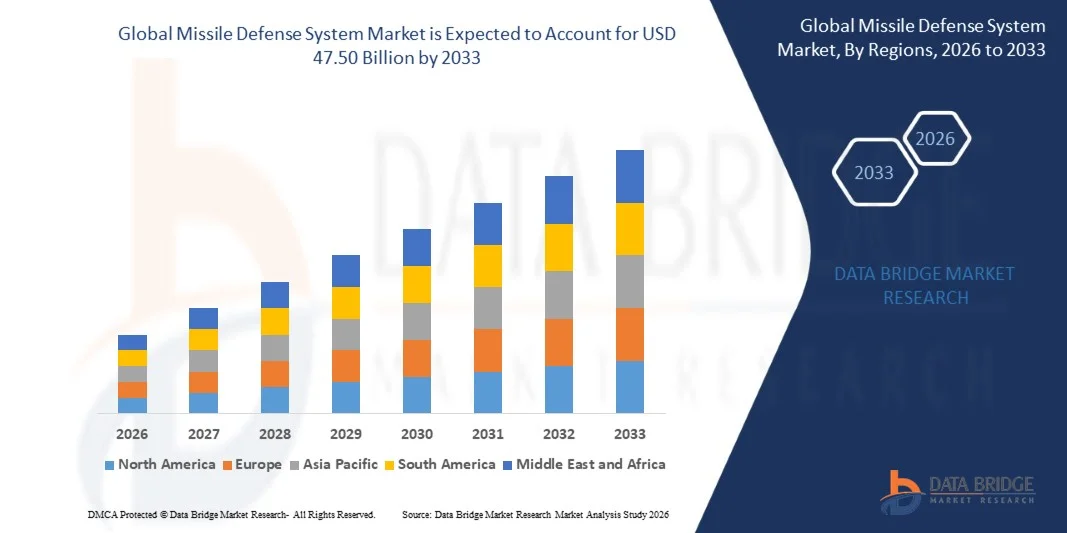
- As per Data Bridge Market Research analysis, the missile defense system market was valued at USD 33.60 billion in 2025 and is projected to reach USD 47.50 billion by 2033, growing at a CAGR of 7.20% from 2026 to 2033.
- The market is witnessing steady growth driven by increasing geopolitical tensions, rising defense budgets, and the growing need to counter evolving aerial threats such as ballistic missiles, cruise missiles, hypersonic weapons, and unmanned aerial systems.
- Continuous advancements in radar technologies, interceptor systems, command-and-control networks, and integrated air and missile defense architectures are enhancing detection, tracking, and interception capabilities, thereby accelerating market adoption across military forces worldwide.
Market Size & Forecast
- Market Value (2025): USD 33.60 Billion
- Expected Market Value (2033): USD 47.50 Billion
- Forecast CAGR (2026–2033): 7.20%
- Leading Region in 2025: North America
- Fastest Growing Region: Asia-Pacific
What are the Major Takeaways of the Missile Defense System Market?
- North America dominated the missile defense system market with the largest revenue share in 2025, supported by substantial defense spending, continuous modernization of missile defense infrastructure, and the presence of leading defense contractors.
- Asia-Pacific missile defense system market is expected to witness the fastest growth rate from 2026 to 2033, supported by increasing regional security concerns, rising defense budgets, and ongoing military modernization programs.
- The theater missile defense systems segment accounted for the largest market share in 2025, driven by increasing deployment of regional missile defense networks, growing military modernization programs, and rising demand for protection against ballistic and cruise missile threats. These systems are widely adopted due to their ability to defend critical military assets, population centers, and strategic infrastructure.
- The strategic missile defense systems segment is projected to witness the fastest growth from 2026 to 2033, driven by increasing investments in homeland defense programs, long-range threat interception capabilities, and the growing emergence of hypersonic missile threats. Governments are investing heavily in next-generation missile shields, space-based sensors, and advanced command-and-control systems to enhance national defense capabilities.
- The ballistic missiles segment held the largest market share in 2025 due to the widespread deployment of missile defense architectures specifically designed to counter short-, medium-, and long-range ballistic missile threats. Numerous countries continue to prioritize ballistic missile defense because of increasing missile proliferation and ongoing geopolitical tensions.
- The hypersonic weapons segment is projected to witness the fastest growth from 2026 to 2033, driven by increasing global development of hypersonic weapons and growing investments in advanced interception and tracking technologies. The rising challenge of detecting and intercepting maneuverable hypersonic threats is accelerating defense spending worldwide.
Report Scope and Missile Defense System Market Segmentation
|
Attributes |
Missile Defense System Key Market Insights |
|
Segments Covered |
|
|
Countries Covered |
North America
Europe
Asia-Pacific
Middle East and Africa
South America
|
|
Key Market Players |
|
|
Market Opportunities |
|
|
Value Added Data Infosets |
In addition to the market insights such as market value, growth rate, market segments, geographical coverage, market players, and market scenario, the market report curated by the Data Bridge Market Research team includes in-depth expert analysis, import/export analysis, pricing analysis, production consumption analysis, and pestle analysis. |
What is the Key Trend in the Missile Defense System Market?
- The growing focus on integrated and multi-layered missile defense architectures capable of countering ballistic missiles, cruise missiles, hypersonic weapons, and unmanned aerial threats is emerging as a major trend in the missile defense system market.
- For instance, in May 2025, the U.S. Department of Defense advanced the Golden Dome for America initiative, a next-generation missile defense architecture designed to strengthen homeland protection against ballistic, hypersonic, and advanced cruise missile threats through a layered defense approach.
- Defense agencies are increasingly investing in interconnected radar networks, advanced command-and-control systems, space-based sensors, and integrated interceptor platforms to improve detection, tracking, and engagement capabilities across multiple threat environments.
- For instance, in June 2025, Lockheed Martin delivered the eighth U.S. Terminal High Altitude Area Defense (THAAD) battery, further strengthening layered missile defense capabilities and enhancing protection against evolving ballistic missile threats.
- The integration of artificial intelligence, real-time data fusion, and network-centric warfare technologies is enabling faster threat assessment and coordinated responses across multiple defense domains.
- As nations continue to modernize their defense infrastructure and strengthen protection against increasingly sophisticated missile threats, the adoption of integrated multi-layered missile defense systems is expected to accelerate, reinforcing their role as a critical component of national security strategies worldwide.
What are the Key Drivers of the Missile Defense System Market?
- The increasing proliferation of ballistic missiles, hypersonic weapons, cruise missiles, and other advanced aerial threats has significantly increased demand for sophisticated missile defense systems capable of protecting critical military and civilian infrastructure.
- For instance, in February 2025, the U.S. Missile Defense Agency awarded Lockheed Martin a contract with a ceiling value of USD 2.8 billion to continue the development and enhancement of the THAAD weapon system, supporting protection against increasingly complex missile threats.
- Governments across North America, Europe, Asia-Pacific, and the Middle East are expanding defense budgets and accelerating modernization programs to strengthen air and missile defense capabilities amid rising geopolitical tensions.
- For instance, in May 2025, the U.S. Government formally advanced plans for the Golden Dome missile defense initiative, highlighting increased investments in next-generation missile defense technologies designed to counter emerging ballistic, cruise, and hypersonic missile threats.
- The growing emphasis on protecting strategic assets, military installations, population centers, and critical infrastructure is encouraging the deployment of advanced radar systems, interceptors, and command-and-control networks.
- With security threats becoming increasingly complex and unpredictable, missile defense systems are expected to remain a top procurement priority for defense organizations worldwide, supporting sustained market growth over the forecast period.
Which Factors are Challenging the Growth of the Missile Defense System Market?
- Advanced missile defense systems require substantial capital investment due to the integration of sophisticated radar networks, interceptor missiles, command-and-control infrastructure, space-based sensors, and continuous system upgrades.
- The high acquisition, deployment, maintenance, and lifecycle costs often create budgetary challenges, particularly for developing economies and countries with limited defense spending capacity.
- For instance, in May 2025, the U.S. Government's Golden Dome for America initiative highlighted the significant financial resources required to establish a comprehensive next-generation homeland missile defense architecture capable of countering ballistic, cruise, and hypersonic missile threats.
- In addition to procurement costs, missile defense programs require extensive testing, personnel training, infrastructure development, and interoperability integration with existing defense networks, further increasing overall expenditures.
- For instance, a May 2025 U.S. Government Accountability Office (GAO) report on the Guam Defense System identified ongoing operational, infrastructure, and support challenges associated with deploying and sustaining advanced missile defense capabilities.
- The substantial financial burden associated with developing, deploying, and maintaining advanced missile defense systems continues to limit adoption among budget-constrained nations. This challenge may slow market expansion in certain regions despite the growing need for enhanced protection against evolving missile threats.
How is the Missile Defense System Market Segmented?
The market is segmented on the basis of system type, threat type, interceptor type, platform, component, range, guidance & tracking technology, engagement phase, end user, capability, and distribution channel.
- By System Type
On the basis of system type, the missile defense system market is segmented into strategic missile defense systems, theater missile defense systems, and tactical missile defense systems. The theater missile defense systems segment accounted for the largest market share in 2025, driven by increasing deployment of regional missile defense networks, growing military modernization programs, and rising demand for protection against ballistic and cruise missile threats. These systems are widely adopted due to their ability to defend critical military assets, population centers, and strategic infrastructure. Growing procurement of Patriot, SAMP/T, and THAAD systems by NATO members and Asia-Pacific countries further strengthened segment dominance. The increasing need for layered defense capabilities against evolving regional security threats continues to support market expansion.
The strategic missile defense systems segment is projected to witness the fastest growth from 2026 to 2033, driven by increasing investments in homeland defense programs, long-range threat interception capabilities, and the growing emergence of hypersonic missile threats. Governments are investing heavily in next-generation missile shields, space-based sensors, and advanced command-and-control systems to enhance national defense capabilities.
- By Threat Type
On the basis of threat type, the missile defense system market is segmented into ballistic missiles, cruise missiles, hypersonic weapons, and air-breathing threats. The ballistic missiles segment held the largest market share in 2025 due to the widespread deployment of missile defense architectures specifically designed to counter short-, medium-, and long-range ballistic missile threats. Numerous countries continue to prioritize ballistic missile defense because of increasing missile proliferation and ongoing geopolitical tensions. The deployment of Ground-Based Midcourse Defense (GMD), Aegis BMD, and THAAD systems has further strengthened the segment's market position. Continuous investments in radar and interceptor technologies are also supporting segment growth.
The hypersonic weapons segment is projected to witness the fastest growth from 2026 to 2033, driven by increasing global development of hypersonic weapons and growing investments in advanced interception and tracking technologies. The rising challenge of detecting and intercepting maneuverable hypersonic threats is accelerating defense spending worldwide.
- By Interceptor Type
On the basis of interceptor type, the missile defense system market is segmented into exo-atmospheric interceptors, endo-atmospheric interceptors, hit-to-kill interceptors, and blast fragmentation interceptors. The hit-to-kill interceptors segment dominated the market in 2025 owing to its high interception accuracy and increasing adoption in advanced missile defense programs. These interceptors eliminate threats through direct kinetic impact, reducing collateral damage and improving engagement effectiveness. Their growing deployment in systems such as THAAD and Ground-Based Interceptors has contributed significantly to market leadership. Advancements in precision guidance technologies are further supporting segment growth.
The exo-atmospheric interceptors segment is anticipated to witness the fastest growth from 2026 to 2033 due to increasing demand for long-range interception capabilities against ballistic and emerging hypersonic threats. Growing investments in homeland missile defense programs are expected to accelerate adoption.
- By Platform
On the basis of platform, the missile defense system market is segmented into land-based systems, naval-based systems, airborne systems, and space-based systems. The land-based systems segment accounted for the largest market share in 2025 due to extensive deployment of ground-based missile defense systems by major military powers. These systems provide continuous protection for military installations, strategic assets, and population centers. The widespread adoption of Patriot, THAAD, S-400, and Iron Dome systems has strengthened segment growth. Rising defense modernization initiatives across North America, Europe, and Asia-Pacific continue to drive investments in land-based defense platforms.
The space-based systems segment is projected to witness the fastest growth from 2026 to 2033, supported by increasing investments in satellite-based tracking, early warning systems, and space-domain awareness capabilities. Governments are prioritizing space-based missile detection to improve response times against advanced threats.
- By Component
On the basis of component, the missile defense system market is segmented into interceptors, radar systems, electro-optical and infrared sensors, and command and control systems. The interceptors segment held the largest market share in 2025 owing to high procurement costs and continuous replenishment requirements for operational missile defense systems. Interceptors represent the primary engagement element of missile defense architecture and account for a substantial portion of defense spending. Increased procurement of advanced interceptor missiles by defense agencies worldwide continues to support segment growth. Ongoing modernization of missile inventories is further contributing to demand.
The command-and-control systems segment is projected to witness the fastest growth from 2026 to 2033, driven by increasing demand for integrated battle management, sensor fusion, and network-centric warfare capabilities. Advanced command platforms are becoming critical for coordinating multi-domain defense operations.
- By Range
On the basis of range, the missile defense system market is segmented into very short-range defense, short-range defense, medium-range defense, and long-range defense. The medium-range defense segment dominated the market in 2025 due to its extensive deployment across military installations and regional defense networks. These systems provide an effective balance between operational coverage and deployment flexibility. Increasing procurement by armed forces to counter tactical ballistic missiles and cruise missile threats has strengthened segment demand. The segment also benefits from strong integration with existing air defense systems.
The long-range defense segment is projected to witness the fastest growth from 2026 to 2033, supported by increasing investments in strategic homeland defense initiatives and long-range missile interception technologies. Growing concerns over intercontinental and hypersonic missile threats are accelerating adoption.
- By Guidance & Tracking Technology
On the basis of guidance and tracking technology, the missile defense system market is segmented into radar-guided systems, infrared-guided systems, multi-mode guidance, and satellite-assisted guidance. The radar-guided systems segment accounted for the largest market share in 2025 due to their widespread use in missile detection, tracking, and engagement operations. Modern radar technologies offer high-precision target identification and long-range surveillance capabilities. The deployment of active electronically scanned array (AESA) radars has significantly improved detection performance. Continuous advancements in radar technology continue to strengthen segment dominance.
The satellite-assisted guidance segment is anticipated to witness the fastest growth from 2026 to 2033, driven by advancements in space-based surveillance, precision targeting, and integrated defense networks. Increasing military reliance on satellite-enabled situational awareness is expected to support rapid growth.
- By Engagement Phase
On the basis of engagement phase, the missile defense system market is segmented into boost-phase intercept, midcourse-phase intercept, terminal-phase intercept, and layered defense engagement. The terminal-phase intercept segment held the largest market share in 2025 owing to its operational maturity and widespread deployment in existing missile defense architectures. These systems are designed to neutralize threats during the final stage of flight before impact. Their proven effectiveness and extensive deployment across defense forces worldwide have supported market leadership. Continuous upgrades in interceptor accuracy and sensor integration are further enhancing segment performance.
The layered defense engagement segment is projected to witness the fastest growth from 2026 to 2033 as defense organizations increasingly adopt multi-tiered interception strategies to improve mission success rates. The ability to engage threats at multiple stages of flight is driving strong investment in this segment.
- By End User
On the basis of end user, the missile defense system market is segmented into army, navy, air force, and joint defense commands. The army segment accounted for the largest market share in 2025 due to extensive deployment of ground-based air and missile defense systems across military forces worldwide. Army forces are responsible for protecting critical infrastructure, military bases, and operational units from missile attacks. Continuous procurement of tactical and strategic missile defense systems has reinforced segment leadership. Rising border security concerns and regional conflicts are also contributing to demand.
The joint defense commands segment is expected to witness the fastest growth from 2026 to 2033, driven by increasing emphasis on integrated multi-domain operations and coordinated missile defense strategies. Governments are increasingly investing in unified command structures to improve operational effectiveness.
- By Capability
On the basis of capability, the missile defense system market is segmented into detection and early warning, tracking and target identification, battle management, and interception and neutralization. The interception and neutralization segment dominated the market in 2025 due to significant investments in interceptor missiles and engagement systems. The ability to successfully eliminate incoming threats remains the primary objective of missile defense architectures. Continuous advancements in kinetic kill vehicles, directed-energy technologies, and advanced interceptors are supporting segment growth. Increased defense procurement programs worldwide are further strengthening demand.
The battle management segment is projected to witness the fastest growth from 2026 to 2033, supported by rising demand for real-time decision-making, artificial intelligence integration, and network-enabled defense operations. Advanced battle management systems are becoming essential for coordinating complex missile defense missions.
- By Distribution Channel
On the basis of distribution channel, the missile defense system market is segmented into direct sales, channel partner sales, project-based procurement, and online sales. The direct sales segment accounted for the largest market share in 2025 as missile defense systems are primarily procured through direct government-to-contractor agreements and defense contracts. Long-term procurement programs, strategic partnerships, and government defense budgets support the dominance of this segment. Direct procurement ensures compliance with national security requirements and facilitates customized system integration. Major defense contractors continue to rely heavily on direct government engagements.
The project-based procurement segment i is projected to witness the fastest growth from 2026 to 2033, driven by increasing large-scale modernization programs, long-term defense infrastructure projects, and multi-year procurement initiatives. Growing investments in integrated missile defense networks and homeland security programs are expected to accelerate segment expansion.
Which Region Holds the Largest Share of the Missile Defense System Market?
- North America dominated the missile defense system market with the largest revenue share in 2025, supported by substantial defense spending, continuous modernization of missile defense infrastructure, and the presence of leading defense contractors.
- The region benefits from extensive deployment of advanced missile defense systems such as Ground-Based Midcourse Defense (GMD), Aegis Ballistic Missile Defense, Patriot, and THAAD. Rising concerns regarding ballistic, cruise, and hypersonic missile threats, coupled with increasing investments in next-generation interception technologies, continue to strengthen market growth. Strong government support for homeland security and strategic defense initiatives further reinforces North America's leading position in the global market.
U.S. Missile Defense System Market Insight
The U.S. missile defense system market captured the largest revenue share in 2025 within North America, driven by significant investments in homeland defense, missile interception capabilities, and integrated air and missile defense networks. The country continues to prioritize modernization programs involving THAAD, Patriot, Aegis BMD, and Next Generation Interceptor (NGI) systems. Growing emphasis on countering hypersonic weapons, ballistic missiles, and emerging aerial threats is accelerating procurement activities. In addition, the integration of artificial intelligence, space-based sensors, and advanced command-and-control platforms is supporting the expansion of missile defense capabilities across multiple military domains.
Europe Missile Defense System Market Insight
The Europe missile defense system market is expected to witness significant growth from 2026 to 2033, primarily driven by rising geopolitical tensions, increased defense budgets, and expanding military modernization programs across the region. European countries are increasingly investing in integrated air and missile defense systems to strengthen protection against evolving missile threats. Growing cooperation among NATO members and increased deployment of advanced radar, interceptor, and surveillance technologies are further supporting market growth. The region is also witnessing increased procurement of multi-layered defense systems to enhance collective security capabilities.
U.K. Missile Defense System Market Insight
The U.K. missile defense system market is expected to witness strong growth from 2026 to 2033, driven by increasing investments in air and missile defense modernization and growing participation in NATO security initiatives. The country's focus on strengthening national defense capabilities against advanced missile threats is encouraging procurement of next-generation surveillance, command-and-control, and interception systems. Ongoing investments in integrated air defense programs and advanced radar technologies are expected to support market expansion. The increasing importance of protecting critical infrastructure and military assets is also contributing to demand.
Germany Missile Defense System Market Insight
The Germany missile defense system market is expected to witness substantial growth from 2026 to 2033, fueled by increasing defense expenditures and strategic efforts to strengthen national and regional security. Germany continues to invest in advanced air and missile defense capabilities as part of broader European defense modernization initiatives. The growing emphasis on integrated defense networks, long-range surveillance systems, and interoperable NATO defense capabilities is accelerating adoption. Furthermore, rising investments in next-generation missile interception technologies are expected to support long-term market development.
Asia-Pacific Missile Defense System Market Insight
The Asia-Pacific missile defense system market is expected to witness the fastest growth rate from 2026 to 2033, supported by increasing regional security concerns, rising defense budgets, and ongoing military modernization programs. Countries across the region are actively investing in advanced missile defense technologies to address evolving ballistic and hypersonic missile threats. The expansion of indigenous defense manufacturing capabilities, coupled with growing procurement of radar systems, interceptors, and command-and-control solutions, is driving market growth. Government initiatives focused on strengthening national defense readiness are further accelerating adoption throughout the region.
Japan Missile Defense System Market Insight
The Japan missile defense system market is expected to witness strong growth from 2026 to 2033 due to increasing investments in national security and growing concerns regarding regional missile threats. The country continues to strengthen its missile defense architecture through deployments of Aegis-equipped destroyers, Patriot PAC-3 systems, and advanced early-warning capabilities. Rising emphasis on counter-hypersonic defense technologies and enhanced surveillance capabilities is supporting market expansion. Furthermore, ongoing collaboration with allied nations on missile defense development is expected to create additional growth opportunities.
China Missile Defense System Market Insight
The China missile defense system market accounted for the largest market revenue share in Asia-Pacific in 2025, attributed to substantial investments in military modernization, indigenous defense technology development, and strategic missile defense capabilities. The country continues to expand its air and missile defense infrastructure through the deployment of advanced radar systems, interceptor technologies, and integrated command-and-control networks. Increasing focus on countering evolving aerial threats and strengthening national security is driving demand for sophisticated missile defense solutions. Strong government support for defense innovation and modernization remains a key factor supporting market growth in China.
Which are the Top Companies in Missile Defense System Market?
The missile defense system industry is primarily led by well-established companies, including:
- Northrop Grumman Corporation (U.S.)
- Lockheed Martin Corporation (U.S.)
- L3Harris Technologies, Inc. (U.S.)
- General Dynamics Corporation (U.S.)
- BAE Systems (U.K.)
- Leonardo S.p.A. (Italy)
- Thales S.A. (France)
- Saab AB (Sweden)
- Rheinmetall AG (Germany)
- Hanwha Aerospace Co., Ltd. (South Korea)
- Mitsubishi Heavy Industries, Ltd. (Japan)
- Israel Aerospace Industries Ltd. (Israel)
- Kongsberg Gruppen ASA (Norway)
- Bharat Electronics Limited (India)
- MBDA S.A.S. (France)
- Rafael Advanced Defense Systems Ltd. (Israel)
- Diehl Defence GmbH & Co. KG (Germany)
- Aselsan A.Ş. (Türkiye)
- EDGE Group PJSC (U.A.E.)
- China Aerospace Science and Industry Corporation (China)
- Almaz-Antey Air and Space Defence Corporation (Russia)
- Roketsan A.Ş. (Türkiye)
- Bharat Dynamics Limited (India)
What are Latest Developments in Missile Defense System Market?
- In January 2026, Israel Aerospace Industries (IAI) received a contract valued at approximately USD 3.1 billion from Israel’s Ministry of Defense in support of Germany’s acquisition of the Arrow 3 missile defense system under a larger USD 6.5 billion program. The agreement highlights the increasing international demand for advanced missile defense technologies and reflects Germany’s ongoing efforts to strengthen its strategic air and missile defense infrastructure amid a rapidly evolving security environment.

- Interactive Data Analysis Dashboard
- Company Analysis Dashboard for high growth potential opportunities
- Research Analyst Access for customization & queries
- Competitor Analysis with Interactive dashboard
- Latest News, Updates & Trend analysis
- Harness the Power of Benchmark Analysis for Comprehensive Competitor Tracking
Data collection and base year analysis are done using data collection modules with large sample sizes. The stage includes obtaining market information or related data through various sources and strategies. It includes examining and planning all the data acquired from the past in advance. It likewise envelops the examination of information inconsistencies seen across different information sources. The market data is analysed and estimated using market statistical and coherent models. Also, market share analysis and key trend analysis are the major success factors in the market report. To know more, please request an analyst call or drop down your inquiry.
The key research methodology used by DBMR research team is data triangulation which involves data mining, analysis of the impact of data variables on the market and primary (industry expert) validation. Data models include Vendor Positioning Grid, Market Time Line Analysis, Market Overview and Guide, Company Positioning Grid, Patent Analysis, Pricing Analysis, Company Market Share Analysis, Standards of Measurement, Global versus Regional and Vendor Share Analysis. To know more about the research methodology, drop in an inquiry to speak to our industry experts.
Data Bridge Market Research is a leader in advanced formative research. We take pride in servicing our existing and new customers with data and analysis that match and suits their goal. The report can be customized to include price trend analysis of target brands understanding the market for additional countries (ask for the list of countries), clinical trial results data, literature review, refurbished market and product base analysis. Market analysis of target competitors can be analyzed from technology-based analysis to market portfolio strategies. We can add as many competitors that you require data about in the format and data style you are looking for. Our team of analysts can also provide you data in crude raw excel files pivot tables (Fact book) or can assist you in creating presentations from the data sets available in the report.












