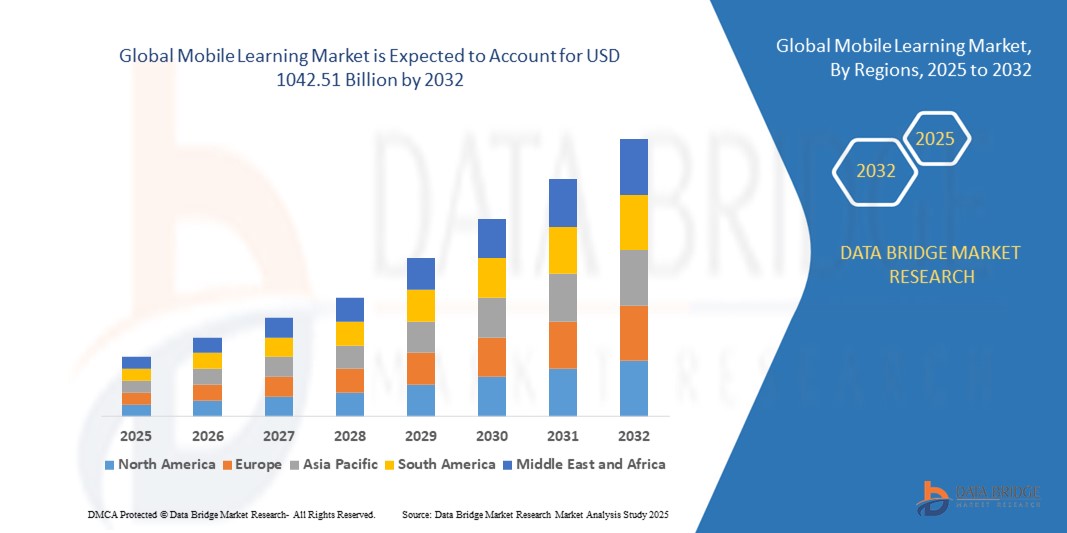
What is the Global Mobile Learning Market Size and Growth Rate?
- The global mobile learning market size was valued at USD 110.06 billion in 2024 and is expected to reach USD 1042.51 billion by 2032, at a CAGR of 32.45% during the forecast period
- The high mobile and smartphone penetration rates is the major factor accelerating the growth of the mobile learning market in the forecast period of 2025 to 2032. Furthermore, the government initiatives and investment towards digital education system, rise in corporate focus on BYOD model to optimize operational expenses, rise in number of E-books and rise in content digitization and higher education institutes are implementing mobile learning solutions in their system are also expected to drive the growth of the mobile learning market
What are the Major Takeaways of Mobile Learning Market?
- Mobile Learning, delivering education and training through smartphones, tablets, and other portable devices, is becoming a crucial part of modern education and corporate training systems due to its flexibility, accessibility, and ability to support interactive and personalized learning experiences
- The rising demand for mobile learning is primarily driven by increasing smartphone penetration, growing adoption of digital education platforms, and a strong preference for cost-effective, on-the-go learning solutions among students and professionals
- North America dominated the mobile learning market with the largest revenue share of 38.19% in 2024, driven by widespread smartphone penetration, advanced network infrastructure, and the strong adoption of digital education tools across schools, universities, and enterprises
- The Asia-Pacific Mobile Learning market is set to grow at the fastest CAGR of 8.85% from 2025 to 2032, propelled by increasing smartphone adoption, affordable mobile data, and government-backed digital learning initiatives in countries such as China, India, and Japan
- The Mobile and Video-based Courseware segment dominated the market with the largest market revenue share of 38.4% in 2024, driven by the rising preference for visual and interactive content among learners
Report Scope and Mobile Learning Market Segmentation
|
Attributes |
Mobile Learning Key Market Insights |
|
Segments Covered |
|
|
Countries Covered |
North America
Europe
Asia-Pacific
Middle East and Africa
South America
|
|
Key Market Players |
|
|
Market Opportunities |
|
|
Value Added Data Infosets |
In addition to the insights on market scenarios such as market value, growth rate, segmentation, geographical coverage, and major players, the market reports curated by the Data Bridge Market Research also include in-depth expert analysis, pricing analysis, brand share analysis, consumer survey, demography analysis, supply chain analysis, value chain analysis, raw material/consumables overview, vendor selection criteria, PESTLE Analysis, Porter Analysis, and regulatory framework. |
What is the Key Trend in the Mobile Learning Market?
Enhanced Personalization Through AI and Gamification
- A major trend in the global mobile learning market is the integration of artificial intelligence (AI) and gamification features to create more personalized, adaptive, and engaging learning experiences. AI-powered platforms can assess learner progress in real time, recommend tailored courses, and deliver adaptive quizzes, making learning more effective
- For instance, Duolingo employs gamification elements such as leaderboards, streaks, and reward systems while using AI-driven assessments to customize language learning journeys. Similarly, Coursera leverages AI to provide skill-based recommendations aligned with career goals
- Gamification techniques, including points, badges, and interactive challenges, significantly improve engagement and learner retention rates. AI-driven chatbots also provide real-time assistance, fostering interactive and accessible mobile-based learning
- This trend toward personalized, gamified, and AI-enabled Mobile Learning solutions is reshaping user expectations, making digital learning more interactive and motivating across both academic and corporate training environments
What are the Key Drivers of Mobile Learning Market?
- The rising adoption of smartphones and high-speed internet connectivity is one of the most significant drivers of the mobile learning market, enabling easy access to learning resources anytime and anywhere
- For instance, in May 2024, Coursera announced a strategic collaboration with Google to expand mobile-based career certificate programs, improving workforce skill development across emerging markets. Such partnerships are fueling the rapid expansion of Mobile Learning solutions globally
- Growing demand for cost-effective and flexible learning models among students, professionals, and enterprises is propelling adoption. Mobile Learning platforms provide features such as offline accessibility, microlearning, and push notifications, making education more flexible and learner-friendly
- In .addition, the rising popularity of corporate training and upskilling programs via mobile platforms supports market growth. Enterprises are increasingly leveraging Mobile Learning apps to train employees, reduce training costs, and monitor learner progress in real time
Which Factor is Challenging the Growth of the Mobile Learning Market?
- Concerns around data privacy and cybersecurity vulnerabilities in mobile applications pose a critical challenge to the mobile learning market. With the growing reliance on personal devices and cloud-based platforms, risks of data breaches, unauthorized access, and misuse of learner data have become significant barriers
- For instance, instances of unauthorized access to EdTech platforms have raised concerns among learners and institutions about safeguarding sensitive student and corporate information
- To address this, companies are incorporating end-to-end encryption, multi-factor authentication, and GDPR-compliant security protocols to strengthen user trust. However, the high initial investment in premium Mobile Learning apps, along with subscription costs, remains a barrier for price-sensitive markets
- While affordable solutions are expanding, bridging the trust gap in data security and ensuring accessibility at lower price points will be crucial for sustaining Mobile Learning adoption, especially in emerging economies
How is the Mobile Learning Market Segmented?
The market is segmented on the basis of solution, application, and end user.
- By Solution
On the basis of solution, the mobile learning market is segmented into Mobile Content Authoring, E-books, Portable LMS, Mobile and Video-based Courseware, Interactive Assessments, Content Development, and m-Enablement. The Mobile and Video-based Courseware segment dominated the market with the largest market revenue share of 38.4% in 2024, driven by the rising preference for visual and interactive content among learners. Its ability to deliver engaging lessons anytime, anywhere has made it the backbone of both academic and corporate training programs. Furthermore, the growing popularity of short-form, micro-learning modules supports its strong adoption across industries.
The m-Enablement segment is expected to witness the fastest CAGR of 21.2% from 2025 to 2032, fueled by increasing demand for mobile optimization of existing training content. Organizations are increasingly adopting m-Enablement to make their legacy learning materials mobile-friendly, ensuring wider accessibility and improved learner engagement across devices.
- By Application
On the basis of application, the mobile learning market is segmented into In-Class Learning, Simulation-Based Learning, Corporate Learning, and Online-on-the Job Training. The Corporate Learning segment captured the largest revenue share of 41.6% in 2024, supported by the rising need for workforce upskilling, compliance training, and the cost-effectiveness of mobile-based corporate training programs. Multinational enterprises and SMEs are increasingly investing in mobile-first learning to ensure seamless access for employees working in hybrid and remote environments.
The Simulation-Based Learning segment is projected to grow at the fastest CAGR of 23.4% during 2025–2032, driven by its immersive approach that leverages AR/VR and gamified tools to replicate real-world scenarios. This method is particularly popular in fields such as healthcare, aviation, and technical training, where practical experience is critical. Growing emphasis on experiential learning is positioning simulation-based mobile solutions as a transformative force in education and training.
- By End User
On the basis of end user, the mobile learning market is segmented into Academic, Government, and Corporate. The Corporate segment dominated the market with the largest market revenue share of 47.2% in 2024, fueled by enterprises adopting mobile platforms to train employees, enhance productivity, and reduce training costs. Increasing reliance on mobile-based training for new employee onboarding, leadership programs, and compliance certifications further strengthens its dominance.
The Academic segment is forecasted to witness the fastest CAGR of 20.5% from 2025 to 2032, supported by the rapid adoption of e-learning in schools, colleges, and universities. Mobile Learning in academics is gaining traction due to the flexibility it offers students for personalized and remote learning. Government initiatives promoting digital education and the integration of mobile apps into classroom ecosystems are also expected to drive significant growth in this segment over the coming years.
Which Region Holds the Largest Share of the Mobile Learning Market?
- North America dominated the mobile learning market with the largest revenue share of 38.19% in 2024, driven by widespread smartphone penetration, advanced network infrastructure, and the strong adoption of digital education tools across schools, universities, and enterprises
- Learners and organizations in the region increasingly value flexibility, personalized learning pathways, and seamless integration of mobile platforms with other e-learning ecosystems.
- High digital literacy rates, substantial investments in educational technology, and the growing trend of remote and hybrid learning further reinforce the dominance of North America in the global Mobile Learning market
U.S. Mobile Learning Market Insight
The U.S. captured 81% of the North American market share in 2024, fueled by the strong adoption of corporate mobile training solutions and the rapid expansion of e-learning platforms in higher education. Mobile applications supporting microlearning, AI-driven recommendations, and gamification are gaining traction across sectors. The rising popularity of cloud-based LMS platforms and mobile-first course content is further propelling growth, making the U.S. the epicenter of innovation in Mobile Learning.
Europe Mobile Learning Market Insight
The Europe mobile learning market is projected to grow at a substantial CAGR during the forecast period, supported by strong government-backed digital education initiatives and a rising focus on upskilling and reskilling programs. Rapid urbanization, combined with high mobile device usage, is driving adoption across schools, training centers, and enterprises. European learners are attracted to the flexibility, multilingual content, and interactive formats that Mobile Learning offers. Demand is particularly high in corporate training and vocational education, with mobile-first platforms being deployed in both traditional classrooms and online modules.
U.K. Mobile Learning Market Insight
The U.K. market is expected to expand at a notable CAGR, driven by the government’s focus on digital learning adoption and strong consumer demand for remote and hybrid education. Rising concerns about workforce readiness and the adoption of mobile-first platforms by universities and enterprises are accelerating growth. With its robust edtech ecosystem, the U.K. is positioned as one of Europe’s leading hubs for Mobile Learning solutions.
Germany Mobile Learning Market Insight
The Germany market is forecast to grow at a steady CAGR, supported by its advanced digital infrastructure and focus on innovation-driven education. Emphasis on eco-friendly, efficient, and scalable Mobile Learning solutions aligns well with Germany’s broader sustainability goals. The adoption of mobile-first platforms in corporate upskilling and vocational training is strong, further reinforced by integration with advanced technologies such as AI and AR for immersive learning experiences.
Which Region is the Fastest Growing in the Mobile Learning Market?
The Asia-Pacific mobile learning market is set to grow at the fastest CAGR of 8.85% from 2025 to 2032, propelled by increasing smartphone adoption, affordable mobile data, and government-backed digital learning initiatives in countries such as China, India, and Japan. Rapid urbanization, a young and tech-savvy population, and a surge in demand for flexible, affordable education are accelerating growth. In .addition, the region’s role as a manufacturing hub for mobile technologies is expanding access to Mobile Learning platforms across diverse income groups.
Japan Mobile Learning Market Insight
Japan’s market is witnessing robust growth, supported by its high-tech culture, aging population, and emphasis on lifelong learning. Mobile Learning adoption is increasing in both academic and corporate environments, particularly through platforms integrating with AR/VR simulations and IoT devices. The focus on convenience and advanced personalization is driving rapid deployment of Mobile Learning across industries.
China Mobile Learning Market Insight
China held the largest share of the Asia-Pacific Mobile Learning market in 2024, driven by its massive middle-class population, rapid urbanization, and high rates of mobile adoption. Mobile Learning is increasingly embedded into the country’s smart education and smart city initiatives, with strong support from domestic edtech firms. Affordable mobile-first platforms and the government’s push for digital literacy are cementing China’s position as a global leader in Mobile Learning adoption.
Which are the Top Companies in Mobile Learning Market?
The mobile learning industry is primarily led by well-established companies, including:
- MOBILEIRON INC. (U.S.)
- Ventraq Corporation (U.S.)
- SAP SE (Germany)
- Broadcom (U.S.)
- Mitsogo Inc. (U.S.)
- 42Gears Mobility Systems Pvt Ltd. (India)
- FiberLink Communications, LLC (U.S.)
- ZOHO Corp. (India)
- Absolute Software Inc. (Canada)
- Apple Inc. (U.S.)
- NortonLifeLock Inc. (U.S.)
- Blackberry Limited (Canada)
- SOTI Inc. (Canada)
- Sophos Ltd. (U.K.)
- Microsoft (U.S.)
- Citrix Systems (U.S.)
- Cisco Systems Inc. (U.S.)
- Ivanti (U.S.)
- Matrix42 AG (Germany)
- VMware, Inc. (U.S.)
- IBM Corporation (U.S.)
What are the Recent Developments in Global Mobile Learning Market?
- In June 2024, Adobe introduced Adobe Learning Manager, a platform designed to provide seamless access to training content, courses, and assessments directly on mobile devices. The application also supports offline learning, bookmarking, progress tracking, and multimedia features, offering learners a flexible and user-friendly mobile learning experience. This launch marks Adobe’s strong step toward enhancing digital and mobile-first education solutions
- In August 2023, Echo360 unveiled EchoExam, a SaaS-based summative assessment solution aimed at both education and business sectors. Expanding upon its previous ExamView software, the platform delivers improved compatibility, multi-modal exam delivery, and enhanced administrative control to ensure equitable testing conditions. This advancement reinforces Echo360’s position as a leader in modern digital assessments
- In March 2023, INSEAD, a globally renowned business school, rolled out a mobile application subscription service through its INSEAD Learning Hub. The platform allows lifelong learners to access exclusive content from faculty and alumni while connecting with INSEAD’s global community. This initiative highlights INSEAD’s commitment to fostering continuous, accessible education worldwide
- In November 2022, Bodyswaps, in collaboration with Meta Immersive Learning, announced a project providing over 100 educational institutions across the U.K., North America, France, and Belgium with access to immersive VR learning technology. This collaboration emphasizes the growing role of virtual reality in transforming higher and further education experiences
- In September 2022, Skilldora, a South Carolina-based e-learning company, partnered with D-ID, an Israel-based creative reality firm, to launch AI-powered courses entirely taught by virtual instructors. This partnership represents a milestone in leveraging artificial intelligence to redefine teaching methodologies in digital education

- Interactive Data Analysis Dashboard
- Company Analysis Dashboard for high growth potential opportunities
- Research Analyst Access for customization & queries
- Competitor Analysis with Interactive dashboard
- Latest News, Updates & Trend analysis
- Harness the Power of Benchmark Analysis for Comprehensive Competitor Tracking
Data collection and base year analysis are done using data collection modules with large sample sizes. The stage includes obtaining market information or related data through various sources and strategies. It includes examining and planning all the data acquired from the past in advance. It likewise envelops the examination of information inconsistencies seen across different information sources. The market data is analysed and estimated using market statistical and coherent models. Also, market share analysis and key trend analysis are the major success factors in the market report. To know more, please request an analyst call or drop down your inquiry.
The key research methodology used by DBMR research team is data triangulation which involves data mining, analysis of the impact of data variables on the market and primary (industry expert) validation. Data models include Vendor Positioning Grid, Market Time Line Analysis, Market Overview and Guide, Company Positioning Grid, Patent Analysis, Pricing Analysis, Company Market Share Analysis, Standards of Measurement, Global versus Regional and Vendor Share Analysis. To know more about the research methodology, drop in an inquiry to speak to our industry experts.
Data Bridge Market Research is a leader in advanced formative research. We take pride in servicing our existing and new customers with data and analysis that match and suits their goal. The report can be customized to include price trend analysis of target brands understanding the market for additional countries (ask for the list of countries), clinical trial results data, literature review, refurbished market and product base analysis. Market analysis of target competitors can be analyzed from technology-based analysis to market portfolio strategies. We can add as many competitors that you require data about in the format and data style you are looking for. Our team of analysts can also provide you data in crude raw excel files pivot tables (Fact book) or can assist you in creating presentations from the data sets available in the report.