


Mobile Personal Emergency Response Systems Market Size
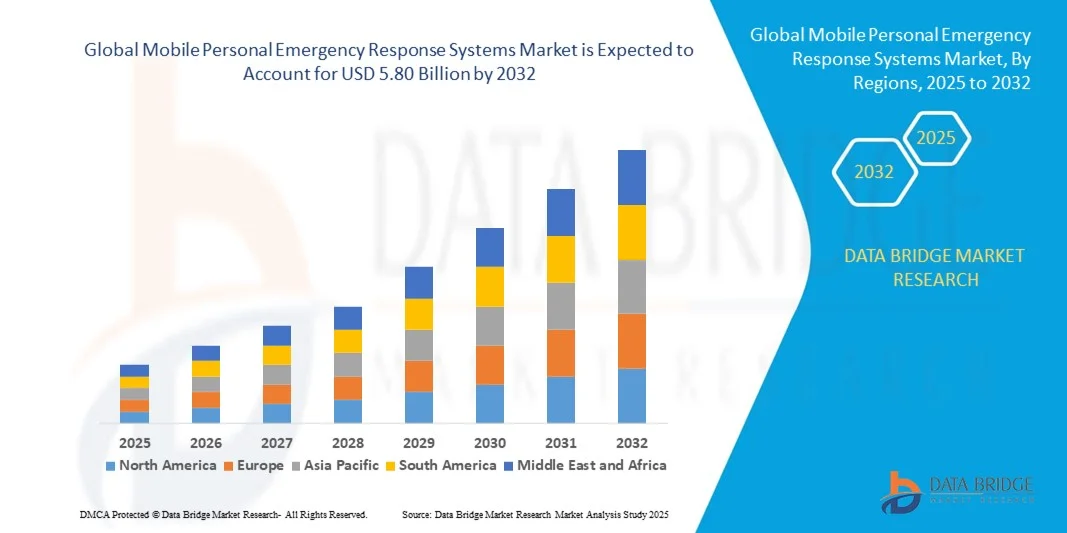
- The global mobile personal emergency response systems market size was valued at USD 3.33 billion in 2024 and is expected to reach USD 5.80 billion by 2032, at a CAGR of 7.20% during the forecast period
- The market growth is largely fuelled by the increasing aging population and the rising demand for real-time health monitoring and emergency assistance solutions
- The growing adoption of mobile health technologies, integration of GPS and cellular connectivity, and the shift toward independent living among seniors are further driving market expansion
Mobile Personal Emergency Response Systems Market Analysis
- The global mobile personal emergency response systems market is witnessing robust growth due to advancements in wearable devices and the integration of smart technologies such as AI and IoT for improved emergency response efficiency
- The rise in chronic disease prevalence and the increasing need for rapid medical assistance are pushing healthcare providers and consumers to adopt mobile-based emergency systems for enhanced safety and peace of mind
- North America dominated the mobile personal emergency response systems (mPERS) market with the largest revenue share of 41.25% in 2024, driven by the growing aging population, increasing adoption of telehealth solutions, and strong awareness of personal safety technologies
- Asia-Pacific region is expected to witness the highest growth rate in the global mobile personal emergency response systems market, driven by increasing healthcare investments, expanding telemedicine adoption, and growing demand for connected health and monitoring solutions among aging populations
- The GPS-Based segment held the largest market revenue share in 2024, driven by its advanced location-tracking capabilities and ability to provide real-time monitoring during emergencies. These systems are highly preferred by caregivers and healthcare providers as they enable immediate location identification and rapid assistance for users in distress
Report Scope and Mobile Personal Emergency Response Systems Market Segmentation
|
Attributes |
Mobile Personal Emergency Response Systems Key Market Insights |
|
Segments Covered |
|
|
Countries Covered |
North America
Europe
Asia-Pacific
Middle East and Africa
South America
|
|
Key Market Players |
|
|
Market Opportunities |
|
|
Value Added Data Infosets |
In addition to the insights on market scenarios such as market value, growth rate, segmentation, geographical coverage, and major players, the market reports curated by the Data Bridge Market Research also include in-depth expert analysis, geographically represented company-wise production and capacity, network layouts of distributors and partners, detailed and updated price trend analysis and deficit analysis of supply chain and demand. |
Mobile Personal Emergency Response Systems Market Trends
Integration Of Artificial Intelligence And IoT In Mobile PERS Devices
- The increasing integration of Artificial Intelligence (AI) and Internet of Things (IoT) technologies is transforming the mobile personal emergency response systems (mPERS) market by enabling predictive analytics, real-time monitoring, and automatic emergency detection. These technologies enhance user safety by identifying abnormal activity patterns and alerting caregivers or emergency responders instantly. In addition, AI-driven algorithms can analyze user behavior over time to detect subtle health changes, helping prevent critical incidents before they occur and improving long-term patient outcomes
- The widespread adoption of wearable and connected devices, such as smartwatches and health-tracking pendants, is accelerating the demand for IoT-enabled mobile PERS. These systems allow continuous tracking of user health metrics such as heart rate, movement, and fall detection, ensuring immediate intervention in case of emergencies. Moreover, advancements in sensor technology and battery efficiency are enhancing device accuracy and longevity, making these solutions more reliable and appealing to both healthcare providers and individual users
- The growing elderly population and the need for independent living solutions are further driving the adoption of AI-based mobile PERS. These systems help seniors maintain autonomy while providing families and caregivers peace of mind through 24/7 monitoring and instant communication capabilities. The combination of mobility, real-time location tracking, and advanced alert systems ensures that elderly users receive timely assistance during emergencies, supporting the global trend toward aging-in-place care models
- For instance, in 2023, several healthcare technology companies in the U.S. introduced AI-integrated PERS devices that combine voice recognition and biometric monitoring to provide automatic alerts during health crises such as heart attacks or falls, enhancing emergency response efficiency. These devices can analyze voice tone and physical cues to identify distress signals even when the user cannot press the help button. As adoption grows, such innovations are setting new standards for proactive healthcare and remote patient safety
- While AI and IoT integration in mobile PERS is enhancing safety, the success of these solutions depends on reliable connectivity, data privacy, and user-friendly interfaces. Manufacturers must ensure secure data transmission and device interoperability to build trust and drive wider adoption. Furthermore, ensuring compliance with global healthcare data regulations and offering multilingual, intuitive designs will be key to increasing accessibility across diverse age groups and regions
Mobile Personal Emergency Response Systems Market Dynamics
Driver
Increasing Geriatric Population And Rising Demand For Independent Living Solutions
- The rising global geriatric population is a major factor driving the mobile PERS market as elderly individuals seek greater independence and safety through mobile monitoring solutions. The ability of these systems to provide round-the-clock emergency response services is particularly appealing for aging populations in both developed and emerging economies. In addition, healthcare organizations are increasingly promoting mobile PERS as part of preventive care programs to reduce hospitalization rates and emergency room visits
- Growing preference for aging-in-place and home-based care is boosting the adoption of mobile PERS, which enable users to summon assistance at any time through GPS-enabled devices. Healthcare institutions are increasingly integrating these systems into eldercare programs to enhance response times and reduce hospitalization rates. Furthermore, the inclusion of AI and cloud-based monitoring platforms enhances tracking accuracy and helps caregivers make informed decisions in real time
- Government initiatives promoting digital healthcare and telecare services are further strengthening market expansion. Supportive reimbursement frameworks and technological advancements in wearable healthcare devices are enabling cost-effective deployment of mobile PERS for senior citizens. Public-private partnerships are also emerging to distribute low-cost emergency response systems in rural and underserved areas, expanding market accessibility
- For instance, in 2023, the U.K. government launched a telecare support initiative for elderly residents, including subsidies for GPS-based PERS devices that allow users to connect directly with emergency services, significantly improving response times during incidents. This program has inspired similar initiatives in Europe and Asia, emphasizing proactive healthcare management for the elderly population
- While growing awareness of independent living and telehealth support fuels market growth, the sustained adoption of mobile PERS depends on affordability, reliable connectivity, and personalized device functionality tailored to senior users’ needs. Addressing usability challenges, such as simplified interfaces and voice-assisted operation, will further enhance market penetration among elderly demographics
Restraint/Challenge
High Subscription Costs And Data Privacy Concerns In Connected PERS Devices
- The recurring subscription fees and initial setup costs of mobile PERS remain significant barriers for users, particularly among low-income and rural populations. Despite technological advancements, affordability remains a concern, as many devices require ongoing service payments for monitoring and connectivity. To address this, manufacturers are exploring cost-efficient subscription models and bundling services with healthcare insurance to enhance adoption
- Data privacy and security concerns are becoming increasingly prominent due to the sensitive health and location data collected by mobile PERS. Unauthorized data access, hacking risks, and lack of standard cybersecurity frameworks can undermine consumer trust and limit adoption among privacy-conscious users. Establishing strong encryption protocols and transparent privacy policies is essential for mitigating these risks and fostering consumer confidence
- Technical challenges related to network connectivity, particularly in remote or low-signal areas, hinder the effectiveness of mobile PERS devices. Dependence on stable internet and cellular services restricts device reliability during emergencies, especially in rural or underdeveloped regions. Continuous advancements in 5G infrastructure and satellite connectivity are expected to gradually resolve these limitations, expanding the global reach of mobile PERS
- For instance, in 2023, several European countries reported incidents of delayed emergency alerts from mobile PERS due to weak network coverage, leading to increased scrutiny over the reliability and connectivity standards of these systems. As a result, regulators are introducing quality benchmarks for emergency communication systems to ensure consistent response efficiency across all regions
- While connected mobile PERS solutions offer significant safety benefits, overcoming cost, connectivity, and privacy concerns will be essential for sustained market growth. Collaboration among device manufacturers, telecom providers, and policymakers will be key to ensuring secure, affordable, and reliable emergency response solutions worldwide, supporting the broader goal of digital health inclusion
Mobile Personal Emergency Response Systems Market Scope
The market is segmented on the basis of device type, component, subscription model, and end user.
- By Device Type
On the basis of device type, the global mobile personal emergency response systems (mPERS) market is segmented into Wireless, Cellular, and GPS-Based. The GPS-Based segment held the largest market revenue share in 2024, driven by its advanced location-tracking capabilities and ability to provide real-time monitoring during emergencies. These systems are highly preferred by caregivers and healthcare providers as they enable immediate location identification and rapid assistance for users in distress.
The Cellular segment is expected to witness the fastest growth rate from 2025 to 2032, owing to the increasing penetration of mobile networks and the convenience of two-way communication through smartphones and wearable devices. Cellular-enabled mPERS provide continuous connectivity without the need for Wi-Fi, making them ideal for outdoor and on-the-go users seeking reliable emergency support.
- By Component
On the basis of component, the global mobile personal emergency response systems market is segmented into Smoke Detectors, Bed Sensors, Fall Detection Sensors, and Others. The Fall Detection Sensors segment accounted for the largest revenue share in 2024, driven by the growing adoption of AI-enabled fall detection technologies that automatically trigger alerts without manual input. These sensors are widely used among elderly individuals and patients with mobility challenges, enhancing safety and responsiveness.
The Bed Sensors segment is expected to witness the fastest growth rate from 2025 to 2032 due to increasing deployment in senior care and healthcare facilities. These sensors help monitor sleep patterns, breathing rates, and movement, enabling early detection of health anomalies and ensuring timely caregiver intervention.
- By Subscription Model
On the basis of subscription model, the market is segmented into Monthly, Annual, and Others. The Monthly segment dominated the market in 2024, supported by its affordability, flexibility, and convenience for users who prefer short-term commitments. Monthly subscriptions are particularly attractive for first-time users seeking to evaluate service quality and for caregivers managing temporary medical monitoring needs.
The Annual segment is expected to witness the fastest growth rate from 2025 to 2032, driven by the increasing preference for long-term service stability and cost benefits offered through discounted plans. Annual subscriptions also ensure continuous monitoring without service interruptions, which is crucial for elderly and high-risk users requiring uninterrupted emergency response coverage.
- By End User
On the basis of end user, the global mobile personal emergency response systems market is categorized into Home-Based Users, Senior Living Facilities, and Assisted Living Facilities. The Home-Based Users segment held the largest share in 2024, attributed to the growing trend of aging-in-place and rising adoption of smart healthcare technologies among elderly individuals living independently. These systems enable users to access help instantly, ensuring safety and peace of mind for both users and their families.
The Assisted Living Facilities segment is expected to witness the fastest growth rate from 2025 to 2032 period due to the increasing integration of mPERS solutions into institutional care environments. These systems improve response efficiency, reduce dependency on staff for routine checks, and support personalized emergency care for residents in assisted living settings.
Mobile Personal Emergency Response Systems Market Regional Analysis
- North America dominated the mobile personal emergency response systems (mPERS) market with the largest revenue share of 41.25% in 2024, driven by the growing aging population, increasing adoption of telehealth solutions, and strong awareness of personal safety technologies
- Consumers in the region highly value the convenience, reliability, and 24/7 monitoring features offered by mobile PERS devices, which integrate seamlessly with smartphones and wearable technologies for enhanced emergency response
- This widespread adoption is further supported by robust healthcare infrastructure, favorable reimbursement policies, and the rising trend of independent living among seniors, establishing mobile PERS as an essential component of home-based healthcare and personal safety systems
U.S. Mobile Personal Emergency Response Systems Market Insight
The U.S. mobile personal emergency response systems market captured the largest revenue share in 2024 within North America, driven by the rapid expansion of telehealth services and the increasing focus on elderly safety and wellness. The integration of GPS-enabled tracking, fall detection, and voice-activated alerts in wearable devices is significantly enhancing response times during emergencies. Moreover, the adoption of AI-powered health monitoring tools is strengthening the overall mPERS ecosystem. The country’s strong network connectivity, coupled with growing awareness about preventive healthcare, continues to propel market growth.
Europe Mobile Personal Emergency Response Systems Market Insight
The Europe mobile personal emergency response systems market is expected to witness the fastest growth rate from 2025 to 2032, primarily driven by the expanding elderly population and government initiatives supporting telecare services. Rising healthcare costs and a preference for home-based care are accelerating the adoption of mobile PERS across residential and institutional settings. European consumers are increasingly embracing wearable emergency devices equipped with GPS, Wi-Fi, and cellular connectivity. In addition, collaborations between healthcare providers and technology companies are enabling more efficient remote monitoring and emergency response services across the region.
U.K. Mobile Personal Emergency Response Systems Market Insight
The U.K. mobile personal emergency response systems market is expected to witness the fastest growth rate from 2025 to 2032, fueled by the rising demand for digital healthcare solutions and government-led telecare initiatives. Growing concerns about elderly safety and the increasing emphasis on independent living are driving the use of mobile PERS devices. The U.K.’s well-developed telecommunications infrastructure, along with growing investments in healthcare digitization, is facilitating widespread adoption. Moreover, the growing partnership between care providers and technology firms is improving accessibility and user engagement, enhancing emergency management efficiency.
Germany Mobile Personal Emergency Response Systems Market Insight
The Germany mobile personal emergency response systems market is expected to witness the fastest growth rate from 2025 to 2032, supported by the country’s advanced healthcare infrastructure and strong focus on patient-centric technology. Rising healthcare digitalization, combined with a growing elderly population, is fueling demand for smart emergency response solutions. The integration of mobile PERS with IoT-based home monitoring systems and health analytics tools is also becoming increasingly common. Germany’s emphasis on data security and privacy ensures consumer confidence, making it one of the most promising markets for mobile PERS adoption.
Asia-Pacific Mobile Personal Emergency Response Systems Market Insight
The Asia-Pacific mobile personal emergency response systems market is expected to witness the fastest growth rate from 2025 to 2032, driven by rising healthcare awareness, rapid urbanization, and increasing adoption of wearable technology across countries such as China, Japan, and India. The growing elderly population, coupled with government-led digital health initiatives, is strengthening demand for mobile PERS solutions. Furthermore, the availability of affordable devices and improving network infrastructure are expanding access to emergency monitoring services. APAC’s emergence as a manufacturing hub for wearable health technologies is further supporting regional market expansion.
Japan Mobile Personal Emergency Response Systems Market Insight
The Japan mobile personal emergency response systems market is expected to witness the fastest growth rate from 2025 to 2032 due to its rapidly aging population, high technological adoption rate, and strong preference for independent living. The Japanese market is witnessing widespread adoption of AI-powered emergency devices capable of detecting falls and abnormal health conditions in real time. Integration with smart home and healthcare ecosystems is further driving innovation. Moreover, government initiatives promoting digital healthcare services are helping improve accessibility and response efficiency for elderly users.
China Mobile Personal Emergency Response Systems Market Insight
The China mobile personal emergency response systems market accounted for the largest revenue share in Asia-Pacific in 2024, attributed to its massive aging population, growing disposable income, and expanding healthcare technology sector. China’s focus on smart city development and digital health transformation is fostering the integration of mobile PERS solutions into urban healthcare infrastructure. The proliferation of affordable, locally manufactured PERS devices is increasing accessibility for middle- and low-income consumers. In addition, collaborations between tech startups and healthcare providers are driving innovation in emergency response and remote patient monitoring systems across the country.
Mobile Personal Emergency Response Systems Market Share
The Mobile Personal Emergency Response Systems industry is primarily led by well-established companies, including:
• AlertOne Services LLC. (U.S.)
• Cisco Systems, Inc. (U.S.)
• Nortek Control (U.S.)
• Valued Relationships, Inc. (VRI) (U.S.)
• Honeywell International Inc. (U.S.)
• Tunstall Group (U.K.)
• Robert Bosch GmbH (Germany)
• GreatCall Inc. (U.S.)
• Koninklijke Philips N.V. (Netherlands)
• ADT Inc. (U.S.)
• Bay Alarm Family of Companies (U.S.)
• Medical Guardian, LLP. (U.S.)
• AT&T Intellectual Property (U.S.)
• Aerotel Medical Systems Ltd. (Israel)
• MobileHelp (U.S.)
• NXT-ID Inc. (U.S.)
• MedicAlert Foundation (U.S.)
• Cape Cod Healthcare Inc. (U.S.)
• Connect America (U.S.)
• Critical Signal Technologies (U.S.)

- Interactive Data Analysis Dashboard
- Company Analysis Dashboard for high growth potential opportunities
- Research Analyst Access for customization & queries
- Competitor Analysis with Interactive dashboard
- Latest News, Updates & Trend analysis
- Harness the Power of Benchmark Analysis for Comprehensive Competitor Tracking
Global Mobile Personal Emergency Response Systems Market, Supply Chain Analysis and Ecosystem Framework
To support market growth and help clients navigate the impact of geopolitical shifts, DBMR has integrated in-depth supply chain analysis into its Global Mobile Personal Emergency Response Systems Market research reports. This addition empowers clients to respond effectively to global changes affecting their industries. The supply chain analysis section includes detailed insights such as Global Mobile Personal Emergency Response Systems Market consumption and production by country, price trend analysis, the impact of tariffs and geopolitical developments, and import and export trends by country and HSN code. It also highlights major suppliers with data on production capacity and company profiles, as well as key importers and exporters. In addition to research, DBMR offers specialized supply chain consulting services backed by over a decade of experience, providing solutions like supplier discovery, supplier risk assessment, price trend analysis, impact evaluation of inflation and trade route changes, and comprehensive market trend analysis.
Data collection and base year analysis are done using data collection modules with large sample sizes. The stage includes obtaining market information or related data through various sources and strategies. It includes examining and planning all the data acquired from the past in advance. It likewise envelops the examination of information inconsistencies seen across different information sources. The market data is analysed and estimated using market statistical and coherent models. Also, market share analysis and key trend analysis are the major success factors in the market report. To know more, please request an analyst call or drop down your inquiry.
The key research methodology used by DBMR research team is data triangulation which involves data mining, analysis of the impact of data variables on the market and primary (industry expert) validation. Data models include Vendor Positioning Grid, Market Time Line Analysis, Market Overview and Guide, Company Positioning Grid, Patent Analysis, Pricing Analysis, Company Market Share Analysis, Standards of Measurement, Global versus Regional and Vendor Share Analysis. To know more about the research methodology, drop in an inquiry to speak to our industry experts.
Data Bridge Market Research is a leader in advanced formative research. We take pride in servicing our existing and new customers with data and analysis that match and suits their goal. The report can be customized to include price trend analysis of target brands understanding the market for additional countries (ask for the list of countries), clinical trial results data, literature review, refurbished market and product base analysis. Market analysis of target competitors can be analyzed from technology-based analysis to market portfolio strategies. We can add as many competitors that you require data about in the format and data style you are looking for. Our team of analysts can also provide you data in crude raw excel files pivot tables (Fact book) or can assist you in creating presentations from the data sets available in the report.













