What is the Global Mobile Robots in Agriculture Market Size and Growth Rate?
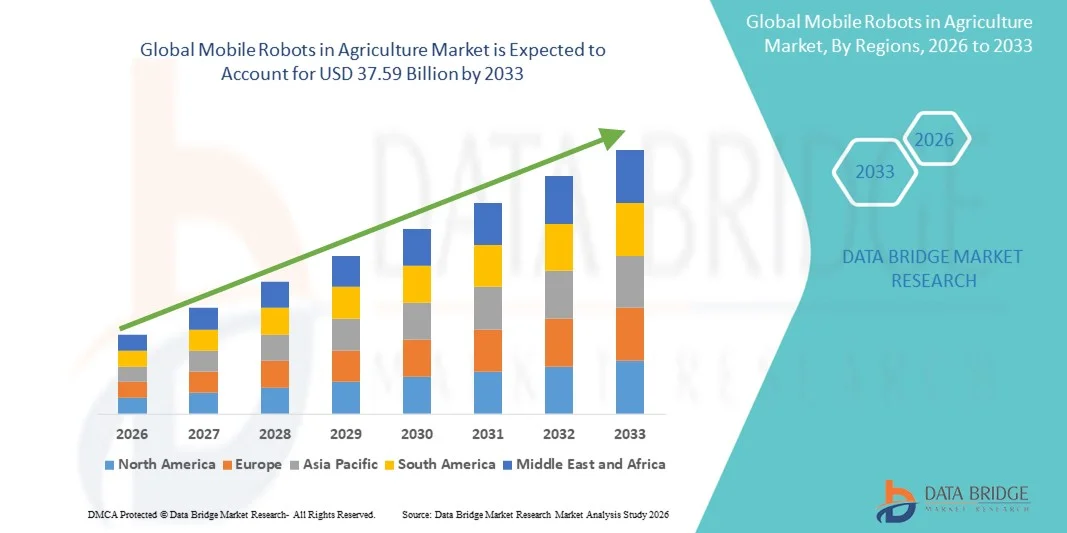
- The global mobile robots in agriculture market size was valued at USD 5.69 billion in 2025 and is expected to reach USD 37.59 billion by 2033, at a CAGR of 26.60% during the forecast period
- Increase in need for safety for human life is the vital factor escalating the market growth, also increasing upsurge in demand for mobile logistics by online retailers, rising demand for warehouse automation, rising productivity and farm efficiency, increasing automation leading to minimized use of labor, rising efficient use of natural resources, increase in the population growth, increasing constant innovation in technology and continuous decline in the availability of workforce and less time-consuming nature are the major factors among others driving the growth of mobile robots in agriculture market
What are the Major Takeaways of Mobile Robots in Agriculture Market?
- Rising focus on developing robots with special features, rising geriatric population and increasing technological advancements and modernization in the healthcare sector will further create new opportunities for mobile robots in agriculture market
- However, increasing initial acquisition cost, rising challenges in working in untested environments and increasing lack of high-level interfacing are the major factors among others acting as restraints, while increasing safety concerns while working with humans will further challenge the growth of mobile robots in agriculture market
- North America dominated the mobile robots in agriculture market with the largest revenue share of 42.3% in 2025, attributed to the presence of leading agricultural robotics manufacturers, advanced IT and automation infrastructure, and widespread adoption of smart farm solutions across the U.S. and Canada
- Asia-Pacific is projected to witness the fastest growth rate of 10.3% during 2026–2033, fueled by the rising mechanization of agriculture, government-led smart farming initiatives, and growing adoption of drones, autonomous tractors, and robotic arms across China, India, Japan, and South Korea
- The Drones segment dominated the market with a revenue share of 41.2% in 2025, driven by their widespread adoption for crop monitoring, aerial imaging, precision spraying, and real-time data collection
Report Scope and Mobile Robots in Agriculture Market Segmentation
|
Attributes |
Mobile Robots in Agriculture Key Market Insights |
|
Segments Covered |
|
|
Countries Covered |
North America
Europe
Asia-Pacific
Middle East and Africa
South America
|
|
Key Market Players |
|
|
Market Opportunities |
|
|
Value Added Data Infosets |
In addition to the insights on market scenarios such as market value, growth rate, segmentation, geographical coverage, and major players, the market reports curated by the Data Bridge Market Research also include in-depth expert analysis, pricing analysis, brand share analysis, consumer survey, demography analysis, supply chain analysis, value chain analysis, raw material/consumables overview, vendor selection criteria, PESTLE Analysis, Porter Analysis, and regulatory framework. |
What is the Key Trend in the Mobile Robots in Agriculture Market?
Rising Adoption of Autonomous and AI-Enabled Agricultural Robotics for Precision Farming
- The mobile robots in agriculture market is witnessing a key trend of integrating AI, machine learning, and IoT technologies into autonomous robots to optimize planting, monitoring, harvesting, and crop management. These solutions allow farmers to increase productivity, reduce labor dependency, and improve operational efficiency
- For instance, John Deere, Trimble, and AGCO have introduced AI-powered mobile agricultural robots that combine autonomous navigation, real-time crop monitoring, and precision spraying to optimize yield and resource utilization
- Increasing adoption of smart farming initiatives and precision agriculture techniques is driving demand for autonomous robots capable of reducing input costs and maximizing crop output
- Farmers are leveraging AI-enabled dashboards, sensor networks, and autonomous vehicle platforms to dynamically manage crop health, irrigation, and harvesting operations
- Rising sustainability mandates, labor shortages, and the need for efficient land management are motivating adoption of intelligent, autonomous mobile robots in agriculture
- As agriculture increasingly focuses on precision farming, resource optimization, and sustainable practices, AI-integrated mobile robots will remain a defining trend shaping future market growth
What are the Key Drivers of Mobile Robots in Agriculture Market?
- Increasing demand for precision farming, labor efficiency, and high crop yield is a major driver for the Mobile Robots in Agriculture market. Farmers and agribusinesses are prioritizing autonomous solutions to reduce operational costs while enhancing productivity
- For instance, in 2025, John Deere deployed AI-enabled autonomous tractors and crop monitoring robots across U.S. farms to enhance precision and reduce labor requirements
- Rising adoption of smart farming technologies, drones, and IoT-enabled agricultural systems is fueling widespread demand for mobile robotic solutions
- Technological advancements in robotics, AI, GPS guidance, and sensor-based crop analytics are enabling autonomous robots to perform complex field tasks with accuracy
- Growing focus on sustainability, water efficiency, and soil health management motivates farmers to invest in smart mobile robots for optimized farming practices
- As adoption expands across large-scale farms, horticulture, and greenhouse operations, the Mobile Robots in Agriculture market is expected to grow steadily, driven by technological innovation and the need for efficient farm management
Which Factor is Challenging the Growth of the Mobile Robots in Agriculture Market?
- High initial costs of autonomous robots, integration complexities, and limited infrastructure in developing regions are key challenges for mobile robots in agriculture adoption
- For instance, during 2024–2025, small- and mid-sized farms delayed robot adoption due to expensive equipment, software licensing, and lack of technical expertise
- Data security and connectivity issues in rural areas restrict large-scale deployment of cloud-based autonomous platforms
- Competition from traditional farming equipment and local automation providers creates pricing pressure and slows adoption in cost-sensitive markets
- The need for skilled personnel to operate, maintain, and program autonomous robots adds operational challenges
- To overcome these hurdles, market players are focusing on modular designs, subscription-based robotics services, and strategic partnerships to reduce costs, enhance accessibility, and ensure efficient, secure adoption of mobile agricultural robots
How is the Mobile Robots in Agriculture Market Segmented?
The market is segmented on the basis of technology, material, fuel, vehicle, distribution channel, design, and system type.
- By Product Type
On the basis of product type, the mobile robots in agriculture market is segmented into Drones, Autonomous Tractors, Robotic Arms, and Others. The Drones segment dominated the market with a revenue share of 41.2% in 2025, driven by their widespread adoption for crop monitoring, aerial imaging, precision spraying, and real-time data collection. Drones are highly valued for reducing labor costs, improving field visibility, and enhancing operational efficiency across large-scale farms.
The Autonomous Tractors segment is projected to grow at the fastest CAGR from 2026 to 2033, fueled by increasing mechanization in agriculture, rising adoption of AI-driven autonomous navigation systems, and demand for precision planting and harvesting solutions. Growing integration with IoT platforms, GPS-guided systems, and AI analytics is further boosting tractor deployment in both developed and emerging markets. Continuous innovation in lightweight, energy-efficient autonomous vehicles will accelerate market expansion in this segment globally.
- By Application
On the basis of application, the mobile robots in agriculture market is segmented into Oil Management, Harvest Management, Dairy Farm Management, Field Farming, and Irrigation Management. The Field Farming segment dominated the market with a revenue share of 36.5% in 2025, attributed to the extensive use of autonomous tractors, drones, and robotic arms for planting, soil monitoring, and crop maintenance. Field farming benefits from automation through increased accuracy, labor savings, and higher yield efficiency.
The Harvest Management segment is expected to witness the fastest CAGR during 2026–2033, driven by rising adoption of AI-enabled harvesting robots and machinery capable of precision crop collection, sorting, and packaging. Advanced vision systems, robotic arms, and autonomous vehicles are being increasingly deployed in fruit, vegetable, and cereal harvesting to reduce losses and improve throughput. Technological advancements in robotics and AI-powered operational analytics are further accelerating automation adoption in harvest management globally.
- By Component
On the basis of component, the mobile robots in agriculture market is segmented into Control Systems and Sensors. The Control Systems segment dominated the market with a revenue share of 53.4% in 2025, owing to their critical role in coordinating autonomous navigation, task execution, and system safety across drones, tractors, and robotic platforms. Robust control systems enable precise route planning, real-time decision-making, and seamless integration with IoT platforms, which enhances operational efficiency across farms of all scales.
The Sensors segment is projected to grow at the fastest CAGR from 2026 to 2033, driven by increasing adoption of AI-based vision, LiDAR, GPS, and soil/nutrient monitoring sensors. Sensor integration allows real-time crop monitoring, automated irrigation, and pest/disease detection, supporting precision agriculture initiatives and reducing manual intervention. Continuous innovation in compact, energy-efficient sensors is expected to drive rapid market expansion globally.
- By Type
On the basis of type, the mobile robots in agriculture market is segmented into Professional and Personal and Domestic Robots. The Professional Robots segment dominated the market with a revenue share of 61.7% in 2025, driven by adoption in commercial farms, large-scale horticulture, and greenhouse operations requiring high precision, automation, and productivity. Professional robots are increasingly preferred for crop management, irrigation, planting, and harvesting tasks, providing scalable solutions for agribusinesses.
The Personal and Domestic Robots segment is expected to grow at the fastest CAGR from 2026 to 2033, fueled by rising interest among small-scale farmers, hobbyists, and urban agriculture practitioners. Affordable, compact autonomous solutions for home gardens, small fields, and livestock management are increasingly deployed, integrating IoT and cloud analytics for improved productivity. Rapid innovation in AI, navigation systems, and user-friendly interfaces is accelerating adoption in this segment globally.
Which Region Holds the Largest Share of the Mobile Robots in Agriculture Market?
- North America dominated the mobile robots in agriculture market with the largest revenue share of 42.3% in 2025, attributed to the presence of leading agricultural robotics manufacturers, advanced IT and automation infrastructure, and widespread adoption of smart farm solutions across the U.S. and Canada. High demand for precision agriculture, autonomous tractors, drones, and robotic arms has accelerated market penetration in both large-scale and specialized farms
- Enterprises in the region are investing heavily in AI-based navigation systems, IoT-enabled monitoring, and cloud-based control platforms to improve crop yield, operational efficiency, and sustainability. The region’s mature agricultural ecosystem, coupled with advanced RandD capabilities, further strengthens North America’s dominance
- Favorable government programs supporting agricultural innovation, precision farming, and sustainable practices continue to position North America as a global leader in Mobile Robots in Agriculture
U.S. Mobile Robots in Agriculture Market Insight
The U.S. represents the largest contributor to the North American mobile robots in agriculture market, supported by technological innovation, strong agri-tech investments, and a large commercial farm base. Domestic companies such as Deere and Company, Trimble Inc., and Ag Leader Technology are developing autonomous tractors, drones, and robotic arms for planting, harvesting, and field monitoring. Adoption of AI-driven sensors and cloud-based control systems is enhancing efficiency, reducing labor dependency, and optimizing precision farming operations. Government initiatives, including subsidies for smart agriculture and sustainable farming practices, further reinforce U.S. leadership in both OEM and aftermarket robotics solutions.
Canada Mobile Robots in Agriculture Market Insight
Canada contributes steadily to the North American mobile robots in agriculture market, driven by adoption of autonomous tractors, drones, and precision irrigation systems. Government programs promoting sustainable agriculture, agricultural RandD, and smart farm technologies are encouraging robotic deployments across farms of all scales. Collaborative projects between research institutions and robotics providers are accelerating innovation in sensor integration, AI-driven farm analytics, and autonomous machinery. Increasing consumer awareness of efficient food production and cost reduction is also boosting demand for mobile robots in agriculture in Canada.
Asia-Pacific Mobile Robots in Agriculture Market Insight
Asia-Pacific is projected to witness the fastest growth rate of 10.3% during 2026–2033, fueled by the rising mechanization of agriculture, government-led smart farming initiatives, and growing adoption of drones, autonomous tractors, and robotic arms across China, India, Japan, and South Korea. Rapid expansion of arable land management, horticulture, and commercial farming operations is driving regional demand. The integration of AI, IoT, and cloud-based farm management platforms is enhancing yield, reducing labor dependency, and optimizing resource usage, accelerating adoption in both large-scale and smallholder farms.
China Mobile Robots in Agriculture Market Insight
China represents the largest contributor to the Asia-Pacific Mobile Robots in Agriculture market, supported by large-scale farming operations, high investment in agri-tech, and government incentives for precision agriculture. Domestic companies such as AGCO and Grownetics are actively deploying autonomous tractors, drones, and robotic solutions for planting, crop monitoring, and field mapping. Rapid adoption of AI-driven sensors, GPS-based navigation, and autonomous spraying systems is enhancing operational efficiency and crop productivity.
India Mobile Robots in Agriculture Market Insight
India is emerging as a key growth market within Asia-Pacific, driven by rising demand for mechanized farming, government programs such as the “Digital Agriculture Mission,” and increasing awareness of yield optimization. Small and mid-sized farms are adopting drones and robotic arms for irrigation, soil monitoring, and harvesting tasks. Investments in AI-based precision agriculture, IoT-enabled sensors, and autonomous machinery are accelerating market growth in the region. Continuous innovation in affordable robotics solutions is further propelling adoption across rural and commercial farms.
Europe Mobile Robots in Agriculture Market Insight
Europe holds a significant share in the global Mobile Robots in Agriculture market, driven by strong RandD infrastructure, precision agriculture adoption, and sustainability mandates in countries such as Germany, France, and the U.K. European farms are integrating autonomous tractors, drones, and robotic arms to optimize productivity, reduce labor costs, and comply with EU environmental regulations. Growing demand for IoT-enabled farm monitoring and automated crop management systems continues to enhance regional adoption.
Germany Mobile Robots in Agriculture Market Insight
Germany leads the European Mobile Robots in Agriculture market, supported by advanced agricultural machinery manufacturers, strong automation expertise, and government incentives for smart farming. Adoption of autonomous tractors, robotic arms, and drones is widespread in both large-scale and specialized farms. Continuous RandD and collaboration between agri-tech providers and research institutions strengthen Germany’s market leadership.
U.K. Mobile Robots in Agriculture Market Insight
The U.K. market is steadily expanding, driven by adoption of robotic farming solutions in commercial and precision agriculture. Domestic manufacturers and solution providers are integrating AI-driven sensors, autonomous vehicles, and IoT-based monitoring platforms to improve farm productivity and sustainability. Growing government initiatives supporting smart agriculture and digital farm infrastructure continue to fuel market expansion across both OEM and aftermarket channels in the U.K.
Which are the Top Companies in Mobile Robots in Agriculture Market?
The mobile robots in agriculture industry is primarily led by well-established companies, including:
- Deere and Company (U.S.)
- Trimble Inc. (U.S.)
- AGCO Corporation (U.S.)
- Lely (Netherlands)
- Topcon Corporation (Japan)
- AgJunction (Canada)
- BouMatic (U.S.)
- Ag Leader Technology (U.S.)
- AgEagle Aerial Systems, Inc. (U.S.)
- AutoCopter Corp (U.S.)
- Blue River Technology (U.S.)
- Auroras s.r.l. (Italy)
- Grownetics (U.S.)
- Autonomous Solutions Inc. (U.S.)
- Autonomous Tractor Corporation (U.S.)
- Clearpath Robotics Inc. (Canada)
- Deepfield Robotics (U.S.)
- DeLaval. (Sweden)
- GEA Group Aktiengesellschaft (Germany)
- Harvest Automation (U.S.)
What are the Recent Developments in Global Mobile Robots in Agriculture Market?
- In December 2023, Chipotle Mexican Grill announced its investment in Greenfield Robotics, a Kansas-based regenerative farming company, to expand the global adoption of agricultural robots, reinforcing its commitment to innovative farming technologies
- In November 2023, Chinese drone manufacturer DJI unveiled two new drones, the T60 and T25P, designed for applications such as farmland spraying and aerial seeding, highlighting the growing role of drones in modern agriculture, forestry, and aquaculture
- In September 2023, Robotics Plus, a New Zealand-based agri-tech company, launched Prospr, a multi-purpose autonomous robot for orchard and vineyard crop harvesting, marking a significant step in automation for specialized agricultural tasks
- In July 2023, XAG introduced the P100 agricultural drone in Vietnam, featuring full autonomy, ease of operation, and a high payload capacity of up to 50 kg, enhancing efficiency in large-scale farming operations
- In June 2021, CNH Industrial N.V. completed the acquisition of 100% of Raven Industries’ stock to strengthen its agricultural equipment presence across multiple geographies, reflecting a strategic move to expand its global footprint in precision farming solutions

- Interactive Data Analysis Dashboard
- Company Analysis Dashboard for high growth potential opportunities
- Research Analyst Access for customization & queries
- Competitor Analysis with Interactive dashboard
- Latest News, Updates & Trend analysis
- Harness the Power of Benchmark Analysis for Comprehensive Competitor Tracking
Data collection and base year analysis are done using data collection modules with large sample sizes. The stage includes obtaining market information or related data through various sources and strategies. It includes examining and planning all the data acquired from the past in advance. It likewise envelops the examination of information inconsistencies seen across different information sources. The market data is analysed and estimated using market statistical and coherent models. Also, market share analysis and key trend analysis are the major success factors in the market report. To know more, please request an analyst call or drop down your inquiry.
The key research methodology used by DBMR research team is data triangulation which involves data mining, analysis of the impact of data variables on the market and primary (industry expert) validation. Data models include Vendor Positioning Grid, Market Time Line Analysis, Market Overview and Guide, Company Positioning Grid, Patent Analysis, Pricing Analysis, Company Market Share Analysis, Standards of Measurement, Global versus Regional and Vendor Share Analysis. To know more about the research methodology, drop in an inquiry to speak to our industry experts.
Data Bridge Market Research is a leader in advanced formative research. We take pride in servicing our existing and new customers with data and analysis that match and suits their goal. The report can be customized to include price trend analysis of target brands understanding the market for additional countries (ask for the list of countries), clinical trial results data, literature review, refurbished market and product base analysis. Market analysis of target competitors can be analyzed from technology-based analysis to market portfolio strategies. We can add as many competitors that you require data about in the format and data style you are looking for. Our team of analysts can also provide you data in crude raw excel files pivot tables (Fact book) or can assist you in creating presentations from the data sets available in the report.