


Mobile Stroke Unit (MSU) Market Overview
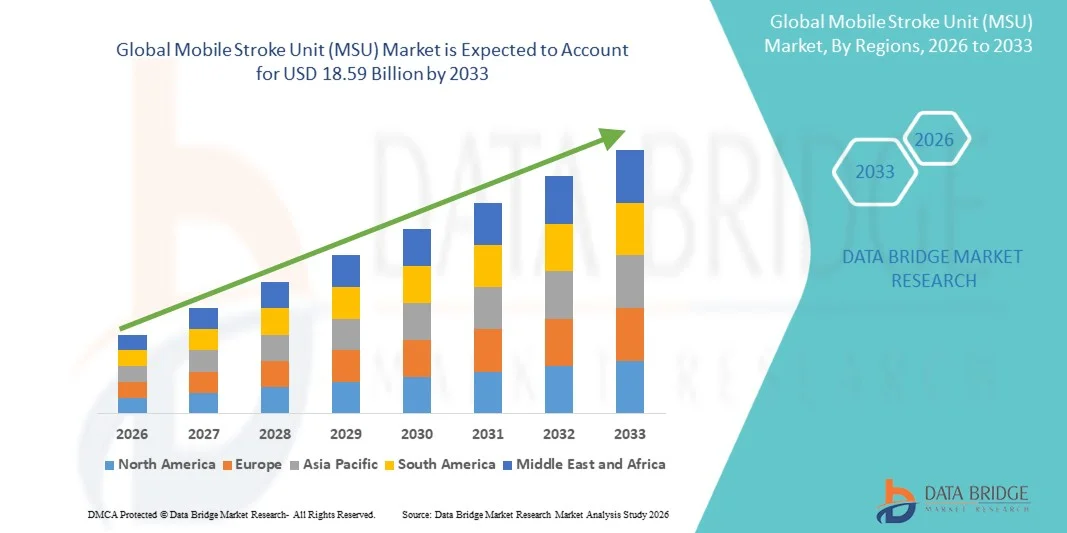
The Mobile Stroke Unit (MSU) Market was valued at USD 11.32 billion in 2025 and is projected to reach USD 18.59 billion by 2033, growing at a CAGR of 6.40% from 2026 to 2033. Market growth is driven by the increasing global incidence of stroke, rapid advances in portable computed tomography (CT) imaging, expanding telemedicine infrastructure, and evolving reimbursement frameworks supporting prehospital stroke treatment.
Mobile stroke units are specialized ambulances equipped with CT scanners, telemedicine systems, and onboard medical personnel capable of diagnosing and initiating treatment for acute stroke patients in the field. The clinical benefits of MSUs, including significantly reduced time to thrombolytic therapy, improved patient outcomes, and lower rates of long-term disability, are accelerating adoption among hospital networks, emergency medical services, and public health systems worldwide. Technological advancements such as AI-assisted image analysis, 5G-enabled telemedicine, and lightweight imaging systems are further expanding the clinical applicability and operational efficiency of MSUs. In addition, growing healthcare infrastructure investments in emerging markets and increasing awareness of stroke as a leading cause of death and disability are creating new opportunities for stakeholders across the forecast period.
Key Market Trends & Insights
- North America dominated the global mobile stroke unit market with the largest revenue share of 38.5% in 2025, supported by a mature emergency medical services infrastructure, pioneering academic medical centers, and favorable Medicare reimbursement policies.
- Asia-Pacific is expected to be the fastest-growing region at a CAGR of 9.2% from 2026 to 2033, driven by expanding healthcare infrastructure, rising stroke incidence, and increasing government investments in prehospital care.
- The Frazers' Mobile Stroke Unit segment led the type category with a 58.4% market share in 2025, reflecting its established position as a leading MSU platform and widespread adoption in North America and Europe.
- The Demers Mobile Stroke Unit segment is anticipated to be the fastest-growing type category, driven by increasing demand for cost-effective, modular MSU solutions in emerging markets.
- The Computed Tomography Scanner segment dominated the product category with a 40.2% market share in 2025, supported by its critical role in enabling rapid stroke diagnosis and treatment initiation in the field.
- The Telemedicine System segment is expected to witness the fastest growth during the forecast period, driven by advances in 5G connectivity, remote neurologist consultation, and integrated telehealth platforms.
- The Mobile Healthcare Industry segment dominated the application category with a 74.6% market share in 2025, supported by the primary deployment of MSUs within emergency medical services and hospital-affiliated mobile health programs.
Market Size & Forecast
- Global Market Value (2025): USD 11.32 Billion
- Expected Market Value (2033): USD 18.59 Billion
- Forecast CAGR (2026–2033): 6.40%
- Leading Region in 2025: North America
- Fastest Growing Region: Asia-Pacific
Report Scope and Mobile Stroke Unit (MSU) Market Segmentation
|
Attributes |
Mobile Stroke Unit (MSU) Key Market Insights |
|
Segments Covered |
|
|
Countries Covered |
North America · U.S. · Canada · Mexico Europe · Germany · France · U.K. · Netherlands · Switzerland · Belgium · Russia · Italy · Spain · Turkey · Rest of Europe Asia-Pacific · China · Japan · India · South Korea · Singapore · Malaysia · Australia · Thailand · Indonesia · Philippines · Rest of Asia-Pacific Middle East and Africa · Saudi Arabia · U.A.E. · South Africa · Egypt · Israel · Rest of Middle East and Africa South America · Brazil · Argentina · Rest of South America |
|
Key Market Players |
· Frazer, Ltd. (U.S.) · Demers Ambulances (Canada) · Siemens Healthineers AG (Germany) · GE HealthCare (U.S.) · Koninklijke Philips N.V. (Netherlands) · Medtronic plc (Ireland) · ZOLL Medical Corporation (U.S.) · Stryker (U.S.) · Samsung Electronics Co., Ltd. (South Korea) · Teleflex Incorporated (U.S.) |
|
Market Opportunities |
· Expansion of mobile stroke unit programs into emerging markets with growing healthcare infrastructure and rising stroke incidence · Development of lightweight, AI-integrated CT imaging systems enabling broader deployment in ambulance-based and helicopter-based MSU platforms |
|
Value Added Data Infosets |
In addition to the insights on market scenarios such as market value, growth rate, segmentation, geographical coverage, and major players, the market reports curated by the Data Bridge Market Research also include depth expert analysis, patient epidemiology, pipeline analysis, pricing analysis, and regulatory framework. |
Mobile Stroke Unit (MSU) Market Trends
Trend: Integration of AI-Assisted Imaging and 5G Telemedicine Platforms
Clinical adoption of mobile stroke units continues to accelerate as technological innovations improve diagnostic accuracy, treatment speed, and connectivity. Advanced AI-assisted CT image analysis enables rapid identification of ischemic stroke versus hemorrhage, supporting faster treatment decisions in the field. The integration of 5G-enabled telemedicine platforms allows real-time remote consultation with stroke neurologists, expanding access to specialist expertise regardless of geographic location.
For instance,
The deployment of photon-counting CT and AI-based triage tools in next-generation MSUs is shortening diagnostic cycles and elevating clinical confidence in field decisions, enabling more patients to receive thrombolytic therapy within the critical "golden hour."
In addition, research demonstrates that MSUs speed stroke treatment into the first "golden hour" when better outcomes from thrombolysis are achieved, with two landmark controlled trials, B_PROUD and BEST-MSU, showing that MSUs result in significantly lesser disability compared to conventional ambulance care. The growing emphasis on integrated healthcare solutions and partnerships between hospitals, imaging vendors, and telemedicine providers is driving market innovation and expanding clinical applicability.
Mobile Stroke Unit (MSU) Market Dynamics
Key Market Driver: Rising Global Stroke Incidence and Aging Population
The growing global burden of stroke, combined with aging populations in North America, Europe, Japan, and Australia, is a primary driver of market growth. Stroke remains a leading cause of death and long-term disability worldwide, with approximately 795,000 strokes occurring annually in the United States alone. Mobile stroke units enable faster diagnosis and treatment initiation, reducing time to thrombolytic therapy and improving patient outcomes.
For instance,
A 2025 study published in the Journal of the American Heart Association found that MSU patients were significantly more likely to receive tissue-type plasminogen activator (49.9% versus 9.4%; difference, 37.5 percentage points; P <0.001) compared to propensity score-matched controls transported by traditional ambulances, demonstrating the clinical impact of prehospital stroke care.
Rising stroke incidence, particularly among older adults, is expected to strengthen adoption of mobile stroke unit technologies globally and support continued market expansion.
Key Restraint/Challenge: High Capital Investment and Operational Costs
The substantial upfront capital investment required for mobile stroke units, including CT scanners, telemedicine equipment, and specialized ambulance platforms, presents a significant barrier to adoption, particularly for smaller healthcare systems and institutions in emerging markets. The total cost of ownership, including equipment maintenance, consumables, staffing, and training, can limit the financial feasibility of MSU programs.
For instance,
The capital cost of ambulance-based MSUs ranges from USD 850,000 to USD 1.4 million per unit, while helicopter-based MSUs can cost USD 2.5 million to USD 5 million per aircraft, creating challenges for budget-constrained healthcare providers seeking to establish or expand MSU services.
High acquisition and operating costs may constrain adoption, particularly among smaller health systems and in regions with limited reimbursement frameworks.
Key Market Opportunity: Expansion into Emerging Markets and Public-Private Partnerships
The development of modular, cost-effective MSU platforms is creating opportunities for adoption beyond traditional hospital settings and established markets. Public-private partnerships are enabling healthcare systems to spread the heavy capital load of MSU programs, while expanding healthcare infrastructure in Asia-Pacific, Latin America, and the Middle East is driving demand for prehospital stroke capabilities in previously underserved markets.
Strategic partnerships between hospitals, imaging vendors, and emergency medical services are accelerating MSU deployment and expanding access to advanced prehospital stroke care.
Mobile Stroke Unit (MSU) Market Scope
The mobile stroke unit market is segmented on the basis of type, product, and application.
By Type
On the basis of type, the global mobile stroke unit market is segmented into Frazers' Mobile Stroke Unit and Demers Mobile Stroke Unit. The Frazers' Mobile Stroke Unit segment dominated the market with a 58.4% market share in 2025, reflecting its established position as a leading MSU platform and widespread adoption across North America and Europe. Frazers' MSU platforms are recognized for their robust construction, integration with advanced imaging and telemedicine systems, and strong clinical track record in prehospital stroke care. High procedure volumes in academic medical centers and specialized stroke programs contribute to segment leadership.
The Demers Mobile Stroke Unit segment is expected to witness the fastest growth from 2026 to 2033, with a projected CAGR of 7.8%. Demers MSU platforms are gaining traction due to their modular design, cost-effective acquisition, and adaptability for deployment in a variety of healthcare settings, including emerging markets and public-private partnership models. Increasing demand for affordable, high-quality MSU solutions is expanding the addressable market for Demers platforms.
By Product
On the basis of product, the global mobile stroke unit market is segmented into Computed Tomography Scanner, Conventional Emergency Equipment, Telemedicine System, Automated Image Analysis, POC Laboratory System, and Others. The Computed Tomography Scanner segment dominated the market with a 40.2% market share in 2025, supported by its critical role in enabling rapid stroke diagnosis and treatment initiation in the field. Portable CT scanners are the technological cornerstone of MSU platforms, allowing emergency medical teams to differentiate between ischemic stroke and hemorrhage and initiate appropriate therapy before hospital arrival.
The Telemedicine System segment is expected to witness the fastest growth from 2026 to 2033, with a projected CAGR of 9.4%. Advances in 5G connectivity, remote neurologist consultation, and integrated telehealth platforms are driving adoption of telemedicine systems within MSU programs, enabling real-time specialist input regardless of geographic location.
By Application
On the basis of application, the global mobile stroke unit market is segmented into Mobile Healthcare Industry and Other. The Mobile Healthcare Industry segment dominated the market with a 74.6% market share in 2025, driven by the primary deployment of MSUs within emergency medical services, hospital-affiliated mobile health programs, and public health initiatives focused on prehospital stroke care. Hospitals, ambulance services, and integrated health systems serve as the primary operators of MSU fleets, with high procedure volumes and established clinical protocols supporting segment leadership.
The Other segment is expected to witness the fastest growth from 2026 to 2033, with a projected CAGR of 8.1%. This segment encompasses research applications, clinical trial deployments, academic medical center programs, and public health demonstration projects. Growing interest in MSU-based research, including outcomes studies and technology validation, is expanding the addressable market beyond routine clinical operations.
Mobile Stroke Unit (MSU) Market Regional Analysis
North America dominated the mobile stroke unit market with a revenue share of 38.5% in 2025, supported by a mature emergency medical services infrastructure, pioneering academic medical centers such as the University of Texas Health Science Center at Houston, favorable Medicare reimbursement policies including a 2024 CMS billing code for prehospital CT scanning, and approximately 795,000 annual strokes in the United States driving consistent demand.
U.S. Mobile Stroke Unit (MSU) Market Insight
The U.S. mobile stroke unit market benefits from the highest installed base of MSU platforms globally, extensive surgeon and emergency medical personnel training programs, and strong clinical evidence supporting MSU adoption. Academic medical centers, large health systems, and specialty stroke programs continue to expand MSU operations across urban and suburban settings. Favorable Medicare and commercial payer reimbursement supports procedural volumes and equipment investment.
The U.S. accounted for the dominant share within North America in 2025, with a market share of 82.4% among regional countries, reflecting the pioneering role of U.S. institutions in MSU development and deployment.
Europe Mobile Stroke Unit (MSU) Market Insight
The Europe mobile stroke unit market remains a major contributor, with strong hospital-based MSU programs across Germany, the U.K., France, and Italy. The region accounted for approximately 28.2% of the global market in 2025. Growing adoption of cost-effective MSU platforms and structured training pathways are improving surgical outcomes and standardizing care delivery. Cross-disciplinary guidelines and collaborative research networks are supporting market expansion.
U.K. Mobile Stroke Unit (MSU) Market Insight
The U.K. mobile stroke unit market is characterized by expanding MSU programs within NHS hospitals and private healthcare facilities. Investment in MSU platforms for prehospital stroke diagnosis and treatment is improving access to minimally invasive options and reducing time to thrombolysis.
Germany Mobile Stroke Unit (MSU) Market Insight
Germany's robust hospital infrastructure and advanced emergency medical services support comprehensive MSU programs across urban and rural regions. Strong clinical training networks and favorable reimbursement frameworks contribute to high procedure volumes and technology adoption. Germany held the largest market share among European countries in 2025.
Asia-Pacific Mobile Stroke Unit (MSU) Market Insight
The Asia-Pacific mobile stroke unit market is poised for rapid growth with a CAGR of 9.2% during the forecast period, driven by expanding healthcare infrastructure, rising stroke incidence, and increasing government investments in prehospital care. Private healthcare systems in China, Japan, India, and South Korea are investing in MSU capabilities to meet growing patient demand and improve clinical outcomes.
Japan Mobile Stroke Unit (MSU) Market Insight
The Japan mobile stroke unit market benefits from advanced healthcare infrastructure, strong emergency medical services expertise, and favorable reimbursement for prehospital stroke procedures. MSU programs are well-established, with expanding applications in urban centers and aging population regions.
Japan held the fastest-growing position among Asia-Pacific countries, with a projected CAGR of 10.1% from 2026 to 2033, driven by aging demographics and government initiatives to improve stroke outcomes.
China Mobile Stroke Unit (MSU) Market Insight
The China mobile stroke unit market is experiencing rapid growth driven by healthcare modernization initiatives, expanding hospital networks, and increasing patient demand for advanced stroke care options. Domestic MSU platform development is complementing imported platforms, improving market accessibility.
Mobile Stroke Unit (MSU) Market Share
The mobile stroke unit industry is primarily led by well-established companies, including:
- Frazer, Ltd. (U.S.)
- Demers Ambulances (Canada)
- Siemens Healthineers AG (Germany)
- GE HealthCare (U.S.)
- Koninklijke Philips N.V. (Netherlands)
- Medtronic plc (Ireland)
- ZOLL Medical Corporation (U.S.)
- Stryker (U.S.)
- Samsung Electronics Co., Ltd. (South Korea)
- Teleflex Incorporated (U.S.)
Latest Developments in Mobile Stroke Unit (MSU) Market
- In March 2026, Siemens Healthineers announced the launch of its next-generation portable CT imaging system designed for mobile stroke unit applications, featuring AI-assisted image analysis and reduced weight for easier ambulance integration. The launch supports Siemens Healthineers' strategy to expand its prehospital stroke care portfolio and improve diagnostic speed in MSU deployments.
- In January 2026, Medtronic plc announced a strategic partnership with a leading U.S. academic medical center to expand mobile stroke unit telemedicine capabilities, integrating its remote monitoring and telehealth platforms into MSU operations. The partnership aims to enhance real-time neurologist consultation and improve patient outcomes in prehospital stroke care.
- In November 2025, Frazer, Ltd. delivered its 100th mobile stroke unit to a U.S. hospital network, marking a significant milestone in the company's MSU manufacturing history. The delivery underscores growing demand for specialized prehospital stroke care vehicles across North America.
- In September 2025, ZOLL Medical Corporation announced the integration of advanced patient monitoring solutions into mobile stroke unit platforms, enabling continuous vital sign tracking and data transmission to receiving hospitals. The integration supports improved clinical decision-making during prehospital stroke transport.
- In June 2025, Koninklijke Philips N.V. announced a collaboration with a major European hospital system to pilot AI-powered telemedicine platforms in mobile stroke units, aiming to reduce time to treatment and improve stroke outcomes through real-time specialist consultation.
- In April 2025, Demers Ambulances introduced a modular mobile stroke unit platform designed for cost-effective deployment in emerging markets, featuring interchangeable imaging and telemedicine components. The modular design supports flexible MSU program development for healthcare systems with varying resource levels.
- In February 2025, GE HealthCare announced the development of a lightweight portable CT scanner optimized for mobile stroke unit installation, supporting broader MSU adoption in ambulance-based and helicopter-based platforms.
- In December 2024, Samsung Electronics Co., Ltd. announced the expansion of its medical imaging portfolio to include portable CT systems suitable for mobile stroke unit deployment, leveraging its expertise in display and semiconductor technologies.

- Interactive Data Analysis Dashboard
- Company Analysis Dashboard for high growth potential opportunities
- Research Analyst Access for customization & queries
- Competitor Analysis with Interactive dashboard
- Latest News, Updates & Trend analysis
- Harness the Power of Benchmark Analysis for Comprehensive Competitor Tracking
Data collection and base year analysis are done using data collection modules with large sample sizes. The stage includes obtaining market information or related data through various sources and strategies. It includes examining and planning all the data acquired from the past in advance. It likewise envelops the examination of information inconsistencies seen across different information sources. The market data is analysed and estimated using market statistical and coherent models. Also, market share analysis and key trend analysis are the major success factors in the market report. To know more, please request an analyst call or drop down your inquiry.
The key research methodology used by DBMR research team is data triangulation which involves data mining, analysis of the impact of data variables on the market and primary (industry expert) validation. Data models include Vendor Positioning Grid, Market Time Line Analysis, Market Overview and Guide, Company Positioning Grid, Patent Analysis, Pricing Analysis, Company Market Share Analysis, Standards of Measurement, Global versus Regional and Vendor Share Analysis. To know more about the research methodology, drop in an inquiry to speak to our industry experts.
Data Bridge Market Research is a leader in advanced formative research. We take pride in servicing our existing and new customers with data and analysis that match and suits their goal. The report can be customized to include price trend analysis of target brands understanding the market for additional countries (ask for the list of countries), clinical trial results data, literature review, refurbished market and product base analysis. Market analysis of target competitors can be analyzed from technology-based analysis to market portfolio strategies. We can add as many competitors that you require data about in the format and data style you are looking for. Our team of analysts can also provide you data in crude raw excel files pivot tables (Fact book) or can assist you in creating presentations from the data sets available in the report.













