


Mobile Telepresence Robots Market Overview
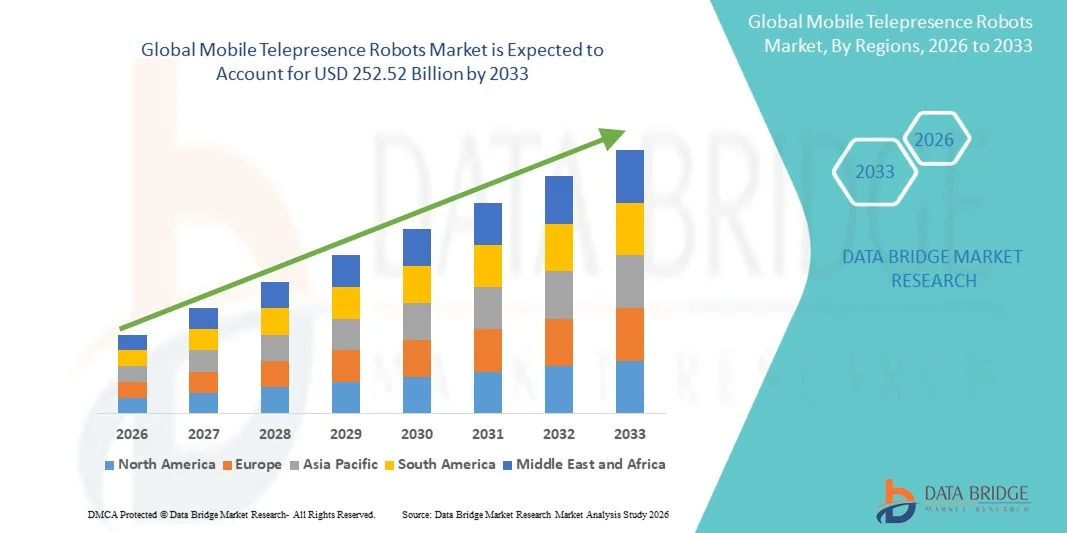
The Mobile Telepresence Robots Market was valued at USD 84.29 billion in 2025 and is projected to reach USD 252.52 billion by 2033, growing at a CAGR of 14.70% from 2026 to 2033. Market growth is driven by the rapid adoption of remote communication technologies, increasing demand for hybrid work solutions, expanding applications in healthcare and education, and continuous advancements in robotics, artificial intelligence (AI), and video conferencing systems. Mobile telepresence robots enable users to interact, navigate, and maintain a virtual presence in distant environments in real time, offering significant advantages over traditional video conferencing by providing mobility, two-way communication, and situational awareness.
The integration of AI-powered autonomous navigation, enhanced sensor technologies, and cloud-based connectivity is expanding the functional scope of mobile telepresence robots across corporate, healthcare, educational, and homecare settings. As organizations and individuals increasingly prioritize seamless remote interaction and digital transformation, the role of mobile telepresence robots as communication facilitators and productivity enhancers is expected to grow substantially over the forecast period. Rising investments in smart infrastructure, growing acceptance of telemedicine and distance learning, and favorable regulatory environments are further supporting market expansion globally.
Key Market Trends & Insights
- North America dominated the Mobile Telepresence Robots Market with the largest revenue share of 38.50% in 2025, supported by advanced technology infrastructure, high enterprise adoption of hybrid work models, and strong demand from healthcare and education sectors.
- Asia-Pacific is expected to be the fastest-growing region at a CAGR of 17.85% from 2026 to 2033, driven by rapid digitalization, expanding healthcare infrastructure, growing investments in smart education, and increasing corporate adoption of remote collaboration tools.
- The Body segment led the component category with a 58.2% market share in 2025, reflecting the critical role of power systems, sensors, and control mechanisms in enabling robot mobility and autonomous navigation.
- The Mobile segment dominated the type category with a 61.5% market share in 2025, supported by strong demand for flexible, navigable telepresence solutions across diverse industry applications.
- The Healthcare application segment is anticipated to be the fastest-growing application category, driven by the expansion of telemedicine, remote patient monitoring, and virtual consultations.
- The Hardware segment accounted for the largest share of the interface category with a market share of 64.3% in 2025, reflecting the importance of cameras, displays, sensors, and control systems in telepresence robot functionality.
Market Size & Forecast
- Global Market Value (2025): USD 84.29 Billion
- Expected Market Value (2033): USD 252.52 Billion
- Forecast CAGR (2026–2033): 14.70%
- Leading Region in 2025: North America
- Fastest Growing Region: Asia-Pacific
Report Scope and Mobile Telepresence Robots Market Segmentation
|
Attributes |
Mobile Telepresence Robots Key Market Insights |
|
Segments Covered |
|
|
Countries Covered |
North America · U.S. · Canada · Mexico Europe · Germany · France · U.K. · Netherlands · Switzerland · Belgium · Russia · Italy · Spain · Turkey · Rest of Europe Asia-Pacific · China · Japan · India · South Korea · Singapore · Malaysia · Australia · Thailand · Indonesia · Philippines · Rest of Asia-Pacific Middle East and Africa · Saudi Arabia · U.A.E. · South Africa · Egypt · Israel · Rest of Middle East and Africa South America · Brazil · Argentina · Rest of South America |
|
Key Market Players |
· Double Robotics (U.S.) · Anybots Inc. (U.S.) · OhmniLabs Inc. (U.S.) · Ava Robotics (U.S.) · VGo Communications Inc. (U.S.) · InTouch Health (U.S.) · Suitable Technologies Inc. (U.S.) · Gostai SAS (France) · MantaroBot (U.S.) · Xandex Inc. (U.S.) · Amy Robotics (China) · AXYN Robotique (France) · Camanio Care AB (Sweden) · Endurance Robot (Russia) · Qihan Technology Co. (China) |
|
Market Opportunities |
· Integration of artificial intelligence and machine learning for enhanced autonomous navigation and user interaction. · Expansion of telemedicine and remote patient monitoring applications in healthcare settings |
|
Value Added Data Infosets |
In addition to the insights on market scenarios such as market value, growth rate, segmentation, geographical coverage, and major players, the market reports curated by the Data Bridge Market Research also include depth expert analysis, patient epidemiology, pipeline analysis, pricing analysis, and regulatory framework. |
Mobile Telepresence Robots Market Trends
Trend: Integration of AI-Powered Autonomous Navigation and Cloud Connectivity
The mobile telepresence robots market is witnessing a transformative shift with the integration of artificial intelligence, machine learning, and cloud-based connectivity. Modern telepresence robots are increasingly equipped with advanced sensors, computer vision systems, and autonomous navigation capabilities that enable seamless movement through complex environments without manual intervention. Cloud-based platforms facilitate remote software updates, centralized fleet management, and enhanced data security, expanding the operational scope of telepresence robots across enterprise, healthcare, and educational settings.
For instance,
Leading manufacturers such as Ava Robotics and Double Robotics have introduced cloud-connected telepresence solutions that offer real-time video conferencing, autonomous obstacle avoidance, and integration with enterprise collaboration platforms, supporting hybrid work environments and remote consultations.
In addition, the convergence of IoT connectivity and robotics is enabling telepresence robots to interact with smart building systems, access control mechanisms, and environmental sensors, further enhancing their utility in corporate and healthcare facilities.
Mobile Telepresence Robots Market Dynamics
Key Market Driver: Rising Demand for Remote Collaboration and Hybrid Work Solutions
The global shift toward hybrid work models and distributed teams has significantly accelerated demand for advanced remote collaboration tools. Mobile telepresence robots offer a tangible presence in remote locations, enabling users to attend meetings, conduct facility tours, and interact with colleagues in real time. Enterprises across sectors are adopting telepresence robots to bridge the gap between remote and on-site work environments, enhance employee engagement, and reduce travel costs.
For instance,
Organizations in North America and Europe have deployed mobile telepresence robots from Double Robotics and OhmniLabs to facilitate virtual site inspections, remote training sessions, and executive participation in on-site events, resulting in improved productivity and cost savings.
This driver is expected to continue strengthening market growth as organizations prioritize seamless collaboration, workforce connectivity, and cost-efficient operations.
Key Restraint/Challenge: High Initial Investment and Integration Complexity
The adoption of mobile telepresence robots is constrained by the high upfront costs associated with hardware, software, and infrastructure integration. Small and medium-sized enterprises may find it challenging to justify the investment, particularly in regions with limited IT infrastructure. In addition, integrating telepresence robots with existing enterprise systems, network security protocols, and compliance requirements can be complex and resource-intensive.
For instance,
Market analysis indicates that the premium pricing of advanced telepresence robots, such as those offered by Ava Robotics, may deter smaller organizations from adoption, while integration with legacy systems remains a key barrier in sectors with stringent data security requirements.
Key Market Opportunity: Expansion of Telemedicine and Remote Patient Monitoring
The healthcare sector presents a significant growth opportunity for mobile telepresence robots, driven by the expansion of telemedicine, remote patient monitoring, and virtual consultations. Telepresence robots enable physicians to conduct remote rounds, interact with patients in isolation units, and collaborate with on-site medical staff, improving access to care and reducing the risk of infection transmission.
For instance,
Healthcare institutions in the U.S. and Europe have deployed telepresence robots from InTouch Health and VGo Communications to facilitate virtual consultations in intensive care units, long-term care facilities, and rural clinics, supporting continuity of care and specialist access. Growing adoption in healthcare is expected to accelerate market expansion by improving care accessibility, efficiency, and remote clinical collaboration.
Mobile Telepresence Robots Market Scope
The mobile telepresence robots market is segmented on the basis of component, interface, type, and application.
By Component
On the basis of component, the Mobile Telepresence Robots Market is segmented into head and body. The Body segment dominated the market with a 58.2% market share in 2025, reflecting the critical importance of power sources, sensors, and control systems in enabling robot mobility, autonomous navigation, and operational reliability. Continuous advancements in battery technology, sensor miniaturization, and motor efficiency are supporting the segment's dominance.
The Head segment is expected to grow with fastest CAGR during the forecast period, driven by innovations in high-definition cameras, wide-angle displays, directional microphones, and speaker systems that enhance audio-visual communication quality. The segment is expected to witness steady growth as manufacturers focus on improving user experience and remote interaction capabilities.
By Interface
On the basis of interface, the market is segmented into hardware and software. The Hardware segment dominated the market with a market share of 64.3% in 2025, reflecting the foundational role of cameras, displays, sensors, power systems, and control mechanisms in telepresence robot functionality. Strong demand for high-quality imaging, robust mobility systems, and reliable connectivity hardware is supporting the segment's leadership.
The Software segment is expected to be the fastest-growing segment from 2026 to 2033, driven by the integration of AI-powered navigation, cloud-based fleet management, real-time analytics, and enterprise collaboration platform compatibility. Increasing demand for remote software updates, cybersecurity features, and user-friendly control interfaces is further accelerating software adoption.
By Type
On the basis of type, the market is segmented into stationary and mobile. The Mobile segment dominated the market with a market share of 61.5% in 2025, supported by strong demand for flexible, navigable telepresence solutions that allow users to move through multiple environments and interact in real time from different locations. Mobile telepresence robots are favored in settings where mobility, real-time communication, and situational awareness are critical, including healthcare, enterprise, and education.
The Stationary segment is rapidly gaining traction due to advancements in telecommunication technology, increasing adoption in healthcare and enterprise environments, and cost-effective deployment for fixed-location conferencing and monitoring applications.
By Application
On the basis of application, the market is segmented into education, healthcare, enterprise, homecare, and others. The Enterprise segment dominated the market with a market share of 34.2% in 2025, driven by the widespread adoption of hybrid work models, corporate collaboration requirements, and the need for virtual participation in on-site meetings, facility tours, and training sessions. Large enterprises and multinational corporations are leading adopters of telepresence robots for remote employee engagement and operational efficiency.
The Healthcare segment is expected to be the fastest-growing application segment from 2026 to 2033, driven by the expansion of telemedicine, remote patient monitoring, virtual consultations, and specialist access in underserved areas. Telepresence robots are increasingly deployed in hospitals, long-term care facilities, and rural clinics to enhance care delivery and reduce infection risks.
Mobile Telepresence Robots Market Regional Analysis
North America dominated the mobile telepresence robots market with a revenue share of 38.50% in 2025, supported by advanced technology infrastructure, high enterprise adoption of hybrid work models, and strong demand from healthcare and education sectors. Favorable regulatory frameworks, robust investment in robotics and AI, and the presence of leading market players are further strengthening the region's leadership.
U.S. Mobile Telepresence Robots Market Insight
The U.S. mobile telepresence robots market is the largest in North America, driven by widespread enterprise adoption, strong healthcare sector demand, and continuous innovation from leading manufacturers such as Double Robotics, Ava Robotics, and OhmniLabs. The expansion of telemedicine, hybrid work policies, and smart campus initiatives is supporting sustained market growth.
Europe Mobile Telepresence Robots Market Insight
The Europe mobile telepresence robots market remains a major contributor, with strong adoption in corporate, healthcare, and educational settings. Countries such as Germany, France, and the U.K. are leading adopters, supported by favorable government initiatives for digital transformation, aging population demographics, and increasing investments in smart healthcare infrastructure.
U.K. Mobile Telepresence Robots Market Insight
The U.K. mobile telepresence robots market benefits from strong healthcare sector adoption, growing demand for remote patient consultations, and increasing deployment in educational institutions. The National Health Service (NHS) and private healthcare providers are expanding the use of telepresence robots for virtual rounds and specialist consultations.
Germany Mobile Telepresence Robots Market Insight
Germany's robust manufacturing and healthcare sectors are driving adoption of mobile telepresence robots for remote inspections, facility monitoring, and telemedicine applications. Strong government support for Industry 4.0 initiatives and smart hospital infrastructure is further accelerating market growth.
Asia-Pacific Mobile Telepresence Robots Market Insight
The Asia-Pacific mobile telepresence robots market is poised for rapid growth with a CAGR of 17.85% during the forecast period, driven by rapid digitalization, expanding healthcare infrastructure, growing investments in smart education, and increasing corporate adoption of remote collaboration tools. Countries such as China, Japan, India, and South Korea are leading the regional expansion.
Japan Mobile Telepresence Robots Market Insight
The Japan advanced robotics industry, aging population, and strong healthcare infrastructure are supporting the adoption of mobile telepresence robots for elderly care, remote patient monitoring, and enterprise collaboration. Government initiatives promoting robotics innovation are further strengthening market growth.
China Mobile Telepresence Robots Market Insight
The China mobile telepresence robots market is experiencing rapid growth, driven by large-scale digital transformation initiatives, expanding telemedicine adoption, and increasing demand for smart education solutions. Domestic manufacturers such as Amy Robotics and Qihan Technology are expanding their product portfolios to meet growing demand.
Mobile Telepresence Robots Market Share
The mobile telepresence robots industry is primarily led by well-established companies, including:
- Double Robotics (U.S.)
- Anybots Inc. (U.S.)
- OhmniLabs Inc. (U.S.)
- Ava Robotics (U.S.)
- VGo Communications Inc. (U.S.)
- InTouch Health (U.S.)
- Suitable Technologies Inc. (U.S.)
- Gostai SAS (France)
- MantaroBot (U.S.)
- Xandex Inc. (U.S.)
- Amy Robotics (China)
- AXYN Robotique (France)
- Camanio Care AB (Sweden)
- Endurance Robot (Russia)
- Qihan Technology Co. (China)
Latest Developments in Mobile Telepresence Robots Market
- In January 2024, Double Robotics launched the Double 4 telepresence robot featuring enhanced autonomous navigation, improved camera resolution, and integration with major enterprise collaboration platforms.
- In March 2024, Ava Robotics announced a partnership with a leading U.S. healthcare system to deploy Ava telepresence robots for remote patient consultations and virtual specialist access across multiple hospital campuses.
- In June 2023, OhmniLabs Inc. introduced the Ohmni Supercam, an advanced telepresence robot with 4K HDR video, AI-powered auto-framing, and enhanced audio for enterprise and education applications.
- In September 2023, InTouch Health expanded its telehealth platform to integrate with mobile telepresence robots, enabling seamless remote consultations and virtual rounding in acute care settings.
- In November 2023, Amy Robotics launched a new series of mobile telepresence robots targeting the education sector in Asia-Pacific, featuring multilingual support and cloud-based classroom integration.
- In February 2023, Gostai SAS unveiled an upgraded Jazz telepresence robot with improved obstacle avoidance, extended battery life, and enhanced web-based remote control interface.

- Interactive Data Analysis Dashboard
- Company Analysis Dashboard for high growth potential opportunities
- Research Analyst Access for customization & queries
- Competitor Analysis with Interactive dashboard
- Latest News, Updates & Trend analysis
- Harness the Power of Benchmark Analysis for Comprehensive Competitor Tracking
Data collection and base year analysis are done using data collection modules with large sample sizes. The stage includes obtaining market information or related data through various sources and strategies. It includes examining and planning all the data acquired from the past in advance. It likewise envelops the examination of information inconsistencies seen across different information sources. The market data is analysed and estimated using market statistical and coherent models. Also, market share analysis and key trend analysis are the major success factors in the market report. To know more, please request an analyst call or drop down your inquiry.
The key research methodology used by DBMR research team is data triangulation which involves data mining, analysis of the impact of data variables on the market and primary (industry expert) validation. Data models include Vendor Positioning Grid, Market Time Line Analysis, Market Overview and Guide, Company Positioning Grid, Patent Analysis, Pricing Analysis, Company Market Share Analysis, Standards of Measurement, Global versus Regional and Vendor Share Analysis. To know more about the research methodology, drop in an inquiry to speak to our industry experts.
Data Bridge Market Research is a leader in advanced formative research. We take pride in servicing our existing and new customers with data and analysis that match and suits their goal. The report can be customized to include price trend analysis of target brands understanding the market for additional countries (ask for the list of countries), clinical trial results data, literature review, refurbished market and product base analysis. Market analysis of target competitors can be analyzed from technology-based analysis to market portfolio strategies. We can add as many competitors that you require data about in the format and data style you are looking for. Our team of analysts can also provide you data in crude raw excel files pivot tables (Fact book) or can assist you in creating presentations from the data sets available in the report.













