


What is the Mobile Virtual Network Aggregator Market Size and Overview?
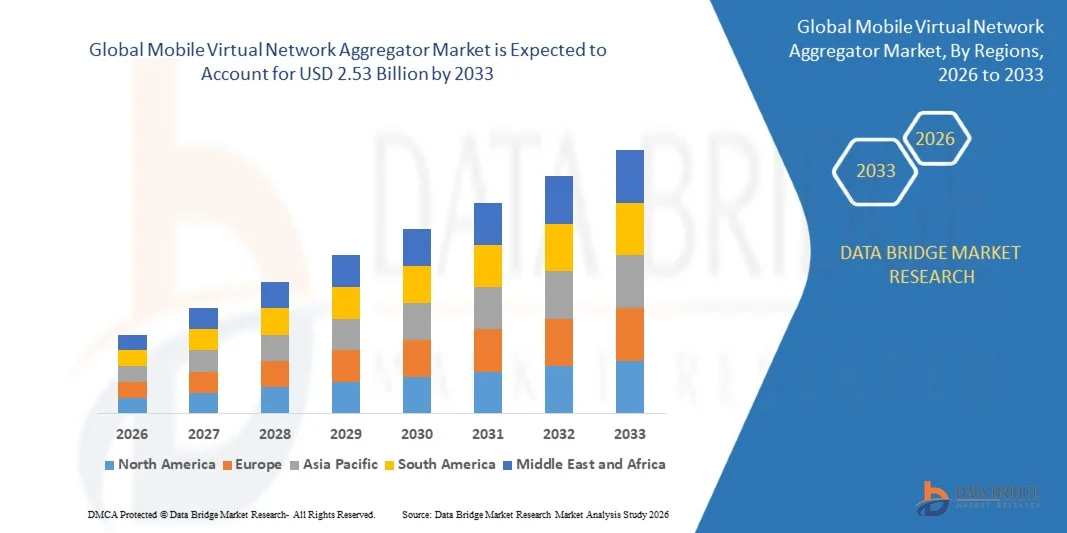
The Mobile Virtual Network Aggregator Market was valued at USD 1.14 billion in 2025 and is projected to reach USD 2.53 billion by 2033, growing at a CAGR of 10.50% from 2026 to 2033. The market is witnessing strong growth driven by increasing adoption of mobile virtual network operator (MVNO) business models, rising demand for cost-efficient telecom infrastructure, and growing expansion of digital connectivity services across emerging and developed economies.
The increasing need for simplified network integration, subscriber management, billing support, and telecom service orchestration is encouraging MVNOs to collaborate with mobile virtual network aggregators (MVNAs) for faster market entry and operational efficiency. MVNAs are increasingly providing centralized platforms that enable smaller telecom providers and enterprises to access mobile network infrastructure without large capital investments.
Key Market Trends & Insights
- Europe dominated the Mobile Virtual Network Aggregator Market with the largest revenue share of 34.18% in 2025, supported by strong MVNO penetration and mature telecom infrastructure.
- Asia-Pacific is expected to be the fastest-growing region at a CAGR of 12.4% from 2026 to 2033, fueled by rising mobile subscriber base, rapid digitalization, and growing telecom partnerships across India, China, and Southeast Asia
- The MVNA Enablement Services segment led the market with a 44.63% share in 2025, driven by increasing demand for subscriber management, network integration, and telecom enablement platforms.
- The Cloud-Based deployment segment is projected to register the fastest CAGR of 11.8%, reflecting increasing demand for scalable and cost-efficient telecom infrastructure management solutions.
- The MVNOs segment dominated the end-user category with a 41.27% revenue share in 2025, led by increasing adoption of outsourced telecom operational services and rising competition in the mobile connectivity market.
- Telecom operators are increasingly partnering with MVNAs to improve operational efficiency, reduce infrastructure complexity, and accelerate deployment of digital connectivity services.
- AI-driven subscriber analytics, eSIM management platforms, and IoT connectivity orchestration are emerging as key innovation areas across the MVNA ecosystem.
Market Size & Forecast
- Global Market Value (2025): USD 1.14 Billion
- Expected Market Value (2033): USD 2.53 Billion
- Forecast CAGR (2026–2033): 10.50%
- Leading Region in 2025: Europe
- Fastest Growing Region: Asia-Pacific
Report Scope and Mobile Virtual Network Aggregator Market Segmentation
|
Attributes |
Mobile Virtual Network Aggregator Key Market Insights |
|
Segments Covered |
|
|
Countries Covered |
North America
Europe
Asia-Pacific
Middle East and Africa
South America
|
|
Key Market Players |
|
|
Market Opportunities |
|
|
Value Added Data Infosets |
In addition to the market insights such as market value, growth rate, market segments, geographical coverage, market players, and market scenario, the market report curated by the Data Bridge Market Research team includes in-depth expert analysis, import/export analysis, pricing analysis, production consumption analysis, and pestle analysis. |
What is the Key Trend in the Mobile Virtual Network Aggregator Market?
Trend: Growing Adoption of eSIM and Digital Connectivity Platforms
The increasing adoption of eSIM technology and digital connectivity management platforms is emerging as a major trend in the Mobile Virtual Network Aggregator Market. MVNAs are increasingly deploying cloud-native platforms capable of supporting remote SIM provisioning, digital onboarding, IoT connectivity management, and real-time subscriber analytics. Telecom operators and enterprises are increasingly leveraging eSIM-enabled services to improve operational flexibility, reduce physical SIM distribution costs, and accelerate customer onboarding processes.
For instance,
In March 2026, according to the Trusted Connectivity Alliance (TCA), the total number of eSIMs shipped globally in 2025 grew by 18%, reaching a new annual high of 605 million.
Additionally, the integration of AI-driven customer analytics, automated billing systems, and centralized telecom orchestration platforms is improving operational efficiency and enabling scalable telecom service delivery across multiple industries
Mobile Virtual Network Aggregator Market Dynamics
Key Market Driver: Increasing Expansion of MVNO Ecosystems
The rapid expansion of MVNO ecosystems globally is significantly driving demand for mobile virtual network aggregator services. Telecom companies, enterprises, and digital service providers are increasingly adopting MVNO business models to deliver customized mobile services without investing heavily in physical telecom infrastructure. MVNAs provide critical backend support including network integration, subscriber management, billing systems, regulatory compliance, and operational enablement, helping new entrants accelerate market deployment and reduce operational complexity.
For instance,
In March 2026, according to Telecom Analysis, globally, the number of MVNO subscribers is set to increase from 333 million in 2026 to 438 million in 2030, an increase of over 31%
Key Restraint/Challenge: Regulatory and Network Integration Complexities
A major challenge in the Mobile Virtual Network Aggregator Market is the complexity associated with telecom regulations, spectrum policies, and network integration across multiple operators and regions. Compliance requirements, roaming agreements, interoperability standards, and evolving telecom policies create operational barriers for MVNAs operating across international markets. Additionally, integration with legacy telecom infrastructure and multi-network environments can increase deployment complexity and operational costs.
Key Market Opportunity: Growth of IoT Connectivity and Enterprise Mobility
The increasing adoption of IoT connectivity solutions and enterprise mobility services presents substantial growth opportunities for the MVNA market. Enterprises across logistics, healthcare, manufacturing, retail, and smart city infrastructure are increasingly deploying connected devices requiring scalable mobile connectivity management solutions. MVNAs are increasingly offering centralized connectivity platforms capable of managing IoT subscriptions, device provisioning, and cross-border connectivity services efficiently.
For instance,
The number of connected IoT devices reached 18.5 billion in 2024, representing a 12% growth over 2023, according to IoT Analytics
How is the Mobile Virtual Network Aggregator Market Segmented?
The mobile virtual network aggregator market is segmented on the basis of service type, deployment model, and end user.
- By Service Type
On the basis of service type, the Mobile Virtual Network Aggregator Market is segmented into MVNA enablement services, managed services, and billing & OSS/BSS solutions. The MVNA enablement services segment dominated the market with a share of 44.63% in 2025 due to increasing demand for network integration, subscriber management, telecom enablement platforms, and operational support services among MVNO providers globally. Rising adoption of digital telecom ecosystems and cloud-native enablement platforms is further supporting segment growth.
The billing & OSS/BSS solutions segment is expected to witness the fastest CAGR of 11.3% from 2026 to 2033, driven by increasing demand for automated billing systems, real-time subscriber analytics, revenue assurance platforms, and integrated telecom operational management solutions across multi-network environments.
- By Deployment Model
On the basis of deployment model, the Mobile Virtual Network Aggregator Market is segmented into cloud-based, on-premise, and hybrid. The on-premise segment dominated the market with a share of 42.18% in 2025 due to strong preference among telecom operators and large enterprises requiring greater infrastructure control, data security, and regulatory compliance management.
The cloud-based segment is expected to witness the fastest CAGR of 11.8% from 2026 to 2033, driven by increasing demand for scalable telecom infrastructure, remote service management, lower deployment costs, and centralized subscriber management platforms. Cloud-native MVNA solutions are enabling telecom providers to improve operational flexibility and accelerate service deployment globally.
- By End User
On the basis of end user, the Mobile Virtual Network Aggregator Market is segmented into MVNOs, telecom operators, and enterprises. The MVNOs segment dominated the market with a share of 41.27% in 2025 due to increasing adoption of outsourced telecom operational services, growing demand for niche connectivity solutions, and rising competition within the mobile services industry. MVNAs enable MVNOs to reduce infrastructure dependency while improving service delivery efficiency.
The enterprises segment is expected to witness the fastest CAGR of 11.6% from 2026 to 2033, driven by rising demand for enterprise mobility management, IoT connectivity services, private wireless networks, and cross-border communication solutions across multiple industries.
Which Region Holds the Largest Share of the Mobile Virtual Network Aggregator Market?
Europe dominated the mobile virtual network aggregator market and accounted for the largest revenue share of 34.18% in 2025, supported by high MVNO penetration, mature telecom infrastructure, and favorable regulatory frameworks encouraging telecom competition. The region benefits from strong digital connectivity ecosystems and increasing enterprise mobility adoption.
U.K. Mobile Virtual Network Aggregator Market Insight
The U.K. mobile virtual network aggregator market is witnessing strong growth due to increasing MVNO adoption, rising demand for enterprise mobility services, and expansion of digital telecom ecosystems. Telecom providers are increasingly partnering with MVNAs to improve subscriber management and operational efficiency.
Germany Mobile Virtual Network Aggregator Market Insight
The Germany mobile virtual network aggregator market is expanding steadily due to increasing enterprise digitalization, strong telecom infrastructure, and rising demand for IoT connectivity services. Enterprises are increasingly deploying centralized telecom management solutions to support digital transformation initiatives.
France Mobile Virtual Network Aggregator Market Insight
The France mobile virtual network aggregator market is witnessing stable growth due to increasing adoption of cloud-based telecom enablement platforms and rising investments in digital communication infrastructure. Telecom operators are increasingly leveraging MVNA services to improve network scalability and operational efficiency.
North America Mobile Virtual Network Aggregator Market Insight
The North America mobile virtual network aggregator market remains a significant contributor to global revenue, driven by increasing adoption of enterprise mobility solutions, rising deployment of IoT devices, and expansion of 5G-enabled telecom ecosystems. Telecom providers are increasingly investing in AI-driven subscriber management and digital connectivity platforms.
Asia-Pacific Mobile Virtual Network Aggregator Market Insight
The Asia-Pacific mobile virtual network aggregator market is expected to witness rapid growth, driven by increasing mobile subscriber penetration, expansion of digital payment ecosystems, rising smartphone adoption, and growing telecom partnerships across China, India, and Southeast Asia. Governments and telecom operators are increasingly investing in digital infrastructure modernization and 5G connectivity deployment.
China Mobile Virtual Network Aggregator Market Insight
The China mobile virtual network aggregator market is growing rapidly due to strong investments in telecom infrastructure, increasing enterprise connectivity demand, and the expansion of IoT-enabled services. The country’s growing digital economy is significantly supporting demand for scalable telecom enablement platforms.
India Mobile Virtual Network Aggregator Market Insight
The India mobile virtual network aggregator market is witnessing strong growth due to rising mobile subscriber base, increasing digital transformation initiatives, and growing demand for cost-effective telecom service delivery models. Increasing adoption of cloud-based telecom management solutions is further supporting market expansion.
Which are the Top Companies in Mobile Virtual Network Aggregator Market?
The mobile virtual network aggregator industry is primarily led by well-established companies, including:
- Plintron Global Technology Solutions Pvt. Ltd. (India)
- Transatel S.A. (France)
- Effortel Technologies SA (Belgium)
- Telness Tech AB (Sweden)
- Pareteum Corporation (U.S.)
- Truphone Limited (U.K.)
- BICS SA (Belgium)
- Gigs (Germany)
- Lebara Group B.V. (Netherlands)
- Comviva Technologies Limited (India)
- Synchronoss Technologies, Inc. (U.S.)
- iBASIS, Inc. (U.S.)
- Tata Communications Limited (India)
- NTT Communications Corporation (Japan)
- Verizon Communications Inc. (U.S.)
- Vodafone Group Plc (U.K.)
- Telefónica S.A. (Spain)
- Orange S.A. (France)
- ZTE Corporation (China)
- Amdocs Limited (U.S.)
What are Latest Developments in Mobile Virtual Network Aggregator Market?
- In January 2022, PLINTRON Group has attained the stature of being the world's largest end-to-end multi-country MVNA & MVNE services, IoT and CPaaS player.
- In January 2025, Transatel enhanced its IoT connectivity management platform to support large-scale enterprise mobility and cross-border communication services across multiple telecom networks.
- In January 2026, Amdocs (NASDAQ: DOX), a leading provider of software and services to communications and media companies, announced aOS (agentic operating system for telecom), an agentic operating system purpose-built for telecommunications.
- In May 2026, Vodafone and AWS signed an agreement to strengthen sovereign cloud services for German businesses and public authorities.
- In July 2024, Truphone introduced enhanced eSIM orchestration capabilities focused on enterprise mobility and global IoT connectivity management applications.

- Interactive Data Analysis Dashboard
- Company Analysis Dashboard for high growth potential opportunities
- Research Analyst Access for customization & queries
- Competitor Analysis with Interactive dashboard
- Latest News, Updates & Trend analysis
- Harness the Power of Benchmark Analysis for Comprehensive Competitor Tracking
Data collection and base year analysis are done using data collection modules with large sample sizes. The stage includes obtaining market information or related data through various sources and strategies. It includes examining and planning all the data acquired from the past in advance. It likewise envelops the examination of information inconsistencies seen across different information sources. The market data is analysed and estimated using market statistical and coherent models. Also, market share analysis and key trend analysis are the major success factors in the market report. To know more, please request an analyst call or drop down your inquiry.
The key research methodology used by DBMR research team is data triangulation which involves data mining, analysis of the impact of data variables on the market and primary (industry expert) validation. Data models include Vendor Positioning Grid, Market Time Line Analysis, Market Overview and Guide, Company Positioning Grid, Patent Analysis, Pricing Analysis, Company Market Share Analysis, Standards of Measurement, Global versus Regional and Vendor Share Analysis. To know more about the research methodology, drop in an inquiry to speak to our industry experts.
Data Bridge Market Research is a leader in advanced formative research. We take pride in servicing our existing and new customers with data and analysis that match and suits their goal. The report can be customized to include price trend analysis of target brands understanding the market for additional countries (ask for the list of countries), clinical trial results data, literature review, refurbished market and product base analysis. Market analysis of target competitors can be analyzed from technology-based analysis to market portfolio strategies. We can add as many competitors that you require data about in the format and data style you are looking for. Our team of analysts can also provide you data in crude raw excel files pivot tables (Fact book) or can assist you in creating presentations from the data sets available in the report.













