


Mobile Virtualization Market Size and Growth Rate
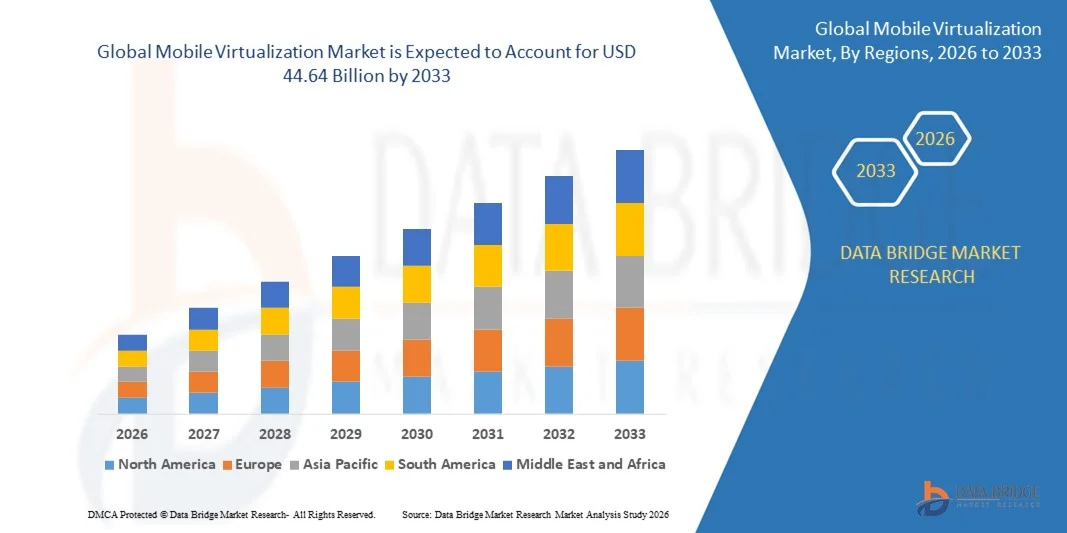
- As per Data Bridge Market Research Analysis the global mobile virtualization market size was valued at USD 11.10 billion in 2025 and is expected to reach USD 44.64 billion by 2033, at a CAGR of 19.0% during the forecast period
- The market growth is largely fueled by the increasing adoption of mobile devices across enterprises and the rapid digital transformation initiatives, which are driving the need for secure, scalable, and efficient mobile virtualization solutions
- Rising demand from enterprises for secure, flexible, and centrally managed mobile workspaces is establishing mobile virtualization as a critical solution for workforce productivity and data protection. These converging factors, including regulatory compliance requirements and the need for seamless device management, are significantly accelerating the adoption of mobile virtualization solutions across industries
Market Size and Forecast:
- Global Market Value (2025): USD 11.10 billion
- Expected Market Value (2033):USD 44.64 billion
- Forecast CAGR (2026–2033): 19.0%
Mobile Virtualization Market Analysis
- Mobile virtualization, enabling multiple operating systems or isolated applications to run on a single device, is becoming increasingly vital for enterprises seeking secure, efficient, and manageable mobile environments. The technology supports enhanced security, remote access, and operational efficiency across distributed workforces, making it a key component of modern IT infrastructure
- The escalating demand for mobile virtualization is primarily fueled by enterprise adoption of cloud services, the need for secure BYOD implementations, and the growing focus on endpoint security. In addition, organizations are increasingly leveraging hypervisors, MDM, and application container solutions to streamline device management, safeguard corporate data, and optimize mobile workforce productivity
- North America dominated the mobile virtualization market with a share of 45.6% in 2025, due to the increasing adoption of mobile virtualization solutions across enterprises and government sectors
- Asia-Pacific is expected to be the fastest growing region in the mobile virtualization market during the forecast period due to increasing digitalization, rising enterprise mobility adoption, and technological advancements in countries such as China, Japan, and India
- Hypervisor segment dominated the market with a market share of 43% in 2025, due to its robust capability to run multiple virtual environments on a single mobile device while maintaining strong security controls. Enterprises often prioritize hypervisor-based solutions for their ability to isolate sensitive applications from general device usage, ensuring compliance and data protection. The segment’s dominance is reinforced by compatibility with both corporate-owned and BYOD (bring your own device) strategies and its support for complex enterprise workflows
Report Scope and Mobile Virtualization Market Segmentation
|
Attributes |
Mobile Virtualization Key Market Insights |
|
Segments Covered |
|
|
Countries Covered |
North America
Europe
Asia-Pacific
Middle East and Africa
South America
|
|
Key Market Players |
|
|
Market Opportunities |
|
|
Value Added Data Infosets |
In addition to the market insights such as market value, growth rate, market segments, geographical coverage, market players, and market scenario, the market report curated by the Data Bridge Market Research team includes in-depth expert analysis, import/export analysis, pricing analysis, production consumption analysis, and pestle analysis. |
Mobile Virtualization Market Trends
Rising Adoption of Hypervisor and MDM Technologies
- A prominent trend in the mobile virtualization market is the increasing adoption of hypervisor technologies and mobile device management (MDM) solutions, driven by the growing need for secure, flexible, and isolated mobile workspaces across enterprises. This trend is enabling organizations to manage multiple operating environments on a single mobile device while ensuring data security and operational efficiency
- For instance, VMware offers VMware Workspace ONE, which integrates hypervisor-based virtualization and MDM capabilities to streamline enterprise mobility management and secure corporate data on employees’ devices. Such solutions are helping IT departments enforce policies, monitor device compliance, and enable secure access to corporate applications
- The adoption of mobile virtualization is expanding in government and defense sectors where secure multi-environment mobile platforms are critical for classified communication and field operations. Hypervisor technologies allow compartmentalization of sensitive applications, reducing risks associated with data breaches and unauthorized access
- Enterprises in healthcare and finance are leveraging mobile virtualization to maintain regulatory compliance while enabling mobile access to critical applications. Virtualized environments allow secure handling of patient records and financial data without compromising device performance or security
- Mobile virtualization is gaining traction in BYOD (bring your own device) programs where employees use personal devices for corporate tasks. Virtualization ensures that corporate data remains isolated from personal apps, enhancing privacy and minimizing security vulnerabilities
- The market is witnessing growth in integration with cloud-based services and unified endpoint management platforms. This rising convergence of mobile virtualization with cloud ecosystems and MDM solutions is reinforcing enterprises’ ability to maintain secure, efficient, and scalable mobile infrastructures
Mobile Virtualization Market Dynamics
Driver
Increasing Demand for Secure and Managed Mobile Workspaces
- The growing reliance on mobile devices for enterprise operations is driving demand for secure and managed mobile workspaces, where applications and data are isolated in controlled virtual environments. These workspaces enable companies to safeguard sensitive information while allowing flexible remote access for employees
- For instance, Citrix provides Citrix Endpoint Management and Citrix Workspace solutions that deliver secure, virtualized mobile applications and desktops to corporate users. These solutions facilitate policy enforcement, real-time monitoring, and secure collaboration across diverse device types
- Organizations are adopting mobile virtualization to reduce risks associated with cyber threats, malware, and data leaks, especially in sectors handling confidential or regulated information. Secure virtual environments mitigate vulnerabilities and allow controlled access without exposing the device’s entire operating system
- Enterprises are integrating mobile virtualization with cloud services to enable centralized management and seamless deployment of virtual applications. This integration supports scalability, consistent policy application, and simplified IT management for geographically distributed teams
- The trend toward remote work and digital transformation is amplifying the need for mobile virtualization platforms that ensure consistent security and performance across all endpoints. This driver continues to propel investment in technologies that support secure and efficient mobile workspaces
Restraint/Challenge
High Implementation and Integration Costs
- The mobile virtualization market faces challenges due to the substantial costs associated with deploying hypervisor-based solutions and integrating them with existing IT infrastructures. Enterprises must invest in software licenses, hardware upgrades, and specialized expertise to implement virtualized mobile environments effectively
- For instance, BlackBerry’s Dynamics platform, while offering robust secure containerization and MDM capabilities, requires significant initial investment for deployment, training, and integration with enterprise systems. These costs can be a barrier for small and medium-sized businesses seeking mobile virtualization solutions
- Integrating virtualization platforms with diverse mobile operating systems and enterprise applications adds complexity and extends project timelines. Companies must ensure compatibility, maintain performance, and address potential security gaps during implementation
- The need for continuous maintenance, updates, and support services further increases the total cost of ownership. Enterprises must allocate resources for ongoing monitoring, patching, and user support to sustain a secure mobile virtualization environment
- Market growth can be constrained by budget limitations and the reluctance of organizations to undertake expensive IT infrastructure overhauls. These cost-related challenges influence adoption rates and require solution providers to demonstrate clear ROI to justify investment
Mobile Virtualization Market Scope
The market is segmented on the basis of technology, application, organization size, and industry vertical.
- By Technology
On the basis of technology, the Mobile Virtualization market is segmented into Hypervisor, Mobile Device Management (MDM), and Application Container. The Hypervisor segment dominated the market with the largest revenue share of 43% in 2025, driven by its robust capability to run multiple virtual environments on a single mobile device while maintaining strong security controls. Enterprises often prioritize hypervisor-based solutions for their ability to isolate sensitive applications from general device usage, ensuring compliance and data protection. The segment’s dominance is reinforced by compatibility with both corporate-owned and BYOD (bring your own device) strategies and its support for complex enterprise workflows. The increasing deployment of hypervisors in regulated sectors such as BFSI and healthcare further boosts adoption, while continuous advancements in virtualization efficiency enhance overall operational performance.
The Mobile Device Management (MDM) segment is anticipated to witness the fastest growth rate from 2026 to 2033, driven by the rising need for centralized device monitoring, configuration, and policy enforcement across distributed mobile workforces. For instance, VMware’s Workspace ONE MDM solution enables organizations to manage devices securely while providing flexibility for remote access and application distribution. The growing reliance on smartphones and tablets in enterprise environments, combined with increasing regulatory requirements for data security, fuels adoption of MDM technologies. MDM’s scalability and cloud-based management capabilities make it a preferred choice for businesses expanding their mobile virtualization deployments, while integration with existing IT infrastructure ensures smoother implementation.
- By Application
On the basis of application, the Mobile Virtualization market is segmented into Enterprise and Consumer. The Enterprise segment dominated the market with the largest revenue share in 2025 due to high adoption of mobile virtualization technologies to secure corporate data, streamline mobile operations, and manage remote or hybrid workforce requirements. Enterprises benefit from virtualized environments that isolate work and personal data, reducing risk of data breaches and enabling compliance with industry standards such as GDPR and HIPAA. The segment’s growth is supported by increasing BYOD policies and deployment of secure virtual mobile apps for employee productivity. Mobile virtualization in enterprise applications also facilitates secure collaboration, remote access, and centralized device administration, making it critical for modern business operations.
The Consumer segment is expected to witness the fastest growth from 2026 to 2033, driven by rising adoption of virtualization apps and tools for personal data protection, multi-user device setups, and enhanced mobile gaming or entertainment experiences. For instance, Samsung Knox’s consumer-focused virtualization solutions allow users to separate personal and sensitive profiles on the same device. The growing awareness of digital privacy, along with the popularity of personal cloud services and virtualized app environments, fuels consumer adoption. As smartphones become central to daily life, virtualization solutions provide users with security, convenience, and enhanced performance without requiring multiple devices.
- By Organization Size
On the basis of organization size, the Mobile Virtualization market is segmented into Large Enterprises and Small and Medium-Sized Enterprises (SMEs). Large Enterprises dominated the market in 2025, driven by their complex IT infrastructure, diverse mobile workforce, and stringent data security requirements. Large organizations deploy mobile virtualization to protect sensitive corporate information, ensure compliance with regulatory frameworks, and manage multiple mobile platforms effectively. These enterprises benefit from economies of scale, allowing them to implement advanced hypervisor or MDM solutions across departments and geographies. The segment also benefits from the integration of mobile virtualization with enterprise mobility management suites, enhancing operational efficiency and productivity.
SMEs are projected to witness the fastest growth from 2026 to 2033 due to increasing digitalization, cloud adoption, and growing awareness of mobile security solutions. For instance, Citrix Workspace enables SMEs to implement cost-effective virtualization without significant infrastructure investments. SMEs leverage virtualization to securely manage remote or hybrid teams while maintaining flexibility in device and application deployment. The rising adoption of subscription-based mobile virtualization platforms reduces upfront costs, encouraging SMEs to adopt mobile virtualization solutions rapidly.
- By Industry Vertical
On the basis of industry vertical, the Mobile Virtualization market is segmented into BFSI, Energy and Utility, Entertainment and Media, Healthcare and Life Sciences, IT and Telecom, Manufacturing and Supply Chain Management, Retail, Public Sector and Education, and Others. The BFSI segment dominated the market with the largest revenue share in 2025, driven by the critical need to secure sensitive financial data, enable secure remote banking services, and comply with regulatory standards. Banks and financial institutions implement mobile virtualization to isolate applications, protect customer data, and allow secure mobile transactions. The segment benefits from growing digital banking adoption and increasing reliance on mobile platforms for payments, trading, and enterprise operations. Mobile virtualization also supports secure BYOD policies and enhances operational resilience against cyber threats in the BFSI sector.
The IT and Telecom segment is expected to witness the fastest growth from 2026 to 2033, fueled by continuous advancements in mobile virtualization platforms to support cloud services, enterprise mobility, and secure device management. For instance, IBM MaaS360 leverages mobile virtualization for enhanced security and management across telecom and IT deployments. The segment’s rapid growth is driven by increasing adoption of remote work models, expansion of mobile applications, and the need for scalable, secure virtualization solutions to manage multiple devices and users efficiently. Mobile virtualization enables IT and telecom companies to improve network security, optimize device usage, and deliver flexible mobile services to employees and clients.
Mobile Virtualization Market Regional Analysis
- North America dominated the mobile virtualization market with the largest revenue share of 45.6% in 2025, driven by the increasing adoption of mobile virtualization solutions across enterprises and government sectors
- Organizations in the region prioritize secure, scalable mobile environments to manage remote and hybrid workforces while ensuring compliance with stringent data protection regulations
- This widespread adoption is supported by advanced IT infrastructure, high cloud penetration, and strong technological awareness, establishing mobile virtualization as a critical solution for both large enterprises and SMEs
U.S. Mobile Virtualization Market Insight
The U.S. mobile virtualization market captured the largest revenue share in 2025 within North America, fueled by extensive deployment of hypervisor-based solutions and mobile device management platforms. Enterprises are increasingly leveraging virtualization to secure sensitive corporate data and enable flexible mobile access for employees. The growing reliance on remote work, cloud integration, and BYOD policies further propels the market. In addition, the adoption of enterprise mobility management suites, along with advanced cybersecurity frameworks, significantly contributes to market expansion.
Europe Mobile Virtualization Market Insight
The Europe mobile virtualization market is projected to expand at a substantial CAGR throughout the forecast period, driven by regulatory compliance requirements and rising demand for secure mobile enterprise solutions. The adoption is further supported by digital transformation initiatives across industries such as BFSI, healthcare, and IT. European organizations are implementing mobile virtualization to improve operational efficiency, secure sensitive data, and provide controlled access across multiple devices. The increasing integration of virtualization solutions with cloud services enhances remote work capabilities, promoting growth across both enterprise and government sectors.
U.K. Mobile Virtualization Market Insight
The U.K. mobile virtualization market is anticipated to grow at a noteworthy CAGR during the forecast period, fueled by the growing need for data security and operational flexibility. Organizations are increasingly deploying hypervisor and MDM solutions to ensure secure mobile access while supporting hybrid and remote work models. The rising focus on regulatory compliance, along with the adoption of enterprise mobility strategies and cloud-based virtualization platforms, is expected to continue driving market growth.
Germany Mobile Virtualization Market Insight
The Germany mobile virtualization market is expected to expand at a considerable CAGR during the forecast period, driven by heightened awareness of cybersecurity, digital transformation, and data privacy. Germany’s strong IT infrastructure, emphasis on technological innovation, and corporate adoption of BYOD policies facilitate market growth. Enterprises are integrating mobile virtualization with secure cloud services and mobile management solutions, providing enhanced operational efficiency and robust protection of sensitive corporate information.
Asia-Pacific Mobile Virtualization Market Insight
The Asia-Pacific mobile virtualization market is poised to grow at the fastest CAGR during the forecast period of 2026 to 2033, driven by increasing digitalization, rising enterprise mobility adoption, and technological advancements in countries such as China, Japan, and India. Organizations across BFSI, IT, manufacturing, and healthcare sectors are adopting mobile virtualization solutions to secure mobile endpoints and manage distributed workforces efficiently. Furthermore, government initiatives promoting digital workplaces, cloud adoption, and IT modernization are significantly accelerating market growth in the region.
Japan Mobile Virtualization Market Insight
The Japan mobile virtualization market is gaining momentum due to the country’s advanced IT landscape, high mobile penetration, and emphasis on operational efficiency and data security. Enterprises are leveraging mobile virtualization to manage secure access to applications and segregate corporate and personal environments on mobile devices. The adoption is further supported by initiatives to enhance enterprise mobility, secure cloud integration, and workforce flexibility. The demand for user-friendly, secure mobile solutions in both corporate and government sectors is fueling growth.
China Mobile Virtualization Market Insight
The China mobile virtualization market accounted for the largest market revenue share in Asia-Pacific in 2025, attributed to rapid enterprise digitalization, government IT modernization projects, and high adoption of mobile and cloud technologies. Organizations across BFSI, IT, and manufacturing sectors are increasingly deploying mobile virtualization to ensure secure device management and compliance with corporate policies. The presence of strong domestic solution providers, coupled with affordable virtualization solutions and the expansion of hybrid and remote work models, is driving significant market growth.
Mobile Virtualization Market Share
The mobile virtualization industry is primarily led by well-established companies, including:
- Broadcom Inc. (U.S.)
- Oracle Corporation (U.S.)
- Microsoft Corporation (U.S.)
- Google LLC (U.S.)
- IBM Corporation (U.S.)
- VMware, Inc. (U.S.)
- Citrix Systems, Inc. (U.S.)
- AT&T Intellectual Property (U.S.)
- HARMAN International (U.S.)
- BlackBerry Limited (Canada)
- Cellrox Life Sciences (U.S.)
- Red Hat, Inc. (U.S.)
- Parallels International GmbH (Germany)
- Workspot, Inc. (U.S.)
- TOSHIBA Corporation (Japan)
- SAMSUNG Electronics (South Korea)
- Amazon.com, Inc. (U.S.)
Latest Developments in Global Mobile Virtualization Market
- In November 2024, Google implemented a significant mandate requiring that all new chipsets launching with Android 15 support the Android Virtualization Framework (AVF). This initiative standardized virtualization capabilities across the mobile ecosystem, allowing devices to execute isolated operating systems and secure code environments efficiently. The development is expected to accelerate the adoption of advanced virtualization use cases, such as running Linux applications on consumer smartphones through protected virtual machines. By enforcing this technical standard, Google strengthened device security, increased the versatility of mobile hardware, and directly influenced the growth trajectory of the global mobile virtualization market by making advanced virtualization capabilities widely accessible
- In July 2024, Omnissa officially launched as an independent software company following its acquisition by a global investment firm from Broadcom. Formerly the End-User Computing division of VMware, Omnissa now focuses exclusively on digital work platforms, including its flagship virtualization solutions such as Horizon and Workspace ONE. This strategic restructuring is expected to positively impact the mobile virtualization market by enabling the company to dedicate resources entirely to mobile virtualization and unified endpoint management. The launch positioned Omnissa to enhance enterprise virtual mobile infrastructure, offering autonomous workspace solutions that strengthen enterprise adoption of mobile virtualization technologies worldwide
- In June 2024, Qualcomm Technologies, Inc. completed the acquisition of specific virtualization assets from OpenSynergy GmbH, including the COQOS Hypervisor technology designed for mixed-criticality systems on mobile and embedded platforms. This move allowed Qualcomm to integrate advanced hypervisor capabilities into its Snapdragon Digital Chassis, strengthening support for software-defined vehicles and mobile edge computing. The acquisition is expected to drive growth in the mobile virtualization market by reinforcing the importance of hypervisor technology in managing multiple operating environments on a single processor and enabling broader adoption across both mobile and automotive platforms
- In January 2024, BlackBerry Limited, in partnership with Stellantis and Amazon Web Services, introduced a cloud-based virtual cockpit platform leveraging the QNX Hypervisor. The platform created a virtualized environment that replicated vehicle controls and systems, enabling developers to test and validate software without physical hardware. This development advanced the application of mobile virtualization in embedded systems, accelerating deployment cycles for connected vehicle software. The collaboration is expected to influence the mobile virtualization market by demonstrating the benefits of cloud-based virtualization for both enterprise and automotive sectors, highlighting opportunities for safer, more efficient software development processes
- In April 2023, V-Valley, a leading value-added IT distributor, announced a strategic partnership with StarWind Software, Inc., a company specializing in storage virtualization and software-defined storage. The collaboration enables V-Valley customers to access StarWind’s catalog of hyper-converged all-flash virtualization products and services. This initiative is expected to enhance the adoption of mobile enterprise virtualization by providing easier access to advanced virtualization solutions and comprehensive support. By bridging distribution and technology expertise, the partnership strengthens market penetration and encourages enterprises to implement scalable mobile virtualization infrastructure efficiently

- Interactive Data Analysis Dashboard
- Company Analysis Dashboard for high growth potential opportunities
- Research Analyst Access for customization & queries
- Competitor Analysis with Interactive dashboard
- Latest News, Updates & Trend analysis
- Harness the Power of Benchmark Analysis for Comprehensive Competitor Tracking
Data collection and base year analysis are done using data collection modules with large sample sizes. The stage includes obtaining market information or related data through various sources and strategies. It includes examining and planning all the data acquired from the past in advance. It likewise envelops the examination of information inconsistencies seen across different information sources. The market data is analysed and estimated using market statistical and coherent models. Also, market share analysis and key trend analysis are the major success factors in the market report. To know more, please request an analyst call or drop down your inquiry.
The key research methodology used by DBMR research team is data triangulation which involves data mining, analysis of the impact of data variables on the market and primary (industry expert) validation. Data models include Vendor Positioning Grid, Market Time Line Analysis, Market Overview and Guide, Company Positioning Grid, Patent Analysis, Pricing Analysis, Company Market Share Analysis, Standards of Measurement, Global versus Regional and Vendor Share Analysis. To know more about the research methodology, drop in an inquiry to speak to our industry experts.
Data Bridge Market Research is a leader in advanced formative research. We take pride in servicing our existing and new customers with data and analysis that match and suits their goal. The report can be customized to include price trend analysis of target brands understanding the market for additional countries (ask for the list of countries), clinical trial results data, literature review, refurbished market and product base analysis. Market analysis of target competitors can be analyzed from technology-based analysis to market portfolio strategies. We can add as many competitors that you require data about in the format and data style you are looking for. Our team of analysts can also provide you data in crude raw excel files pivot tables (Fact book) or can assist you in creating presentations from the data sets available in the report.













