


Modified and Controlled Atmosphere Packaging (MAP and CAP) Market Overview
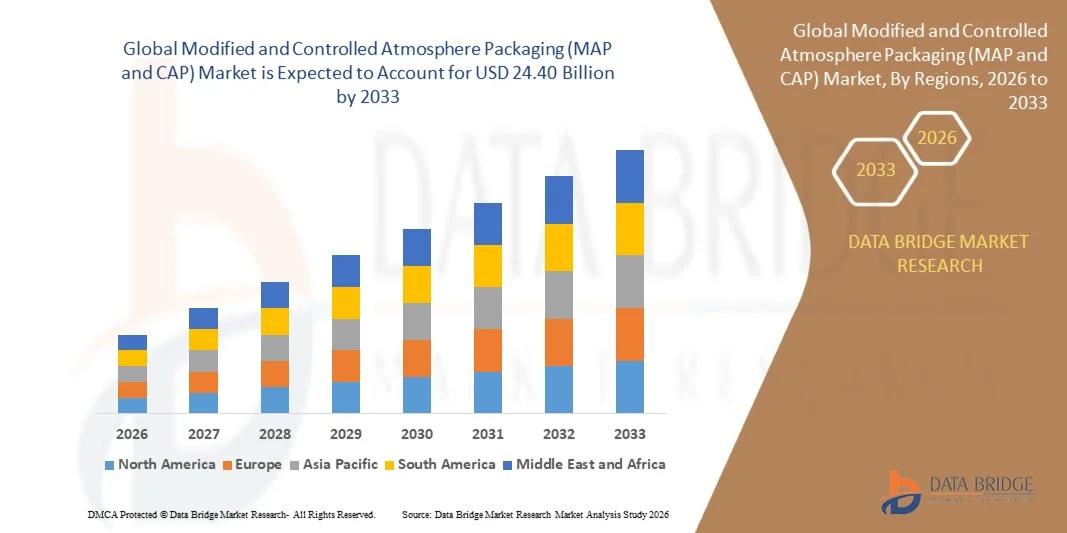
As per Data Bridge Market Research analysis the Modified and Controlled Atmosphere Packaging (MAP and CAP) Market was valued at USD 18.11 billion in 2025 and is projected to reach USD 24.40 billion by 2033, growing at a CAGR of 3.80% from 2026 to 2033. The market is experiencing steady growth driven by increasing demand for extended food shelf life, rising consumption of fresh and minimally processed food products, and growing adoption of advanced packaging technologies across meat, poultry, seafood, bakery, dairy, fruits, vegetables, and ready-to-eat meal applications.
The growing need to reduce food spoilage and wastage across global food supply chains is encouraging food manufacturers, retailers, and food service providers to adopt MAP and CAP solutions. These packaging systems regulate the concentration of gases such as oxygen, carbon dioxide, and nitrogen within food packages to slow microbial growth, preserve product freshness, maintain texture and color, and improve shelf life without relying heavily on chemical preservatives.
The expansion of organized retail, e-commerce grocery platforms, cold-chain logistics, and convenience food consumption is further supporting market growth. In addition, rising consumer preference for hygienically packed fresh foods, premium meat and seafood products, and preservative-free food offerings is increasing the use of high-barrier films, trays, gas flushing systems, and intelligent atmosphere control technologies across the food packaging industry.
Key Market Trends & Insights
- North America dominated the modified and controlled atmosphere packaging (MAP and CAP) market with the largest revenue share of 38.7% in 2025, supported by strong cold chain infrastructure, high consumption of packaged meat and dairy products, advanced food processing capabilities, and widespread adoption of gas-flush and vacuum packaging technologies across retail and food service sectors.
- Asia-Pacific is expected to be the fastest-growing region, recording a CAGR of 9.1% from 2026 to 2033. Growth is driven by rapid urbanization, rising disposable incomes, expanding packaged food consumption, increasing demand for ready-to-eat meals, and strong growth in cold chain logistics and modern retail infrastructure across countries such as China, India, and Japan.
- The poultry, seafood, and meat products segment held the largest market revenue share of approximately 34.6% in 2025 driven by strong demand for extended shelf life packaging, strict cold chain requirements, and increasing consumption of fresh protein products across retail and food service channels. MAP technology is widely used in fresh meat packaging to control oxygen levels and slow microbial growth, significantly reducing spoilage during distribution and retail display.
- The convenience food segment is projected to register the fastest growth at a CAGR of 9.2% from 2026 to 2033, driven by rising demand for ready-to-eat meals, packaged snacks, and chilled food products. Increasing urbanization, expansion of food delivery platforms, and growing preference for minimally processed foods are accelerating adoption of MAP trays, lidding films, and vacuum skin packaging formats.
- The nitrogen segment held the largest market revenue share of approximately 41.3% in 2025 driven by its inert nature, cost-effectiveness, and wide use in displacing oxygen to prevent oxidation and microbial growth in packaged foods. Nitrogen flushing is extensively used in bakery products, snacks, dairy packaging, and dry food applications to maintain product freshness and texture.
- The oxygen segment is projected to register the fastest growth at a CAGR of 8.6% from 2026 to 2033, driven by its controlled use in fresh produce packaging where respiration balance is critical. Low oxygen atmospheres are essential in maintaining color stability in red meat and regulating respiration rates in fruits and vegetables during storage and transportation.
- The low-density polyethylene (LDPE) segment held the largest market revenue share of approximately 38.9% in 2025 driven by its flexibility, strong moisture barrier properties, cost efficiency, and wide use in food packaging films and wraps used in MAP applications across retail and food service sectors.
- The other packaging materials segment, including biodegradable and high-barrier multilayer films, is projected to register the fastest growth at a CAGR of 9.8% from 2026 to 2033, driven by increasing demand for sustainable packaging solutions, regulatory pressure on single-use plastics, and rising adoption of recyclable mono-material structures in MAP and CAP applications across global food supply chains.
Market Size & Forecast
- Global Market Value (2025): USD 18.11 Billion
- Expected Market Value (2033): USD 24.40 Billion
- Forecast CAGR (2026–2033): 3.80%
- Leading Region in 2025: North America
- Fastest Growing Region: Asia-Pacific
Report Scope and Modified and Controlled Atmosphere Packaging (MAP and CAP) Market Segmentation
|
Attributes |
Modified and Controlled Atmosphere Packaging (MAP and CAP) Key Market Insights |
|
Segments Covered |
|
|
Countries Covered |
North America
Europe
Asia-Pacific
Middle East and Africa
South America
|
|
Key Market Players |
• MicrobeGuard Corporation (U.S.) |
|
Market Opportunities |
• Expansion Of Sustainable Food Delivery Packaging Solutions |
|
Value Added Data Infosets |
In addition to the insights on market scenarios such as market value, growth rate, segmentation, geographical coverage, and major players, the market reports curated by the Data Bridge Market Research also include import export analysis, production capacity overview, production consumption analysis, price trend analysis, climate change scenario, supply chain analysis, value chain analysis, raw material/consumables overview, vendor selection criteria, PESTLE Analysis, Porter Analysis, and regulatory framework. |
Modified and Controlled Atmosphere Packaging (MAP and CAP) Market Trends
Trend: Growth In Extended Shelf Life Packaging And Advanced Gas Control Technologies
Increasing demand for fresh, minimally processed, and preservative-free food products across retail, food service, and e-commerce channels is driving the adoption of modified atmosphere packaging (MAP) and controlled atmosphere packaging (CAP) solutions. These technologies are widely used to regulate oxygen, carbon dioxide, and nitrogen levels inside packaging to slow microbial growth, reduce oxidation, and extend product shelf life while maintaining food quality, texture, and appearance.
In modern food supply chains, MAP systems are increasingly being integrated into meat, poultry, seafood, bakery, and fresh produce packaging to reduce spoilage and food waste. For instance, modified atmosphere packaging can extend the shelf life of fresh red meat from approximately 3–5 days to 10–14 days under refrigerated conditions by controlling oxygen levels and inhibiting microbial activity, significantly improving logistics efficiency and retail inventory management.
In industrial food processing environments, CAP systems are being used in large-scale storage and transportation of fruits and vegetables to maintain optimal respiration rates during long-distance shipping. For instance, controlled atmosphere storage for apples and pears can extend storage life up to 6–12 months by maintaining low oxygen and elevated carbon dioxide conditions, reducing post-harvest losses in global agricultural supply chains.
The rapid expansion of organized retail, cold chain logistics, and global food trade is also increasing demand for high-barrier films, gas-flush packaging machines, vacuum skin packaging, and intelligent atmosphere control systems. In addition, rising consumption of ready-to-eat meals and convenience foods is accelerating the use of MAP trays, lidding films, and flexible packaging formats capable of maintaining product freshness without chemical preservatives.
Modified and Controlled Atmosphere Packaging (MAP and CAP) Market Dynamics
Key Market Driver: Rising Demand For Extended Food Shelf Life And Reduced Food Waste
Food producers, retailers, and logistics providers are increasingly under pressure to reduce food waste, improve supply chain efficiency, and maintain product freshness over longer distribution cycles. Globally, nearly 13% of food is lost between harvest and retail stages, highlighting the need for advanced preservation technologies such as MAP and CAP that can slow degradation and extend usability without compromising food safety.
The food industry is increasingly adopting MAP systems for fresh meat, seafood, dairy products, bakery items, and ready-to-eat meals to maintain quality during transportation and retail display. For instance, MAP-packed poultry products can achieve shelf life extensions of up to 7–10 additional days compared to conventional air packaging under refrigerated storage conditions, reducing spoilage losses and improving retail profitability.
Similarly, controlled atmosphere storage is widely used in large-scale fruit and vegetable supply chains to maintain quality during long-distance export. In countries with strong agricultural export markets such as the Netherlands, China, and the U.S., controlled atmosphere storage systems are widely deployed to preserve high-value crops such as apples, grapes, and citrus fruits during extended shipping durations.
Key Restraint/Challenge: High Equipment Costs And Cold Chain Dependency
The implementation of MAP and CAP technologies requires specialized equipment such as gas mixers, sealing machines, barrier films, and controlled storage facilities, which increases overall packaging system costs. Small and medium-sized food producers often face challenges in adopting these systems due to high initial investment requirements and operational complexity.
In addition, MAP and CAP systems are highly dependent on uninterrupted cold chain infrastructure to maintain effectiveness. Any temperature fluctuation during storage or transportation can significantly reduce shelf life benefits and compromise food safety. This dependency increases logistical complexity, particularly in developing regions where cold chain infrastructure is still expanding.
Commercial packaging studies indicate that while MAP can extend shelf life by 2–3 times for certain perishable food products, performance effectiveness can decline sharply if temperature control deviates beyond recommended ranges of 0°C to 5°C, limiting its reliability in inconsistent storage environments.
Key Market Opportunity: Expansion Of Sustainable And Smart Food Packaging Solutions
Modern food packaging manufacturers are increasingly integrating MAP and CAP technologies with recyclable, biodegradable, and mono-material packaging structures to align with sustainability goals and regulatory requirements. This includes the development of paper-based trays with barrier coatings, recyclable polyethylene films, and compostable lidding solutions designed for modified atmosphere systems.
Food manufacturers are also exploring smart packaging integration with MAP systems, including freshness indicators and oxygen sensors that provide real-time information about product quality. For instance, intelligent packaging solutions can help monitor oxygen leakage and microbial activity in packaged foods, reducing waste and improving consumer safety.
In addition, advancements in high-barrier biopolymer films, vacuum skin packaging, and automated gas-flush systems are expanding application opportunities across Asia-Pacific and North America. Large-scale food distribution networks and growing demand for export-quality fresh produce are further driving adoption of advanced MAP and CAP solutions across global food supply chains.
Modified and Controlled Atmosphere Packaging (MAP and CAP) Market Scope
The market is segmented on the basis of application, packaging gas, and packaging material
• By Application
On the basis of application, the Modified and Controlled Atmosphere Packaging (MAP and CAP) Market is segmented into dairy products, bakery and confectionery, poultry, seafood, and meat products, convenience food, fruits and vegetables, and others. The poultry, seafood, and meat products segment held the largest market revenue share of approximately 34.6% in 2025 driven by strong demand for extended shelf life packaging, strict cold chain requirements, and increasing consumption of fresh protein products across retail and food service channels. MAP technology is widely used in fresh meat packaging to control oxygen levels and slow microbial growth, significantly reducing spoilage during distribution and retail display.
The convenience food segment is projected to register the fastest growth at a CAGR of 9.2% from 2026 to 2033, driven by rising demand for ready-to-eat meals, packaged snacks, and chilled food products. Increasing urbanization, expansion of food delivery platforms, and growing preference for minimally processed foods are accelerating adoption of MAP trays, lidding films, and vacuum skin packaging formats.
• By Packaging Gas
On the basis of packaging gas, the Modified and Controlled Atmosphere Packaging (MAP and CAP) Market is segmented into oxygen, nitrogen, carbon dioxide, and other gases. The nitrogen segment held the largest market revenue share of approximately 41.3% in 2025 driven by its inert nature, cost-effectiveness, and wide use in displacing oxygen to prevent oxidation and microbial growth in packaged foods. Nitrogen flushing is extensively used in bakery products, snacks, dairy packaging, and dry food applications to maintain product freshness and texture.
The oxygen segment is projected to register the fastest growth at a CAGR of 8.6% from 2026 to 2033, driven by its controlled use in fresh produce packaging where respiration balance is critical. Low oxygen atmospheres are essential in maintaining color stability in red meat and regulating respiration rates in fruits and vegetables during storage and transportation.
• By Packaging Material
On the basis of packaging material, the Modified and Controlled Atmosphere Packaging (MAP and CAP) Market is segmented into polyvinylchloride (PVC), low-density polyethylene (LDPE), polypropylene (PP), and other packaging materials. The low-density polyethylene (LDPE) segment held the largest market revenue share of approximately 38.9% in 2025 driven by its flexibility, strong moisture barrier properties, cost efficiency, and wide use in food packaging films and wraps used in MAP applications across retail and food service sectors.
The other packaging materials segment, including biodegradable and high-barrier multilayer films, is projected to register the fastest growth at a CAGR of 9.8% from 2026 to 2033, driven by increasing demand for sustainable packaging solutions, regulatory pressure on single-use plastics, and rising adoption of recyclable mono-material structures in MAP and CAP applications across global food supply chains.
Modified and Controlled Atmosphere Packaging (MAP and CAP) Market Regional Analysis
North America Modified And Controlled Atmosphere Packaging (MAP And CAP) Market Insight
North America dominated the modified and controlled atmosphere packaging (MAP and CAP) market with the largest revenue share of 38.7% in 2025, supported by strong demand for extended shelf life food products, well-developed cold chain logistics, and high consumption of packaged meat, seafood, dairy, and convenience foods. Food manufacturers and retailers in the region are increasingly adopting MAP systems such as gas-flushed trays, vacuum skin packaging, and high-barrier films to reduce food spoilage and maintain product freshness. The presence of advanced food processing infrastructure, high consumer awareness regarding food safety, and growing demand for minimally processed packaged foods further strengthens regional market leadership.
U.S. Modified And Controlled Atmosphere Packaging (MAP And CAP) Market Insight
The U.S. modified and controlled atmosphere packaging (MAP and CAP) market captured the largest revenue share in 2025 within North America, driven by strong adoption of advanced food preservation technologies across retail chains, quick service restaurants, and packaged food manufacturers. Increasing demand for ready-to-eat meals, fresh meat products, and chilled packaged foods is accelerating the use of nitrogen flushing systems, carbon dioxide-based preservation, and multilayer barrier packaging solutions. The expansion of organized grocery retail and food delivery platforms is further supporting the integration of MAP technologies into high-volume food distribution systems across the country.
Europe Modified And Controlled Atmosphere Packaging (MAP And CAP) Market Insight
The Europe modified and controlled atmosphere packaging (MAP and CAP) market is expected to witness the fastest growth rate from 2026 to 2033, primarily driven by strict food safety regulations, rising demand for fresh and preservative-free food products, and strong emphasis on reducing food waste. European food producers are increasingly adopting MAP and CAP technologies for meat, dairy, bakery, and fresh produce packaging to comply with sustainability and quality standards. The region is also witnessing strong growth in recyclable barrier films, compostable trays, and advanced gas control packaging systems across retail and food service sectors.
U.K. Modified And Controlled Atmosphere Packaging (MAP And CAP) Market Insight
The U.K. modified and controlled atmosphere packaging (MAP and CAP) market is expected to witness strong growth from 2026 to 2033, driven by increasing consumer demand for fresh, safe, and minimally processed food products. Rising popularity of chilled ready meals, packaged meat, and bakery items is encouraging food manufacturers and retailers to adopt MAP solutions such as modified atmosphere trays and vacuum packaging systems. Concerns regarding food waste reduction and strict regulatory focus on packaging sustainability are further accelerating adoption of advanced atmosphere control packaging technologies across the country.
Germany Modified And Controlled Atmosphere Packaging (MAP And CAP) Market Insight
The Germany modified and controlled atmosphere packaging (MAP and CAP) market is expected to witness strong growth from 2026 to 2033, supported by advanced food processing infrastructure, strong sustainability regulations, and high consumer preference for high-quality packaged food products. German food manufacturers are increasingly integrating MAP technologies into meat, dairy, and fresh produce packaging to extend shelf life and maintain product integrity. The country’s emphasis on recycling, eco-friendly packaging materials, and efficient supply chain management is further supporting the adoption of controlled atmosphere packaging solutions.
Asia-Pacific Modified And Controlled Atmosphere Packaging (MAP And CAP) Market Insight
The Asia-Pacific modified and controlled atmosphere packaging (MAP and CAP) market is expected to witness the fastest growth rate from 2026 to 2033, driven by rapid urbanization, rising disposable incomes, and increasing consumption of packaged and convenience foods across countries such as China, India, and Japan. Expanding cold chain infrastructure, growing food export activities, and rising demand for fresh meat, seafood, and ready-to-eat meals are accelerating the adoption of MAP and CAP technologies. In addition, increasing investments in modern retail and food processing facilities are further strengthening regional market expansion.
Japan Modified And Controlled Atmosphere Packaging (MAP And CAP) Market Insight
The Japan modified and controlled atmosphere packaging (MAP and CAP) market is expected to witness strong growth from 2026 to 2033 due to high demand for premium-quality packaged food, strict food safety standards, and advanced packaging technology adoption. The Japanese food industry widely uses MAP systems for seafood, meat, and ready meals to maintain freshness, color, and texture. Increasing aging population and demand for convenient, ready-to-consume packaged foods are further encouraging the use of vacuum packaging, gas flushing systems, and high-barrier films across retail and food service applications.
China Modified And Controlled Atmosphere Packaging (MAP And CAP) Market Insight
The China modified and controlled atmosphere packaging (MAP and CAP) market accounted for the largest market revenue share in Asia-Pacific in 2025, attributed to rapid urbanization, expansion of organized retail, and strong growth in packaged food consumption. China’s large-scale food manufacturing base and expanding cold chain logistics network are driving widespread adoption of MAP technologies in meat, seafood, fruits, and ready-to-eat food segments. Government focus on reducing food waste, increasing export-quality food production, and improving food safety standards is further accelerating market growth across the country.
Modified and Controlled Atmosphere Packaging (MAP and CAP) Market Share
The Modified and Controlled Atmosphere Packaging (MAP and CAP) industry is primarily led by well-established companies, including:
- MicrobeGuard Corporation (U.S.)
- Amcor plc (Australia)
- Sealed Air (U.S.)
- Klöckner Pentaplast (Germany)
- Berry Global Inc. (U.S.)
- Filtration Group (U.S.)
- Linde plc (Ireland)
- Barry-Wehmiller Companies (U.S.)
- Air Products and Chemicals, Inc., (U.S.)
- COVERIS (U.K.)
- CVP Systems LLC (U.S.)
- Bemis Manufacturing Company (U.S.)
- IMA-Ilapak. (Russia)
- ORICS (U.S.)
- TOTAL PACKAGING SOLUTIONS (U.S.)
- WINPAK LTD (Canada)
- Reiser (U.S.)

- Interactive Data Analysis Dashboard
- Company Analysis Dashboard for high growth potential opportunities
- Research Analyst Access for customization & queries
- Competitor Analysis with Interactive dashboard
- Latest News, Updates & Trend analysis
- Harness the Power of Benchmark Analysis for Comprehensive Competitor Tracking
Global Modified And Controlled Atmosphere Packaging Map Cap Market, Supply Chain Analysis and Ecosystem Framework
To support market growth and help clients navigate the impact of geopolitical shifts, DBMR has integrated in-depth supply chain analysis into its Global Modified And Controlled Atmosphere Packaging Map Cap Market research reports. This addition empowers clients to respond effectively to global changes affecting their industries. The supply chain analysis section includes detailed insights such as Global Modified And Controlled Atmosphere Packaging Map Cap Market consumption and production by country, price trend analysis, the impact of tariffs and geopolitical developments, and import and export trends by country and HSN code. It also highlights major suppliers with data on production capacity and company profiles, as well as key importers and exporters. In addition to research, DBMR offers specialized supply chain consulting services backed by over a decade of experience, providing solutions like supplier discovery, supplier risk assessment, price trend analysis, impact evaluation of inflation and trade route changes, and comprehensive market trend analysis.
Data collection and base year analysis are done using data collection modules with large sample sizes. The stage includes obtaining market information or related data through various sources and strategies. It includes examining and planning all the data acquired from the past in advance. It likewise envelops the examination of information inconsistencies seen across different information sources. The market data is analysed and estimated using market statistical and coherent models. Also, market share analysis and key trend analysis are the major success factors in the market report. To know more, please request an analyst call or drop down your inquiry.
The key research methodology used by DBMR research team is data triangulation which involves data mining, analysis of the impact of data variables on the market and primary (industry expert) validation. Data models include Vendor Positioning Grid, Market Time Line Analysis, Market Overview and Guide, Company Positioning Grid, Patent Analysis, Pricing Analysis, Company Market Share Analysis, Standards of Measurement, Global versus Regional and Vendor Share Analysis. To know more about the research methodology, drop in an inquiry to speak to our industry experts.
Data Bridge Market Research is a leader in advanced formative research. We take pride in servicing our existing and new customers with data and analysis that match and suits their goal. The report can be customized to include price trend analysis of target brands understanding the market for additional countries (ask for the list of countries), clinical trial results data, literature review, refurbished market and product base analysis. Market analysis of target competitors can be analyzed from technology-based analysis to market portfolio strategies. We can add as many competitors that you require data about in the format and data style you are looking for. Our team of analysts can also provide you data in crude raw excel files pivot tables (Fact book) or can assist you in creating presentations from the data sets available in the report.













