


What is the Modified Atmosphere Packaging for Produce Logistics Market Size and Growth Rate?
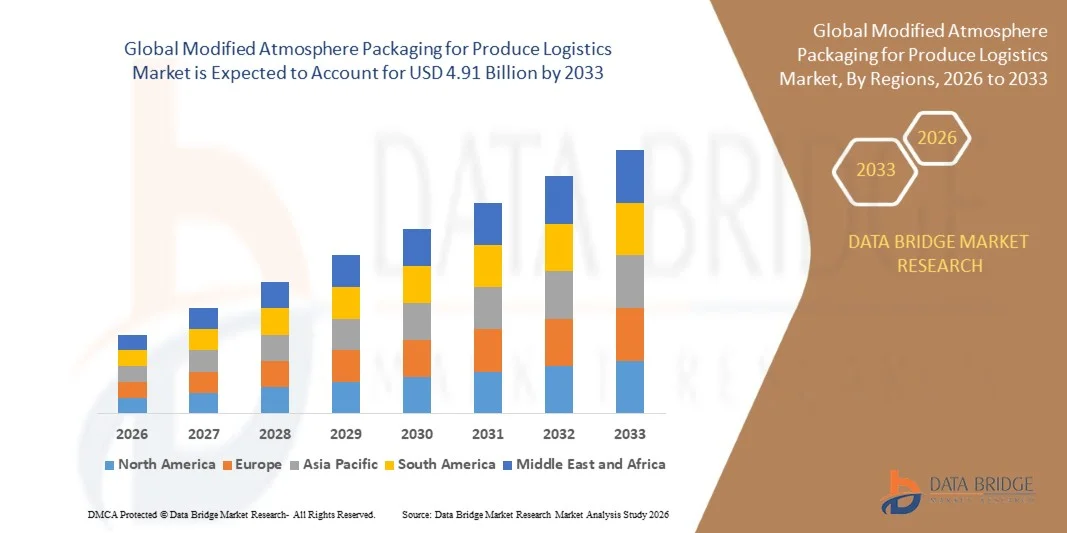
- As per Data Bridge Market Research analysis, the modified atmosphere packaging for produce logistics market was valued at USD 3.13 billion in 2025 and is projected to reach USD 4.91 billion by 2033, growing at a CAGR of 5.80% from 2026 to 2033.
- The market is experiencing consistent growth driven by increasing consumer demand for fresh and high-quality fruits and vegetables, rising concerns about food waste, globalization of food supply chains, and technological advancements in packaging materials, active and passive MAP systems.
- The increasing need to extend the shelf life of fresh produce, maintain quality, and reduce spoilage during storage and transportation, combined with growing organized retail and cold-chain logistics, is compelling producers and logistics providers to adopt advanced MAP technologies. Research indicates that MAP alters the surrounding gas composition through the interaction between packaging-film permeability and produce respiration, helping preserve fresh and minimally processed fruits and vegetables.
Market Size & Forecast
- Global Market Value (2025): USD 3.13 Billion
- Expected Market Value (2033): USD 4.91 Billion
- Forecast CAGR (2026–2033): 5.80%
- Leading Region in 2025: North America
- Fastest Growing Region: Asia Pacific
What are the Major Takeaways of the Modified Atmosphere Packaging for Produce Logistics Market?
- North America dominated the modified atmosphere packaging for produce logistics market with the largest revenue share of 37.3% in 2025, supported by a highly developed retail infrastructure, significant consumer demand for fresh produce year-round, stringent food safety regulations, and robust cold-chain logistics.
- Asia-Pacific is expected to be the fastest-growing region at a CAGR of 6.7% from 2026 to 2033, fueled by rapid urbanization, rising disposable incomes, increasing consumer awareness of food safety and quality, and investments in cold-chain infrastructure and advanced packaging technologies
- The bags & pouches segment led the market with a 32.1% share in 2025, driven by their flexibility, cost-effectiveness, lightweight construction, and suitability for fresh produce logistics.
- Containers are the fastest-growing packaging type, projected to register a CAGR of 6.4%, reflecting the surge in demand for rigid packaging formats in premium produce applications.
- The active MAP segment dominated the technology category with a 62.3% revenue share in 2025, led by its ability to actively establish a controlled atmosphere before package sealing.
- Fruits accounted for 38.2% of the market share in 2025, preferred by the need to preserve freshness and extend shelf life during storage and transportation.
- The polypropylene segment is the fastest-growing material category, with a CAGR of 13%, driven by its favorable barrier properties, temperature resistance, lightweight structure, and suitability for fresh-produce packaging.
Report Scope and Modified Atmosphere Packaging for Produce Logistics Market Segmentation
|
Attributes |
Modified Atmosphere Packaging for Produce Logistics Key Market Insights |
|
Segments Covered |
|
|
Countries Covered |
North America
Europe
Asia-Pacific
Middle East and Africa
South America
|
|
Key Market Players |
|
|
Market Opportunities |
|
|
Value Added Data Infosets |
In addition to the insights on market scenarios such as market value, growth rate, segmentation, geographical coverage, and major players, the market reports curated by the Data Bridge Market Research also include import export analysis, production capacity overview, production consumption analysis, price trend analysis, climate change scenario, supply chain analysis, value chain analysis, raw material/consumables overview, vendor selection criteria, PESTLE Analysis, Porter Analysis, and regulatory framework. |
What is the Key Trend in the Modified Atmosphere Packaging for Produce Logistics Market?
- Fresh-produce packagers are increasingly adopting optimized MAP systems with microperforated films and product-specific gas permeability to balance respiration, gas exchange, moisture, and shelf life during storage and transportation.
- For instance, in September 2024, researchers developed microperforated polybutylene succinate (PBS) films for bananas using CO₂ laser technology, demonstrating that controlled microhole size and number can regulate gas permeability and help preserve banana quality.
- Advanced MAP design increasingly combines produce respiration rates, packaging-film permeability, temperature, humidity, and heat transfer to optimize package performance under actual supply-chain conditions.
- Packaging developers are also focusing on sustainable MAP solutions as concerns over plastic waste increase, while maintaining the protective and shelf-life benefits required for fresh produce logistics.
- For instance, in June 2024, researchers combined indirect cold plasma with MAP for cherry tomatoes, cucumbers, and lettuce, finding that the combined treatment reduced microbial proliferation and lowered respiration rates by 29.1% compared with the control, demonstrating the trend toward integrating MAP with advanced preservation technologies.
- As fresh-produce supply chains become more demanding and require longer storage and transportation periods, the development of product-specific, sustainable, and scientifically optimized MAP systems is expected to accelerate, strengthening MAP's role in maintaining produce quality and reducing deterioration.
What are the Key Drivers of the Modified Atmosphere Packaging for Produce Logistics Market?
- The growing need to extend fresh-produce shelf life and maintain quality during refrigerated storage and transportation is significantly increasing demand for modified atmosphere packaging technologies.
- For instance, in June 2024, researchers from ICAR–Indian Institute of Vegetable Research found that MAP substantially improved cucumber shelf life during cold storage: packaged cucumbers recorded only 10.09% weight loss versus 60.72% for control fruits after 18 days at 15°C, demonstrating MAP's ability to preserve quality and reduce postharvest losses.
- MAP enables produce suppliers and logistics operators to control the headspace atmosphere through the interaction between produce respiration and packaging-film permeability, supporting quality preservation throughout distribution.
- The increasing economic and environmental importance of reducing food loss and waste across fresh-produce supply chains is further encouraging adoption of technologies that preserve freshness and extend marketable shelf life.
- For instance, in July 2023, researchers demonstrated that combining ethylene-scavenging active packaging with MAP reduced postharvest losses in bananas and kiwifruit; bananas remained acceptable for 9 days, while kiwifruit remained acceptable for 30 days under the tested MAP conditions.
- With fresh produce continuing to undergo physiological and metabolic changes after harvest, MAP combined with appropriate storage conditions and packaging design will remain an important technology for extending storage life and maintaining product quality across produce logistics networks.
Which Factors are Challenging the Growth of the Modified Atmosphere Packaging for Produce Logistics Market?
- The use of plastic-based films, bags, trays, and containers in MAP creates sustainability and recyclability concerns, increasing pressure on manufacturers to develop packaging that delivers both gas-control performance and lower environmental impact.
- For instance, in September 2024, a study of the UK fresh-produce sector reported that fruit and vegetables use approximately 38 kilotonnes of plastic consumer packaging annually, highlighting the plastic-waste and sustainability concerns associated with packaging-intensive fresh-produce distribution.
- These sustainability concerns can complicate packaging selection because simply removing plastic from fresh-produce packaging may not provide the required protection, shelf-life extension, or logistical performance.
- MAP performance is also highly sensitive to produce respiration, transpiration, temperature, humidity, and packaging permeability, making it difficult to develop one packaging configuration that performs optimally across different commodities and logistics conditions.
- For instance, in April 2023, a article in Postharvest Biology and Technology reported that commercial MAP adoption remains limited to a few commodities and identified moisture condensation as an unresolved problem, highlighting the technical limitations that can restrict wider MAP adoption in fresh-produce logistics.
- These technical and sustainability challenges continue to increase the complexity of designing commercially viable MAP solutions, particularly for high-respiring commodities and supply chains exposed to changing temperature and humidity conditions, potentially limiting broader adoption.
How is the Modified Atmosphere Packaging for Produce Logistics Market Segmented?
The modified atmosphere packaging for produce logistics market is segmented on the basis of packaging type, technology, application, material, and distribution channel.
- By Packaging Type
On the basis of packaging type, the modified atmosphere packaging for produce logistics market is segmented into bags & pouches, films, trays, containers, and others. The bags & pouches segment dominated the market with an estimated 32.1% share in 2025, driven by their flexibility, cost-effectiveness, lightweight construction, and suitability for fresh produce logistics. These formats are widely applicable to fruits, vegetables, and fresh-cut produce requiring controlled atmospheric conditions. Their flexible structure allows packaging manufacturers to accommodate different produce sizes and volumes. Lightweight packaging can also support efficient handling and transportation across distribution networks. Growing demand for convenient fresh-produce packaging and expansion of online grocery distribution are further supporting segment demand.
The containers segment is projected to register the fastest growth at a CAGR of 6.4% from 2026 to 2033, supported by demand for rigid packaging formats in premium produce applications. Containers provide greater structural protection during transportation, handling, and distribution. Their rigid construction can help reduce physical damage to delicate fruits and vegetables. Transparent container formats also provide product visibility, which is beneficial in retail environments. Increasing transportation of higher-value produce over longer distances is creating additional demand for protective packaging. Expansion of organized retail and cold-chain infrastructure is expected to further support container-based MAP solutions.
- By Technology
On the basis of technology, the modified atmosphere packaging for produce logistics market is segmented into active MAP and passive MAP. The active MAP segment dominated the market with an estimated 62.3% share in 2025, owing to its ability to actively establish a controlled atmosphere before package sealing. Active MAP uses specific gas mixtures to modify oxygen and carbon dioxide concentrations within packages. This provides greater control over atmospheric conditions for highly perishable produce. The technology is particularly useful where precise gas composition is required throughout storage and transportation. Growing demand for extended shelf life and improved fresh-produce quality is supporting adoption of active systems. Increasing integration of gas-flushing technologies with automated packaging equipment is further strengthening this segment.
The passive MAP segment is projected to be the fastest-growing application at a CAGR of 7.7% from 2026 to 2033. Passive MAP develops through the natural interaction between produce respiration and packaging-film permeability. This approach can provide a relatively simple solution for produce with appropriate respiration characteristics. Advances in packaging-film technology are improving control over oxygen and carbon dioxide transmission. The technology can reduce the need for active gas-flushing equipment in suitable applications. Its comparatively simple operating requirements can support adoption among cost-sensitive produce packagers.
- By Application
On the basis of application, the modified atmosphere packaging for produce logistics market is segmented into fruits, vegetables, salads, and others. The fruits segment dominated the market with an estimated 38.2% share in 2025, driven by the need to preserve freshness and extend shelf life during storage and transportation. Fruits continue to respire after harvesting, making atmospheric control important for maintaining quality. MAP can help slow physiological deterioration and delay ripening under appropriate storage conditions. The technology is particularly relevant to supply chains involving long transportation distances and extended distribution periods. Increasing year-round consumer demand for fresh fruits is supporting investment in effective postharvest packaging solutions. Growing efforts to reduce postharvest losses are also strengthening demand for MAP in fruit logistics.
The salads segment is projected to be the fastest-growing application at a CAGR of 8.5% from 2026 to 2033, supported by rising demand for fresh-cut and ready-to-eat produce. Fresh-cut salads generally have increased respiration rates because cutting exposes more tissue to the surrounding atmosphere. MAP can help control gas composition and maintain quality during refrigerated distribution. Increasing consumer preference for convenient, minimally processed foods is supporting expansion of packaged salad products. Growth of supermarkets, online grocery platforms, and refrigerated delivery networks is increasing the availability of fresh-cut salads.
- By Material
On the basis of material, the modified atmosphere packaging for produce logistics market is segmented into polyethylene, polypropylene, polyamide, and others. The polyethylene segment dominated the market with an estimated 42.3% share in 2025, owing to its versatility, flexibility, cost-effectiveness, and extensive use in packaging films. Polyethylene can be processed into different flexible packaging structures used for fresh produce. Its mechanical characteristics make it suitable for packaging that experiences handling and transportation stresses. The material is also used in multilayer packaging structures designed to achieve specific gas-barrier characteristics. Established manufacturing capabilities and broad availability further support its market position. Increasing demand for flexible MAP formats is therefore expected to sustain polyethylene's leading position.
The polypropylene segment is projected to register the fastest growth at a CAGR of 13% from 2026 to 2033, driven by its favorable barrier properties, temperature resistance, lightweight structure, and suitability for fresh-produce packaging. Polypropylene is increasingly used in films, trays, and rigid packaging formats for MAP applications. Its ability to withstand processing and transportation conditions supports its use across different produce logistics requirements. The material also provides a useful combination of strength and packaging flexibility. Growing demand for durable and efficient packaging formats is supporting polypropylene adoption. Increasing use of polypropylene in advanced multilayer packaging structures is expected to further accelerate segment growth.
- By Distribution Channel
On the basis of distribution channel, the modified atmosphere packaging for produce logistics market is segmented into supermarkets/hypermarkets, online stores, specialty stores, and others. The supermarkets/hypermarkets segment dominated the market with an estimated 44.7% share in 2025, supported by extensive fresh-produce distribution networks and high product turnover. These retailers require packaging capable of maintaining freshness from transportation through storage and retail display. MAP can help extend the marketable shelf life of fresh produce and reduce deterioration. Large retail chains also have established cold-chain infrastructure that supports MAP-packaged products. Increasing consumer preference for hygienically packaged and conveniently available fresh produce is supporting adoption. Expansion of organized retail in emerging markets is expected to further strengthen the segment.
The online stores segment is projected to register the fastest growth at a CAGR of 9.7% from 2026 to 2033, driven by rapid expansion of online grocery retail and fresh-produce home delivery. E-commerce supply chains require packaging that can protect produce during additional transportation and last-mile handling. MAP can help maintain freshness and quality during longer delivery periods. Increasing consumer preference for convenient online grocery purchasing is accelerating demand for packaged fresh produce. Lightweight flexible formats such as bags and pouches are particularly suitable for e-commerce distribution because of their efficient handling characteristics. Continued investment in cold-chain and last-mile delivery infrastructure is expected to further accelerate adoption through online channels.
Which Region Holds the Largest Share of the Modified Atmosphere Packaging for Produce Logistics Market?
- North America dominated the modified atmosphere packaging for produce logistics market with the largest revenue share of 37.3% in 2025, supported by a highly developed retail infrastructure, significant consumer demand for fresh produce year-round, stringent food safety regulations, and robust cold-chain logistics.
- The region also benefits from robust cold-chain infrastructure, early adoption of advanced packaging technologies, and growing demand for fresh and convenience-oriented foods, while retailers and produce distributors increasingly use MAP to preserve freshness, extend shelf life, and reduce spoilage during transportation and distribution. North America's mature supermarket and hypermarket networks provide a strong distribution base for MAP-packaged produce. Increasing consumer expectations for year-round availability of fresh fruits and vegetables further support the need for effective packaging technologies
U.S. Modified Atmosphere Packaging for Produce Logistics Market Insight
The U.S. modified atmosphere packaging for produce logistics market is witnessing steady growth due to strong demand for fresh and minimally processed produce, advanced cold-chain infrastructure, and widespread use of packaging technologies that extend shelf life. The country’s sophisticated food-retail and distribution network creates significant requirements for packaging that can maintain produce quality during transportation and storage. MAP is particularly relevant because fresh produce continues to respire after harvest, requiring controlled oxygen and carbon dioxide transmission through packaging materials. Research confirms that MAP can preserve fresh-produce quality and extend storage life when packaging design and storage conditions are appropriately matched to the product. The combination of established logistics infrastructure and demand for year-round fresh produce continues to support MAP adoption in the U.S.
Asia-Pacific Modified Atmosphere Packaging for Produce Logistics Market Insight
The Asia-Pacific modified atmosphere packaging for produce logistics market is expected to witness rapid growth, driven by large-scale fruit and vegetable production, expanding urban populations, developing organized retail, and increasing investments in modern food logistics. Countries across the region are increasingly focusing on technologies that can reduce postharvest deterioration and maintain produce quality during transportation. India and China are particularly important because of their large fresh-produce production bases and extensive domestic distribution requirements. Scientific research identifies MAP as an effective postharvest technology for extending the storage life of fresh and minimally processed fruits and vegetables. The region’s expanding fresh-food consumption and modernization of produce supply chains are expected to accelerate demand for advanced packaging solutions.
Japan Modified Atmosphere Packaging for Produce Logistics Market Insight
The Japan modified atmosphere packaging for produce logistics market is witnessing consistent growth due to the country's advanced food-processing capabilities, emphasis on fresh-produce quality, and established research base in MAP technology. Japanese researchers have conducted extensive work on determining optimum packaging conditions based on produce respiration rates and packaging-film gas permeability. Research has also evaluated polyethylene and polypropylene films for fruits including avocado, papaya, and mango to determine appropriate oxygen and carbon dioxide conditions. These studies demonstrate the country's continued emphasis on matching packaging materials and atmospheric conditions with individual produce characteristics. Increasing demand for high-quality fresh foods and efficient preservation technologies continues to support MAP applications in Japan.
China Modified Atmosphere Packaging for Produce Logistics Market Insight
The China modified atmosphere packaging for produce logistics market is growing rapidly, supported by its large-scale fruit and vegetable production, expanding food distribution networks, and increasing demand for technologies that preserve fresh-produce quality. China’s extensive geographic distribution of agricultural production creates a strong requirement for packaging solutions that can maintain freshness during transportation and storage. MAP is particularly relevant because controlled oxygen and carbon dioxide concentrations can reduce respiration and delay quality deterioration. Increasing modernization of China's fresh-food supply chain and growing demand for packaged produce are creating additional opportunities for advanced MAP technologies. Continued development of specialized films, microperforated packaging, and product-specific MAP designs is expected to strengthen adoption across China's produce logistics sector.
U.K. Modified Atmosphere Packaging for Produce Logistics Market Insight
The U.K. modified atmosphere packaging for produce logistics market is experiencing steady growth, supported by established supermarket supply chains, high demand for fresh and convenience-oriented foods, and increasing focus on reducing food waste. MAP is particularly relevant to the U.K. produce supply chain because packaging can help maintain quality during transportation, storage, and retail distribution. Recent research highlights the growing commercial application of MAP beyond whole produce to fresh-cut products, where packaging must maintain recommended oxygen and carbon dioxide levels. The U.K. market is also influenced by sustainability concerns surrounding plastic packaging, encouraging development of biodegradable films and reusable packaging approaches. These factors are supporting continued innovation in MAP solutions for fresh-produce logistics.
Germany Modified Atmosphere Packaging for Produce Logistics Market Insight
The Germany modified atmosphere packaging for produce logistics market is expanding steadily due to its sophisticated food-processing sector, advanced packaging industry, and strong emphasis on efficient fresh-food supply chains. German and European produce distributors require packaging systems capable of maintaining quality while products move through refrigerated storage, transportation, and retail networks. Scientific research demonstrates that MAP performance depends on integrating produce respiration, packaging-material properties, and environmental conditions, which supports the development of increasingly precise packaging solutions. Advanced MAP designs can use microperforation and specialized films to establish appropriate gas conditions for different fresh-produce commodities. Germany’s advanced manufacturing capabilities and focus on sustainable packaging innovation therefore provide a strong foundation for continued MAP adoption.
Which are the Top Companies in Modified Atmosphere Packaging for Produce Logistics Market?
The modified atmosphere packaging for produce logistics industry is primarily led by well-established companies, including:
- Amcor plc (U.K.)
- Winpak LTD. (Canada)
- ProAmpac (U.S.)
- Mondi plc (U.K.)
- Coveris (Austria)
- Huhtamaki (Finland)
- Graphic Packaging International, LLC (U.S.)
- Sonoco Products Company (U.S.)
- Smurfit Westrock (Ireland)
- Placon (U.S.)
- MULTIVAC (Germany)
- ULMA Packaging (Spain)
- Ishida Ltd. (Japan)
- Reepack Srl Società Unipersonale (Italy)
- FLEXOPACK S.A. (Greece)
- StePac PPC (Israel)
- ILPRA S.p.A. (Italy)
- Constantia Flexibles (Austria)
- Printpack (U.S.)
What are Latest Developments in Modified Atmosphere Packaging for Produce Logistics Market?
- In February 2025, StePacPPC introduced a new range of modified-atmosphere packaging solutions designed to extend the shelf life of fresh produce. The company developed the solutions to address produce shelf-life challenges during long-distance transportation and distribution, with MAP technology designed to regulate the package atmosphere and slow produce deterioration. The development is particularly relevant to produce logistics because it targets preservation during extended supply-chain journeys.
- In January 2024, StePacPPC introduced a new sustainable MAP packaging solution for fresh mushrooms. The new packaging was developed specifically to address the shelf-life challenges associated with mushrooms and was reported to generate positive feedback from mushroom growers and shippers. The development demonstrates the increasing use of commodity-specific MAP technologies for highly perishable produce.
- In August 2023, Bloomflex announced the launch of Bloom45, a precision-engineered modified-atmosphere packaging (MAP) solution specifically designed for fresh produce. The product combines MAP packaging with post-harvest handling guidance and was developed using Bloomflex’s in-house extrusion capabilities, polymer and packaging engineering expertise, and produce-specific breathing-rate mapping. This launch is directly relevant to the produce-logistics MAP market because it represents a commercial packaging product developed specifically for maintaining fresh-produce quality after harvest.
- In December 2022, BASF and StePac introduced Xgo Circular, a fresh-produce packaging solution incorporating chemically recycled polyamide 6. The material was incorporated into StePac's flexible MAP products, including Xgo and Xtend, with the recycled material initially accounting for 30% of the packaging structure. The solution was designed to combine StePac's MAP and humidity-control technology with chemically recycled plastic, supporting longer produce shelf life while reducing reliance on virgin fossil raw materials.
- In September 2021, StePac launched a fully recyclable top-seal solution for fresh produce packaging. The upgraded portfolio included lean, fully recyclable easy-peel film structures designed for sealing trays and containers containing summer fruits, fresh-cut fruits, and vegetables. The films incorporated StePac's MAP technology, which was designed to extend fresh-produce shelf life while preserving quality. This development illustrates the industry's shift toward combining MAP performance with recyclable packaging structures.

- Interactive Data Analysis Dashboard
- Company Analysis Dashboard for high growth potential opportunities
- Research Analyst Access for customization & queries
- Competitor Analysis with Interactive dashboard
- Latest News, Updates & Trend analysis
- Harness the Power of Benchmark Analysis for Comprehensive Competitor Tracking
Global Modified Atmosphere Packaging For Produce Logistics Market, Supply Chain Analysis and Ecosystem Framework
To support market growth and help clients navigate the impact of geopolitical shifts, DBMR has integrated in-depth supply chain analysis into its Global Modified Atmosphere Packaging For Produce Logistics Market research reports. This addition empowers clients to respond effectively to global changes affecting their industries. The supply chain analysis section includes detailed insights such as Global Modified Atmosphere Packaging For Produce Logistics Market consumption and production by country, price trend analysis, the impact of tariffs and geopolitical developments, and import and export trends by country and HSN code. It also highlights major suppliers with data on production capacity and company profiles, as well as key importers and exporters. In addition to research, DBMR offers specialized supply chain consulting services backed by over a decade of experience, providing solutions like supplier discovery, supplier risk assessment, price trend analysis, impact evaluation of inflation and trade route changes, and comprehensive market trend analysis.
Data collection and base year analysis are done using data collection modules with large sample sizes. The stage includes obtaining market information or related data through various sources and strategies. It includes examining and planning all the data acquired from the past in advance. It likewise envelops the examination of information inconsistencies seen across different information sources. The market data is analysed and estimated using market statistical and coherent models. Also, market share analysis and key trend analysis are the major success factors in the market report. To know more, please request an analyst call or drop down your inquiry.
The key research methodology used by DBMR research team is data triangulation which involves data mining, analysis of the impact of data variables on the market and primary (industry expert) validation. Data models include Vendor Positioning Grid, Market Time Line Analysis, Market Overview and Guide, Company Positioning Grid, Patent Analysis, Pricing Analysis, Company Market Share Analysis, Standards of Measurement, Global versus Regional and Vendor Share Analysis. To know more about the research methodology, drop in an inquiry to speak to our industry experts.
Data Bridge Market Research is a leader in advanced formative research. We take pride in servicing our existing and new customers with data and analysis that match and suits their goal. The report can be customized to include price trend analysis of target brands understanding the market for additional countries (ask for the list of countries), clinical trial results data, literature review, refurbished market and product base analysis. Market analysis of target competitors can be analyzed from technology-based analysis to market portfolio strategies. We can add as many competitors that you require data about in the format and data style you are looking for. Our team of analysts can also provide you data in crude raw excel files pivot tables (Fact book) or can assist you in creating presentations from the data sets available in the report.













