Modular Gas Processing Plant Market Size
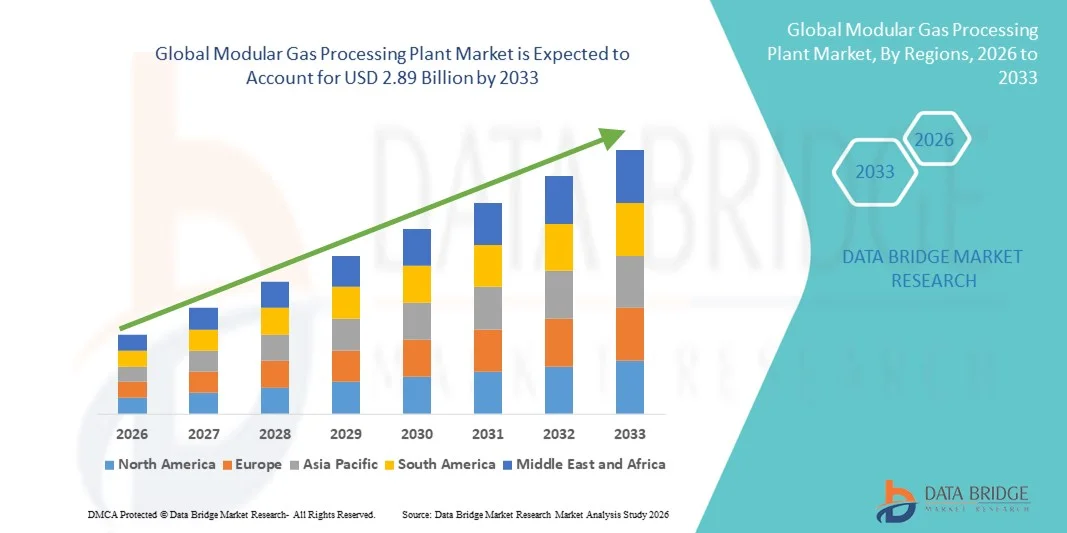
- The global modular gas processing plant market size was valued at USD 1.6 billion in 2025 and is expected to reach USD 2.89 billion by 2033, at a CAGR of 7.70% during the forecast period
- The market growth is largely fueled by increasing global demand for natural gas, the shift toward cleaner energy sources, and the rising adoption of modular, scalable, and cost-efficient gas processing solutions for both onshore and offshore applications
- Furthermore, technological advancements in modular plant design, including faster commissioning, automation, and remote monitoring capabilities, are enabling operators to achieve higher operational efficiency and lower capital expenditure. These converging factors are accelerating the uptake of modular gas processing plants, thereby significantly boosting the industry’s growth
Modular Gas Processing Plant Market Analysis
- Modular gas processing plants, offering compact, flexible, and scalable solutions for processing LNG, LPG, CNG, and other gases, are increasingly critical in both conventional and renewable energy projects due to their ability to reduce installation time, optimize operations, and support rapid deployment in remote or space-constrained locations
- The escalating demand for modular gas processing plants is primarily driven by global energy transition initiatives, growing industrial and transportation fuel requirements, and the need for cost-effective, efficient, and environmentally sustainable processing solutions across emerging and developed markets
- North America dominated the modular gas processing plant market with a share of 32.3% in 2025, due to the region’s advanced energy infrastructure, rising natural gas production, and growing investments in modular and scalable gas processing solutions
- Asia-Pacific is expected to be the fastest growing region in the modular gas processing plant market during the forecast period due to rising energy demand, rapid industrialization, and expanding natural gas production in countries such as China, India, and Japan
- Liquefied natural gas segment dominated the market with a market share of 46.1% in 2025, due to the rising global demand for natural gas as a cleaner energy source and the established infrastructure for LNG storage and transport. LNG processing plants are favored for their ability to handle large-scale production efficiently and their compatibility with international trade requirements
Report Scope and Modular Gas Processing Plant Market Segmentation
|
Attributes |
Modular Gas Processing Plant Key Market Insights |
|
Segments Covered |
|
|
Countries Covered |
North America
Europe
Asia-Pacific
Middle East and Africa
South America
|
|
Key Market Players |
|
|
Market Opportunities |
|
|
Value Added Data Infosets |
In addition to the insights on market scenarios such as market value, growth rate, segmentation, geographical coverage, and major players, the market reports curated by the Data Bridge Market Research also include import export analysis, production capacity overview, production consumption analysis, price trend analysis, climate change scenario, supply chain analysis, value chain analysis, raw material/consumables overview, vendor selection criteria, PESTLE Analysis, Porter Analysis, and regulatory framework. |
Modular Gas Processing Plant Market Trends
Rising Adoption of Modular and Scalable Gas Processing Solutions
- A significant trend in the modular gas processing plant market is the increasing adoption of modular and scalable solutions that allow faster deployment, flexible capacity expansion, and reduced on-site construction requirements. These solutions are becoming critical for meeting global energy demands efficiently and supporting smaller-scale natural gas projects in remote or offshore locations
- For instance, Technip Energies and Honeywell UOP provide modular gas processing units that are deployed in offshore and stranded gas projects, enabling rapid commissioning and operational flexibility. Such installations reduce construction time and lower logistical challenges in regions with limited infrastructure
- The growing focus on reducing environmental impact is driving the adoption of modular gas plants that incorporate cleaner processing technologies such as natural gas dehydration, NGL recovery, and CO₂ capture. These technologies help operators comply with stricter emission regulations while maintaining operational efficiency
- Operators are increasingly using modular plants for liquefied natural gas (LNG) production and midstream gas processing, enabling smaller operators to enter the market without large capital expenditures. This is enhancing accessibility and diversification in natural gas supply chains
- The energy transition and fluctuating global gas demand are encouraging companies to adopt plants that can be easily relocated or reconfigured to suit market requirements. Modular plants allow operators to adjust production capacity with minimal downtime and investment
- The market is witnessing increasing integration of automation and digital monitoring systems in modular gas processing plants, improving operational control, predictive maintenance, and safety standards. These advancements are strengthening process reliability and supporting long-term plant sustainability
Modular Gas Processing Plant Market Dynamics
Driver
Increasing Global Demand for Cleaner Energy and Natural Gas
- Rising global energy consumption and the shift toward cleaner fuels are driving the demand for natural gas processing solutions that ensure efficient production, transportation, and storage. Modular plants help operators quickly meet regional gas requirements while minimizing environmental impact
- For instance, Honeywell UOP supplies modular gas processing technologies that support small-scale LNG and natural gas projects worldwide, enabling operators to deliver cleaner energy efficiently. These solutions contribute to global energy diversification and help reduce dependency on traditional fossil fuels
- The push for decarbonization and regulatory compliance is encouraging the adoption of advanced processing units that can handle sulfur removal, CO₂ capture, and other emission-reducing operations. Modular plants allow incorporation of these technologies with lower capital and time investments
- The growing use of natural gas in power generation, transportation, and industrial applications is expanding the market for modular processing plants capable of scaling to meet demand fluctuations. Operators can adjust processing capacity without extensive infrastructure changes
- Governments and energy companies are incentivizing investments in modular and small-scale gas processing plants to improve regional energy security and accessibility. These drivers collectively increase adoption rates and market growth
Restraint/Challenge
High Capital Investment and Complex Regulatory Compliance
- Despite advantages, modular gas processing plants require substantial initial investment in engineering, fabrication, and deployment. The cost of high-performance materials, specialized equipment, and skilled labor adds to the overall project expenditure
- For instance, Technip Energies deploys modular LNG and NGL processing units that involve intricate design, compliance with international safety standards, and specialized installation, contributing to high upfront costs. These investments can limit adoption by smaller operators or projects with budget constraints
- Navigating complex local and international regulations, environmental approvals, and safety certifications can delay project timelines and increase operational challenges. Compliance with emission standards, safety protocols, and construction codes adds complexity to modular plant deployment
- Integration of advanced automation and digital control systems requires additional capital and technical expertise, which can be a barrier for some operators. The need to balance technological sophistication with economic feasibility remains a persistent challenge
- The market continues to face hurdles in optimizing modular plant deployment while ensuring cost-effectiveness, operational efficiency, and regulatory compliance. Addressing these challenges is critical for broader adoption and long-term growth of modular gas processing solutions
Modular Gas Processing Plant Market Scope
The market is segmented on the basis of gas type, type, and application.
- By Gas Type
On the basis of gas type, the modular gas processing plant market is segmented into liquefied natural gas (LNG), liquefied petroleum gas (LPG), compressed natural gas (CNG), and other types. The LNG segment dominated the market with the largest market revenue share of 46.1% in 2025, driven by the rising global demand for natural gas as a cleaner energy source and the established infrastructure for LNG storage and transport. LNG processing plants are favored for their ability to handle large-scale production efficiently and their compatibility with international trade requirements. The demand is also fueled by growing investments in LNG import-export terminals and the need for reliable, scalable processing solutions. Technological advancements in modular LNG plant designs enhance operational flexibility, reduce installation time, and optimize energy efficiency, reinforcing their market dominance.
The CNG segment is expected to witness the fastest growth rate from 2026 to 2033, propelled by increasing adoption in transportation and industrial applications. CNG plants are gaining traction due to their environmental benefits, lower carbon emissions, and government initiatives promoting cleaner fuels. The modular nature of these plants allows for rapid deployment and cost-effective scalability, catering to emerging urban and regional markets. Ease of integration with existing fuel infrastructure and growing demand for sustainable energy alternatives further drive the segment’s expansion.
- By Type
On the basis of type, the market is segmented into portable and stationary modular gas processing plants. The stationary segment dominated the market in 2025, accounting for the largest revenue share due to its suitability for large-scale operations and consistent output requirements. Stationary plants offer high processing capacities, robust safety standards, and long-term operational reliability, making them the preferred choice for established industrial and export-oriented facilities. Their fixed installations support advanced automation and remote monitoring systems, increasing operational efficiency. In addition, stationary plants benefit from economies of scale and established regulatory compliance frameworks, strengthening their position in the market.
The portable segment is projected to register the fastest growth from 2026 to 2033, driven by rising demand for flexible and rapidly deployable processing solutions. Portable plants are ideal for remote or temporary locations, enabling quick setup and minimal infrastructure requirements. Industries increasingly adopt portable units for exploration projects, emergency gas processing needs, and modular expansion of existing facilities. The compact design, combined with easy transportability and reduced commissioning time, makes portable plants highly attractive in emerging markets and areas with limited infrastructure.
- By Application
On the basis of application, the modular gas processing plant market is segmented into onshore and offshore applications. The onshore segment dominated the market in 2025, capturing the largest revenue share due to the ease of construction, lower operational costs, and greater accessibility for maintenance and monitoring. Onshore modular plants allow for rapid installation, scalability, and integration with existing pipelines and storage facilities. They are widely preferred in industrial hubs and energy-intensive regions where consistent gas supply is critical. Technological improvements in modular onshore designs enhance processing efficiency, reduce energy consumption, and ensure compliance with environmental regulations, further solidifying their market leadership.
The offshore segment is anticipated to witness the fastest growth rate from 2026 to 2033, driven by expanding offshore exploration and production activities. Offshore modular plants offer compact, adaptable solutions for gas processing at sea, reducing dependence on long-distance transportation to onshore facilities. Their modularity allows for efficient installation on platforms, minimizing downtime and supporting continuous operations in challenging marine environments. Increasing offshore investments, coupled with advancements in remote monitoring and automation, enhance the appeal of modular offshore plants in both developed and emerging markets.
Modular Gas Processing Plant Market Regional Analysis
- North America dominated the modular gas processing plant market with the largest revenue share of 32.3% in 2025, driven by the region’s advanced energy infrastructure, rising natural gas production, and growing investments in modular and scalable gas processing solutions
- Companies and operators in the region prioritize efficiency, safety, and rapid deployment offered by modular plants, enabling faster setup compared with conventional processing units
- This widespread adoption is further supported by government incentives for cleaner energy, technological expertise, and strong industrial demand, establishing modular gas processing plants as a preferred solution for both onshore and offshore operations
U.S. Modular Gas Processing Plant Market Insight
The U.S. modular gas processing plant market captured the largest revenue share in 2025 within North America, fueled by extensive shale gas exploration and increasing adoption of modular solutions for LNG, LPG, and CNG processing. Operators are focusing on faster project commissioning, cost efficiency, and reduced footprint offered by modular designs. Growing demand for cleaner fuels, coupled with advancements in automation and remote monitoring, is further boosting market growth. Moreover, investments in infrastructure for gas export and domestic energy security are driving the widespread implementation of modular gas processing technologies.
Europe Modular Gas Processing Plant Market Insight
The Europe market is projected to expand at a substantial CAGR throughout the forecast period, primarily driven by stringent environmental regulations, decarbonization initiatives, and the shift towards cleaner energy sources. Countries such as Germany, Norway, and the Netherlands are increasingly adopting modular gas processing solutions to optimize operations and reduce project timelines. The region’s focus on sustainable energy, energy security, and efficient processing methods is fostering market growth across industrial, commercial, and energy sectors.
U.K. Modular Gas Processing Plant Market Insight
The U.K. market is anticipated to grow at a noteworthy CAGR during the forecast period, driven by rising offshore gas production and the demand for rapid deployment of modular processing units. The government’s emphasis on energy efficiency, coupled with technological innovation in modular plant designs, supports the adoption of these systems. In addition, operators are leveraging compact, scalable solutions to meet regulatory compliance while optimizing operational costs.
Germany Modular Gas Processing Plant Market Insight
The Germany market is expected to expand at a considerable CAGR during the forecast period, fueled by the country’s commitment to sustainable energy, advanced industrial infrastructure, and focus on operational efficiency. Modular gas processing plants are increasingly preferred for onshore applications, providing flexibility, reduced installation time, and adaptability to fluctuating production requirements. Integration with advanced automation and monitoring systems is further encouraging adoption in both industrial and commercial sectors.
Asia-Pacific Modular Gas Processing Plant Market Insight
The Asia-Pacific market is poised to grow at the fastest CAGR during the forecast period of 2026 to 2033, driven by rising energy demand, rapid industrialization, and expanding natural gas production in countries such as China, India, and Japan. The adoption of modular gas processing plants is increasing due to their scalability, reduced capital expenditure, and faster commissioning compared with conventional plants. Government initiatives supporting LNG infrastructure, coupled with growing investments from domestic and international energy companies, are accelerating market growth.
Japan Modular Gas Processing Plant Market Insight
The Japan market is gaining momentum due to the country’s energy security focus, high demand for natural gas, and adoption of advanced, compact processing technologies. Modular plants are favored for their ability to support offshore and remote projects with minimal installation time. Japan’s integration of smart monitoring, automation, and energy-efficient solutions in modular plants is further driving adoption across industrial and commercial sectors.
China Modular Gas Processing Plant Market Insight
The China market accounted for the largest market revenue share in Asia-Pacific in 2025, attributed to the country’s growing natural gas consumption, expanding industrial base, and investments in modular LNG and CNG processing. Domestic manufacturers are increasingly offering cost-effective and technologically advanced modular solutions. The government’s push for cleaner energy, rapid urbanization, and development of smart energy infrastructure are key factors driving adoption across residential, commercial, and industrial applications in China.
Modular Gas Processing Plant Market Share
The modular gas processing plant industry is primarily led by well-established companies, including:
- Technip Energies (France)
- Honeywell International Inc. (U.S.)
- Peiyang Chemical Equipment Co. Ltd. (China)
- Siemens Energy AG (Germany)
- Black & Veatch (U.S.)
- Mitsubishi Heavy Industries Ltd (Japan)
- ABB Ltd (Switzerland)
- JGC Holdings Corporation (Japan)
- Doosan Enerbility Co. Ltd. (South Korea)
- Tata Projects (India)
- Fluor Corporation (U.S.)
- Linde Engineering (Germany)
- Bechtel Corporation (U.S.)
- Jacobs Solutions Inc. (U.S.)
- Worley Limited (Australia)
- Petrofac Limited (U.K.)
- General Electric Company (U.S.)
- McDermott International Ltd (U.S.)
- AtkinsRéalis Group Inc. (Canada)
- KBR Inc. (U.S.)
Latest Developments in Global Modular Gas Processing Plant Market
- In April 2024, Archaea Energy commissioned its largest original Archaea Modular Design (AMD) Renewable Natural Gas (RNG) facility in Shawnee, Kansas. The facility, situated adjacent to a major landfill, can process 9,600 standard cubic meters of landfill per minute into RNG, sufficient to heat approximately 38,000 homes annually. This development highlights the increasing adoption of modular designs in renewable natural gas production and demonstrates the scalability and efficiency of modular solutions for converting waste into clean energy. It reinforces market confidence in modular plants as viable options for both sustainability goals and rapid deployment in energy-intensive applications
- In April 2023, Strike Energy completed initial engineering work with Technip Energies for an affordable, modular, and scalable gas processing plant at the Mid-West Low Carbon Manufacturing Precinct. This facility, aligned with the commissioning of the South Erregulla gas field, exemplifies how modular designs enable cost-efficient, scalable solutions for new gas production sites. The development emphasizes the market trend toward flexible modular plants that can be rapidly deployed to support low-carbon and mid-scale operations, enhancing energy efficiency while minimizing capital expenditure
- In January 2023, GazSurf introduced a standard line of modular block units for gas processing, capable of implementing a complete technological chain from basic field gas setups to advanced facilities achieving over 90% recovery of liquid hydrocarbons and producing multiple end products. This innovation underscores the modular market’s push for standardization and efficiency, allowing operators to adopt plug-and-play solutions that reduce construction time, lower costs, and increase operational flexibility. The introduction of block-based modular units strengthens the market’s appeal for both onshore and offshore applications
- In April 2022, Modular Plant Solutions (MPS) announced a contract to support Arbor Renewable Gas in constructing the first-ever modularized green gasoline plant at the Spindletop site in Beaumont, Texas. The plant is designed to convert woody biomass, including forest residues, into carbon-negative green gasoline. This project demonstrates the growing role of modular solutions in supporting low-carbon fuel initiatives and the renewable energy segment, driving market interest in modular plants for sustainable and environmentally focused processing applications
- In October 2020, West Virginia Methanol Inc. completed a USD 350 million investment to build a modular plant in Pleasants County for producing ultrapure methanol from natural gas. The facility created 30 permanent jobs and also reinforced the viability of modular plants in producing high-purity chemicals efficiently. This development highlights the modular plant market’s impact on industrial-scale chemical processing, showcasing cost-effective, scalable solutions capable of supporting regional energy and industrial demands

- Interactive Data Analysis Dashboard
- Company Analysis Dashboard for high growth potential opportunities
- Research Analyst Access for customization & queries
- Competitor Analysis with Interactive dashboard
- Latest News, Updates & Trend analysis
- Harness the Power of Benchmark Analysis for Comprehensive Competitor Tracking
Data collection and base year analysis are done using data collection modules with large sample sizes. The stage includes obtaining market information or related data through various sources and strategies. It includes examining and planning all the data acquired from the past in advance. It likewise envelops the examination of information inconsistencies seen across different information sources. The market data is analysed and estimated using market statistical and coherent models. Also, market share analysis and key trend analysis are the major success factors in the market report. To know more, please request an analyst call or drop down your inquiry.
The key research methodology used by DBMR research team is data triangulation which involves data mining, analysis of the impact of data variables on the market and primary (industry expert) validation. Data models include Vendor Positioning Grid, Market Time Line Analysis, Market Overview and Guide, Company Positioning Grid, Patent Analysis, Pricing Analysis, Company Market Share Analysis, Standards of Measurement, Global versus Regional and Vendor Share Analysis. To know more about the research methodology, drop in an inquiry to speak to our industry experts.
Data Bridge Market Research is a leader in advanced formative research. We take pride in servicing our existing and new customers with data and analysis that match and suits their goal. The report can be customized to include price trend analysis of target brands understanding the market for additional countries (ask for the list of countries), clinical trial results data, literature review, refurbished market and product base analysis. Market analysis of target competitors can be analyzed from technology-based analysis to market portfolio strategies. We can add as many competitors that you require data about in the format and data style you are looking for. Our team of analysts can also provide you data in crude raw excel files pivot tables (Fact book) or can assist you in creating presentations from the data sets available in the report.