What is the Molded Fiber Electronics Packaging Market Size and Growth Rate?
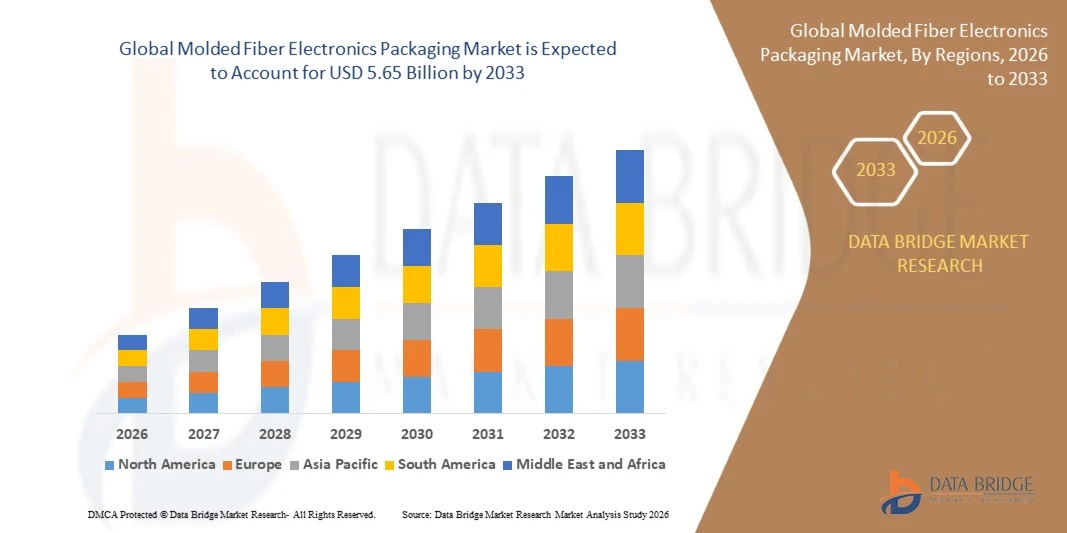
- As per Data Bridge Market Research analysis, the molded fiber electronics packaging market was valued at USD 3.85 billion in 2025 and is projected to reach USD 5.65 billion by 2033, growing at a CAGR of 9.40% from 2026 to 2033.
- The market is experiencing consistent growth driven by rising demand for sustainable electronics packaging, increasing adoption of recyclable and biodegradable materials, and expanding applications across smartphones, laptops, televisions, and other consumer electronics.
- Growing environmental concerns, combined with stricter regulations on plastic packaging and increasing corporate sustainability commitments, are encouraging electronics manufacturers to adopt molded fiber packaging solutions. Protective trays, inserts, and cushioning components are increasingly replacing conventional plastic foam packaging, offering recyclable, lightweight, and shock-absorbing solutions for the safe transportation and storage of electronic devices.
Market Size & Forecast
- Global Market Value (2025): USD 3.85 Billion
- Expected Market Value (2033): USD 5.65 Billion
- Forecast CAGR (2026–2033): 9.40%
- Leading Region in 2025: North America
- Fastest Growing Region: Asia Pacific
What are the Major Takeaways of the Molded Fiber Electronics Packaging Market?
- North America dominated the molded fiber electronics packaging market with the largest revenue share of 35.0% in 2025, supported by strong consumer electronics demand, growing adoption of sustainable packaging materials, and increasing investments in recyclable packaging solutions across the U.S., Canada, and Mexico.
- Asia-Pacific is expected to be the fastest-growing region at a CAGR of 10.5% from 2026 to 2033, fueled by expanding electronics manufacturing, rising environmental awareness, and increasing demand for sustainable packaging solutions in China, India, Japan, and South Korea.
- The recycled paper pulp segment led the market with a 45.0% share in 2025, driven by its wide availability, cost-effectiveness, and compatibility with sustainable packaging requirements.
- Bamboo pulp are the fastest-growing source material type, projected to register a CAGR of 6.0%, reflecting the surge in interest in renewable and alternative fiber sources
- The trays segment dominated the product type category with a 30.0% revenue share in 2025, led by widespread use in packaging smartphones, laptops, computer accessories, and other electronic products
- Transfer-molded fiber packaging accounted for 45% of the market share in 2025, preferred by its established manufacturing processes, cost-effectiveness, and ability to produce protective packaging with consistent dimensions.
- The gaming consoles and accessories segment is the fastest-growing application category, with a CAGR of 6.7%, driven by demand for protective packaging for consoles, controllers, headsets, and related electronic accessories.
Report Scope and Molded Fiber Electronics Packaging Market Segmentation
|
Attributes |
Molded Fiber Electronics Packaging Key Market Insights |
|
Segments Covered |
|
|
Countries Covered |
North America
Europe
Asia-Pacific
Middle East and Africa
South America
|
|
Key Market Players |
|
|
Market Opportunities |
|
|
Value Added Data Infosets |
In addition to the insights on market scenarios such as market value, growth rate, segmentation, geographical coverage, and major players, the market reports curated by the Data Bridge Market Research also include import export analysis, production capacity overview, production consumption analysis, price trend analysis, climate change scenario, supply chain analysis, value chain analysis, raw material/consumables overview, vendor selection criteria, PESTLE Analysis, Porter Analysis, and regulatory framework. |
What is the Key Trend in the Molded Fiber Electronics Packaging Market?
- Electronics manufacturers are increasingly adopting molded fiber packaging to reduce plastic consumption, improve recyclability, and support corporate sustainability targets while maintaining adequate protection for sensitive electronic products.
- For instance, in April 2026, Apple reported that it had completed its transition to 100% fiber-based packaging in 2025, replacing plastic trays, screen protectors, and other packaging components with recyclable fiber alternatives and avoiding more than 15,000 metric tons of plastic over five years.
- Advances in molded fiber design enable manufacturers to develop customized trays, inserts, and cushioning structures that protect electronic devices against impact, vibration, and damage during shipping.
- Electronics brands and packaging suppliers are also investing in recycled fibers, precision molding, and packaging designs that improve material efficiency while simplifying disposal and recycling.
- For instance, in April 2024, Apple announced that its first-ever 100% fiber-based packaging for the Apple Watch lineup and Apple Vision Pro had helped advance its plastic-reduction strategy, alongside work on fiber-based alternatives to protective foam.
- As electronics manufacturers continue prioritizing plastic reduction, recyclable materials, and efficient shipping designs, demand for molded fiber packaging is expected to increase, strengthening its position as an alternative to conventional plastic foam packaging.
What are the Key Drivers of the Molded Fiber Electronics Packaging Market?
- The increasing environmental concerns and stricter packaging regulations are encouraging electronics manufacturers to replace conventional plastic packaging with recyclable fiber-based alternatives that support circular-economy objectives.
- For instance, in June 2024, Google released its plastic-free packaging design guide, detailing the use of molded fiber trays, hang tabs, and other fiber-based alternatives for consumer electronics packaging. Google reported that it was 96% of the way toward eliminating plastic from its consumer hardware packaging in 2022.
- Rising global shipments of smartphones, computers, gaming devices, and other consumer electronics are increasing demand for lightweight, customized protective packaging that can withstand handling and transportation.
- Electronics manufacturers are integrating sustainable packaging into product development and supply-chain operations to reduce material waste, improve packaging efficiency, and meet environmental commitments.
- For instance, in December 2023, PulPac introduced a Dry Molded Fiber Phone Tray Insert, designed as a cost-effective, environmentally responsible alternative to conventional plastic and fiber-based packaging for mobile phones.
- As regulatory pressure, electronics production, and sustainability commitments continue to expand, molded fiber packaging is expected to gain traction as manufacturers seek recyclable protective materials and more resource-efficient packaging solutions.
What Factors are Challenging the Growth of the Molded Fiber Electronics Packaging Market?
- Molded fiber electronics packaging faces technical challenges related to moisture resistance, dimensional stability, surface smoothness, and precise fitting requirements for delicate electronic products.
- For instance, in July 2025, researchers published a study in BioResources examining molded fiber packaging made from sugarcane bagasse. The study highlighted limitations in moisture-barrier performance and manufacturing challenges associated with drying three-dimensional molded fiber products, which can restrict their use in applications requiring enhanced protection.
- These limitations can restrict its use in applications requiring high protection against humidity, electrostatic discharge, and demanding transportation conditions.
- Manufacturers must also invest in specialized molds, product-specific engineering, quality testing, and production processes to achieve consistent protective performance across different electronic device shapes and sizes.
- For instance, in October 2022, researchers published a study in Micromachines examining how moisture diffusion affects electronic packaging modules, demonstrating that humidity can increase internal stress and deformation and create reliability challenge
- The technical limitations and customization requirements associated with molded fiber packaging can increase development complexity and hinder adoption in applications requiring specialized protection. Overcoming these barriers through material innovation, improved molding processes, and rigorous product testing will be essential for broader adoption across the electronics packaging industry.
How is the Molded Fiber Electronics Packaging Market Segmented?
The molded fiber electronics packaging market is segmented on the basis of source material, product type, packaging type, and application.
- By Source Material
On the basis of source material, the molded fiber electronics packaging market is segmented into recycled paper pulp, virgin paper pulp, wood pulp, bamboo pulp, bagasse pulp, and mixed fiber pulp. The recycled paper pulp segment is expected to dominate the market with an estimated share of 45.0% in 2025, owing to its wide availability, cost-effectiveness, and compatibility with sustainable packaging requirements. Recycled paper fibers can be processed into protective trays, inserts, and cushioning components for electronic devices. Electronics manufacturers increasingly prefer recycled materials to reduce dependence on virgin resources and minimize packaging waste. The segment also benefits from established paper recycling infrastructure and the availability of recovered paper from commercial and household sources. Growing corporate commitments to reduce plastic packaging are further supporting demand.
The bamboo pulp segment is expected to witness the fastest growth at an estimated CAGR of 6.0% from 2026 to 2033, supported by increasing interest in renewable and alternative fiber sources. Bamboo grows relatively quickly compared with many conventional forestry resources, making it attractive for sustainable material development. Its fibers can be processed into molded packaging products for selected electronics applications. Growing investment in alternative fiber technologies is encouraging manufacturers to explore bamboo-based packaging formulations. Demand for diversified fiber sourcing is also increasing as companies seek to reduce reliance on conventional wood-based materials. Improvements in pulping and molding processes may further enhance the commercial feasibility of bamboo pulp packaging.
- By Product Type
On the basis of product type, the molded fiber electronics packaging market is segmented into trays, clamshells, inserts and cushioning, end caps, protective corner pads, and custom-molded components. The trays segment is expected to dominate the market with an estimated share of 30.0% in 2025, driven by widespread use in packaging smartphones, laptops, computer accessories, and other electronic products. Molded fiber trays help position devices securely and reduce movement during storage and transportation. Their customized compartments can accommodate products of different shapes and sizes. Trays can also replace plastic thermoformed inserts in selected packaging applications. Electronics manufacturers benefit from their lightweight construction and potential compatibility with paper recycling streams.
The custom-molded components segment is expected to witness the fastest growth at an estimated CAGR of 6.5% from 2026 to 2033, driven by demand for packaging tailored to increasingly diverse electronic product designs. These components can be engineered to accommodate irregular shapes, delicate surfaces, and product-specific protection requirements. Customized designs help minimize movement within packaging and reduce the risk of transit damage. Manufacturers can integrate several protective functions into a single molded fiber structure. The expansion of premium electronics, specialized accessories, and direct-to-consumer shipping is creating additional demand for product-specific packaging. Advances in mold design and manufacturing precision are improving customization possibilities.
- By Packaging Type
On the basis of packaging type, the molded fiber electronics packaging market is segmented into thick-wall molded fiber packaging, transfer-molded fiber packaging, thermoformed molded fiber packaging, and processed molded fiber packaging. The transfer-molded fiber packaging segment is expected to dominate the market with an estimated share of 45.0% in 2025, supported by its established manufacturing processes, cost-effectiveness, and ability to produce protective packaging with consistent dimensions. The process is suitable for manufacturing inserts, trays, and cushioning components for consumer electronics. Its versatility allows manufacturers to develop packaging for different device sizes and configurations. Transfer molding can also support large-scale production for electronics supply chains. Growing demand for recyclable alternatives to expanded polystyrene and plastic inserts further supports adoption.
The thermoformed molded fiber packaging segment is expected to witness the fastest growth at an estimated CAGR of 6.5% from 2026 to 2033, driven by demand for precise, smooth, and visually appealing protective packaging. Thermoforming can produce components with improved dimensional accuracy and surface finish compared with some conventional molded fiber formats. These characteristics are particularly valuable for premium electronic devices and retail-ready packaging. Manufacturers can create fitted compartments that improve product positioning and presentation. Growing demand for sustainable packaging that maintains a premium unboxing experience is supporting interest in thermoformed fiber solutions. Technological improvements are also helping expand design flexibility and manufacturing consistency.
- By Application
On the basis of application, the molded fiber electronics packaging market is segmented into smartphones and mobile devices, laptops and tablets, televisions and monitors, computer peripherals, audio and video equipment, cameras and imaging devices, gaming consoles and accessories, and other consumer electronics. The smartphones and mobile devices segment is expected to account for an estimated share of 30.0% in 2025, supported by substantial global device shipments and the need for compact, lightweight protective packaging. Molded fiber trays and inserts can secure smartphones and accessories during distribution. Electronics brands are increasingly seeking alternatives to plastic trays and protective components. The segment also benefits from packaging designs that accommodate charging cables, adapters, and other accessories. High product turnover and frequent device launches create recurring packaging demand.
The gaming consoles and accessories segment is expected to witness the fastest growth at an estimated CAGR of 6.7% from 2026 to 2033, driven by demand for protective packaging for consoles, controllers, headsets, and related electronic accessories. These products often require compartmentalized packaging to prevent movement and surface damage during shipping. Molded fiber components can be customized to accommodate different device shapes and accessory configurations. The expansion of online gaming hardware sales and direct-to-consumer distribution is increasing the importance of protective shipping materials. Manufacturers are also exploring recyclable packaging alternatives to reduce plastic waste. Customized molded fiber inserts can improve packaging organization while supporting sustainability objectives.
Which Region Holds the Largest Share of the Molded Fiber Electronics Packaging Market?
- North America dominated the molded fiber electronics packaging market with the largest revenue share of 35.0% in 2025, supported by strong consumer electronics demand, growing adoption of sustainable packaging materials, and increasing investments in recyclable packaging solutions across the U.S., Canada, and Mexico.
- The region also benefits from growing corporate sustainability commitments, rising demand for protective packaging in e-commerce shipments, and investments in plastic-free packaging alternatives. Increasing focus on reducing packaging waste and developing customized molded fiber solutions for smartphones, laptops, and other electronic devices continues to strengthen North America’s leadership position in the global market.
U.S. Molded Fiber Electronics Packaging Market Insight
The U.S. molded fiber electronics packaging market is witnessing steady growth due to rising demand for sustainable packaging solutions, increasing adoption of recyclable materials, and growing focus on reducing plastic waste. The country’s established consumer electronics industry, along with increasing demand for protective packaging for smartphones, laptops, and electronic components, is driving market expansion. In addition, growing corporate sustainability commitments and investments in customized molded fiber packaging solutions are accelerating adoption across electronics manufacturers and e-commerce businesses.
Asia-Pacific Molded Fiber Electronics Packaging Market Insight
The Asia-Pacific molded fiber electronics packaging market is expected to witness rapid growth, driven by expanding electronics manufacturing, rising consumer electronics demand, and increasing investments in sustainable packaging across countries such as China, India, and Japan. Growing awareness regarding environmental protection, rising adoption of recyclable packaging materials, and increasing demand for cost-effective protective solutions are supporting regional market expansion. In addition, the growing presence of electronics manufacturing hubs and export-oriented production facilities is accelerating the adoption of molded fiber packaging across consumer electronics applications.
Japan Molded Fiber Electronics Packaging Market Insight
The Japan molded fiber electronics packaging market is witnessing consistent growth due to rising investments in sustainable packaging technologies, advanced electronics manufacturing, and environmentally responsible product design. Electronics manufacturers are increasingly adopting molded fiber trays, inserts, and cushioning solutions to protect delicate components while reducing dependence on conventional plastic packaging. Moreover, increasing focus on material efficiency, recyclability, and high-quality packaging performance is further contributing to market growth.
China Molded Fiber Electronics Packaging Market Insight
The China molded fiber electronics packaging market is growing rapidly, driven by expanding electronics production, rising demand for consumer devices, and increasing focus on sustainable packaging alternatives. Growing adoption of molded fiber inserts and protective trays across smartphones, computers, and other electronic products is significantly boosting market demand. In addition, rising investments in recyclable packaging materials, increasing environmental awareness, and the country’s strong electronics manufacturing ecosystem are positioning China as a key growth market for molded fiber electronics packaging.
U.K. Molded Fiber Electronics Packaging Market Insight
The U.K. molded fiber electronics packaging market is experiencing steady growth, supported by rising adoption of recyclable packaging materials, increasing demand for sustainable electronics shipping solutions, and growing corporate commitments to reduce plastic waste. Increasing investments in innovative molded fiber designs and growing demand for protective packaging across consumer electronics and e-commerce applications are contributing to market growth. Furthermore, advancements in fiber molding technologies and greater emphasis on circular packaging practices are strengthening the adoption of molded fiber solutions across the U.K. electronics packaging industry.
Germany Molded Fiber Electronics Packaging Market Insight
The Germany molded fiber electronics packaging market is expanding steadily due to the country’s strong industrial base, advanced packaging capabilities, and increasing adoption of sustainable materials. Electronics manufacturers and packaging suppliers are increasingly utilizing molded fiber trays, inserts, and cushioning solutions to improve product protection and reduce reliance on plastic packaging. Continuous advancements in fiber-based packaging design, material performance, and recycling technologies, along with strong emphasis on environmental responsibility and resource efficiency, are further driving market growth in Germany.
Which are the Top Companies in Molded Fiber Electronics Packaging Market?
The molded fiber electronics packaging industry is primarily led by well-established companies, including:
- Molded Fiber Technologies (U.S.)
- Golden Arrow Packaging & Innovation (U.S.)
- Esen (China)
- buhl-paperform GmbH (Germany)
- PAPACKS GmbH (Germany)
- Pacific Pulp Molding, Inc. (U.S.)
- EnviroPAK Corporation (U.S.)
- UFP Technologies, Inc. (U.S.)
- Thermoform Engineered Quality, LLC (U.S.)
- Celluloses de la Loire (France)
- Pulp Moulded Products (Canada)
- Protopak Engineering Corporation (Canada)
- Keiding, Inc. (U.S.)
- Henry Molded Products, Inc. (U.S.)
- Sabert Corporation (U.S.)
- Genpak, LLC (U.S.)
- Brødrene Hartmann A/S (Denmark)
- Huhtamäki Oyj (Finland)
- Pro-Pac Packaging Limited (Australia)
- THECA (Türkiye)
What are Latest Developments in Molded Fiber Electronics Packaging Market?
- In July 2025, Lenovo highlighted the expansion of bamboo-fiber packaging for laptops and smartphones. The company reported that flagship products, including the ThinkPad X9 series and Motorola Razr 50d, were using bamboo-fiber packaging. This development reflects growing adoption of renewable molded-fiber alternatives in electronics packaging, helping reduce reliance on conventional plastic cushioning while maintaining product protection.
- In August 2024, Google announced that packaging for its Pixel, Fitbit, and Nest hardware had become completely plastic-free. The redesigned packaging uses a molded-fiber pulp formula made partly from recycled newspaper to protect devices, alongside recyclable paper materials and improved packaging structures. The development demonstrates how consumer electronics brands are incorporating fiber-based materials into packaging to reduce plastic use and improve recyclability.
- In April 2024, Apple announced progress in developing fiber-based alternatives to conventional protective packaging materials. As part of its sustainability initiatives, the company reported work with RISE Research Institutes of Sweden on a fiber-based alternative to protective foams used in packaging. The development highlights ongoing efforts to replace plastic-based cushioning with fiber materials that can help protect electronic products while supporting improved packaging sustainability.
- In December 2023, PulPac launched its Dry Molded Fiber Phone Tray Insert for mobile phone packaging. The product was developed to provide an alternative to conventional plastic inserts and support demand for more sustainable electronics packaging. By adding a ready-to-use phone tray to its Dry Molded Fiber portfolio, PulPac expanded the potential use of fiber-based materials in protective packaging for mobile devices.
- In April 2021, HP and Innofibre showcased advances in molded fiber packaging production and tooling technology. HP presented performance findings for its Molded Fiber Advanced Tooling Solution, highlighting improved precision, faster forming and drainage, and greater flexibility in producing customized molded fiber designs. The announcement also described the use of the technology by Eco Pulp to manufacture molded fiber inserts for electronic devices, demonstrating progress toward more efficient and adaptable fiber-based packaging production.

- Interactive Data Analysis Dashboard
- Company Analysis Dashboard for high growth potential opportunities
- Research Analyst Access for customization & queries
- Competitor Analysis with Interactive dashboard
- Latest News, Updates & Trend analysis
- Harness the Power of Benchmark Analysis for Comprehensive Competitor Tracking
Global Molded Fiber Electronics Packaging Market, Supply Chain Analysis and Ecosystem Framework
To support market growth and help clients navigate the impact of geopolitical shifts, DBMR has integrated in-depth supply chain analysis into its Global Molded Fiber Electronics Packaging Market research reports. This addition empowers clients to respond effectively to global changes affecting their industries. The supply chain analysis section includes detailed insights such as Global Molded Fiber Electronics Packaging Market consumption and production by country, price trend analysis, the impact of tariffs and geopolitical developments, and import and export trends by country and HSN code. It also highlights major suppliers with data on production capacity and company profiles, as well as key importers and exporters. In addition to research, DBMR offers specialized supply chain consulting services backed by over a decade of experience, providing solutions like supplier discovery, supplier risk assessment, price trend analysis, impact evaluation of inflation and trade route changes, and comprehensive market trend analysis.
Data collection and base year analysis are done using data collection modules with large sample sizes. The stage includes obtaining market information or related data through various sources and strategies. It includes examining and planning all the data acquired from the past in advance. It likewise envelops the examination of information inconsistencies seen across different information sources. The market data is analysed and estimated using market statistical and coherent models. Also, market share analysis and key trend analysis are the major success factors in the market report. To know more, please request an analyst call or drop down your inquiry.
The key research methodology used by DBMR research team is data triangulation which involves data mining, analysis of the impact of data variables on the market and primary (industry expert) validation. Data models include Vendor Positioning Grid, Market Time Line Analysis, Market Overview and Guide, Company Positioning Grid, Patent Analysis, Pricing Analysis, Company Market Share Analysis, Standards of Measurement, Global versus Regional and Vendor Share Analysis. To know more about the research methodology, drop in an inquiry to speak to our industry experts.
Data Bridge Market Research is a leader in advanced formative research. We take pride in servicing our existing and new customers with data and analysis that match and suits their goal. The report can be customized to include price trend analysis of target brands understanding the market for additional countries (ask for the list of countries), clinical trial results data, literature review, refurbished market and product base analysis. Market analysis of target competitors can be analyzed from technology-based analysis to market portfolio strategies. We can add as many competitors that you require data about in the format and data style you are looking for. Our team of analysts can also provide you data in crude raw excel files pivot tables (Fact book) or can assist you in creating presentations from the data sets available in the report.