


What is the Mooring Inspection Market Size and Overview?
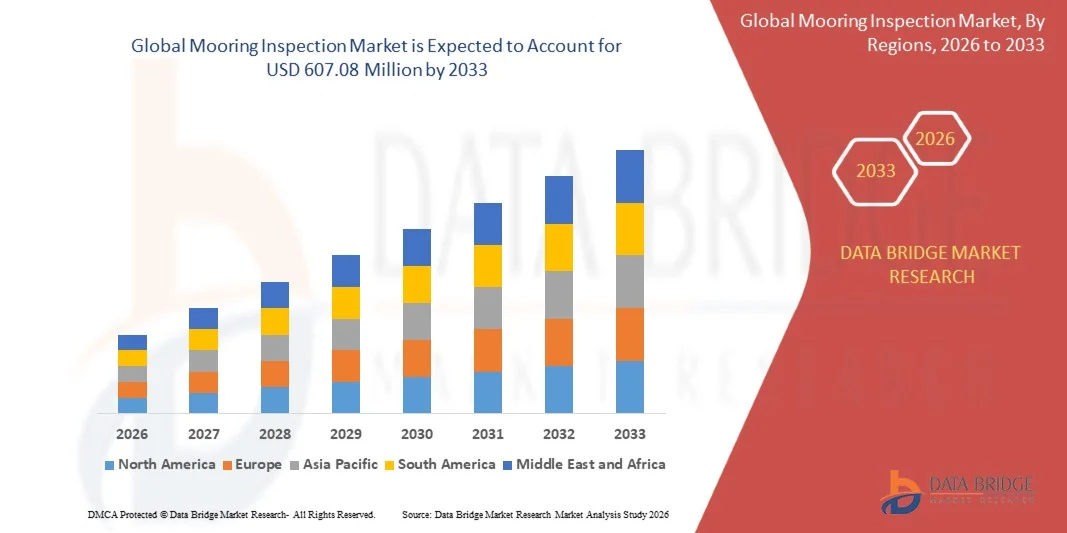
As per Data Bridge Market Research analysis, the mooring inspection market was valued at USD 443.59 million in 2025 and is projected to reach USD 607.08 million by 2033, growing at a CAGR of 4.00% from 2026 to 2033. The market is experiencing consistent growth driven by increasing demand for offshore asset integrity management, rising focus on maritime safety, strict regulatory requirements for maintaining mooring systems, and growing offshore oil and gas exploration activities. The increasing adoption of advanced inspection technologies, including close visual inspection, magnetic particle inspection, ultrasonic testing, and electromagnetic detection, to improve inspection accuracy and operational reliability.
The increasing complexity of offshore operations, combined with the need to minimize operational downtime, equipment failures, and safety risks, is compelling offshore operators, marine companies, and energy organizations to adopt advanced mooring inspection solutions. Regular inspection and maintenance procedures help identify defects such as corrosion, abrasion, fatigue damage, excessive tension, and component wear, enabling safer and more efficient offshore operations through reliable and risk-based inspection methods.
Market Size & Forecast
- Global Market Value (2025): USD 443.59 Million
- Expected Market Value (2033): USD 607.08 Million
- Forecast CAGR (2026–2033): 4.00%
- Leading Region in 2025: North America
- Fastest Growing Region: Asia Pacific
What are the Major Takeaways of Mooring Inspection Market?
- North America dominated the mooring inspection market with the largest revenue share of 34.8% in 2025, supported by advanced offshore oil and gas infrastructure, increasing focus on offshore asset integrity management, and growing adoption of inspection solutions for floating offshore platform
- The below water inspection (BWI) mooring inspection segment led the market with a 59.2% share in 2025, driven by the increasing requirement for underwater assessment of mooring chains, anchors, connectors, and submerged components of offshore structures
- Asia-Pacific is expected to be the fastest-growing region at a CAGR of 4.9% from 2026 to 2033, fueled by expanding offshore exploration activities, increasing investments in floating offshore infrastructure, and rising adoption of advanced marine inspection technologies across emerging economies
- Above water inspection (AWI) mooring inspection are the fastest-growing type, projected to register a CAGR of 3.5%, reflecting the surge in demand for inspection of accessible mooring components positioned above the waterline
- The close visual inspection segment dominated the technology category with a 34.7% revenue share in 2025, led by its widespread application in identifying visible defects in mooring systems.
- Oil industry accounted for 49.1% of the market, preferred by extensive adoption of mooring inspection services across offshore oil platforms, FPSOs, and deepwater production facilities
- The natural gas industry segment is the fastest-growing application category, with a CAGR of 4.5%, driven by increasing offshore natural gas exploration activities and rising investments in floating liquefied natural gas (FLNG) and offshore gas production facilities
Report Scope and Mooring Inspection Market Segmentation
Attributes |
Mooring Inspection Key Market Insights |
|
Segments Covered |
|
|
Countries Covered |
North America
Europe
Asia-Pacific
Middle East and Africa
South America
|
|
Key Market Players |
|
|
Market Opportunities |
|
|
Value Added Data Infosets |
In addition to the insights on market scenarios such as market value, growth rate, segmentation, geographical coverage, and major players, the market reports curated by the Data Bridge Market Research also include import export analysis, production capacity overview, production consumption analysis, price trend analysis, climate change scenario, supply chain analysis, value chain analysis, raw material/consumables overview, vendor selection criteria, PESTLE Analysis, Porter Analysis, and regulatory framework. |
What is the Key Trend in the Mooring Inspection Market?
Trend: Adoption of Advanced Remote Inspection Technologies
Offshore operators are increasingly adopting advanced mooring inspection technologies, including remotely operated vehicles (ROVs), autonomous underwater vehicles (AUVs), and digital monitoring systems, to improve inspection efficiency, reduce operational risks, and enhance asset integrity management. These technologies enable accurate assessment of submerged mooring components, identification of corrosion, fatigue, wear, and structural defects, while minimizing the need for divers and reducing inspection downtime. The integration of data analytics and condition-based monitoring is further supporting predictive maintenance strategies for offshore platforms, FPSOs, and floating renewable energy structures. For instance, in December 2024, Fugro announced the deployment of fully remote subsea inspection surveys for Petrobras in Brazil using Blue Essence uncrewed surface vessel and Blue Volta electric remotely operated vehicle technology, demonstrating the growing adoption of remote inspection solutions to improve offshore safety and efficiency.
The growing adoption of remote and digital inspection solutions is strengthening the mooring inspection market by enabling safer, faster, and more reliable offshore asset monitoring.
Mooring Inspection Market Dynamics
Key Market Driver: Increasing Offshore Oil & Gas and Floating Energy Development
The expansion of offshore oil and gas exploration activities and the rising deployment of floating offshore structures are major drivers accelerating demand for mooring inspection services. Offshore operators require regular inspection and maintenance of mooring lines, chains, anchors, and connectors to ensure structural reliability, regulatory compliance, and safe operation under harsh marine conditions. Growing investments in deepwater projects, FPSOs, floating production systems, and floating offshore wind platforms are increasing the need for advanced inspection technologies and asset integrity management solutions. For instance, in October 2024, the International Energy Agency (IEA) reported continued global expansion of renewable energy capacity, with offshore wind expected to experience significant growth through 2030, increasing the deployment of floating offshore structures and creating demand for reliable inspection and maintenance solutions
Rising offshore infrastructure investments and increasing focus on operational safety are creating sustained demand for advanced mooring inspection services globally.
Key Restraint/Challenge: High Cost and Operational Complexity of Inspection Activities
A significant challenge in the mooring inspection market is the high cost associated with offshore inspection operations, including specialized equipment, skilled personnel, vessel support, and advanced underwater technologies. Deepwater and harsh marine environments increase inspection complexity, requiring expensive ROV systems, diving operations, and advanced non-destructive testing methods. These cost pressures can limit adoption among smaller offshore operators and increase maintenance expenditure, particularly for aging offshore assets requiring frequent inspection and monitoring. For instance, in February 2024, the International Marine Contractors Association (IMCA) released the revised “The Safe and Efficient Operation of Remotely Operated Vehicles (IMCA R004)” guidance, highlighting the need for specialized ROV equipment, operational procedures, equipment maintenance, and competent personnel for safe offshore subsea operations, reflecting the technical complexity involved in offshore inspection activities.
High operational costs and technical complexities remain key barriers, requiring cost-effective digital solutions and automation to improve inspection accessibility and efficiency.
Key Market Opportunity: Integration of AI-Based Predictive Monitoring and Digital Twin Technologies
The integration of artificial intelligence, digital twins, and predictive analytics presents a significant opportunity for the mooring inspection market. AI-enabled inspection platforms can analyze real-time monitoring data, identify early signs of mooring system degradation, and support predictive maintenance decisions for offshore operators. The adoption of digital twin technology enables continuous simulation and performance assessment of mooring systems, improving reliability, reducing downtime, and optimizing lifecycle management of offshore assets. For instance, in December 2024, Offshore Renewable Energy (ORE) Catapult highlighted the use of artificial intelligence (AI) and digital technologies to improve offshore wind operations and maintenance by analysing live operational data, predicting component failures, and reducing operational risks and costs
AI-driven monitoring and digital twin solutions are expected to create new growth opportunities by transforming traditional inspection processes into data-driven asset integrity management systems.
How is the Mooring Inspection Market Segmented?
The mooring inspection market is segmented on the basis of type, technology, and application.
- By Type
On the basis of type, the mooring inspection market is segmented into below water inspection (BWI) mooring inspection and above water inspection (AWI) mooring inspection. The below water inspection (BWI) mooring inspection segment dominated the market with the largest share of 59.2% in 2025, owing to the increasing requirement for underwater assessment of mooring chains, anchors, connectors, and submerged components of offshore structures. BWI inspection is widely adopted across FPSOs, floating production systems, and offshore platforms due to its ability to detect corrosion, fatigue, wear, and structural degradation below the waterline. Increasing offshore oil and gas exploration activities and the growing deployment of deepwater assets are driving demand for underwater inspection solutions. The integration of remotely operated vehicles (ROVs), subsea measurement technologies, and non-destructive testing methods is improving inspection accuracy and operational safety. Growing focus on offshore asset integrity management and regulatory compliance is further strengthening the adoption of BWI solutions. The segment continues to maintain its leading position due to the critical requirement for reliable monitoring of underwater mooring systems.
The above water inspection (AWI) mooring inspection segment is projected to the fastest growth at a CAGR of 3.5% from 2026 to 2033, supported by increasing demand for inspection of accessible mooring components positioned above the waterline. AWI methods are used for evaluating visible sections of mooring systems, including fairleads, chain stoppers, and connection points, to identify corrosion, deformation, and surface-level damage. These inspection methods support preventive maintenance strategies by enabling early identification of defects before they affect offshore operations. Rising emphasis on offshore safety, maintenance optimization, and asset reliability is increasing adoption of AWI procedures. The segment is gaining importance with the expansion of floating offshore infrastructure and aging marine assets requiring regular condition assessment. Advancements in inspection tools and digital monitoring technologies are expected to create additional opportunities for AWI-based inspection services.
- By Technology
On the basis of technology, the mooring inspection market is segmented into close visual inspection, magnetic particle inspection, ROV based measurement, ultrasonic testing, 3-D modelling, optical chain measurement systems, rope measurement systems, electromagnetic detection, HD 3-D videos, subsea chain measurement caliper, and mooring line dimension measurement. The close visual inspection segment dominated the market with a 34.7% share in 2025, owing to its widespread application in identifying visible defects in mooring systems. Close visual inspection allows operators to assess corrosion, cracks, deformation, abrasion, and surface deterioration in mooring chains and associated components. The technology is extensively used because of its ability to provide direct condition assessment and reliable inspection results. Increasing offshore asset integrity requirements and preventive maintenance programs are supporting demand for visual inspection solutions. The method is frequently integrated with ROV-based systems to improve inspection coverage in underwater environments. Its cost-effectiveness, operational simplicity, and reliability continue to support its leading market position.
The ROV based measurement segment is projected to register the fastest growth at a CAGR of 5.0% from 2026 to 2033, driven by increasing adoption of remotely operated vehicles for underwater inspection activities. ROV-based measurement systems enable accurate assessment of mooring chains, anchors, and submerged components in deepwater and complex offshore environments while reducing dependence on diver-based inspection methods. These systems provide real-time imaging, measurement capabilities, and inspection data that improve offshore asset management decisions. Rising offshore exploration activities, increasing FPSO deployment, and expansion of floating offshore infrastructure are accelerating adoption of ROV technologies. Continuous improvements in underwater robotics, high-definition imaging, and sensor integration are enhancing inspection efficiency. Growing demand for safer, faster, and more reliable subsea inspection solutions is expected to support strong segment growth during the forecast period.
- By Application
On the basis of application, the mooring inspection market is segmented into natural gas industry, oil industry, robotics, aquaculture, and others. The oil industry segment dominated the market with a 49.1% share in 2025, supported by extensive adoption of mooring inspection services across offshore oil platforms, FPSOs, and deepwater production facilities. Offshore oil operators require regular inspection of mooring systems to ensure operational safety, prevent failures, and maintain compliance with offshore maintenance standards. Increasing offshore exploration and production activities are driving demand for advanced inspection technologies. The segment benefits from growing adoption of ROV-based inspection, non-destructive testing, and digital monitoring solutions. Aging offshore infrastructure and increasing focus on preventive maintenance are further strengthening demand for inspection services. Continued investments in offshore oil production assets are expected to maintain the segment’s dominant position globally.
The natural gas industry segment is projected to register the fastest growth at a CAGR of 4.5% from 2026 to 2033, driven by increasing offshore natural gas exploration activities and rising investments in floating liquefied natural gas (FLNG) and offshore gas production facilities. Mooring inspection solutions play an important role in ensuring the reliability and safety of floating gas infrastructure operating under challenging marine conditions. Growing global demand for natural gas is encouraging offshore gas field development, increasing the requirement for inspection and maintenance services. Adoption of advanced technologies, including ROV inspection, electromagnetic detection, and digital monitoring systems, is improving asset integrity management. Increasing focus on reducing operational downtime and enhancing offshore safety is supporting demand among natural gas operators. Expansion of offshore gas infrastructure and floating production facilities is expected to create significant opportunities for mooring inspection providers.
Mooring Inspection Market Regional Analysis
North America dominated the mooring inspection market with the largest revenue share of 34.8% in 2025, supported by advanced offshore oil and gas infrastructure, increasing focus on offshore asset integrity management, and growing adoption of inspection solutions for floating offshore platform. The region benefits from the presence of major offshore exploration activities, stringent safety regulations, and growing adoption of advanced inspection technologies, including remotely operated vehicles (ROVs), non-destructive testing, and digital monitoring solutions. Increasing deployment of predictive maintenance systems, subsea inspection technologies, and real-time condition monitoring platforms is accelerating market development. Growing emphasis on offshore operational safety, reduction of asset downtime, and improvement of maintenance efficiency continues to strengthen North America's leadership position in the global mooring inspection market.
U.S. Mooring Inspection Market Insight
The U.S. mooring inspection market is witnessing strong growth due to rising offshore oil and gas activities, increasing deployment of floating production systems, and growing demand for advanced subsea inspection technologies. The country’s established offshore energy infrastructure, along with increasing adoption of ROV-based inspection, non-destructive testing, and digital monitoring solutions, is driving demand across oil & gas, marine, and offshore renewable applications. In addition, growing emphasis on offshore safety regulations, asset integrity management, and reducing operational downtime is accelerating inspection adoption among offshore operators. The U.S. Gulf of Mexico remains one of the major offshore oil and gas production regions, with the Bureau of Safety and Environmental Enforcement (BSEE) implementing inspection and safety programs to improve offshore asset reliability and operational safety. The U.S. market growth is supported by extensive offshore infrastructure, strict safety standards, and increasing adoption of advanced mooring inspection technologies.
Europe Mooring Inspection Market Insight
The Europe mooring inspection market remains a major contributor to global revenue, driven by strong offshore renewable energy development, advanced marine engineering capabilities, and increasing demand for offshore asset integrity solutions. The widespread adoption of ROV-based inspection, subsea monitoring systems, and digital maintenance technologies across offshore wind, oil, and gas projects is supporting market expansion across the region. Increasing investments in floating offshore wind projects, coupled with strict maritime safety regulations and environmental standards, continue to enhance the adoption of mooring inspection solutions throughout Europe. According to the European Commission, offshore renewable energy development is a key priority under the EU Offshore Renewable Energy Strategy, with member states targeting significant offshore wind capacity expansion by 2050, increasing the need for reliable inspection and maintenance solutions. Europe’s offshore renewable expansion and strong regulatory framework will continue driving demand for advanced mooring inspection services.
U.K. Mooring Inspection Market Insight
The U.K. mooring inspection market is experiencing steady growth, supported by increasing offshore wind development, offshore oil and gas operations, and rising adoption of advanced subsea inspection technologies. Increasing investments in floating offshore wind infrastructure, ROV inspection systems, and predictive maintenance solutions are contributing to market growth. Furthermore, integration of digital monitoring technologies, robotics, and data-driven asset management solutions is improving inspection efficiency and operational reliability, positioning the U.K. as a key innovation hub in offshore inspection services. The U.K. government has set a target of achieving 50 GW of offshore wind capacity by 2030, including 5 GW of floating offshore wind, creating increased demand for offshore asset monitoring and maintenance solutions. The U.K. market is expected to benefit from offshore wind expansion and increasing adoption of advanced inspection technologies.
Germany Mooring Inspection Market Insight
The Germany mooring inspection market is expanding steadily due to the country’s strong offshore renewable energy sector, advanced engineering capabilities, and increasing adoption of marine monitoring technologies. Offshore wind operators and marine service providers are increasingly utilizing inspection solutions for mooring systems, subsea components, and floating structures to improve reliability and operational efficiency. Continuous advancements in digital monitoring, predictive maintenance, and offshore robotics technologies, along with strong government support for renewable energy development, are further driving market growth in Germany. Germany’s offshore wind capacity reached more than 8 GW, according to WindEurope, supporting continued demand for inspection and maintenance services for offshore infrastructure. Germany’s offshore renewable energy leadership and engineering expertise will continue supporting growth opportunities for the mooring inspection market
Asia-Pacific Mooring Inspection Market Insight
The Asia-Pacific mooring inspection market is expected to witness rapid growth, driven by increasing offshore oil and gas exploration, expanding floating infrastructure, and rising investments in offshore renewable energy projects across China, Japan, India, and Southeast Asia. Growing adoption of ROV-based inspection technologies, subsea monitoring systems, and digital asset management solutions is supporting regional market expansion. In addition, increasing offshore production activities, rising focus on maritime safety, and development of floating offshore wind projects are accelerating demand for advanced mooring inspection services. The International Energy Agency (IEA) reported continued expansion of offshore wind deployment in Asia-Pacific, particularly in China, increasing the requirement for reliable inspection and maintenance of offshore structures. Asia-Pacific is positioned as a high-growth region due to expanding offshore infrastructure and increasing investment in marine energy projects.
Japan Mooring Inspection Market Insight
The Japan mooring inspection market is witnessing consistent growth due to rising investments in offshore renewable energy, advanced marine technologies, and floating offshore infrastructure development. Energy companies and marine operators are increasingly adopting inspection solutions to ensure reliability of mooring systems, subsea components, and floating structures operating in challenging marine environments. Moreover, increasing integration of robotics, remote inspection technologies, and digital monitoring systems is improving inspection accuracy and operational efficiency. Japan’s focus on floating offshore wind development and marine technology innovation is further contributing to market growth. Japan’s Ministry of Economy, Trade and Industry (METI) has promoted offshore wind expansion as a major component of its renewable energy strategy, supporting development of offshore infrastructure requiring advanced inspection solutions. Japan’s offshore renewable energy initiatives and technology-driven marine sector will continue creating opportunities for mooring inspection providers.
China Mooring Inspection Market Insight
The China mooring inspection market is growing rapidly, driven by expanding offshore energy activities, increasing deployment of offshore wind farms, and rising government focus on marine infrastructure development. Growing adoption of ROV-based inspection, subsea monitoring technologies, and advanced marine robotics across offshore oil, gas, and renewable energy projects is significantly boosting market demand. In addition, rising investments in offshore wind capacity, increasing offshore engineering activities, and rapid technological advancements are positioning China as one of the fastest-growing markets for mooring inspection solutions globally. According to the Global Wind Energy Council (GWEC), China remained the world’s largest offshore wind market, accounting for approximately half of global cumulative offshore wind installations in 2024, increasing the requirement for offshore asset inspection and maintenance solutions. China’s large offshore infrastructure base and rapid offshore renewable expansion will continue driving demand for mooring inspection technologies.
Mooring Inspection Market Share
The mooring inspection industry is primarily led by well-established companies, including:
- Ashtead Technology (U.K.)
- Bureau Veritas (France)
- DNV (Norway)
- American Bureau of Shipping (U.S.)
- Intertek Group plc (U.K.)
- TÜV SÜD (Germany)
- TÜV NORD GROUP (Germany)
- RINA S.p.A. (Italy)
- Lloyd’s Register (U.K.)
- MISTRAS (U.S.)
- Oceaneering International, Inc. (U.S.)
- DeepOcean (Norway)
- DOF (Norway)
- Subsea 7 (Luxembourg)
- Fugro. (Netherlands)
- KONGSBERG (Norway)
- Kraken Robotics Inc. (Canada)
- Nexxis (Australia)
- Sonardyne (U.K.)
Latest Developments in Mooring Inspection Market
- In May 2024, Bureau Veritas granted Approval in Principle (AiP) to TotalEnergies’ Skipe V2 mooring integrity monitoring technology, designed to improve safety monitoring of floating offshore units. The technology uses a status-based detection method to identify potential mooring line failures by analyzing floating unit position and heading information. The solution supports continuous monitoring of mooring system integrity while improving operational reliability and reducing inspection-related risks. This approval demonstrates the growing importance of digital monitoring platforms in offshore mooring integrity management
- In April 2024, Kawasaki Heavy Industries announced the release of its Tension Monitoring System for Mooring Lines, designed to improve safety and operational efficiency in ship mooring operations. The system enables remote monitoring of mooring line tension, helping operators manage changes caused by tidal variations, cargo conditions, and environmental factors. The digital solution replaces traditional manual tension monitoring practices with real-time data-based management. This development highlights the increasing adoption of digital monitoring technologies for improving mooring safety and reducing operational risks in marine environments
- In April 2022, Ashtead Technology launched a new Optical Chain Measurement System (CMS) designed to improve accuracy and efficiency in subsea mooring chain inspection. The system uses high-resolution video and machine vision algorithms to provide accurate measurement of chain dimensions, corrosion, wear, and elongation between inspection surveys. The technology reduces inspection time compared with traditional measurement approaches while providing real-time results for offshore operators
- In July 2021, SBM Offshore received Technology Qualification from the American Bureau of Shipping (ABS) for its AI-powered Intelligent Agent Mooring Line Integrity Tool, designed to improve continuous monitoring of offshore mooring systems. The technology uses artificial intelligence and machine learning capabilities by combining operational data, including vessel position, heading, and environmental information, to detect potential mooring line failures and their locations
- In May 2021, Kraken Robotics announced its participation in the LifeMoor project, an industry collaboration focused on improving the lifetime assessment of subsea mooring chains used in offshore structures. The project aimed to develop advanced inspection and monitoring methods to improve understanding of mooring chain degradation mechanisms and extend asset operational life. Kraken Robotics contributed its subsea imaging and sensing expertise to support improved condition assessment of mooring systems

- Interactive Data Analysis Dashboard
- Company Analysis Dashboard for high growth potential opportunities
- Research Analyst Access for customization & queries
- Competitor Analysis with Interactive dashboard
- Latest News, Updates & Trend analysis
- Harness the Power of Benchmark Analysis for Comprehensive Competitor Tracking
Global Mooring Inspection Market, Supply Chain Analysis and Ecosystem Framework
To support market growth and help clients navigate the impact of geopolitical shifts, DBMR has integrated in-depth supply chain analysis into its Global Mooring Inspection Market research reports. This addition empowers clients to respond effectively to global changes affecting their industries. The supply chain analysis section includes detailed insights such as Global Mooring Inspection Market consumption and production by country, price trend analysis, the impact of tariffs and geopolitical developments, and import and export trends by country and HSN code. It also highlights major suppliers with data on production capacity and company profiles, as well as key importers and exporters. In addition to research, DBMR offers specialized supply chain consulting services backed by over a decade of experience, providing solutions like supplier discovery, supplier risk assessment, price trend analysis, impact evaluation of inflation and trade route changes, and comprehensive market trend analysis.
Data collection and base year analysis are done using data collection modules with large sample sizes. The stage includes obtaining market information or related data through various sources and strategies. It includes examining and planning all the data acquired from the past in advance. It likewise envelops the examination of information inconsistencies seen across different information sources. The market data is analysed and estimated using market statistical and coherent models. Also, market share analysis and key trend analysis are the major success factors in the market report. To know more, please request an analyst call or drop down your inquiry.
The key research methodology used by DBMR research team is data triangulation which involves data mining, analysis of the impact of data variables on the market and primary (industry expert) validation. Data models include Vendor Positioning Grid, Market Time Line Analysis, Market Overview and Guide, Company Positioning Grid, Patent Analysis, Pricing Analysis, Company Market Share Analysis, Standards of Measurement, Global versus Regional and Vendor Share Analysis. To know more about the research methodology, drop in an inquiry to speak to our industry experts.
Data Bridge Market Research is a leader in advanced formative research. We take pride in servicing our existing and new customers with data and analysis that match and suits their goal. The report can be customized to include price trend analysis of target brands understanding the market for additional countries (ask for the list of countries), clinical trial results data, literature review, refurbished market and product base analysis. Market analysis of target competitors can be analyzed from technology-based analysis to market portfolio strategies. We can add as many competitors that you require data about in the format and data style you are looking for. Our team of analysts can also provide you data in crude raw excel files pivot tables (Fact book) or can assist you in creating presentations from the data sets available in the report.













