


More Electric Aircraft Market Size
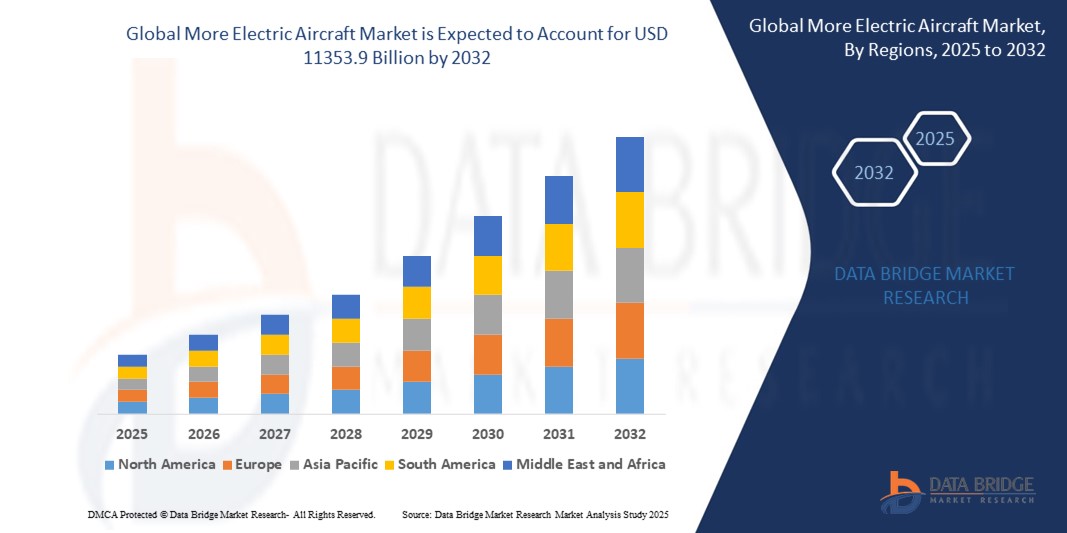
- The global more electric aircraft market was valued at USD 3167.85 billion in 2024 and is expected to reach USD 11353.9 billion by 2032
- During the forecast period of 2025 to 2032 the market is likely to grow at a CAGR of 17.30%, primarily driven by optimized aircraft performance
- This growth is driven by factors such as weight reduction, enhanced power management, and improved system efficiency
More Electric Aircraft Market Analysis
- More electric aircraft refers to the integration of electric power systems to replace traditional hydraulic, pneumatic, and mechanical systems in aircraft, aiming to enhance fuel efficiency, reduce emissions, lower maintenance costs, and improve overall aircraft performance. This shift supports advancements in both commercial and military aviation sectors
- Market growth is being driven by increasing demand for fuel-efficient and environmentally sustainable aircraft, rising pressure to comply with stringent emission regulations, and a growing focus on reducing the operational and lifecycle costs of aircraft
- The market is evolving with ongoing innovations in electric propulsion, energy storage systems, power electronics, and smart power distribution technologies that enhance the reliability, efficiency, and performance of aircraft electrical systems
- For instance, companies such as Airbus and Rolls-Royce are actively developing hybrid-electric propulsion systems and electric power distribution architectures for next-generation aircraft
- The more electric aircraft market is expected to witness consistent growth, supported by increasing investments in aerospace electrification, the rise of urban air mobility solutions, advancements in battery and energy management technologies, and government initiatives promoting greener aviation alternatives
Report Scope and More Electric Aircraft Market Segmentation
|
Attributes |
More Electric Aircraft Key Market Insights |
|
Segments Covered |
|
|
Countries Covered |
North America
Europe
Asia-Pacific
Middle East and Africa
South America
|
|
Key Market Players |
|
|
Market Opportunities |
|
|
Value Added Data Infosets |
In addition to the market insights such as market value, growth rate, market segments, geographical coverage, market players, and market scenario, the market report curated by the Data Bridge Market Research team includes in-depth expert analysis, import/export analysis, pricing analysis, production consumption analysis, and pestle analysis. |
More Electric Aircraft Market Trends
“Increasing Adoption of Hybrid-Electric Propulsion Systems”
- One prominent trend in the global more electric aircraft market is the increasing adoption of hybrid-electric propulsion systems
- This trend is driven by the growing need to reduce fuel consumption and carbon emissions, enhance energy efficiency, and meet stringent environmental regulations, particularly in the commercial aviation sector
- For instance, aerospace leaders such as Airbus, Boeing, and Rolls-Royce are actively investing in hybrid-electric aircraft programs that integrate conventional engines with electric motors to achieve optimized performance and lower environmental impact
- The advancement of lightweight batteries, high-power electric motors, and intelligent energy management systems is accelerating the development and feasibility of hybrid-electric aircraft across both regional and urban air mobility applications
- As the aviation industry intensifies efforts toward sustainability and cost-efficiency, hybrid-electric propulsion is expected to play a pivotal role in shaping the future of next-generation aircraft by bridging the gap between traditional and fully electric platforms
More Electric Aircraft Market Dynamics
Driver
“Demand for Fuel Efficiency and Reduced Emissions”
- The growing demand for fuel efficiency and reduced carbon emissions is a major driver of growth in the global more electric aircraft market
- This trend is particularly significant in commercial aviation, where airlines are under pressure to lower operational costs and comply with increasingly stringent international environmental regulations
- By replacing traditional hydraulic and pneumatic systems with electric alternatives, more electric aircraft help reduce overall aircraft weight and fuel consumption, contributing to lower greenhouse gas emissions and improved environmental performance
- Key benefits such as reduced maintenance needs, improved energy conversion efficiency, and minimized fuel burn are reshaping aircraft design strategies and fleet modernization priorities
- Aerospace manufacturers and suppliers are responding by accelerating the development of electric subsystems, power management technologies, and lightweight components that support sustainable and efficient aircraft operations
For instance,
- Airbus' A350 XWB and Boeing's 787 Dreamliner already incorporate MEA technologies to achieve better fuel economy and lower emissions compared to their predecessors
- Rolls-Royce and Safran are investing in electric propulsion and next-generation power systems that align with global carbon neutrality goals
- As the aviation industry moves toward greener skies, the focus on fuel savings and environmental responsibility will continue to propel the adoption of more electric aircraft technologies across both civil and military sectors
Opportunity
“Expansion of Advanced Power Electronic Components”
- The expansion of advanced power electronic components presents a significant opportunity in the more electric aircraft market. These components are essential for enabling efficient power conversion, distribution, and control within electric aircraft systems
- Technological progress in high-power density converters, wide bandgap semiconductors (such as SiC and GaN), and integrated power modules is allowing aircraft to handle higher electrical loads with improved efficiency and reliability
- Features such as compact design, thermal management, high switching frequencies, and improved voltage handling are critical for optimizing performance in electric subsystems including actuators, motors, and avionics
For instance,
- Companies such as GE Aviation and Collins Aerospace are advancing high-voltage power distribution systems and modular power electronics tailored for MEA platforms
- Infineon Technologies and Mitsubishi Electric are developing next-gen semiconductors for aerospace applications, focusing on weight reduction, heat tolerance, and power efficiency
- As demand grows for lighter, more efficient aircraft systems capable of supporting electrification, investment in power electronics innovation is poised to unlock new performance capabilities and accelerate the global transition to electric aviation
Restraint/Challenge
“Battery Energy Density and Weight Limitations”
- Battery energy density and weight limitations present a significant challenge for the more electric aircraft market. Despite the push toward electrification, current battery technologies lack the energy-to-weight efficiency required for long-range and large-scale aviation applications
- This challenge is particularly evident in commercial and regional aircraft segments, where power demands are high and strict weight constraints significantly impact range, payload, and overall aircraft performance
- Low energy density limits the flight duration and scalability of electric propulsion systems, while added battery weight reduces fuel savings and efficiency gains expected from MEA adoption
For instance,
- Lithium-ion batteries, though widely used, are not yet capable of supporting long-haul flights or high-power systems without compromising aircraft design and safety
- Without major breakthroughs in battery technology, the full potential of More Electric Aircraft may be delayed, posing a critical obstacle to achieving long-range, zero-emission aviation and meeting the industry’s ambitious sustainability targets
More Electric Aircraft Market Scope
The market is segmented on the basis of aircraft system, component, application, aircraft type, and end user.
|
Segmentation |
Sub-Segmentation |
|
By Aircraft System |
|
|
By Component |
|
|
By Application |
|
|
By Aircraft Type
|
|
|
By End User |
|
More Electric Aircraft Market Regional Analysis
“Europe is the Dominant Region in the More Electric Aircraft Market”
- Europe dominates the more electric aircraft market, driven by he strict governing guidelines and regulations aimed at reducing carbon emissions and improving aviation sustainability
- Countries such as U.K., Germany, and France are leading the charge in these efforts, with robust policies and funding to support electric aircraft development and deployment
- Notably, the European aviation ecosystem benefits from collaborations between leading aircraft manufacturers such as Airbus, and electric propulsion companies, propelling research and development for electric aircraft solutions
- With an increasing focus on reducing carbon emissions, rising consumer demand for sustainable air travel, and significant investments in electric aviation infrastructure, Europe is expected to maintain its dominance in the more electric aircraft market through the forecast period (2025-2032)
“North America is Projected to Register the Highest Growth Rate”
- North America is expected to witness the highest growth rate in the more electric aircraft market, driven by presence of leading aircraft manufacturers and aerospace giants such as Boeing, Lockheed Martin, and Honeywell, which are actively engaged in developing electric and hybrid-electric aircraft
- U.S., in particular, is heavily investing in electrification initiatives for both civilian and military aircraft, with notable projects such as the U.S. Department of Defense's hybrid-electric propulsion programs and NASA's Sustainable Flight National Partnership
- North America's significant technological infrastructure and focus on adopting sustainable practices in the aviation industry is accelerating the development and deployment of electric aircraft technologies. The growth of urban air mobility (UAM) and electric vertical take-off and landing (eVTOL) aircraft further contributes to the market's expansion
- Moreover, the region’s focus on decarbonizing aviation, alongside increasing funding for R&D in clean technologies, ensures strong market growth from 2025 to 2032. North America’s emphasis on eco-friendly technologies and its established leadership in the aviation industry positions it for the fastest growth in the more electric aircraft market during the forecast period.
More Electric Aircraft Market Share
The market competitive landscape provides details by competitor. Details included are company overview, company financials, revenue generated, market potential, investment in research and development, new market initiatives, global presence, production sites and facilities, production capacities, company strengths and weaknesses, product launch, product width and breadth, application dominance. The above data points provided are only related to the companies' focus related to market.
The Major Market Leaders Operating in the Market Are:
- AMETEK, Inc. (U.S.)
- Safran S.A. (France)
- Astronics Corporation (U.S.)
- Amphenol Corporation (U.S.)
- Honeywell International Inc. (U.S.)
- Thales Group (France)
- The Boeing Company (U.S.)
- Airbus (France)
- Lockheed Martin Corporation (U.S.)
- Textron Inc. (U.S.)
- Elbit Systems Ltd. (Israel)
- RTX (U.S.)
- General Electric Company (U.S.)
- Moog Inc. (U.S.)
- Parker Hannifin Corporation (U.S.)
- Eaton Corporation plc (Ireland)
- BAE Systems plc (U.K.)
- Rolls-Royce plc (U.K.)
Latest Developments in Global More Electric Aircraft Market
- In April 2025, Daher Aircraft announced that insights gained from the EcoPulse demonstrator are guiding its practical strategy toward developing a "more electric" aircraft, expected to launch in 2027. According to CEO Nicolas Chabbert at the Sun ’n Fun Aerospace Expo, this move is expected to significantly strengthen Daher’s position in the more electric aircraft market by aligning with industry demand for sustainable aviation solutions and accelerating its competitive edge in next-generation aircraft innovation

- Interactive Data Analysis Dashboard
- Company Analysis Dashboard for high growth potential opportunities
- Research Analyst Access for customization & queries
- Competitor Analysis with Interactive dashboard
- Latest News, Updates & Trend analysis
- Harness the Power of Benchmark Analysis for Comprehensive Competitor Tracking
Data collection and base year analysis are done using data collection modules with large sample sizes. The stage includes obtaining market information or related data through various sources and strategies. It includes examining and planning all the data acquired from the past in advance. It likewise envelops the examination of information inconsistencies seen across different information sources. The market data is analysed and estimated using market statistical and coherent models. Also, market share analysis and key trend analysis are the major success factors in the market report. To know more, please request an analyst call or drop down your inquiry.
The key research methodology used by DBMR research team is data triangulation which involves data mining, analysis of the impact of data variables on the market and primary (industry expert) validation. Data models include Vendor Positioning Grid, Market Time Line Analysis, Market Overview and Guide, Company Positioning Grid, Patent Analysis, Pricing Analysis, Company Market Share Analysis, Standards of Measurement, Global versus Regional and Vendor Share Analysis. To know more about the research methodology, drop in an inquiry to speak to our industry experts.
Data Bridge Market Research is a leader in advanced formative research. We take pride in servicing our existing and new customers with data and analysis that match and suits their goal. The report can be customized to include price trend analysis of target brands understanding the market for additional countries (ask for the list of countries), clinical trial results data, literature review, refurbished market and product base analysis. Market analysis of target competitors can be analyzed from technology-based analysis to market portfolio strategies. We can add as many competitors that you require data about in the format and data style you are looking for. Our team of analysts can also provide you data in crude raw excel files pivot tables (Fact book) or can assist you in creating presentations from the data sets available in the report.













