


What is the Motor Grader Market Size and Growth Rate?
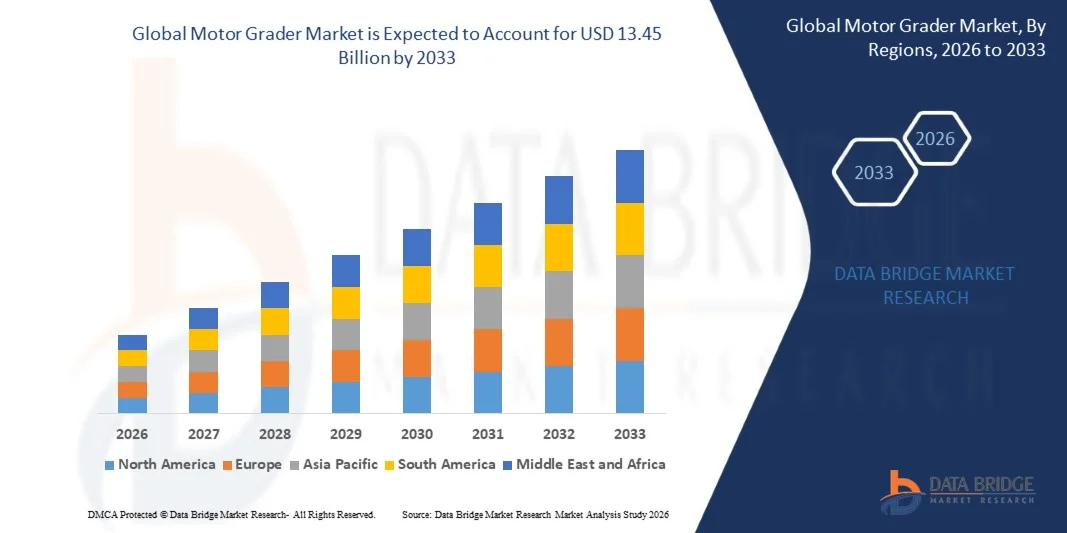
- As per Data Bridge Market Research analysis, the motor grader market was valued at USD 8.70 billion in 2025 and is projected to reach USD 13.45 billion by 2033, growing at a CAGR of 5.60% from 2026 to 2033.
- The market is expanding on the back of sustained public infrastructure spending, large-scale road and highway development across emerging economies, steady replacement demand in mature markets, and rising haul road maintenance activity in surface mining.
- Motor graders are self-propelled earthmoving machines fitted with an adjustable moldboard positioned between the front and rear axles, used to create a flat, precisely sloped surface during road construction, haul road maintenance, site preparation, land levelling, and snow clearing. Their commercial relevance is being reshaped by the rapid adoption of 3D GNSS machine control, which reduces the reliance on highly experienced operators and cuts rework, and by the early emergence of battery electric and hybrid variants intended for emission-regulated mining and urban worksites.
Market Size & Forecast
- Global Market Value (2025): USD 8.70 Billion
- Expected Market Value (2033): USD 13.45 Billion
- Forecast CAGR (2026–2033): 5.60%
- Leading Region in 2025: Asia-Pacific
- Fastest Growing Region: Middle East and Africa
What are the Major Takeaways of the Motor Grader Market?
- Asia-Pacific dominated the global motor grader market with the largest revenue share of 38.74% in 2025, supported by extensive highway and rural road programmes in China and India, large domestic manufacturing bases, and sustained mining activity across Australia and Indonesia.
- The Middle East and Africa is expected to be the fastest-growing region at a CAGR of 7.3% from 2026 to 2033, driven by large-scale giga-project construction in Saudi Arabia and the U.A.E., expanding road networks across Africa, and growing mining investment in the region.
- The medium motor graders segment led the market with a 46.32% share in 2025, owing to its versatility across road construction, municipal maintenance, and general site preparation, and its favourable balance of purchase cost, transportability, and productivity.
- Large motor graders are the fastest-growing product type, projected to register a CAGR of 6.4%, reflecting the growth of surface mining haul road maintenance where higher operating weight and blade downforce directly determine productivity.
- The articulated frame segment dominated the frame type category with a 64.18% revenue share in 2025, favoured for its tighter turning radius, crab-steering capability, and superior performance in confined and irregular grading applications.
- Diesel propulsion accounted for 91.27% of the market in 2025, but battery electric motor graders represent the fastest-growing propulsion segment at a CAGR of 14.6%, albeit from a very small installed base.
- The 3D GNSS machine control segment is the fastest-growing control technology category, with a CAGR of 9.2%, driven by operator shortages, rising accuracy requirements, and the increasing availability of factory-integrated grade control.
Report Scope and Motor Grader Market Segmentation
|
Attributes |
Motor Grader Key Market Insights |
|
Segments Covered |
|
|
Countries Covered |
North America
Europe
Asia-Pacific
Middle East and Africa
South America
|
|
Key Market Players |
|
|
Market Opportunities |
|
|
Value Added Data Infosets |
In addition to the market insights such as market value, growth rate, market segments, geographical coverage, market players, and market scenario, the market report curated by the Data Bridge Market Research team includes in-depth expert analysis, import/export analysis, pricing analysis, production consumption analysis, and pestle analysis. |
What is the Key Trend in the Motor Grader Market?
- Machine control and automation are moving from optional aftermarket attachments to factory-integrated standard equipment, reshaping how motor graders are specified, operated, and valued.
- Grading is among the most skill-intensive tasks on a jobsite, and a persistent shortage of experienced grader operators has made automated blade control a direct productivity and cost solution rather than a technology upgrade.
- For instance, in March 2026, John Deere unveiled its new SmartGrade motor grader portfolio at ConExpo 2026, spanning the 620, 622, 670, 672, 722, 770, 870, and 872 P-Tier models, moving the company’s full grader line from the G Series to its Tier naming system and embedding automated grade control across the range.
- Manufacturers are simultaneously redesigning operator interfaces and cabs to lower the skill threshold required to run the machine productively.
- For instance, in December 2025, Caterpillar added a joystick control option to the next-generation Cat 140 motor grader, allowing customers globally to select either dual joystick controls or a conventional lever and steering wheel configuration, after the joystick variant first appeared at Bauma 2025.
- As machine control penetration deepens and control interfaces continue to simplify, the value proposition of a motor grader is shifting from raw horsepower and blade size toward achieved accuracy, reduced rework, and the ability to deploy less experienced operators productively.
What are the Key Drivers of the Motor Grader Market?
- Sustained government investment in road, highway, and rural connectivity programmes is the principal demand driver, since motor graders are essential to subgrade preparation, base course finishing, and the ongoing maintenance of unpaved and gravel road networks.
- Surface mining operations generate continuous, non-discretionary demand for haul road maintenance, where road condition directly determines truck cycle times, tyre life, and fuel consumption, making grader availability a core operating requirement rather than a capital preference.
- For instance, in January 2024, Komatsu introduced the GD955-7 to the North American market as its largest motor grader for the region, delivering 426 horsepower, an 18-foot moldboard, and a 104,323-pound operating weight representing a 50% increase over its predecessor, specifically to build and maintain haul roads for truck fleets of 100 tons and above.
- Manufacturers are broadening their model ranges to capture demand in power classes and applications previously served by only one or two suppliers, intensifying competition and widening customer access.
- For instance, in March 2026, CASE Construction Equipment announced three new GR Series grader models to enter the 200-plus horsepower segment, complementing its existing lineup and targeting heavy road work, snow removal, and large-site preparation, with the machines configured to integrate with Trimble, Topcon, and Leica grade control systems and deliveries scheduled to begin in the fourth quarter of 2026.
- With infrastructure pipelines committed across Asia-Pacific, the Middle East, and North America, and with mining output supported by demand for construction and battery materials, motor grader demand is expected to remain structurally supported throughout the forecast period.
Which Factors are Challenging the Growth of the Motor Grader Market?
- Motor graders carry high capital cost relative to their utilization rate, since many contractors require a grader only intermittently across a project cycle, which weakens the ownership case compared with excavators or loaders that work continuously.
- This utilization gap pushes a significant share of demand into the rental and used equipment channels, compressing new unit sales volumes and lengthening replacement cycles, particularly among small and mid-sized contractors in price-sensitive markets.
- Electrification of motor graders is also constrained by the duty cycle itself, as grading demands sustained high-load traction and hydraulic power over long shifts in remote locations, where charging infrastructure is typically absent.
- For instance, in March 2023, Vale signed a memorandum of understanding with XCMG to co-develop what was described as the world’s first zero-emission motor grader for mining, with testing planned at mine sites in Minas Gerais and Pará in Brazil, illustrating that zero-emission grading remains at the pilot and validation stage rather than at commercial scale even among the largest fleet operators.
- High acquisition cost, intermittent utilization, a mature and well-supplied used equipment market, and the technical difficulty of electrifying a continuous high-load duty cycle continue to restrain volume growth. These factors are expected to keep the market on a moderate growth trajectory rather than the faster expansion seen in more frequently utilized equipment categories.
How is the Motor Grader Market Segmented?
The motor grader market is segmented on the basis of product type, frame type, operating weight, power output, drive type, propulsion, control technology, application, end user and sales channel.
- By Product Type
On the basis of product type, the market is segmented into small motor graders, medium motor graders, and large motor graders. The medium motor graders segment dominated the market with a 46.32% share in 2025, owing to its versatility across road construction, municipal maintenance, site preparation, and snow clearing, and its favourable balance of purchase price, transportability between jobsites, and blade productivity. This class also represents the highest-volume segment for most global manufacturers, supported by the broadest dealer inventory and the deepest used equipment market.
The large motor graders segment is projected to register the fastest growth at a CAGR of 6.4% from 2026 to 2033, driven by expansion in surface mining, where higher operating weight, greater blade downforce, and longer moldboards determine the productivity of haul road maintenance. Rising mining output and the trend toward larger haul truck fleets are directly increasing demand for graders in the highest size classes.
- By Frame Type
On the basis of frame type, the market is segmented into articulated frame and rigid frame. The articulated frame segment led the market with a 64.18% share in 2025, supported by a tighter turning radius, crab-steering capability that allows the machine to offset its rear frame during bank cutting and ditching, and superior manoeuvrability in confined and irregular working areas, all of which have made articulation the standard configuration in modern grader design.
The rigid frame segment is expected to grow at a CAGR of 5.9% from 2026 to 2033, supported by demand for simpler, lower-cost machines in municipal snow removal, light maintenance grading, and agricultural land levelling, where the additional complexity, cost, and maintenance burden of an articulation joint is difficult to justify.
- By Operating Weight
On the basis of operating weight, the market is segmented into up to 15 tons, 15–25 tons, 25–35 tons, and above 35 tons. The 15–25 tons segment dominated the market with a share of 48.51% in 2025, as this weight class aligns with the most widely specified road construction and maintenance machines, offering sufficient blade downforce for most subgrade and base course work while remaining transportable on standard lowboy trailers.
The above 35 tons segment is anticipated to witness the fastest CAGR of 6.7% from 2026 to 2033, driven by mining haul road applications where machine mass is the primary determinant of cutting performance in compacted and rock-laden surfaces. Manufacturers have increased the top end of their weight ranges specifically to serve fleets operating large-capacity haul trucks.
- By Power Output
On the basis of power output, the market is segmented into below 150 HP, 150–250 HP, 250–350 HP, and above 350 HP. The 150–250 HP segment dominated the market with a share of 43.56% in 2025, reflecting its position as the core power band for general road construction, highway maintenance, and municipal applications, and the concentration of the highest-volume model lines from every major manufacturer within this range.
The above 350 HP segment is expected to witness the fastest CAGR of 6.8% from 2026 to 2033, driven by mining-specification machines and large-scale earthworks where sustained high traction and hydraulic power are required. Recent product introductions in this class have extended power ratings well beyond 400 horsepower to serve large haul road fleets.
- By Drive Type
On the basis of drive type, the market is segmented into rear-wheel drive and all-wheel drive. The rear-wheel drive segment dominated the market with a share of 61.44% in 2025, owing to its lower purchase price, simpler drivetrain, reduced maintenance requirement, and adequate traction for the majority of conventional road construction and maintenance applications.
The all-wheel drive segment is expected to witness the fastest CAGR of 6.9% from 2026 to 2033, driven by demand for improved traction in soft ground, snow clearing, steep gradient work, and fine finishing applications where front-wheel assist improves blade control. Major manufacturers now routinely offer all-wheel drive as a configurable option across their core model lines.
- By Propulsion
On the basis of propulsion, the market is segmented into diesel, battery electric, hybrid, and alternative fuel. The diesel segment dominated the market with a share of 91.27% in 2025, reflecting the sustained power density, refuelling flexibility, and remote-site suitability that diesel engines provide for continuous high-load grading duty cycles.
The battery electric segment is expected to witness the fastest CAGR of 14.6% from 2026 to 2033, albeit from a very small installed base, driven by emissions regulation at urban worksites, underground and enclosed operations, and mining operators pursuing decarbonisation targets. Commercial availability remains limited to a small number of models and pilot deployments.
- By Control Technology
On the basis of control technology, the market is segmented into conventional manual control, 2D grade control, 3D GNSS machine control, and remote-operated & autonomous control. The conventional manual control segment dominated the market with a share of 52.38% in 2025, reflecting the large installed base of older machines, the prevalence of manual operation in maintenance and snow clearing work, and the continued cost sensitivity of smaller contractors.
The 3D GNSS machine control segment is expected to witness the fastest CAGR of 9.2% from 2026 to 2033, driven by shortages of experienced grader operators, tightening tolerance requirements on infrastructure projects, and the shift by manufacturers toward factory-integrated rather than aftermarket-retrofitted grade control systems.
- By Application
On the basis of application, the market is segmented into road construction & maintenance, mining & quarrying, snow removal, agriculture & land levelling, and landfill & site preparation. The road construction & maintenance segment dominated the market with a share of 44.85% in 2025, supported by continuous public expenditure on highway construction, rural road programmes, and the recurring maintenance requirement of unpaved and gravel road networks worldwide.
The mining & quarrying segment is expected to witness the fastest CAGR of 6.5% from 2026 to 2033, driven by the direct link between haul road condition and truck cycle time, tyre life, and fuel consumption, which makes grading a continuous operating necessity rather than a discretionary activity in surface mining operations.
- By End User
On the basis of end user, the market is segmented into construction contractors, mining companies, government & municipal bodies, and agricultural operators. The construction contractors segment dominated the market with a share of 39.63% in 2025, reflecting the concentration of grading work within contracted infrastructure execution and the scale of contractor-owned earthmoving fleets across all major markets.
The government & municipal bodies segment is expected to witness the fastest CAGR of 6.3% from 2026 to 2033, driven by public road maintenance budgets, winter service obligations in northern climates, and rural road programmes executed directly by public works departments rather than through private contractors.
- By Sales Channel
On the basis of sales channel, the market is segmented into OEM direct sales, dealer & distributor networks, and rental & used equipment. The dealer & distributor networks segment dominated the market with a share of 58.92% in 2025, owing to the central role local dealers play in parts availability, field service coverage, operator training, financing arrangements, and trade-in support, all of which are decisive in heavy equipment purchasing.
The rental & used equipment segment is expected to witness the fastest CAGR of 6.8% from 2026 to 2033, driven by the intermittent utilization profile of graders within project cycles, the preference among small and mid-sized contractors to avoid capital commitment, and the continued expansion of organised rental fleets across emerging infrastructure markets.
Which Region Holds the Largest Share of the Motor Grader Market?
- Asia-Pacific dominated the motor grader market and accounted for the largest revenue share of 38.74% in 2025, supported by sustained highway, expressway, and rural road development across China and India, and by the scale of regional mining activity in Australia, Indonesia, and India.
- The region also hosts a substantial domestic manufacturing base, with Chinese and Indian producers supplying both local demand and export markets at competitive price points. Continued public infrastructure allocation, rapid urbanisation, and expanding rental penetration are expected to sustain Asia-Pacific’s leadership through the forecast period.
China Motor Grader Market Insight
China motor grader market holds the leading position within Asia-Pacific, underpinned by a large domestic manufacturing ecosystem and sustained investment in road, rail-adjacent, and mining infrastructure. Domestic manufacturers supply a broad range of models across power classes and increasingly compete internationally on price and specification. Chinese producers have also been early movers in electric and mining-specification grader development, and continued export expansion into Africa, Southeast Asia, and Latin America is reinforcing the country’s role as both the largest regional consumer and a principal global supplier.
India Motor Grader Market Insight
India motor grader market is expanding steadily, supported by national highway expansion programmes, rural road connectivity schemes, and growing coal and mineral extraction activity. Domestic and joint-venture manufacturers produce machines specifically configured for Indian operating conditions and price expectations, while rental penetration continues to rise among small and mid-sized contractors. Increasing adoption of grade control technology on larger highway packages is gradually raising the technology content of machines sold in the market.
Middle East and Africa Motor Grader Market Insight
The Middle East and Africa motor grader market is expanding steadily, driven by massive infrastructure developments, highway expansions, and urban megaprojects like Saudi Arabia's NEOM. Government initiatives aimed at diversifying economies and improving transportation networks across Gulf Cooperation Council (GCC) nations and Sub-Saharan Africa sustain high demand for heavy earthmoving machinery. Furthermore, contractors are increasingly adopting advanced technology-integrated graders featuring GPS and telematics to enhance grading precision, reduce fuel consumption, and optimize job-site efficiency in challenging desert environments.
South Africa Motor Grader Market Insight
The South African motor grader market is experiencing steady growth, anchored by ongoing mining operations, road network expansions, and public infrastructure modernization. Demand is heavily concentrated on middle-tier, fuel-efficient machinery capable of handling rugged terrain and continuous earthmoving workloads. Additionally, contractors are increasingly adopting telematics and precision-grading technologies to optimize operational efficiency, minimize equipment downtime, and reduce maintenance costs across demanding local construction and resource-extraction sites.
UAE Motor Grader Market Insight
The United Arab Emirates motor grader market is driven by large-scale government investments in national transport corridors, logistics hubs, and urban expansion projects. Demand focuses on high-performance, durable heavy machinery capable of withstanding extreme desert operating conditions. Furthermore, contractors are increasingly prioritizing technology-enabled equipment integrated with precision GPS and telematics systems to optimize grading accuracy, reduce fuel consumption, and maximize fleet productivity across complex infrastructure and civil construction sites.
Which are the Top Companies in Motor Grader Market?
The motor grader industry is primarily led by well-established companies, including:
- Caterpillar Inc. (U.S.)
- Deere & Company (U.S.)
- Komatsu Ltd. (Japan)
- Volvo Construction Equipment (Sweden)
- CNH Industrial N.V. (U.K.)
- CASE Construction Equipment (U.S.)
- New Holland Construction (Italy)
- XCMG Group (China)
- SANY Group Co., Ltd. (China)
- Zoomlion Heavy Industry Science and Technology Co., Ltd. (China)
- Guangxi LiuGong Machinery Co., Ltd. (China)
- Shantui Construction Machinery Co., Ltd. (China)
- Lonking Holdings Limited (China)
- Changlin Company Limited (China)
- HBXG Group (China)
- Hitachi Construction Machinery Co., Ltd. (Japan)
- Doosan Bobcat Inc. (South Korea)
- HD Hyundai Construction Equipment Co., Ltd. (South Korea)
- Mahindra & Mahindra Ltd. (India)
- Action Construction Equipment Limited (India)
- Escorts Kubota Limited (India)
- BEML Limited (India)
- Tata Hitachi Construction Machinery Company Private Limited (India)
- HIDROMEK A.Ş. (Turkey)
- NORAM Construction Equipment (Canada)
- LeeBoy (U.S.)
- Mauldin Paving Products (U.S.)
- CMI Roadbuilding Ltd. (U.S.)
- Terex Corporation (U.S.)
- Wirtgen Group (Germany)
What are Latest Developments in Motor Grader Market?
- In March 2026, Caterpillar continued its next-generation motor grader rollout at ConExpo 2026 with the launch of the Cat 150 and 160 models, joining the previously updated 120 and 140. Both machines feature redesigned cabs, increased power, expanded standard technology, and a transmission upgraded from eight to nine speeds enabling working speeds from 0.65 to 1.85 mph for precision work in confined areas, along with a hibernation idle feature that reduces engine speed at idle to save fuel. The 150 with the joystick option is scheduled to launch in European markets in the second half of 2026.
- In March 2026, John Deere introduced its new SmartGrade motor grader portfolio at ConExpo 2026, covering the 620, 622, 670, 672, 722, 770, 870, and 872 P-Tier models. The launch moved the company’s complete grader lineup from the G Series to its Tier naming structure, with G-Tier and P-Tier variants offered across the range except for the two largest models, which are available only in P-Tier specification.
- In March 2026, CASE Construction Equipment announced an expansion of its GR Series with three new models entering the 200-plus horsepower segment, complementing the D Series lineup launched in 2025 comprising the 137-horsepower 836D and 173-horsepower 856D. The new machines are configured to integrate with Trimble, Topcon, and Leica grade control systems, with deliveries expected to begin in the fourth quarter of 2026.
- In August 2025, Caterpillar announced the next-generation Cat 140 LVR motor grader, debuting the machine at the 2025 Public Works Expo in Chicago for launch in early 2026. The model adopts the cab design of the next-generation 120, with larger windows, a standard rearview camera, optional 360-degree vision cameras, a 10-inch touchscreen integrating Cat Grade functions, a redesigned adjustable seat, extended and synchronized maintenance intervals, and a choice of rear tandem drive or all-wheel drive powertrains. In December 2025, the company added a joystick control option to the same model.
- In January 2024, Komatsu introduced the GD955-7 to the North American market as its largest motor grader for the region. The machine delivers 426 horsepower and an 18-foot moldboard, with an operating weight of 104,323 pounds representing a 50% increase over its predecessor to improve blade downforce and stability. It is targeted at building and maintaining haul roads for mining truck fleets of 100 tons and above, and features a dual-mode transmission with eight forward and four reverse speeds, a torque converter, stall-prevention technology, and a hexangular cab design providing an unobstructed view of the moldboard.

- Interactive Data Analysis Dashboard
- Company Analysis Dashboard for high growth potential opportunities
- Research Analyst Access for customization & queries
- Competitor Analysis with Interactive dashboard
- Latest News, Updates & Trend analysis
- Harness the Power of Benchmark Analysis for Comprehensive Competitor Tracking
Data collection and base year analysis are done using data collection modules with large sample sizes. The stage includes obtaining market information or related data through various sources and strategies. It includes examining and planning all the data acquired from the past in advance. It likewise envelops the examination of information inconsistencies seen across different information sources. The market data is analysed and estimated using market statistical and coherent models. Also, market share analysis and key trend analysis are the major success factors in the market report. To know more, please request an analyst call or drop down your inquiry.
The key research methodology used by DBMR research team is data triangulation which involves data mining, analysis of the impact of data variables on the market and primary (industry expert) validation. Data models include Vendor Positioning Grid, Market Time Line Analysis, Market Overview and Guide, Company Positioning Grid, Patent Analysis, Pricing Analysis, Company Market Share Analysis, Standards of Measurement, Global versus Regional and Vendor Share Analysis. To know more about the research methodology, drop in an inquiry to speak to our industry experts.
Data Bridge Market Research is a leader in advanced formative research. We take pride in servicing our existing and new customers with data and analysis that match and suits their goal. The report can be customized to include price trend analysis of target brands understanding the market for additional countries (ask for the list of countries), clinical trial results data, literature review, refurbished market and product base analysis. Market analysis of target competitors can be analyzed from technology-based analysis to market portfolio strategies. We can add as many competitors that you require data about in the format and data style you are looking for. Our team of analysts can also provide you data in crude raw excel files pivot tables (Fact book) or can assist you in creating presentations from the data sets available in the report.













