


What is the Motor Insurance Market Size and Growth Rate?
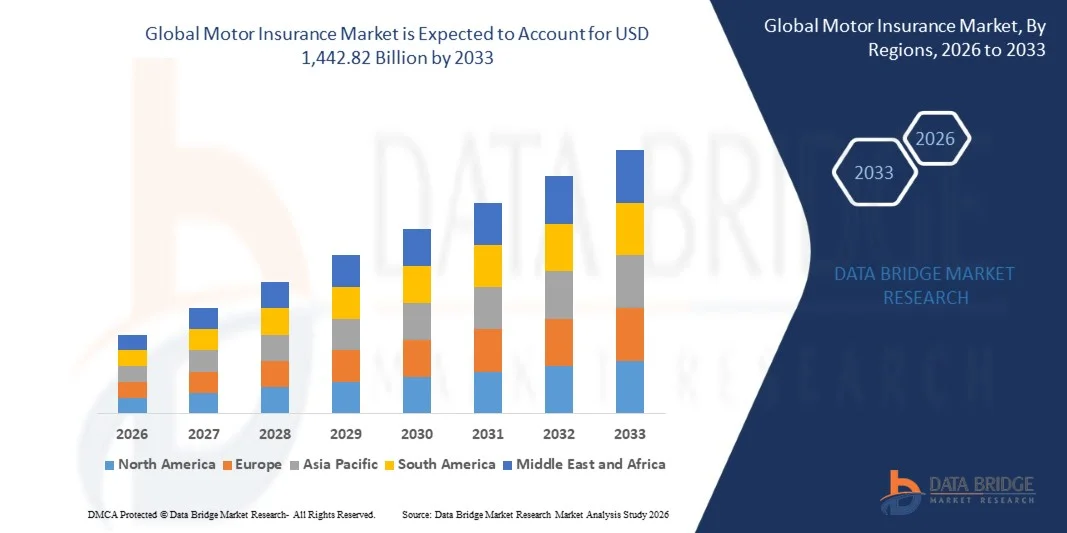
- As per Data Bridge Market Research analysis, the motor insurance market was valued at USD 947.30 billion in 2025 and is projected to reach USD 1,442.82 billion by 2033, growing at a CAGR of 5.4% from 2026 to 2033.
- The market is experiencing steady growth driven by rising global vehicle ownership rates, increasing mandatory third-party liability insurance regulations across emerging economies, and growing consumer adoption of usage-based and telematics-driven insurance products offering more personalized, risk-based premium pricing.
- The growing emphasis on digital-first customer experience, rapid claims processing, and personalized premium pricing based on individual driving behavior is compelling insurers to invest heavily in telematics, artificial intelligence-based underwriting, and direct-to-consumer digital distribution channels. Usage-based insurance products are increasingly complementing traditional fixed-premium policies, offering safer drivers meaningful premium discounts while providing insurers with more granular risk assessment data.
Market Size & Forecast
- Global Market Value (2025): USD 947.30 Billion
- Expected Market Value (2033): USD 1,442.82 Billion
- Forecast CAGR (2026–2033): 5.4%
- Leading Region in 2025: North America
- Fastest Growing Region: Asia-Pacific
What are the Major Takeaways of the Motor Insurance Market?
- North America dominated the global motor insurance market with the largest revenue share of 36.82% in 2025, supported by high vehicle ownership rates, mature insurance industry infrastructure, and widespread mandatory liability insurance requirements across all states and provinces.
- Asia-Pacific is expected to be the fastest-growing region at a CAGR of 7.6% from 2026 to 2033, fueled by rapidly rising vehicle ownership, expanding mandatory insurance regulatory frameworks, and growing insurance penetration across China and India.
- The third-party liability insurance coverage type segment led the market with a 42.63% share in 2025, driven by mandatory legal requirements across virtually all major markets requiring at minimum this baseline level of motor insurance coverage.
- The usage-based insurance/telematics-based premium type segment is the fastest-growing category, projected to register a CAGR of 11.4%, reflecting rapid consumer and insurer adoption of connected vehicle data for more personalized, behavior-based premium pricing.
- The passenger cars vehicle type segment dominated the vehicle category with a 58.72% revenue share in 2025, led by the sheer scale of the global passenger vehicle fleet requiring mandatory and voluntary insurance coverage.
- Direct/online sales distribution channel accounted for 34.86% of the market share in 2025, preferred due to consumer convenience, competitive pricing transparency, and growing comfort with digital insurance purchasing and policy management.
- The electric vehicles vehicle type segment is the fastest-growing category, with a CAGR of 12.8%, driven by rapidly expanding global electric vehicle fleets requiring specialized insurance products addressing unique battery, repair cost, and charging infrastructure risk considerations.
Report Scope and Motor Insurance Market Segmentation
|
Attributes |
Motor Insurance Key Market Insights |
|
Segments Covered |
|
|
Countries Covered |
North America
Europe
Asia-Pacific
Middle East and Africa
South America
|
|
Key Market Players |
|
|
Market Opportunities |
|
|
Value Added Data Infosets |
In addition to the market insights such as market value, growth rate, market segments, geographical coverage, market players, and market scenario, the market report curated by the Data Bridge Market Research team includes in-depth expert analysis, import/export analysis, pricing analysis, production consumption analysis, and pestle analysis. |
What is the Key Trend in the Motor Insurance Market?
- Insurance providers are increasingly integrating artificial intelligence and machine learning algorithms into claims processing and underwriting workflows, enabling faster claims settlement, more accurate fraud detection, and more precise risk-based premium pricing.
- For instance, in August 2022, HDFC ERGO implemented an AI-enabled motor claims solution that analyzes vehicle damage photographs, identifies damaged parts and severity, and supports automated estimation of claim amounts, helping streamline motor-claim settlement processes.
- Growing consumer and regulatory interest in usage-based insurance models is driving insurers to expand telematics device and smartphone application-based driving behavior monitoring programs, offering premium discounts to demonstrably safer drivers while improving overall risk pool assessment accuracy.
- Insurers are increasingly developing specialized motor insurance products tailored specifically to electric vehicle ownership, addressing unique risk factors including battery replacement costs, specialized repair network requirements, and different accident and theft risk profiles compared to conventional internal combustion engine vehicles.
- For instance, in February 2025, Allianz expanded its electric vehicle insurance product line to include specialized battery degradation and replacement coverage options, addressing a key customer concern not adequately addressed by conventional motor insurance policy structures.
- Growing insurer collaboration with automotive OEMs to offer embedded insurance products at the point of vehicle sale is streamlining the insurance purchasing process for consumers, reducing friction and improving policy attachment rates for both new and used vehicle transactions.
- For instance, in January 2025, Polly introduced its Professional Insurance Platform, enabling automotive dealerships to provide insurance quotes within the vehicle-buying process and connect customers with multiple insurance carriers.
- As insurers, regulators, and consumers continue to prioritize digital convenience, personalized pricing, and evolving vehicle technology risk assessment, the adoption of advanced motor insurance products and distribution models is expected to accelerate, reinforcing continued transformation across the global motor insurance industry.
What are the Key Drivers of the Motor Insurance Market?
- The rising global vehicle ownership rate, particularly across rapidly motorizing emerging economies, has significantly increased the overall addressable market for both mandatory and voluntary motor insurance products.
- For instance, in April 2025, ICICI Lombard expanded its motor insurance distribution network across additional regional markets in India to capture growing demand from rapidly increasing vehicle ownership among the country’s expanding middle class.
- The continued expansion and enforcement of mandatory third-party liability insurance regulations across emerging markets is driving substantial growth in baseline insurance policy issuance, as governments increasingly mandate minimum insurance coverage to protect accident victims and reduce uninsured driver populations.
- For instance, in March 2024, Singapore authorities reiterated enforcement against motorists using vehicles without valid insurance coverage, under the Motor Vehicles (Third-Party Risks and Compensation) Act.
- The rapid growth of e-commerce logistics and last-mile delivery services is driving substantial expansion of commercial vehicle fleets requiring comprehensive fleet insurance coverage, creating a growing and increasingly important commercial insurance customer segment for motor insurers worldwide.
- For instance, in October 2024, Amazon India and India Post expanded their nationwide logistics partnership, with Amazon reporting that parcels delivered through the India Post network had increased nearly threefold over the preceding 18 months, demonstrating the continued expansion of e-commerce delivery infrastructure.
- Similarly, in October 2024, Allcargo Gati announced plans to deploy more than 1,700 alternative-fuel vehicles for first- and last-mile deliveries across India, reflecting continued investment in commercial delivery fleets.
- With rising global vehicle ownership, expanding mandatory insurance regulatory frameworks, and continued digital transformation of insurance distribution and claims processing, motor insurance will remain an essential and expanding component of the global automotive and financial services ecosystem.
Which Factors are Challenging the Growth of the Motor Insurance Market?
- Rising vehicle repair and claims costs are challenging insurers as modern vehicles increasingly incorporate advanced driver-assistance systems (ADAS), sensors, cameras, and complex electronic components that require specialized repairs and calibration.
- For instance, in April 2024, EIOPA highlighted the growing complexity and risks associated with digitalisation in the European insurance sector, underscoring the need for insurers to adapt to technology-driven changes.
- Increasing regulatory scrutiny of pricing and data usage is adding compliance complexity as insurers expand telematics- and AI-driven products. Regulators are increasingly focused on data privacy, transparency, consumer protection, and responsible use of customer information.
- Growing motor insurance fraud, including staged accidents, exaggerated claims, and organized fraudulent activities, continues to increase insurer losses and requires greater investment in fraud detection, analytics, and investigations. Overall, rising claims costs, regulatory requirements, and fraud-related expenses can place pressure on premiums, profitability, and customer retention.
How is the Motor Insurance Market Segmented?
The motor insurance market is segmented on the basis of coverage type, vehicle type, policy type, distribution channel, application, and premium type.
- By Coverage Type
On the basis of coverage type, the global motor insurance market is segmented into third-party liability insurance, comprehensive insurance, collision coverage, and personal injury protection/uninsured motorist coverage. The third-party liability insurance segment dominated the market with a 42.63% share in 2025, owing to mandatory legal requirements across virtually all major markets requiring at minimum this baseline level of motor insurance coverage. This coverage type remains the foundational, universally required component of motor insurance policies worldwide.
The comprehensive insurance segment is projected to register the fastest growth at a CAGR of 6.8% from 2026 to 2033, driven by rising vehicle values and growing consumer preference for broader protection covering theft, weather damage, and non-collision incidents alongside mandatory liability coverage.
- By Vehicle Type
On the basis of vehicle type, the global motor insurance market is segmented into passenger cars, commercial vehicles, two-wheelers, and electric vehicles. The passenger cars segment led the market with a 58.72% share in 2025, supported by the sheer scale of the global passenger vehicle fleet requiring mandatory and voluntary insurance coverage across virtually every motorized market worldwide.
The electric vehicles segment is expected to experience the fastest growth at a CAGR of 12.8% from 2026 to 2033, driven by rapidly expanding global electric vehicle fleets requiring specialized insurance products addressing unique battery, repair cost, and charging infrastructure risk considerations.
- By Policy Type
On the basis of policy type, the global motor insurance market is segmented into third-party only, third-party fire & theft, and comprehensive/fully comprehensive. The comprehensive/fully comprehensive segment dominated the market with a share of 47.28% in 2025 due to growing consumer preference for broader financial protection covering both liability and damage to their own vehicle. the rising average value of vehicles on the road continues to reinforce this segment’s leading position as owners seek to protect larger financial investments.
The third-party fire & theft segment is expected to witness the fastest CAGR of 6.4% from 2026 to 2033, driven by this growth is fueled by rising demand among cost-conscious consumers seeking a middle-ground coverage option that extends beyond basic liability protection without the full premium cost of comprehensive coverage.
- By Distribution Channel
On the basis of distribution channel, the global motor insurance market is segmented into insurance agents & brokers, direct/online sales, bancassurance, and insurance aggregators/comparison websites. The insurance agents & brokers segment dominated the market with a share of 38.74% in 2025 due to continued consumer preference for personalized guidance and advice when selecting appropriate coverage levels, particularly for more complex commercial and fleet insurance needs. established agent and broker relationships continue to reinforce this segment’s leading position in many markets.
The direct/online sales segment is expected to witness the fastest CAGR of 8.7% from 2026 to 2033, driven by rising consumer comfort with digital insurance purchasing, competitive pricing transparency, and growing availability of streamlined online quote and policy management platforms.
- By Application
On the basis of application, the global motor insurance market is segmented into individual/personal and fleet/commercial. The individual/personal segment dominated the market with a share of 71.86% in 2025 due to the vast scale of privately owned passenger vehicles requiring mandatory and voluntary insurance coverage across global markets. the widespread private vehicle ownership base continues to reinforce this segment’s leading position.
The fleet/commercial segment is expected to witness the fastest CAGR of 6.9% from 2026 to 2033, driven by rising commercial vehicle fleet expansion supporting growing e-commerce logistics and delivery services requiring comprehensive fleet insurance coverage.
- By Premium Type
On the basis of premium type, the global motor insurance market is segmented into usage-based insurance/telematics-based and traditional fixed premium. The traditional fixed premium segment dominated the market with a share of 81.37% in 2025 due to its continued widespread use across the majority of global motor insurance policies not yet transitioned to telematics-based pricing models. established underwriting practices and broad consumer familiarity continue to support strong demand for traditional premium structures.
The usage-based insurance/telematics-based segment is expected to witness the fastest CAGR of 11.4% from 2026 to 2033, driven by rapid consumer and insurer adoption of connected vehicle data for more personalized, behavior-based premium pricing that rewards demonstrably safer driving habits.
Which Region Holds the Largest Share of the Motor Insurance Market?
- North America dominated the motor insurance market and accounted for the largest revenue share of 36.82% in 2025, supported by high vehicle ownership rates, mature insurance industry infrastructure, and widespread mandatory liability insurance requirements across all states and provinces.
- The region also benefits from a highly developed insurance distribution ecosystem spanning agents, direct online channels, and comparison platforms, along with advanced telematics and usage-based insurance program adoption among leading insurers. Continued digital transformation investment continues to strengthen North America’s leadership position in the global market.
U.S. Motor Insurance Market Insight
The U.S. motor insurance market holds the largest share within North America, driven by high vehicle ownership rates, mature insurance industry infrastructure, and mandatory liability insurance requirements across all fifty states. Rising adoption of telematics-based usage insurance programs and growing consumer preference for direct online insurance purchasing are further supporting market growth. Additionally, continued technology investment by leading domestic insurers in AI-based claims processing and fraud detection is reinforcing the country’s position as the largest market for motor insurance.
Canada Motor Insurance Market Insight
Canada’s motor insurance market is shaped by mandatory coverage requirements, vehicle ownership, claims frequency, and regional regulatory frameworks. Demand remains supported by steady mobility and growing vehicle fleets, while insurers increasingly adopt telematics, digital policy management, and automated claims processing. Electric and connected vehicles are creating new underwriting considerations related to repair costs, battery technology, and vehicle data. Rising repair expenses, severe weather events, fraud risks, and changing provincial regulations continue to influence premiums, profitability, and market competition.
Asia-Pacific Motor Insurance Market Insight
Asia-Pacific motor insurance market is expected to witness rapid growth, driven by rapidly rising vehicle ownership, expanding mandatory insurance regulatory frameworks, and growing insurance penetration across the region. Rising middle-class disposable incomes and growing consumer awareness of financial protection needs are supporting regional market expansion. Additionally, the growing presence of both international and domestic insurers expanding digital distribution capabilities is accelerating market adoption across the region.
China Motor Insurance Market Insight
China motor insurance market is growing rapidly, driven by rapidly rising vehicle ownership, expanding mandatory insurance regulatory enforcement, and growing adoption of digital insurance platforms among increasingly tech-savvy consumers. Growing adoption of usage-based insurance products leveraging connected vehicle data is significantly boosting market demand among domestic insurers. In addition, rising electric vehicle adoption requiring specialized insurance products is positioning China as one of the fastest-growing markets for motor insurance globally.
Japan Motor Insurance Market Insight
Japan motor insurance market is witnessing robust growth, driven by rapidly expanding vehicle ownership, stricter mandatory third-party liability insurance enforcement, and growing consumer awareness of comprehensive coverage benefits. Growing adoption of digital insurance aggregator platforms is supporting market expansion by simplifying policy comparison and purchasing for consumers. Additionally, rising two-wheeler and passenger vehicle sales are further accelerating market growth across the country.
Which are the Top Companies in Motor Insurance Market?
The motor insurance industry is primarily led by well-established companies, including:
- State Farm Mutual Automobile Insurance Company (U.S.)
- GEICO (Berkshire Hathaway) (U.S.)
- Progressive Corporation (U.S.)
- Allstate Corporation (U.S.)
- Allianz SE (Germany)
- AXA SA (France)
- Zurich Insurance Group AG (Switzerland)
- Liberty Mutual Insurance Company (U.S.)
- USAA (U.S.)
- Admiral Group plc (U.K.)
- Aviva plc (U.K.)
- Direct Line Insurance Group plc (U.K.)
- Ping An Insurance (Group) Company of China, Ltd. (China)
- PICC Property and Casualty Company Limited (China)
- Tokio Marine Holdings, Inc. (Japan)
- MS&AD Insurance Group Holdings, Inc. (Japan)
- Sompo Holdings, Inc. (Japan)
- Bajaj Allianz General Insurance Co. Ltd. (India)
- ICICI Lombard General Insurance Company Limited (India)
- Assicurazioni Generali S.p.A. (Italy)
What are Latest Developments in Motor Insurance Market?
- In September 2025, Progressive Corporation expanded its usage-based insurance telematics program to additional states, offering enhanced premium discount tiers for policyholders demonstrating consistently safe driving behavior through connected device monitoring.
- In January 2025, Allianz launched an expanded electric vehicle insurance product across additional European markets, featuring specialized coverage for battery degradation and access to certified EV repair networks.
- In November 2025, Ping An Insurance introduced an upgraded AI-based claims processing platform capable of automatically assessing accident damage from submitted photos and video, significantly reducing average claims settlement time for eligible policyholders.
- In November 2024, Admiral Group expanded its direct-to-consumer digital insurance platform with enhanced telematics integration, allowing new customers to receive personalized quotes based on driving behavior data from the outset of their policy.
- In June 2023, ICICI Lombard partnered with several automotive OEMs in India to offer bundled motor insurance products at the point of vehicle sale, demonstrating improved policy issuance efficiency and customer convenience compared to traditional post-purchase insurance procurement.
- In August 2024, AXA expanded its fleet insurance offerings for commercial delivery and logistics operators across Europe, introducing telematics-based fleet risk management tools to help commercial customers reduce accident rates and manage insurance costs more effectively.

- Interactive Data Analysis Dashboard
- Company Analysis Dashboard for high growth potential opportunities
- Research Analyst Access for customization & queries
- Competitor Analysis with Interactive dashboard
- Latest News, Updates & Trend analysis
- Harness the Power of Benchmark Analysis for Comprehensive Competitor Tracking
Data collection and base year analysis are done using data collection modules with large sample sizes. The stage includes obtaining market information or related data through various sources and strategies. It includes examining and planning all the data acquired from the past in advance. It likewise envelops the examination of information inconsistencies seen across different information sources. The market data is analysed and estimated using market statistical and coherent models. Also, market share analysis and key trend analysis are the major success factors in the market report. To know more, please request an analyst call or drop down your inquiry.
The key research methodology used by DBMR research team is data triangulation which involves data mining, analysis of the impact of data variables on the market and primary (industry expert) validation. Data models include Vendor Positioning Grid, Market Time Line Analysis, Market Overview and Guide, Company Positioning Grid, Patent Analysis, Pricing Analysis, Company Market Share Analysis, Standards of Measurement, Global versus Regional and Vendor Share Analysis. To know more about the research methodology, drop in an inquiry to speak to our industry experts.
Data Bridge Market Research is a leader in advanced formative research. We take pride in servicing our existing and new customers with data and analysis that match and suits their goal. The report can be customized to include price trend analysis of target brands understanding the market for additional countries (ask for the list of countries), clinical trial results data, literature review, refurbished market and product base analysis. Market analysis of target competitors can be analyzed from technology-based analysis to market portfolio strategies. We can add as many competitors that you require data about in the format and data style you are looking for. Our team of analysts can also provide you data in crude raw excel files pivot tables (Fact book) or can assist you in creating presentations from the data sets available in the report.













