


Moyamoya Disease Market Size
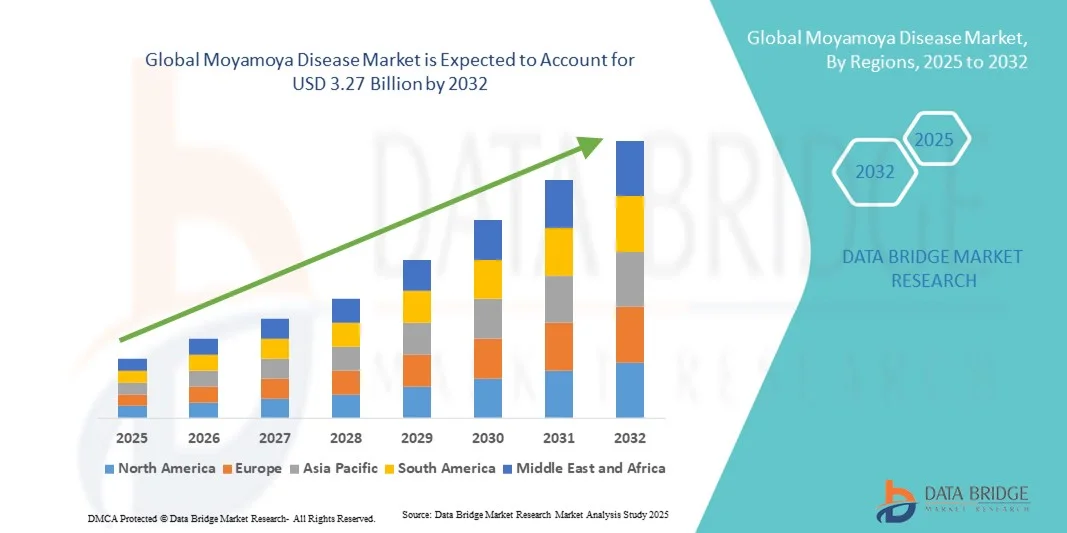
- The global Moyamoya Disease market size was valued at USD 1.89 billion in 2024 and is expected to reach USD 3.27 billion by 2032, at a CAGR of 7.10% during the forecast period
- The market growth is largely fueled by the increasing prevalence of cerebrovascular disorders and the growing advancements in diagnostic imaging technologies, which have significantly improved the early detection and management of Moyamoya disease
- Furthermore, rising awareness of rare neurological conditions, coupled with ongoing research in surgical revascularization techniques and innovative treatment approaches, is accelerating the adoption of moyamoya disease management solutions, thereby significantly boosting the industry's growth
Moyamoya Disease Market Analysis
- Moyamoya disease, a rare cerebrovascular disorder characterized by progressive stenosis of arteries in the brain, is increasingly being recognized across global healthcare systems due to improvements in neuroimaging and growing clinical awareness among neurologists and neurosurgeons
- The escalating demand for moyamoya disease treatment is primarily driven by advancements in surgical revascularization techniques, such as direct and indirect bypass procedures, coupled with the increasing availability of specialized neurosurgical centers and early diagnosis programs
- North America dominated the moyamoya disease market with the largest revenue share of 38.7% in 2024, supported by advanced healthcare infrastructure, high diagnostic rates, and the presence of leading medical research institutions. The U.S. continues to lead the region due to significant investments in rare disease research, patient advocacy initiatives, and increasing availability of minimally invasive surgical options
- Asia-Pacific is expected to be the fastest-growing region in the moyamoya disease market during the forecast period, projected to register a CAGR, owing to the higher prevalence of the disease in East Asian populations, expanding healthcare access, and growing government focus on rare neurological disorders in countries such as Japan, China, and South Korea
- The Surgical Treatment segment dominated the largest market revenue share of 72.4% in 2024, owing to its proven effectiveness in restoring cerebral blood flow and preventing recurrent ischemic or hemorrhagic strokes
Report Scope and Moyamoya Disease Market Segmentation
|
Attributes |
Moyamoya Disease Key Market Insights |
|
Segments Covered |
|
|
Countries Covered |
North America
Europe
Asia-Pacific
Middle East and Africa
South America
|
|
Key Market Players |
|
|
Market Opportunities |
|
|
Value Added Data Infosets |
In addition to the insights on market scenarios such as market value, growth rate, segmentation, geographical coverage, and major players, the market reports curated by the Data Bridge Market Research also include in-depth expert analysis, patient epidemiology, pipeline analysis, pricing analysis, and regulatory framework. |
Moyamoya Disease Market Trends
Advancements in AI and Imaging-Based Diagnostics
- A significant and accelerating trend in the global moyamoya disease market is the deepening integration of artificial intelligence (AI) and advanced neuroimaging technologies such as magnetic resonance angiography (MRA), computed tomography angiography (CTA), and digital subtraction angiography (DSA). This technological evolution is significantly enhancing the precision, speed, and accuracy of diagnosis and disease monitoring
- For instance, AI-based neurovascular imaging software developed by Siemens Healthineers and GE Healthcare assists clinicians in detecting vascular narrowing and collateral vessel formation—hallmarks of Moyamoya Disease—with greater reliability than manual interpretation. Similarly, AI-driven segmentation tools can quantify cerebral blood flow abnormalities, providing more detailed insights into disease progression and surgical planning
- AI integration in neuroimaging enables features such as automated image analysis to identify stenotic regions, predictive modeling for stroke risk, and personalized treatment planning. For instance, algorithms trained on patient data can predict post-surgical outcomes for revascularization procedures and suggest optimal intervention timing. Furthermore, these tools support faster reporting and assist neurosurgeons in developing patient-specific surgical pathways
- The seamless integration of imaging AI with hospital information systems and digital health platforms facilitates centralized management of diagnostic data, surgical outcomes, and patient follow-up, improving multidisciplinary collaboration among neurologists, radiologists, and neurosurgeons
- This trend toward more intelligent, data-driven, and interconnected diagnostic ecosystems is fundamentally reshaping expectations for rare cerebrovascular disorder management. Consequently, companies such as Canon Medical Systems and Philips Healthcare are developing AI-powered diagnostic platforms with automated detection and decision-support features tailored for Moyamoya Disease assessment
- The demand for AI-enabled diagnostic systems that offer rapid, reliable, and accessible evaluation is growing rapidly across both hospitals and research institutes, as clinicians increasingly prioritize early detection, precision treatment, and reduced diagnostic delays in Moyamoya Disease management
Moyamoya Disease Market Dynamics
Driver
Growing Need for Advanced Treatment and Early Diagnosis
- The increasing incidence of moyamoya disease across Asia-Pacific, North America, and Europe, coupled with improved awareness and diagnostic availability, is a significant driver of global market growth
- For instance, in April 2024, the Mayo Clinic announced advancements in bypass grafting techniques, using refined direct and indirect revascularization procedures to improve cerebral blood flow and minimize ischemic events in moyamoya patients. Such innovations are expected to drive the moyamoya disease market during the forecast period
- As healthcare systems emphasize early diagnosis and treatment of rare cerebrovascular conditions, the demand for advanced imaging systems, neurosurgical instruments, and specialized care centers continues to rise, enhancing overall market expansion
- Furthermore, increasing research funding and collaborations among academic institutions and biotechnology firms are facilitating the development of genetic and biomarker-based diagnostic tests, allowing early risk identification and targeted interventions
- The growing availability of minimally invasive surgical techniques, improved perioperative management, and the use of hybrid operating rooms are making treatment safer and more accessible for patients worldwide. These technological and procedural advancements, combined with rising healthcare expenditure and awareness campaigns, are key factors propelling market growth
Restraint/Challenge
High Treatment Costs and Limited Clinical Expertise
- Despite significant progress, high treatment costs and a shortage of trained neurosurgeons and diagnostic specialists pose substantial challenges to broader market accessibility. moyamoya disease often requires complex surgical intervention, long-term follow-up, and specialized imaging resources, which can strain healthcare budgets, particularly in developing economies
- For instance, the costs associated with direct bypass surgeries and advanced imaging diagnostics remain prohibitive for many patients, limiting access to timely and effective care
- Addressing these challenges through government funding, specialized training programs, and improved insurance coverage will be critical to expanding treatment accessibility. Leading hospitals such as Stanford Health Care and Kyoto University Hospital are focusing on training neurosurgeons in microsurgical and revascularization techniques to strengthen clinical capacity
- In addition, limited public awareness and misdiagnosis in early stages delay treatment initiation, increasing the risk of recurrent strokes. While new imaging modalities have improved diagnostic accuracy, their high equipment and maintenance costs hinder widespread adoption in smaller healthcare facilities
- Overcoming these constraints through healthcare infrastructure development, tele-neurology programs, and increased investment in rare disease management will be essential for sustained market growth
Moyamoya Disease Market Scope
The market is segmented on the basis of diagnosis, treatment, and distribution channel.
- By Diagnosis
On the basis of diagnosis, the moyamoya disease market is segmented into Cerebral Angiogram, MRI, MRA, CT Scan, Transcranial Doppler Ultrasound, PET Scan, and Electroencephalography (EEG). The Cerebral Angiogram segment dominated the largest market revenue share of 38.6% in 2024, driven by its position as the gold standard for confirming Moyamoya Disease through visualization of stenosis and collateral vessel networks. This technique provides detailed, high-resolution images of cerebral arteries, enabling clinicians to plan precise surgical interventions and assess disease progression. The widespread use of digital subtraction angiography (DSA) technology, coupled with increasing access to advanced neuroimaging facilities in tertiary hospitals, has significantly supported this segment’s dominance. Moreover, the angiogram’s capability to guide revascularization procedures and monitor post-surgical recovery adds clinical value. The rising burden of ischemic stroke linked to Moyamoya Disease, and ongoing research emphasizing diagnostic accuracy, are further reinforcing its leading position in the market.
The Magnetic Resonance Angiography (MRA) segment is expected to witness the fastest CAGR of 15.8% from 2025 to 2032, supported by its non-invasive nature, absence of ionizing radiation, and improving imaging resolution. MRA is increasingly preferred in both pediatric and adult populations for early detection and follow-up evaluation. Advancements such as 3D time-of-flight and contrast-enhanced MRA have enhanced visualization of intracranial arteries, making it a safer, more accessible diagnostic tool. The growing availability of portable MRI units and AI-based image analysis tools is boosting the adoption of MRA in hospitals and diagnostic centers. In addition, global initiatives to improve rare disease detection and patient safety have accelerated the clinical transition toward non-invasive modalities like MRA, positioning it as the fastest-expanding diagnostic category.
- By Treatment
On the basis of treatment, the moyamoya disease market is segmented into Surgical Treatment and Non-Surgical Treatment. The Surgical Treatment segment dominated the largest market revenue share of 72.4% in 2024, owing to its proven effectiveness in restoring cerebral blood flow and preventing recurrent ischemic or hemorrhagic strokes. Surgical interventions, such as direct bypass (STA-MCA anastomosis) and indirect revascularization (encephaloduroarteriosynangiosis, encephalomyosynangiosis), remain the cornerstone of management. The growing number of specialized neurosurgical centers and the availability of advanced microsurgical tools have further expanded access to effective surgical care. Clinical success rates exceeding 85% in reducing stroke recurrence have bolstered confidence in surgical options. Moreover, continuous innovations in hybrid revascularization techniques and intraoperative imaging are contributing to improved outcomes. Rising awareness among physicians and patients regarding the long-term benefits of surgical restoration of cerebral perfusion underpins the segment’s dominance.
The Non-Surgical Treatment segment is anticipated to witness the fastest growth rate of 13.2% from 2025 to 2032, primarily driven by the increasing focus on early-stage management and supportive therapies. Non-surgical interventions include pharmacological treatments such as antiplatelet agents, anticoagulants, and vasodilators aimed at preventing thrombotic events. The segment’s expansion is further supported by growing clinical research on neuroprotective drugs and personalized medical approaches. In addition, multidisciplinary rehabilitation programs, including physiotherapy and cognitive therapy, are enhancing patient quality of life post-diagnosis. The increasing acceptance of non-invasive interventions for patients unfit for surgery and the rising pipeline of drugs targeting vascular remodeling and inflammation are expected to accelerate this growth.
- By Distribution Channel
On the basis of distribution channel, the moyamoya disease market is segmented into Hospitals, Clinics, Diagnostic Centers, Drug Stores, Pharmacies, and Others. The Hospitals segment dominated the market with the largest revenue share of 51.7% in 2024, attributed to the concentration of advanced imaging technologies, skilled neurosurgeons, and multidisciplinary care teams in hospital settings. Hospitals serve as primary centers for diagnosis, surgical interventions, and long-term monitoring, making them central to Moyamoya Disease management. The availability of high-end neuroimaging infrastructure, hybrid operating rooms, and continuous patient care pathways further reinforces this dominance. In addition, the increasing establishment of tertiary care centers specializing in rare cerebrovascular diseases and the growing integration of hospital-based research programs are driving the hospital segment’s leading role in global market revenue.
The Diagnostic Centers segment is projected to record the fastest CAGR of 14.6% from 2025 to 2032, supported by the rising demand for early and accurate diagnosis through specialized imaging and neurofunctional assessment. The trend toward outpatient diagnostics, coupled with the availability of advanced modalities such as MRI, MRA, and PET scans, is driving patient preference for dedicated diagnostic facilities. These centers offer rapid, cost-effective services and often collaborate with hospitals for surgical referrals. The expansion of private diagnostic chains in emerging economies, coupled with the increasing integration of AI-based analysis tools, is enhancing both speed and precision in Moyamoya Disease detection. The segment’s strong growth trajectory is further strengthened by technological upgrades, favorable reimbursement frameworks, and strategic partnerships among imaging service providers and healthcare networks.
Moyamoya Disease Market Regional Analysis
- North America dominated the moyamoya disease market with the largest revenue share of 38.7% in 2024, supported by advanced healthcare infrastructure, high diagnostic rates, and the presence of leading medical research institutions
- The region benefits from increased awareness among healthcare professionals, the adoption of advanced neuroimaging tools, and a rise in early diagnosis through specialized centers
- Moreover, ongoing clinical trials focused on cerebral revascularization and neuroprotective therapies further contribute to the region’s market leadership
U.S. Moyamoya Disease Market Insight
The U.S. moyamoya disease market captured the largest share within North America in 2024, driven by significant investments in rare disease research, strong patient advocacy networks, and increasing availability of minimally invasive surgical procedures. The presence of leading institutions such as Mayo Clinic and Massachusetts General Hospital, which are at the forefront of Moyamoya research and treatment innovations, further bolsters market growth. In addition, government support for rare disease registries and funding for early diagnosis programs continues to strengthen the U.S. market position.
Europe Moyamoya Disease Market Insight
The Europe moyamoya disease market is anticipated to grow at a steady CAGR during the forecast period, fueled by robust healthcare systems, favorable reimbursement policies for rare diseases, and advancements in neurovascular surgery. Countries such as Germany, France, and the U.K. are witnessing increased clinical research collaborations aimed at understanding the genetic basis of Moyamoya disease. The growing focus on specialized care centers and improvements in diagnostic accuracy are enhancing patient outcomes across the region.
U.K. Moyamoya Disease Market Insight
The U.K. moyamoya disease market is projected to expand notably during the forecast period due to ongoing public health initiatives aimed at improving awareness of rare neurological disorders. The National Health Service (NHS) supports early detection through comprehensive imaging and referral systems, while ongoing research on genetic predisposition and surgical outcomes continues to drive growth.
Germany Moyamoya Disease Market Insight
The Germany moyamoya disease market is expected to register consistent growth, supported by its advanced healthcare infrastructure, strong emphasis on clinical research, and collaboration between academic and medical institutions. The adoption of innovative diagnostic imaging technologies and rising focus on patient-specific treatment planning contribute significantly to market expansion in the country.
Asia-Pacific Moyamoya Disease Market Insight
The Asia-Pacific moyamoya disease market is poised to grow at the fastest CAGR during 2025–2032, driven by the higher prevalence of the disease in East Asian populations, expanding healthcare access, and growing government attention toward rare neurological conditions. Countries such as Japan, China, and South Korea are leading the region’s growth through increased research funding, national registries, and technological advancements in surgical interventions.
Japan Moyamoya Disease Market Insight
The Japan moyamoya disease market holds a significant share within Asia-Pacific, as the country records one of the highest global prevalence rates. Strong government support for early diagnosis programs, robust clinical research activity, and the presence of advanced neurosurgical centers are major growth drivers. The continuous development of revascularization procedures and long-term patient monitoring programs further strengthen Japan’s market position.
China Moyamoya Disease Market Insight
The China moyamoya disease market is expected to witness the highest CAGR in the Asia-Pacific region, attributed to expanding healthcare infrastructure, increased healthcare spending, and growing awareness of rare neurological disorders. Government initiatives aimed at improving access to advanced imaging diagnostics and investments in neurosurgical training are accelerating the country’s progress in Moyamoya disease management.
Moyamoya Disease Market Share
The Moyamoya Disease industry is primarily led by well-established companies, including:
- Chugai Pharmaceutical Co., Ltd. (Japan)
- Novartis AG (Switzerland)
- Bayer AG (Germany)
- Johnson & Johnson and its affiliates (U.S.)
- Pfizer Inc. (U.S.)
- Takeda Pharmaceutical Company Limited (Japan)
- Roche Holding AG (Switzerland)
- Merck & Co., Inc. (U.S.)
- Sanofi (France)
- AstraZeneca plc (UK)
- AbbVie Inc. (U.S.)
- Boston Children’s Hospital (U.S.)
- Stanford Health Care (U.S.)
- Cleveland Clinic (U.S.)
- NeuroVasc Technologies, Inc. (U.S.)
- Penumbra, Inc. (U.S.)
- MicroVention, Inc. (U.S.)
- Stryker (U.S.)
Latest Developments in Global Moyamoya Disease Market
- In May 2022, Japan’s Research Committee on Moyamoya Disease released the 2021 revised diagnostic criteria and management guidelines (published in 2022), which clarified disease definitions (including “quasi-moyamoya”), updated imaging criteria, and refined indications for surgical revascularization. The revision formalized new imaging standards and expanded diagnostic categories to better capture unilateral and syndromic forms, improving case ascertainment and aligning Japanese clinical practice with a clearer, evidence-based framework for when to offer bypass procedures and long-term surveillance
- In February 2023, the European Stroke Organisation published comprehensive Guidelines on Moyamoya angiopathy (endorsed by the Vascular European Reference Network), providing standardized recommendations for diagnosis, imaging work-up, and management of adult and pediatric moyamoya patients across Europe. These guidelines synthesize international evidence, emphasize earlier and more uniform use of non-invasive angiography and perfusion imaging for diagnosis, and set out care pathways to improve timely referral for revascularization and multidisciplinary follow-up — a step intended to reduce regional variability in outcomes and help hospitals implement consistent care protocols
- In March 2024, researchers published a study demonstrating a deep-learning convolutional neural network (CNN) that automatically diagnoses moyamoya disease from magnetic resonance angiography (MRA) with high accuracy. The multicenter retrospective study trained and validated a DenseNet-based model on hundreds of MRA datasets and showed strong discrimination between moyamoya, atherosclerotic intracranial disease, and normal controls — highlighting how AI can speed radiology workflows, flag previously missed cases on routine MRA, and support triage to neurovascular teams in high-volume centers
- In January 2024, investigators reported the development and validation of a deep-learning algorithm that screens for moyamoya disease using retinal fundus photographs, showing that retinal microvascular patterns detectable on routine eye photos can help identify individuals at risk of intracranial moyamoya angiopathy. The study described algorithm training on large real-world retinal datasets and external validation, proposing a low-cost, noninvasive population-level screening tool that could enable earlier referral for neuroimaging in resource-limited settings or as an adjunct in ophthalmology/primary care clinics

- Interactive Data Analysis Dashboard
- Company Analysis Dashboard for high growth potential opportunities
- Research Analyst Access for customization & queries
- Competitor Analysis with Interactive dashboard
- Latest News, Updates & Trend analysis
- Harness the Power of Benchmark Analysis for Comprehensive Competitor Tracking
Data collection and base year analysis are done using data collection modules with large sample sizes. The stage includes obtaining market information or related data through various sources and strategies. It includes examining and planning all the data acquired from the past in advance. It likewise envelops the examination of information inconsistencies seen across different information sources. The market data is analysed and estimated using market statistical and coherent models. Also, market share analysis and key trend analysis are the major success factors in the market report. To know more, please request an analyst call or drop down your inquiry.
The key research methodology used by DBMR research team is data triangulation which involves data mining, analysis of the impact of data variables on the market and primary (industry expert) validation. Data models include Vendor Positioning Grid, Market Time Line Analysis, Market Overview and Guide, Company Positioning Grid, Patent Analysis, Pricing Analysis, Company Market Share Analysis, Standards of Measurement, Global versus Regional and Vendor Share Analysis. To know more about the research methodology, drop in an inquiry to speak to our industry experts.
Data Bridge Market Research is a leader in advanced formative research. We take pride in servicing our existing and new customers with data and analysis that match and suits their goal. The report can be customized to include price trend analysis of target brands understanding the market for additional countries (ask for the list of countries), clinical trial results data, literature review, refurbished market and product base analysis. Market analysis of target competitors can be analyzed from technology-based analysis to market portfolio strategies. We can add as many competitors that you require data about in the format and data style you are looking for. Our team of analysts can also provide you data in crude raw excel files pivot tables (Fact book) or can assist you in creating presentations from the data sets available in the report.












