


MRNA Manufacturing Raw Materials Market Overview
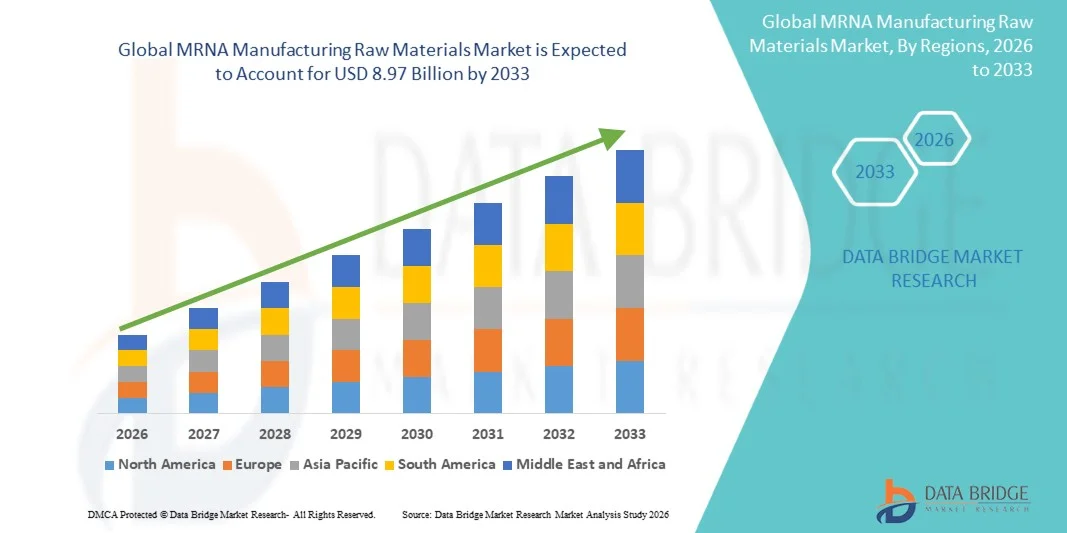
The MRNA Manufacturing Raw Materials Market was valued at USD 2.18 Billion in 2025 and is projected to reach USD 8.97 Billion by 2033, growing at a CAGR of 19.30% from 2026 to 2033. The market is witnessing strong expansion driven by increasing commercialization of mRNA-based vaccines and therapeutics, rising investments in biopharmaceutical manufacturing infrastructure, and growing demand for high-quality raw materials required for large-scale mRNA production.
The rapid advancement of mRNA technology beyond infectious diseases into oncology, rare diseases, and personalized medicine has significantly increased the consumption of critical manufacturing inputs such as nucleotides, plasmid DNA, enzymes, lipids, and specialized reagents. Growing regulatory emphasis on GMP-compliant manufacturing, expansion of CDMO capabilities, and continuous innovation in lipid nanoparticle delivery systems are further accelerating market growth worldwide.
Key Market Trends & Insights
- North America dominated the MRNA Manufacturing Raw Materials Market with the largest revenue share of 39.26% in 2025, supported by strong biopharmaceutical manufacturing capabilities, extensive R&D investments, and the presence of leading mRNA developers.
- The Lipids segment led the market with a 28.64% share in 2025, driven by the widespread adoption of lipid nanoparticle (LNP) delivery systems for mRNA therapeutics and vaccines.
- Asia-Pacific is expected to be the fastest-growing region at a CAGR of 19.4% from 2026 to 2033, fueled by expanding biotechnology manufacturing facilities, increasing government investments, and growing pharmaceutical production across China, India, South Korea, and Japan.
- Plasmid DNA is the fastest-growing raw material segment, projected to register a CAGR of 19.6%, reflecting rising demand for scalable and high-purity templates in mRNA manufacturing.
- The Vaccines segment dominates the application category with a 44.38% revenue share in 2025, supported by continued investments in next-generation infectious disease vaccines and pandemic preparedness programs.
- Biopharmaceutical Companies account for 46.81% of the market, owing to increasing in-house production of mRNA therapeutics and expansion of commercial manufacturing capacity.
- The GMP Grade segment is the fastest-growing grade category, with a CAGR of 19.4%, driven by stringent regulatory requirements for clinical and commercial mRNA production and the increasing number of late-stage pipeline products.
Market Size & Forecast
- Global Market Value (2025): USD 2.18 Billion
- Expected Market Value (2033): USD 8.97 Billion
- Forecast CAGR (2026–2033): 19.30%
- Leading Region in 2025: North America
- Fastest Growing Region: Asia-Pacific
Report Scope and MRNA Manufacturing Raw Materials Market Segmentation
|
Attributes |
MRNA Manufacturing Raw Materials Key Market Insights |
|
Segments Covered |
|
|
Countries Covered |
North America · U.S. · Canada · Mexico Europe · Germany · France · U.K. · Netherlands · Switzerland · Belgium · Russia · Italy · Spain · Turkey · Rest of Europe Asia-Pacific · China · Japan · India · South Korea · Singapore · Malaysia · Australia · Thailand · Indonesia · Philippines · Rest of Asia-Pacific Middle East and Africa · Saudi Arabia · U.A.E. · South Africa · Egypt · Israel · Rest of Middle East and Africa South America · Brazil · Argentina · Rest of South America |
|
Key Market Players |
· Thermo Fisher Scientific Inc. (U.S.) · Merck KGaA (Germany) · Danaher Corporation (U.S.) · Cytiva (U.S.) · Sartorius AG (Germany) · Agilent Technologies, Inc. (U.S.) · Maravai LifeSciences Holdings, Inc. (U.S.) · TriLink BioTechnologies LLC (U.S.) · New England Biolabs, Inc. (U.S.) · GenScript Biotech Corporation (China) · FUJIFILM Holdings Corporation (Japan) · Asahi Kasei Corporation (Japan) · Wacker Chemie AG (Germany) · Repligen Corporation (U.S.) · Bio-Techne Corporation (U.S.) · Lonza Group AG (Switzerland) · Avantor, Inc. (U.S.) · Aldevron LLC (U.S.) · ACROBiosystems Inc. (U.S.) · Creative Biogene (U.S.) · Promega Corporation (U.S.) · BIA Separations (Slovenia) · Roche Holding AG (Switzerland) · Eppendorf SE (Germany) · Bio-Rad Laboratories, Inc. (U.S.) · NIPPON Genetics Co., Ltd. (Japan) · Takara Bio Inc. (Japan) · QIAGEN N.V. (Netherlands) · Evonik Industries AG (Germany) · CordenPharma International (Switzerland) · Bachem Holding AG (Switzerland) · Vector Laboratories (U.S.) · Sino Biological Inc. (China) · Revvity, Inc. (U.S.) |
|
Market Opportunities |
· Expansion of personalized mRNA therapeutics and cancer vaccines · Rising investments in regional GMP-grade raw material manufacturing facilities · Increasing adoption of AI-enabled process optimization and continuous bioprocessing |
|
Value Added Data Infosets |
In addition to the insights on market scenarios such as market value, growth rate, segmentation, geographical coverage, and major players, the market reports curated by the Data Bridge Market Research also include import export analysis, production capacity overview, production consumption analysis, price trend analysis, climate change scenario, supply chain analysis, value chain analysis, raw material/consumables overview, vendor selection criteria, PESTLE Analysis, Porter Analysis, and regulatory framework. |
MRNA Manufacturing Raw Materials Market Trends
Trend: Expansion of GMP-Grade Raw Material Production
The rapid commercialization of mRNA vaccines and therapeutics has significantly increased the demand for GMP-grade manufacturing raw materials, including nucleotides, plasmid DNA, enzymes, capping analogs, and ionizable lipids. Manufacturers are expanding production capacity and investing in high-purity manufacturing technologies to ensure consistent quality, regulatory compliance, and uninterrupted supply. Automated manufacturing platforms, digital quality monitoring, and advanced purification technologies are further improving production efficiency while supporting the growing pipeline of mRNA-based products across infectious diseases, oncology, and rare disorders.
MRNA Manufacturing Raw Materials Market Dynamics
Key Market Driver: Growing Commercialization of mRNA-Based Vaccines and Therapeutics
The expanding pipeline of mRNA vaccines and therapeutics is driving substantial demand for high-quality manufacturing raw materials. Pharmaceutical and biotechnology companies are increasing investments in commercial-scale manufacturing facilities capable of producing GMP-grade nucleotides, enzymes, plasmid DNA, lipid nanoparticles, and specialized reagents. Continuous technological advancements in mRNA synthesis, purification, and formulation are improving production efficiency, reducing manufacturing costs, and accelerating product commercialization. Increasing government funding for pandemic preparedness and next-generation vaccine platforms is further supporting long-term market growth.
Key Restraint/Challenge: Limited Availability and High Cost of Critical GMP Raw Materials
A major challenge for the MRNA Manufacturing Raw Materials Market is the limited global supply of high-purity GMP-grade raw materials required for commercial production. Manufacturing specialized enzymes, modified nucleotides, plasmid DNA, and proprietary lipid components requires advanced production technologies, strict quality control systems, and significant capital investment. Supply shortages, lengthy qualification processes, and dependence on a limited number of specialized suppliers continue to increase procurement costs and create bottlenecks for large-scale manufacturing. The expansion of commercial manufacturing facilities requires substantial investments in quality assurance, regulatory compliance, and specialized production infrastructure, creating barriers for emerging manufacturers.
Key Market Opportunity: Development of Next-Generation Lipid Nanoparticles and Regional Manufacturing Hubs
The development of advanced lipid nanoparticle (LNP) technologies and next-generation delivery systems presents a significant opportunity for market participants. Increasing investments in localized manufacturing facilities across Asia-Pacific, Europe, and the Middle East are reducing supply chain risks while strengthening regional production capabilities. AI-assisted process optimization, continuous bioprocessing, automation, and digital manufacturing platforms are improving production efficiency, reducing batch variability, and enabling scalable commercial manufacturing. These advancements are expected to create substantial growth opportunities for suppliers of high-value raw materials supporting the expanding global mRNA therapeutics ecosystem.
MRNA Manufacturing Raw Materials Market Scope
The MRNA Manufacturing Raw Materials Market is segmented on the basis of raw material type, manufacturing stage, application, end user, source, grade, scale of production, and distribution channel.
- By Raw Material Type
On the basis of raw material type, the MRNA Manufacturing Raw Materials Market is segmented into nucleotides, enzymes, plasmid DNA, lipids, capping reagents, buffers & media, and other reagents. The Lipids segment dominated the market with a 28.64% share in 2025, owing to the extensive adoption of lipid nanoparticle (LNP) delivery systems in commercial mRNA vaccine and therapeutic manufacturing. The increasing demand for ionizable lipids, phospholipids, cholesterol, and PEG-lipids for efficient intracellular delivery has significantly strengthened this segment. Continuous innovations in next-generation LNP formulations, coupled with expanding commercial production capacities, are further supporting the segment's market leadership.
The Plasmid DNA segment is expected to witness the fastest CAGR of 19.6% from 2026 to 2033, driven by growing demand for high-quality DNA templates used during in vitro transcription. The expansion of personalized medicine, oncology therapeutics, and next-generation vaccine pipelines is increasing the need for scalable plasmid DNA manufacturing. Improvements in plasmid production technologies and rising investments in GMP-grade manufacturing facilities are further accelerating segment growth.
- By Manufacturing Stage
On the basis of manufacturing stage, the MRNA Manufacturing Raw Materials Market is segmented into upstream processing, in vitro transcription, purification, and formulation & fill-finish. The In Vitro Transcription segment dominated the market with a 34.92% share in 2025 due to its central role in mRNA synthesis. Increasing utilization of specialized enzymes, nucleotides, capping reagents, and optimized reaction systems for high-yield RNA production continues to drive demand. Advancements in enzymatic manufacturing technologies and increasing commercialization of mRNA therapeutics further reinforce this segment's leading position.
The Formulation & Fill-Finish segment is anticipated to register the fastest CAGR of 19.4% from 2026 to 2033, driven by increasing adoption of advanced lipid nanoparticle formulation technologies, automated aseptic filling systems, and commercial-scale manufacturing facilities. Growing regulatory focus on product quality and stability is further encouraging investments in this manufacturing stage.
- By Application
On the basis of application, the MRNA Manufacturing Raw Materials Market is segmented into vaccines, therapeutics, cancer immunotherapy, protein replacement therapy, gene editing, and research applications. The Vaccines segment dominated the market with a 44.38% share in 2025 due to continued global demand for infectious disease vaccines and expanding government investments in pandemic preparedness. Pharmaceutical companies are increasingly utilizing large volumes of GMP-grade raw materials to support commercial vaccine manufacturing. Continuous development of seasonal, combination, and next-generation vaccines further strengthens this segment.
The Cancer Immunotherapy segment is expected to witness the fastest CAGR of 19.7% from 2026 to 2033, driven by rapid advancements in personalized cancer vaccines, neoantigen-based therapies, and individualized treatment approaches. Increasing clinical trial activity and growing investments in precision oncology are expected to significantly increase demand for specialized mRNA manufacturing raw materials.
- By End User
On the basis of end user, the MRNA Manufacturing Raw Materials Market is segmented into biopharmaceutical companies, contract development & manufacturing organizations (CDMOs), academic & research institutes, and biotechnology companies. The Biopharmaceutical Companies segment dominated the market with a 46.81% share in 2025 owing to increasing investments in commercial-scale mRNA manufacturing, expanding vaccine pipelines, and growing production of therapeutic products. Major pharmaceutical manufacturers continue to invest heavily in vertically integrated manufacturing facilities, ensuring consistent demand for premium-quality raw materials.
The Contract Development & Manufacturing Organizations (CDMOs) segment is expected to witness the fastest CAGR of 19.4% from 2026 to 2033, driven by rising outsourcing of mRNA manufacturing activities by emerging biotechnology companies. Increasing demand for flexible manufacturing capacity, regulatory expertise, and cost-efficient commercial production is accelerating the expansion of global CDMO services.
- By Source
On the basis of source, the MRNA Manufacturing Raw Materials Market is segmented into synthetic and biological. The Synthetic segment dominated the market with a 63.47% share in 2025 due to its ability to provide highly consistent, scalable, and GMP-compliant raw materials required for commercial mRNA manufacturing. Synthetic nucleotides, chemically synthesized capping analogs, and laboratory-produced reagents offer superior purity, lower contamination risks, and greater batch-to-batch consistency, making them the preferred choice for pharmaceutical manufacturers. Increasing commercialization of mRNA vaccines and therapeutics continues to strengthen the demand for synthetic raw materials.
The Biological segment is expected to witness the fastest CAGR of 19.7% from 2026 to 2033, driven by increasing utilization of recombinant enzymes, biological catalysts, and naturally derived manufacturing components for improving transcription efficiency and product quality. Continuous advancements in recombinant protein production technologies and enzyme engineering are further supporting segment growth.
- By Grade
On the basis of grade, the MRNA Manufacturing Raw Materials Market is segmented into research grade and GMP grade. The GMP Grade segment dominated the market with a 61.38% share in 2025 owing to stringent regulatory requirements governing clinical and commercial mRNA manufacturing. Pharmaceutical manufacturers increasingly rely on GMP-certified raw materials to ensure product safety, manufacturing consistency, and global regulatory compliance. The expansion of commercial vaccine and therapeutic production facilities continues to reinforce the dominance of this segment.
The GMP Grade segment is also expected to witness the fastest CAGR of 19.4% from 2026 to 2033, driven by increasing commercialization of mRNA-based therapeutics, rising late-stage clinical development activities, and growing investments in GMP-certified manufacturing infrastructure worldwide.
- By Scale of Production
On the basis of scale of production, the MRNA Manufacturing Raw Materials Market is segmented into clinical scale and commercial scale. The Commercial Scale segment dominated the market with a 57.84% share in 2025 due to increasing global production of approved mRNA vaccines and the rapid expansion of commercial manufacturing facilities. Large-scale production requires significant volumes of high-quality enzymes, nucleotides, plasmid DNA, lipids, and specialized reagents, driving sustained demand across the supply chain.
The Clinical Scale segment is projected to witness the fastest CAGR of 19.5% from 2026 to 2033, driven by the expanding global pipeline of investigational mRNA therapeutics, personalized cancer vaccines, gene-editing applications, and rare disease treatments. Rising numbers of Phase I, II, and III clinical trials continue to generate strong demand for clinical-grade manufacturing materials.
- By Distribution Channel
On the basis of distribution channel, the MRNA Manufacturing Raw Materials Market is segmented into direct sales and distributors & suppliers. The Direct Sales segment dominated the market with a 68.25% share in 2025 due to long-term procurement agreements between raw material manufacturers and pharmaceutical companies. Direct purchasing ensures product traceability, consistent quality standards, secure supply chains, technical support, and regulatory documentation, making it the preferred procurement model for commercial manufacturers.
The Distributors & Suppliers segment is expected to witness the fastest CAGR of 19.5% from 2026 to 2033, driven by increasing expansion of regional life science distribution networks and growing demand from emerging biotechnology companies and research institutions. The expansion of local warehousing facilities, value-added logistics services, and technical support capabilities is improving product accessibility across developing pharmaceutical markets.
MRNA Manufacturing Raw Materials Market Regional Analysis
North America dominated the MRNA Manufacturing Raw Materials Market and accounted for the largest revenue share of 39.26% in 2025, supported by a well-established biopharmaceutical industry, advanced biotechnology infrastructure, and substantial investments in mRNA research and commercial manufacturing. The region benefits from the presence of leading raw material suppliers, strong government funding for next-generation therapeutics, and increasing commercialization of mRNA vaccines and precision medicines. Continuous investments in GMP manufacturing facilities, lipid nanoparticle technologies, and advanced bioprocessing capabilities continue to strengthen North America's leadership position in the global market.
U.S. MRNA Manufacturing Raw Materials Market Insight
The U.S. mRNA manufacturing raw materials market is witnessing significant growth due to increasing investments in commercial-scale mRNA manufacturing, expansion of vaccine and therapeutic pipelines, and strong support from both public and private sectors. The presence of leading biotechnology companies, contract manufacturing organizations, and raw material suppliers has accelerated innovation in enzymes, nucleotides, plasmid DNA, and lipid nanoparticle production. Furthermore, growing adoption of automation, continuous bioprocessing, and AI-enabled manufacturing systems is enhancing production efficiency and supporting long-term market expansion.
Europe MRNA Manufacturing Raw Materials Market Insight
The Europe mRNA manufacturing raw materials market remains a major contributor to global revenue, driven by strong pharmaceutical manufacturing capabilities, increasing government support for biotechnology innovation, and growing investments in advanced biologics production. The region continues to strengthen its supply chain through expansion of GMP-certified manufacturing facilities and strategic collaborations between pharmaceutical companies and raw material suppliers. Rising demand for personalized medicine and oncology therapeutics is further supporting market growth across Europe.
U.K. MRNA Manufacturing Raw Materials Market Insight
The U.K. mRNA manufacturing raw materials market is experiencing steady growth, supported by increasing investments in biotechnology research, expanding clinical development programs, and government initiatives to strengthen domestic vaccine manufacturing capabilities. Growing partnerships between academic institutions, biotechnology firms, and pharmaceutical manufacturers are accelerating innovation in high-purity raw materials and advanced manufacturing technologies. Increasing focus on pandemic preparedness and precision medicine is further contributing to market expansion.
Germany MRNA Manufacturing Raw Materials Market Insight
The Germany mRNA manufacturing raw materials market is expanding steadily due to the country's strong pharmaceutical manufacturing base, advanced biotechnology ecosystem, and continuous investments in biologics production. German manufacturers are increasingly adopting automated production systems, advanced purification technologies, and GMP-compliant manufacturing processes to meet rising global demand for mRNA therapeutics. Growing investments in research collaborations and manufacturing capacity expansion continue to strengthen Germany's position within the European market.
Asia-Pacific MRNA Manufacturing Raw Materials Market Insight
The Asia-Pacific mRNA manufacturing raw materials market is expected to witness the fastest growth, registering a CAGR of 19.4% from 2026 to 2033. Market expansion is supported by increasing biotechnology investments, rapidly growing pharmaceutical manufacturing infrastructure, and favorable government initiatives across China, India, Japan, and South Korea. Rising clinical research activities, expansion of CDMO facilities, and increasing demand for locally manufactured GMP-grade raw materials are accelerating regional market growth. In addition, improving healthcare infrastructure and growing participation in global biologics manufacturing are creating substantial long-term opportunities.
Japan MRNA Manufacturing Raw Materials Market Insight
The Japan mRNA manufacturing raw materials market is witnessing consistent growth owing to increasing investments in advanced pharmaceutical manufacturing, regenerative medicine, and next-generation vaccine development. Strong government support for biotechnology innovation, combined with increasing collaborations between pharmaceutical companies and research institutions, is driving demand for high-quality enzymes, nucleotides, lipid nanoparticles, and specialized reagents. Continued technological advancements in bioprocessing are further strengthening the country's manufacturing capabilities.
China MRNA Manufacturing Raw Materials Market Insight
The China mRNA manufacturing raw materials market is growing rapidly due to expanding domestic biopharmaceutical production, increasing investments in biotechnology research, and strong government support for vaccine self-sufficiency. Local manufacturers are significantly expanding production capacities for nucleotides, plasmid DNA, enzymes, and lipid nanoparticle components to meet rising domestic and international demand. Continuous improvements in manufacturing technologies, regulatory compliance, and export capabilities are positioning China as one of the fastest-growing markets globally.
MRNA Manufacturing Raw Materials Market Share
The mRNA Manufacturing Raw Materials industry is primarily led by well-established companies, including:
- Thermo Fisher Scientific Inc. (U.S.)
- Merck KGaA (Germany)
- Danaher Corporation (U.S.)
- Cytiva (U.S.)
- Sartorius AG (Germany)
- Agilent Technologies, Inc. (U.S.)
- Maravai LifeSciences Holdings, Inc. (U.S.)
- TriLink BioTechnologies LLC (U.S.)
- New England Biolabs, Inc. (U.S.)
- GenScript Biotech Corporation (China)
- FUJIFILM Holdings Corporation (Japan)
- Asahi Kasei Corporation (Japan)
- Wacker Chemie AG (Germany)
- Repligen Corporation (U.S.)
- Bio-Techne Corporation (U.S.)
- Lonza Group AG (Switzerland)
- Avantor, Inc. (U.S.)
- Aldevron LLC (U.S.)
- ACROBiosystems Inc. (U.S.)
- Creative Biogene (U.S.)
- Promega Corporation (U.S.)
- BIA Separations (Slovenia)
- Roche Holding AG (Switzerland)
- Eppendorf SE (Germany)
- Bio-Rad Laboratories, Inc. (U.S.)
- NIPPON Genetics Co., Ltd. (Japan)
- Takara Bio Inc. (Japan)
- QIAGEN N.V. (Netherlands)
- Evonik Industries AG (Germany)
- CordenPharma International (Switzerland)
- Bachem Holding AG (Switzerland)
- Vector Laboratories (U.S.)
- Sino Biological Inc. (China)
- Revvity, Inc. (U.S.)
Latest Developments in MRNA Manufacturing Raw Materials Market
- In February 2026, Thermo Fisher Scientific Inc. expanded its GMP-grade raw material manufacturing capabilities by launching a new production facility dedicated to enzymes, nucleotides, and critical reagents used in mRNA manufacturing. The expansion enhances production capacity, improves supply chain resilience, and supports the growing commercial demand for mRNA vaccines and therapeutics. This investment strengthens the company's position as a leading supplier of high-quality raw materials for global biopharmaceutical manufacturers.
- In October 2025, Merck KGaA introduced an advanced portfolio of GMP-compliant lipid nanoparticle (LNP) raw materials designed to improve mRNA delivery efficiency and manufacturing scalability. The new lipid formulations provide enhanced stability, higher encapsulation efficiency, and improved reproducibility for commercial manufacturing. This development reinforces Merck's leadership in supporting next-generation mRNA therapeutics and vaccine production.
- In August 2025, Danaher Corporation, through Cytiva, expanded its integrated mRNA manufacturing solutions by introducing next-generation purification technologies and scalable process development platforms. The new solutions improve manufacturing efficiency, reduce process variability, and enable faster transition from clinical to commercial production. This launch further strengthens Cytiva's comprehensive offering for mRNA manufacturing workflows.
- In April 2025, Maravai LifeSciences Holdings, Inc., through TriLink BioTechnologies, expanded production capacity for CleanCap® capping reagents and modified nucleotides to support increasing global demand for mRNA therapeutics. The capacity expansion improves product availability while enabling pharmaceutical companies to accelerate clinical development and commercial manufacturing of mRNA products.
- In November 2024, Sartorius AG launched advanced single-use bioprocess solutions optimized for mRNA manufacturing workflows. The new systems improve manufacturing flexibility, reduce contamination risks, and increase production efficiency across upstream processing, purification, and formulation operations. This innovation supports scalable GMP manufacturing while enhancing operational productivity for biopharmaceutical manufacturers.

- Interactive Data Analysis Dashboard
- Company Analysis Dashboard for high growth potential opportunities
- Research Analyst Access for customization & queries
- Competitor Analysis with Interactive dashboard
- Latest News, Updates & Trend analysis
- Harness the Power of Benchmark Analysis for Comprehensive Competitor Tracking
Data collection and base year analysis are done using data collection modules with large sample sizes. The stage includes obtaining market information or related data through various sources and strategies. It includes examining and planning all the data acquired from the past in advance. It likewise envelops the examination of information inconsistencies seen across different information sources. The market data is analysed and estimated using market statistical and coherent models. Also, market share analysis and key trend analysis are the major success factors in the market report. To know more, please request an analyst call or drop down your inquiry.
The key research methodology used by DBMR research team is data triangulation which involves data mining, analysis of the impact of data variables on the market and primary (industry expert) validation. Data models include Vendor Positioning Grid, Market Time Line Analysis, Market Overview and Guide, Company Positioning Grid, Patent Analysis, Pricing Analysis, Company Market Share Analysis, Standards of Measurement, Global versus Regional and Vendor Share Analysis. To know more about the research methodology, drop in an inquiry to speak to our industry experts.
Data Bridge Market Research is a leader in advanced formative research. We take pride in servicing our existing and new customers with data and analysis that match and suits their goal. The report can be customized to include price trend analysis of target brands understanding the market for additional countries (ask for the list of countries), clinical trial results data, literature review, refurbished market and product base analysis. Market analysis of target competitors can be analyzed from technology-based analysis to market portfolio strategies. We can add as many competitors that you require data about in the format and data style you are looking for. Our team of analysts can also provide you data in crude raw excel files pivot tables (Fact book) or can assist you in creating presentations from the data sets available in the report.













