


MulteFire Market Size
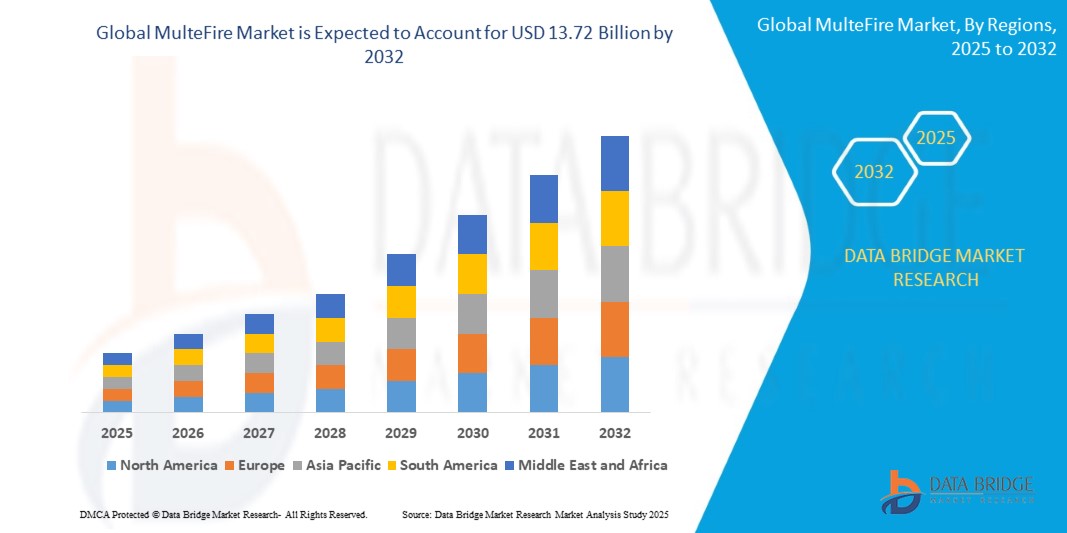
- The Global MulteFire Market was valued at USD 2.32 billion in 2024 and is projected to reach USD 13.72 billion by 2032, growing at a CAGR of 28.9% during the forecast period.
- This growth is fueled by increasing demand for private wireless networks, secure enterprise connectivity, and low-latency communication in industrial and urban environments.
MulteFire Market Analysis
- MulteFire is a wireless communication technology that enables LTE-like performance while operating entirely in unlicensed or shared spectrum, without needing licensed spectrum owned by traditional mobile network operators.
- The market is gaining momentum as industries seek cost-effective alternatives to public 5G for private LTE networks, especially in smart manufacturing, logistics, and utilities.
- MulteFire supports neutral host models, allowing multiple enterprises or tenants to share the same infrastructure for localized, high-performance wireless coverage.
- It is increasingly being adopted in industrial IoT and mission-critical environments where high reliability, security, and spectrum independence are essential.
- Growing emphasis on edge computing, low-latency applications, and interoperable IoT deployments is accelerating interest in MulteFire networks across the globe.
Report Scope and MulteFire Market Segmentation
|
Attributes |
MulteFire Market Key Market Insights |
|
Segments Covered |
|
|
Countries Covered |
North America
Europe
Asia-Pacific
Middle East and Africa
South America
|
|
Key Market Players |
|
|
Market Opportunities |
|
|
Value Added Data Infosets |
In addition to the insights on market scenarios such as market value, growth rate, segmentation, geographical coverage, and major players, the market reports curated by the Data Bridge Market Research also include import export analysis, production capacity overview, production consumption analysis, price trend analysis, climate change scenario, supply chain analysis, value chain analysis, raw material/consumables overview, vendor selection criteria, PESTLE Analysis, Porter Analysis, and regulatory framework. |
MulteFire Market Trends
Private Wireless Evolution and Edge-Driven Industrial Connectivity
- Shift Toward Private LTE/5G Without Licensed Spectrum: Enterprises are increasingly adopting MulteFire to gain the reliability of LTE/5G without the cost and complexity of acquiring licensed spectrum, especially in regions embracing shared and unlicensed spectrum access.
- Integration with Edge AI and IIoT Platforms: MulteFire is being deployed alongside edge computing and AI-powered IIoT systems to enable low-latency control, predictive analytics, and machine learning at the edge, particularly in manufacturing and logistics sectors.
- Rise of Neutral Host and Shared Infrastructure Models: Real estate developers and smart campuses are using MulteFire in neutral host configurations to provide indoor mobile coverage, enterprise connectivity, and tenant-specific services without relying on mobile carriers.
- Standardization and Global Regulatory Alignment: Organizations like the MulteFire Alliance and support from 3GPP and CBRS Alliance are driving global standardization, making the technology more accessible for telcos and non-telcos alike.
- Blurring Lines Between Wi-Fi and Cellular: MulteFire sits at the intersection of Wi-Fi’s ease of deployment and LTE’s performance, increasingly viewed as a middle-ground solution for scenarios that demand both mobility and security.
MulteFire Market Dynamics
Driver
Growing Demand for License-Free Private Wireless Networks in Industrial and Enterprise Environments
- As organizations seek to avoid dependence on telecom operators, private wireless networks using MulteFire technology are gaining popularity due to their license-free deployment, enhanced security, and low-latency capabilities.
- Industries such as manufacturing, logistics, utilities, and healthcare are turning to MulteFire to connect mission-critical devices in facilities where Wi-Fi may be unreliable or lack required mobility support
- With the emergence of smart factories and Industry 4.0, there’s a rising need for predictable and interference-resistant wireless infrastructure—an area where MulteFire outperforms legacy Wi-Fi systems.
- Government incentives for localized, secure communication networks in smart cities and public safety deployments are further encouraging adoption.
Restraint/Challenge
Device Ecosystem Limitations and Interference Management in Unlicensed Spectrum
- The limited availability of MulteFire-compatible end-user devices, especially smartphones and tablets, remains a challenge for broader adoption in commercial applications.
- Operating in unlicensed spectrum (e.g., 5 GHz) means MulteFire networks are subject to co-channel interference from Wi-Fi and other ISM band users, particularly in high-density environments.
- Awareness and technical understanding of MulteFire remains relatively low compared to Wi-Fi and Private 5G, which slows decision-making among enterprise IT buyers.
- Despite promising advantages, some verticals may hesitate due to integration complexity with legacy infrastructure and uncertainty around long-term support for the standard.
MulteFire Market Scope
The market is segmented by deployment type, application, frequency band, and end user, reflecting its broad applicability across industries seeking private and high-performance wireless connectivity.
• By Deployment Type
Includes Standalone and Neutral Host deployments. Standalone deployments lead in 2025 due to increasing use in private LTE/5G networks across manufacturing plants, logistics hubs, and remote field operations. Neutral host models are gaining traction in smart buildings, campuses, and shared public infrastructure.
• By Application
Covers Industrial IoT, Smart Cities, Enterprises, Public Safety, Retail, and Others. Industrial IoT holds the largest share in 2025, driven by demand for wireless automation, remote diagnostics, and secure machine connectivity. Smart cities and public safety applications are rapidly growing, utilizing MulteFire for real-time video, sensor feeds, and resilient communication networks.
• By Frequency Band
Segmented into Licensed, Unlicensed, and Shared Spectrum. Unlicensed spectrum dominates due to its availability and cost advantage, particularly in the 2.4 GHz and 5 GHz bands. Shared spectrum (e.g., CBRS in the U.S.) is expected to witness strong growth, enabling operators and enterprises to deploy hybrid models.
• By End User
Includes Manufacturing, Energy & Utilities, Transportation, Government, Healthcare, and Others. Manufacturing leads in 2025 due to adoption of MulteFire for smart factories, predictive maintenance, and robotics. Transportation and energy sectors are also deploying MulteFire for asset tracking, grid management, and field communication.
MulteFire Market Regional Analysis
- North America leads the market in 2025, driven by CBRS-based private network deployments, enterprise 5G pilots, and early adoption across logistics, ports, and manufacturing sectors. U.S.-based companies are leveraging MulteFire for secure, operator-independent wireless systems.
- Europe sees steady growth, especially in Germany, the U.K., and France, where regulatory frameworks around shared spectrum and industrial 5G trials are well-established. The region benefits from automotive and aerospace industries deploying MulteFire in smart factories and testing labs.
- Asia-Pacific is the fastest-growing region, with China, Japan, South Korea, and India embracing MulteFire in smart manufacturing, telecom R&D, and city digitization initiatives. The proliferation of unlicensed spectrum use and mobile-first enterprise models further supports adoption.
- Middle East and Africa (MEA) are gradually adopting MulteFire in energy & utilities, public safety, and smart infrastructure projects, particularly in UAE, Saudi Arabia, and South Africa, where hybrid private-public deployments are emerging.
- South America, particularly Brazil and Chile, is exploring MulteFire for connectivity in mining, ports, and rural smart grid applications, supported by growing awareness of private LTE/5G opportunities among regional ISPs and energy providers.
United States
The U.S. is at the forefront of the MulteFire market due to the success of CBRS shared spectrum initiatives, enterprise demand for license-free private networks, and government support for Industry 4.0 and smart logistics infrastructure.
Germany
Germany’s strong industrial base and supportive spectrum policies have led to widespread MulteFire trials in automotive manufacturing, logistics hubs, and research centers, accelerating its integration into digital factory ecosystems.
China
China is leveraging MulteFire in smart cities, surveillance, and energy distribution through partnerships between telecoms and municipal authorities. Local vendors are introducing low-cost MulteFire small cells and private EPC systems.
India
India is deploying MulteFire networks in state-run infrastructure, industrial corridors, and healthcare campuses, with government support for private 5G alternatives and startups offering edge AI and MulteFire-powered IoT solutions.
Brazil
Brazil is testing MulteFire solutions in remote mines, industrial zones, and power distribution sites, seeking cost-effective and rugged wireless networks where fiber and traditional mobile coverage are limited.
MulteFire Market Share
The MulteFire industry is primarily led by well-established companies, including:
- Qualcomm Technologies Inc. (U.S.)
- Nokia Corporation (Finland)
- Ericsson AB (Sweden)
- Huawei Technologies Co., Ltd. (China)
- Baicells Technologies Co., Ltd. (China)
- Airspan Networks Inc. (U.S.)
- Casa Systems Inc. (U.S.)
- Athonet Srl (a Hewlett Packard Enterprise company) (Italy
- ip.access Ltd. (U.K.)
- CommScope Inc. (U.S.)
Latest Developments in Global MulteFire Market
- In April 2025, Nokia Corporation launched a new line of MulteFire-compatible industrial base stations, targeting smart factories and logistics hubs. The release includes built-in edge computing capabilities and compatibility with CBRS and unlicensed bands.
- In March 2025, Qualcomm Technologies Inc. announced an updated MulteFire chipset platform optimized for Industry 4.0, providing better interference handling and improved battery life for connected sensors and wearables.
- In February 2025, Baicells Technologies introduced an affordable MulteFire small cell series for rural and enterprise deployments, enabling rapid rollout of private LTE networks in underserved regions.
- In January 2025, Hewlett Packard Enterprise (Athonet) launched a cloud-native MulteFire EPC platform designed for SMEs and remote sites, featuring zero-touch provisioning and AI-powered performance analytics.
- In December 2024, Ericsson announced a collaboration with a leading port authority in Europe to deploy a neutral host MulteFire network, enabling multi-tenant coverage for logistics, surveillance, and customs clearance.

- Interactive Data Analysis Dashboard
- Company Analysis Dashboard for high growth potential opportunities
- Research Analyst Access for customization & queries
- Competitor Analysis with Interactive dashboard
- Latest News, Updates & Trend analysis
- Harness the Power of Benchmark Analysis for Comprehensive Competitor Tracking
Global Multefire Market, Supply Chain Analysis and Ecosystem Framework
To support market growth and help clients navigate the impact of geopolitical shifts, DBMR has integrated in-depth supply chain analysis into its Global Multefire Market research reports. This addition empowers clients to respond effectively to global changes affecting their industries. The supply chain analysis section includes detailed insights such as Global Multefire Market consumption and production by country, price trend analysis, the impact of tariffs and geopolitical developments, and import and export trends by country and HSN code. It also highlights major suppliers with data on production capacity and company profiles, as well as key importers and exporters. In addition to research, DBMR offers specialized supply chain consulting services backed by over a decade of experience, providing solutions like supplier discovery, supplier risk assessment, price trend analysis, impact evaluation of inflation and trade route changes, and comprehensive market trend analysis.
Data collection and base year analysis are done using data collection modules with large sample sizes. The stage includes obtaining market information or related data through various sources and strategies. It includes examining and planning all the data acquired from the past in advance. It likewise envelops the examination of information inconsistencies seen across different information sources. The market data is analysed and estimated using market statistical and coherent models. Also, market share analysis and key trend analysis are the major success factors in the market report. To know more, please request an analyst call or drop down your inquiry.
The key research methodology used by DBMR research team is data triangulation which involves data mining, analysis of the impact of data variables on the market and primary (industry expert) validation. Data models include Vendor Positioning Grid, Market Time Line Analysis, Market Overview and Guide, Company Positioning Grid, Patent Analysis, Pricing Analysis, Company Market Share Analysis, Standards of Measurement, Global versus Regional and Vendor Share Analysis. To know more about the research methodology, drop in an inquiry to speak to our industry experts.
Data Bridge Market Research is a leader in advanced formative research. We take pride in servicing our existing and new customers with data and analysis that match and suits their goal. The report can be customized to include price trend analysis of target brands understanding the market for additional countries (ask for the list of countries), clinical trial results data, literature review, refurbished market and product base analysis. Market analysis of target competitors can be analyzed from technology-based analysis to market portfolio strategies. We can add as many competitors that you require data about in the format and data style you are looking for. Our team of analysts can also provide you data in crude raw excel files pivot tables (Fact book) or can assist you in creating presentations from the data sets available in the report.













