


Multi-Junction Solar Cell (Mj) Market Overview
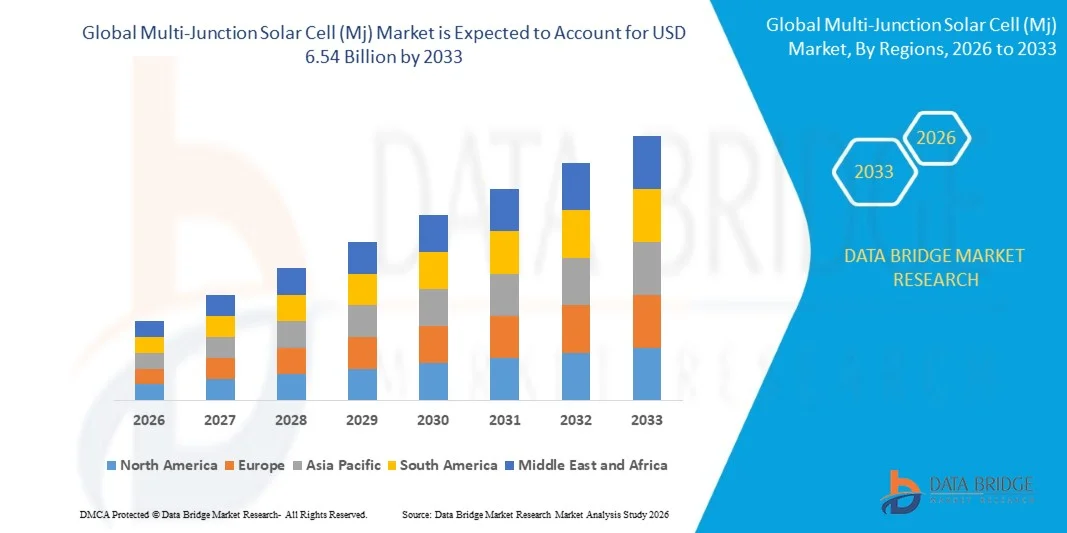
As per Data Bridge Market Research analysis The multi-junction solar cell (Mj) market was valued at USD 2.70 billion in 2025 and is projected to reach USD 6.54 billion by 2033, growing at a CAGR of 11.70% from 2026 to 2033. The market is witnessing steady expansion driven by increasing demand for ultra-high-efficiency photovoltaic technologies, rapid advancements in compound semiconductor materials, and rising deployment in space applications, concentrated solar power systems, and next-generation terrestrial solar installations.
The growing emphasis on renewable energy transition, combined with stringent global decarbonization targets and increasing investments in advanced solar R&D, is accelerating the adoption of multi-junction solar cell technologies. These cells, known for their superior conversion efficiency compared to conventional single-junction photovoltaics, are increasingly used in aerospace, defense satellites, and high-performance solar concentrators, enabling enhanced energy yield in limited-area installations and supporting long-term sustainability goals.
Market Size & Forecast
- Global Market Value (2025): USD 2.70 Billion
- Expected Market Value (2033): USD 6.54 Billion
- Forecast CAGR (2026–2033): 11.70%
- Leading Region in 2025: North America
- Fastest Growing Region: Asia Pacific
Key Market Trends & Insights
- North America dominated the global multi-junction solar cell (Mj) market with the largest revenue share of 36.12% in 2025, supported by strong aerospace demand, advanced space programs, and high R&D investment in III-V compound semiconductors.
- The Space PV segment led the market with a 62.4% share in 2025, driven by extensive deployment in satellites, space probes, and orbital power systems requiring extremely high efficiency and radiation resistance.
- Asia-Pacific is expected to be the fastest-growing region at a CAGR of 7.8% from 2026 to 2033, fueled by expanding semiconductor manufacturing capabilities, rising investments in renewable energy technologies, and increasing participation in space programs across China, India, and Japan.
- Terrestrial CPV are the fastest-growing product type, projected to register a CAGR of 8.1%, reflecting the surge in demand for ultra-high-efficiency ground-based solar power systems.
- The Gallium Arsenide (GaAs)-Based Cells segment dominated the material category with a 46.7% revenue share in 2025, led by its superior efficiency, strong radiation tolerance, and long-term stability in space environments.
- Mars Rover Missions accounted for 38.9% of the market, preferred by the strong demand for reliable, high-efficiency power systems in planetary exploration programs.
- The Electricity Generation segment is the fastest-growing application category, with a CAGR of 8.4%, driven by increasing adoption of concentrated photovoltaic systems and renewable energy expansion
Report Scope and Multi-Junction Solar Cell (Mj) Market Segmentation
|
Attributes |
Multi-Junction Solar Cell (Mj) Key Market Insights |
|
Segments Covered |
|
|
Countries Covered |
North America · U.S. · Canada · Mexico Europe · Germany · France · U.K. · Netherlands · Switzerland · Belgium · Russia · Italy · Spain · Turkey · Rest of Europe Asia-Pacific · China · Japan · India · South Korea · Singapore · Malaysia · Australia · Thailand · Indonesia · Philippines · Rest of Asia-Pacific Middle East and Africa · Saudi Arabia · U.A.E. · South Africa · Egypt · Israel · Rest of Middle East and Africa South America · Brazil · Argentina · Rest of South America |
|
Key Market Players |
· AZUR SPACE Solar Power GmbH (Germany) · Spectrolab (U.S.) · CESI S.p.A. (Italy) · First Solar, Inc. (U.S.) · Canadian Solar Inc. (Canada) · JinkoSolar Holding Co., Ltd. (China) · Trinasolar Co., Ltd. (China) · LONGi Green Energy Technology Co., Ltd. (China) · JA SOLAR Technology Co., Ltd. (China) · Hanwha Solutions Corporation (South Korea) · Sharp Corporation (Japan) · Mitsubishi Electric Corporation (Japan) · San'an Optoelectronics Co., Ltd. (China) · VPEC (Taiwan) · Arima Group (Taiwan) · IQE plc (U.K.) · Microlink Devices, Inc. (U.S.) · Oxford PV Ltd (U.K.) · Solaires Entreprises Inc. (Canada) · dhv technology S.L. (Spain) |
|
Market Opportunities |
· Rising demand for ultra-high-efficiency solar power systems · Expansion of concentrated photovoltaic (CPV) and hybrid solar systems · Increasing investments in next-generation III-V semiconductor manufacturing |
|
Value Added Data Infosets |
In addition to the insights on market scenarios such as market value, growth rate, segmentation, geographical coverage, and major players, the market reports curated by the Data Bridge Market Research also include in-depth expert analysis, geographically represented company-wise production and capacity, network layouts of distributors and partners, detailed and updated price trend analysis and deficit analysis of supply chain and demand. |
Multi-Junction Solar Cell (Mj) Market Trends
Trend: Expansion in Space and Satellite Power Systems
Multi-junction solar cells are increasingly becoming the preferred photovoltaic technology for space-based applications due to their unmatched efficiency, compact design, and superior performance under extreme radiation conditions. Unlike conventional silicon cells, they use stacked semiconductor layers to capture a broader spectrum of sunlight, making them ideal for missions where space, weight, and reliability are critical constraints. Their adoption is expanding in communication satellites, earth observation systems, and deep-space exploration missions, where uninterrupted power generation is essential over long operational lifespans. Continuous advancements in III-V compound semiconductor engineering are further improving energy conversion efficiency and reducing performance degradation in harsh orbital environments.
For instance, NASA and ESA missions such as Mars orbiters and deep-space probes rely on multi-junction solar arrays to maintain stable power output far beyond Earth’s orbit, ensuring continuous operation of scientific instruments and communication systems throughout mission lifecycles.
Multi-Junction Solar Cell (Mj) Market Dynamics
Key Market Driver: Rising Demand for High-Efficiency Renewable Power Systems
The global shift toward high-efficiency renewable energy technologies is significantly driving the demand for multi-junction solar cells, particularly in applications where maximum energy output per unit area is critical. These cells outperform traditional photovoltaic technologies by combining multiple semiconductor layers that capture different wavelengths of sunlight, enabling conversion efficiencies far above conventional silicon-based systems. Governments, aerospace agencies, and advanced technology firms are investing heavily in next-generation solar research to support energy-intensive applications in satellites, defense systems, and concentrated solar power platforms. Their ability to deliver reliable performance in space-constrained environments makes them highly valuable for missions requiring compact yet powerful energy solutions.
For instance, commercial satellite networks used for broadband connectivity and earth monitoring deploy multi-junction solar panels to ensure continuous high-efficiency power generation, even in low-light orbital conditions and extended mission durations.
Key Restraint/Challenge: High Manufacturing Cost and Complex Fabrication
Despite their superior performance, the widespread commercialization of multi-junction solar cells is significantly restricted by their high production cost and technically complex manufacturing processes. These cells require highly specialized epitaxial growth techniques, precise material layering, and expensive III-V semiconductor compounds such as gallium arsenide, which collectively increase production time and capital investment requirements. The fabrication process also demands stringent quality control to maintain lattice matching between layers, making large-scale production both challenging and cost-inefficient compared to silicon-based photovoltaics. As a result, their usage remains concentrated in high-budget sectors where performance outweighs cost considerations.
For instance, satellite manufacturing programs operated by space agencies and defense organizations continue to rely on limited-volume, high-cost multi-junction solar modules because alternative technologies cannot meet their strict efficiency and durability requirements in orbital conditions.
Key Market Opportunity: Advancements in Terrestrial Concentrated Solar Applications
Emerging innovations in concentrated photovoltaic systems are opening new commercial opportunities for multi-junction solar cells beyond traditional aerospace applications, particularly in high-solar-irradiance regions. By using optical concentrators such as lenses and mirrors, sunlight intensity can be significantly amplified before reaching the solar cell, allowing these high-efficiency devices to generate substantially greater power output. Ongoing advancements in thermal management systems, tracking technologies, and cost-reduction strategies are improving system viability for utility-scale renewable energy projects. This is encouraging pilot deployments in desert and arid regions where sunlight is abundant and land efficiency is a priority.
For instance, experimental concentrated solar power plants in desert climates deploy multi-junction cell-based modules to achieve higher energy conversion efficiency compared to conventional solar farms, demonstrating strong potential for future large-scale renewable energy integration.
Multi-Junction Solar Cell (Mj) Market Scope
The multi-junction solar cell (Mj) market is segmented on the basis of product, material, and application
- By Product
On the basis of product, the market is segmented into Space PV and Terrestrial CPV. The Space PV segment dominated the market with a share of 62.4% in 2025, driven by extensive deployment in satellites, space probes, and orbital power systems requiring extremely high efficiency and radiation resistance. Space PV systems are essential for communication satellites, defense surveillance platforms, and deep-space exploration missions where reliability is mission-critical. Their ability to operate efficiently in extreme temperature variations and radiation-heavy environments makes them the preferred choice for aerospace applications. Continuous investments from NASA, ESA, and commercial space companies are further strengthening demand. High lifespan, zero-maintenance requirements, and proven operational stability reinforce their dominant position.
The Terrestrial CPV segment is expected to be the fastest growing, with a CAGR of 8.1% from 2026 to 2033, driven by increasing demand for ultra-high-efficiency ground-based solar power systems. CPV technology enhances energy yield by concentrating sunlight onto multi-junction cells, making it highly suitable for high-irradiance regions such as deserts. Advancements in optical concentrators, tracking systems, and thermal management are improving efficiency and reducing losses. Declining system costs are gradually improving commercial viability beyond pilot projects. Rising renewable energy investments globally are accelerating deployment in utility-scale solar farms.
- By Material
On the basis of material, the market is segmented into Gallium Arsenide (GaAs)-Based Cells, Indium Gallium Phosphide (InGaP), Germanium (Ge) Substrates, III-V Compound Semiconductors, and Other Advanced Compound Materials. The Gallium Arsenide (GaAs)-Based Cells segment dominated the market with a share of 46.7% in 2025, due to its superior efficiency, strong radiation tolerance, and long-term stability in space environments. GaAs-based cells are widely used in satellites and aerospace systems where performance reliability outweighs cost considerations. Their ability to maintain efficiency under extreme thermal and radiation stress makes them ideal for orbital missions. Continuous improvements in epitaxial wafer fabrication are enhancing performance consistency. Despite high production costs, strong demand from defense and space sectors sustains dominance.
The III-V Compound Semiconductors segment is expected to be the fastest growing, with a CAGR of 7.6% from 2026 to 2033, driven by rising innovation in tandem and multi-layer photovoltaic architectures. These materials enable precise bandgap engineering, significantly improving energy conversion efficiency across the solar spectrum. Expanding R&D in advanced semiconductor fabrication is accelerating commercialization potential. Their adaptability for both space-grade and high-end terrestrial applications is increasing adoption scope. Improvements in scalability and material engineering are gradually reducing cost barriers, supporting broader deployment.
- By Application
On the basis of application, the market is segmented into bandgap engineering for microclimates, electricity generation, and mars rover missions. The Mars Rover Missions segment dominated the market with a share of 38.9% in 2025, driven by strong demand for reliable, high-efficiency power systems in planetary exploration programs. Multi-junction solar cells are essential for Mars missions due to their ability to operate under low sunlight, dust accumulation, and extreme temperature fluctuations. Their lightweight structure and high energy density make them ideal for rover mobility and scientific instrumentation. Continuous expansion of interplanetary exploration programs is reinforcing long-term demand. Space agencies prioritize these cells for mission-critical reliability in extraterrestrial environments.
The Electricity Generation segment is expected to be the fastest growing, with a CAGR of 8.4% from 2026 to 2033, supported by increasing adoption of concentrated photovoltaic systems and renewable energy expansion. Multi-junction cells deliver superior efficiency compared to conventional solar technologies, making them attractive for next-generation high-output solar farms. Growing global focus on decarbonization and clean energy transition is accelerating investments. Technological improvements in optical concentration and thermal stability are enhancing commercial viability. Expanding utility-scale renewable projects in high-sunlight regions are further driving growth.
Multi-Junction Solar Cell (Mj) Market Regional Analysis
North America dominated the global multi-junction solar cell (Mj) market with the largest revenue share of 36.12% in 2025, supported by strong aerospace demand, advanced space programs, and high R&D investment in III-V compound semiconductors. The region benefits from the presence of leading space agencies and commercial space companies driving large-scale deployment of high-efficiency solar cells for satellites and deep-space missions. Increasing focus on next-generation space exploration programs, coupled with strong demand for high-performance photovoltaic systems in defense applications, continues to reinforce regional leadership. Continuous innovation in tandem solar architectures and strong government-backed research initiatives further strengthen North America’s dominance in the global market.
U.S. Multi-Junction Solar Cell (Mj) Market Insight
The U.S. multi-junction solar cell (Multi-junction solar cell) market is witnessing strong growth due to rising investments in space exploration programs, advanced satellite deployment, and high R&D activity in III-V semiconductor technologies. The country’s leadership in aerospace and defense, along with strong participation from commercial space companies, is driving demand for ultra-high-efficiency photovoltaic systems. Increasing focus on deep-space missions, satellite communications, and next-generation defense applications is further accelerating adoption. In addition, government-backed innovation programs and private-sector investments in space technology are reinforcing the U.S. position as a global leader in this market.
Europe Multi-Junction Solar Cell Market Insight
The Europe multi-junction solar cell market remains a key contributor to global revenue, driven by strong space research initiatives, advanced photovoltaic innovation, and increasing collaboration between government agencies and research institutions. The region benefits from well-established aerospace programs and a growing focus on sustainable and high-efficiency energy systems. Rising investments in satellite technology and renewable energy R&D are supporting market expansion across major economies. In addition, strong emphasis on technological innovation in compound semiconductors and solar efficiency improvements continues to enhance adoption across the region.
U.K. Multi-Junction Solar Cell Market Insight
The U.K. multi-junction solar cell market is experiencing steady growth, supported by increasing investments in space technology, satellite communications, and advanced photovoltaic research programs. The presence of strong academic institutions and aerospace research centers is fostering innovation in high-efficiency solar cell design. Growing participation in international space missions and satellite development programs is further driving demand. In addition, integration of advanced semiconductor research with defense and aerospace applications is positioning the U.K. as an important innovation hub in this market.
Germany Multi-Junction Solar Cell Market Insight
The Germany multi-junction solar cell market is expanding steadily due to strong semiconductor research capabilities, advanced engineering infrastructure, and growing focus on renewable energy innovation. Research institutions and technology companies are increasingly investing in high-efficiency photovoltaic systems for both aerospace and concentrated solar applications. The country’s emphasis on precision engineering and material science is supporting advancements in III-V compound semiconductors. Furthermore, collaboration between industrial and academic sectors is strengthening innovation in next-generation solar technologies.
Asia-Pacific Multi-Junction Solar Cell Market Insight
The Asia-Pacific multi-junction solar cell market is expected to witness rapid growth, driven by expanding space programs, rising investments in semiconductor manufacturing, and increasing focus on renewable energy technologies in countries such as China, India, and Japan. Growing demand for satellite-based communication systems and earth observation missions is accelerating adoption. In addition, strong government support for space exploration and clean energy initiatives is boosting regional market expansion. Rapid technological advancement and cost-efficient manufacturing capabilities are further positioning Asia-Pacific as a high-growth region.
Japan Multi-Junction Solar Cell Market Insight
The Japan multi-junction solar cell market is witnessing consistent growth due to strong investments in space research, advanced materials science, and high-efficiency photovoltaic technologies. The country’s established aerospace agencies and electronics manufacturers are actively contributing to innovation in compound semiconductor-based solar cells. Increasing focus on satellite missions and deep-space exploration is further driving demand. Moreover, Japan’s emphasis on precision engineering and long-term reliability in energy systems continues to support market development.
China Multi-Junction Solar Cell Market Insight
The China multi-junction solar cell market is growing rapidly, driven by increasing investments in space programs, satellite deployment, and advanced semiconductor manufacturing capabilities. Government-backed initiatives in aerospace development and renewable energy innovation are significantly boosting demand for high-efficiency solar technologies. Expanding research in III-V compound materials and strong industrial scaling capacity are further supporting market growth. In addition, rising participation in global space exploration and satellite communication networks is positioning China as one of the fastest-growing markets worldwide.
Multi-Junction Solar Cell (Mj) Market Share
The multi-junction solar cell (Mj) industry is primarily led by well-established companies, including:
- AZUR SPACE Solar Power GmbH (Germany)
- Spectrolab (U.S.)
- CESI S.p.A. (Italy)
- First Solar, Inc. (U.S.)
- Canadian Solar Inc. (Canada)
- JinkoSolar Holding Co., Ltd. (China)
- Trinasolar Co., Ltd. (China)
- LONGi Green Energy Technology Co., Ltd. (China)
- JA SOLAR Technology Co., Ltd. (China)
- Hanwha Solutions Corporation (South Korea)
- Sharp Corporation (Japan)
- Mitsubishi Electric Corporation (Japan)
- San'an Optoelectronics Co., Ltd. (China)
- VPEC (Taiwan)
- Arima Group (Taiwan)
- IQE plc (U.K.)
- Microlink Devices, Inc. (U.S.)
- Oxford PV Ltd (U.K.)
- Solaires Entreprises Inc. (Canada)
- dhv technology S.L. (Spain)
Latest Developments in Multi-Junction Solar Cell (Mj) Market
- In October 2024, Boeing Spectrolab expanded its production capabilities for advanced multi-junction solar cells used in satellites and high-reliability space missions. The expansion supports increasing demand from commercial satellite operators and defense agencies requiring high-efficiency, radiation-resistant photovoltaic systems. Spectrolab’s III-V compound semiconductor technology continues to set industry benchmarks for space-grade solar performance. This development reflects the growing industrial scaling of ultra-high-efficiency solar technologies for aerospace applications
- In April 2023, the European Space Agency (ESA) successfully launched the Jupiter Icy Moons Explorer (JUICE) mission, which utilizes advanced multi-junction solar cell-based arrays to generate power in extremely low solar irradiance conditions near Jupiter. These high-efficiency III-V solar cells enable long-duration deep-space exploration by maintaining stable energy output far from the Sun, where conventional photovoltaics would be ineffective. The mission demonstrates the critical role of multi-junction technology in next-generation planetary exploration and strengthens its importance in aerospace power systems
- In July 2022, Fraunhofer Institute for Solar Energy Systems (ISE) reported advancements in multi-junction solar cell efficiency research, focusing on III-V compound semiconductor architectures and bandgap optimization. The research achieved significant improvements in laboratory conversion efficiency, pushing the limits of photovoltaic performance for both space and concentrated solar applications. These developments are critical for reducing future energy losses and improving scalability of next-generation solar technologies. Fraunhofer ISE’s work continues to support commercialization pathways for ultra-high-efficiency photovoltaic systems
- In January 2022, Rocket Lab announced the completion of its acquisition of SolAero Holdings, a leading manufacturer of space-grade multi-junction solar cells used in satellites and defense applications. This acquisition significantly enhanced Rocket Lab’s ability to produce high-efficiency photovoltaic systems for spacecraft, integrating solar cell manufacturing directly into its space systems portfolio. SolAero’s advanced III-V multi-junction technology is widely used in commercial and military satellite platforms. The move strengthened supply chain control and expanded production capacity for next-generation space energy systems
- In August 2021, AZUR SPACE Solar Power GmbH advanced its development of triple-junction GaAs-based solar cells designed for high-radiation space environments and satellite power systems. These cells offer superior efficiency and long-term stability under extreme thermal and radiation conditions encountered in orbit. The technology is widely used in commercial, scientific, and defense satellite missions worldwide. This development reinforces AZUR SPACE’s position as a key supplier of space-grade multi-junction photovoltaic technology

- Interactive Data Analysis Dashboard
- Company Analysis Dashboard for high growth potential opportunities
- Research Analyst Access for customization & queries
- Competitor Analysis with Interactive dashboard
- Latest News, Updates & Trend analysis
- Harness the Power of Benchmark Analysis for Comprehensive Competitor Tracking
Global Multi Junction Solar Cell Mj Market, Supply Chain Analysis and Ecosystem Framework
To support market growth and help clients navigate the impact of geopolitical shifts, DBMR has integrated in-depth supply chain analysis into its Global Multi Junction Solar Cell Mj Market research reports. This addition empowers clients to respond effectively to global changes affecting their industries. The supply chain analysis section includes detailed insights such as Global Multi Junction Solar Cell Mj Market consumption and production by country, price trend analysis, the impact of tariffs and geopolitical developments, and import and export trends by country and HSN code. It also highlights major suppliers with data on production capacity and company profiles, as well as key importers and exporters. In addition to research, DBMR offers specialized supply chain consulting services backed by over a decade of experience, providing solutions like supplier discovery, supplier risk assessment, price trend analysis, impact evaluation of inflation and trade route changes, and comprehensive market trend analysis.
Data collection and base year analysis are done using data collection modules with large sample sizes. The stage includes obtaining market information or related data through various sources and strategies. It includes examining and planning all the data acquired from the past in advance. It likewise envelops the examination of information inconsistencies seen across different information sources. The market data is analysed and estimated using market statistical and coherent models. Also, market share analysis and key trend analysis are the major success factors in the market report. To know more, please request an analyst call or drop down your inquiry.
The key research methodology used by DBMR research team is data triangulation which involves data mining, analysis of the impact of data variables on the market and primary (industry expert) validation. Data models include Vendor Positioning Grid, Market Time Line Analysis, Market Overview and Guide, Company Positioning Grid, Patent Analysis, Pricing Analysis, Company Market Share Analysis, Standards of Measurement, Global versus Regional and Vendor Share Analysis. To know more about the research methodology, drop in an inquiry to speak to our industry experts.
Data Bridge Market Research is a leader in advanced formative research. We take pride in servicing our existing and new customers with data and analysis that match and suits their goal. The report can be customized to include price trend analysis of target brands understanding the market for additional countries (ask for the list of countries), clinical trial results data, literature review, refurbished market and product base analysis. Market analysis of target competitors can be analyzed from technology-based analysis to market portfolio strategies. We can add as many competitors that you require data about in the format and data style you are looking for. Our team of analysts can also provide you data in crude raw excel files pivot tables (Fact book) or can assist you in creating presentations from the data sets available in the report.













