


Multi-Med Adherence Packaging Market Size
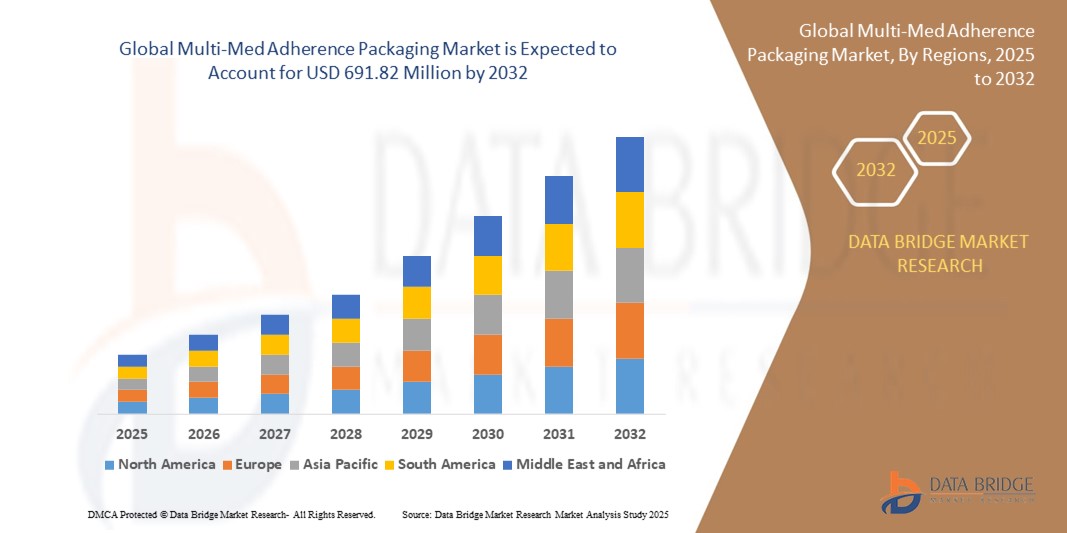
- The global multi-med adherence packaging market size was valued at USD 427.56 million in 2024 and is expected to reach USD 691.82 million by 2032, at a CAGR of 6.2% during the forecast period
- The market growth is largely fueled by the increasing prevalence of chronic diseases, rising polypharmacy cases, and growing awareness of medication adherence among patients and healthcare providers, leading to higher adoption of multi-med adherence packaging solutions across hospitals, retail pharmacies, and long-term care facilities
- Furthermore, the demand for efficient, accurate, and patient-friendly medication management solutions is driving the adoption of automated packaging systems, pre-filled pouches, blister packs, and other adherence-focused packaging formats. These converging factors are accelerating the uptake of multi-med adherence packaging solutions, thereby significantly boosting the market’s growth
Multi-Med Adherence Packaging Market Analysis
- Multi-med adherence packaging solutions are designed to organize, dispense, and track multiple medications for patients, ensuring proper dosing and improving compliance. These systems include blister packs, pouches, automated dispensers, and digital monitoring devices that streamline medication management in hospitals, pharmacies, and long-term care facilities
- The escalating demand for multi-med adherence packaging is primarily fueled by the need to reduce medication errors, enhance patient compliance, and support healthcare providers in managing complex medication regimens. Growing investments in healthcare infrastructure, technological advancements in packaging, and rising patient-centric care initiatives are further driving market expansion
- North America dominated the multi-med adherence packaging market with a share of 33.5% in 2024, due to the rising need for medication adherence solutions across hospitals, retail pharmacies, and long-term care facilities
- Asia-Pacific is expected to be the fastest growing region in the multi-med adherence packaging market during the forecast period due to rising chronic disease prevalence, increasing healthcare infrastructure investments, and growing awareness of medication adherence among patients and caregivers
- Plastic segment dominated the market with a market share of 56.5% in 2024, due to its durability, lightweight nature, and cost-effectiveness. Plastic materials offer excellent protection against moisture, contamination, and breakage, ensuring the integrity of medications over their shelf life. In addition, plastic-based packaging is highly versatile, allowing for customized designs, color coding, and compartmentalization to improve patient adherence. The widespread use of plastic in retail and hospital pharmacy settings further strengthens its market dominance. Moreover, its compatibility with automated packaging machinery supports large-scale production efficiently
Report Scope and Multi-Med Adherence Packaging Market Segmentation
|
Attributes |
Multi-Med Adherence Packaging Key Market Insights |
|
Segments Covered |
|
|
Countries Covered |
North America
Europe
Asia-Pacific
Middle East and Africa
South America
|
|
Key Market Players |
|
|
Market Opportunities |
|
|
Value Added Data Infosets |
In addition to the insights on market scenarios such as market value, growth rate, segmentation, geographical coverage, and major players, the market reports curated by the Data Bridge Market Research also include import export analysis, production capacity overview, production consumption analysis, price trend analysis, climate change scenario, supply chain analysis, value chain analysis, raw material/consumables overview, vendor selection criteria, PESTLE Analysis, Porter Analysis, and regulatory framework. |
Multi-Med Adherence Packaging Market Trends
Increasing Adoption of Eco-Friendly Packaging
- The multi-med adherence packaging market is witnessing accelerated growth as manufacturers respond to environmental pressures by introducing recyclable and biodegradable packaging solutions. Eco-friendly materials such as paper-based pouches and recyclable plastics are replacing traditional formats to meet rising sustainability expectations
- For instance, Jones Healthcare Group has launched recyclable blister packs and sustainable adherence packaging systems widely adopted in hospital pharmacies. Other market leaders are developing innovative green packaging formats to comply with global regulations and consumer preference for responsible healthcare solutions
- Technological innovation is driving expansion with the incorporation of artificial intelligence, RFID tracking, and smart dose recording systems. These advancements enable precise monitoring of patient adherence, reduce medication errors, and facilitate data-driven improvements in medication management
- Growing focus on personalized health and home-based care is increasing demand for user-friendly multi-med adherence packaging. People with chronic illnesses, elderly patients and caregivers are favoring pre-sorted medication packs that simplify scheduling and support independence at home
- The market is shaped by ongoing regulatory changes, which require stringent traceability and patient safety standards. Compliant eco-packaging formats and enhanced track-and-trace features directly impact purchasing decisions of hospitals, insurers, and retail pharmacies globally
- Major industry players are pursuing modular and scalable packaging designs to accommodate pharmaceutical supply chain variability. Flexible packaging lines increase efficiency and allow rapid adjustments to new drug regimens, seasonal demand shifts, and specific patient adherence needs
Multi-Med Adherence Packaging Market Dynamics
Driver
Rising Aging Population
- An expanding aging population and increased prevalence of chronic diseases are central drivers of the market. Elderly patients require tailored multi-med adherence packaging to streamline complex medication routines and improve therapeutic outcomes
- For instance, Omnicell’s MedTrack RFID solutions support medication management for older adults in hospitals and long-term care facilities. The CDC reports 42 percent of U.S. adults live with two or more chronic conditions, creating consistent demand for patient-specific adherence systems
- Home healthcare adoption is fueling market growth as more seniors choose outpatient medication management. Automated blister and pouch packaging systems enhance adherence, reduce hospitalizations, and optimize care outcomes for elderly individuals managing multiple prescriptions
- Government agencies and insurers increasingly incentivize value-based care protocols requiring proof of medication compliance. Multi-med adherence packaging solutions help meet regulatory mandates and support payer investments in adherence-focused patient care
- Advances in pharmacy automation and digital refill reminders are streamlining the dispensing of multi-medicine packs for seniors. These innovative systems improve operational efficiency and accuracy for providers serving aging populations with complex therapeutic regimens
Restraint/Challenge
High Initial Costs of Implementation
- Significant up-front costs for packaging equipment, integration, and staff training pose a major challenge for rapid adoption, particularly among smaller healthcare facilities and regional pharmacies. Investment hurdles remain a barrier to scaling modern adherence packaging solutions
- For instance, industry surveys indicate more than half of independent pharmacies in the U.S. cite cost constraints as a reason for slower automation deployment. The need for specialized staff and ongoing system maintenance further increases total ownership expenses
- Technical complexity of advanced solutions such as RFID-enabled packs, robotics, and AI-driven dispensing requires substantial investment in infrastructure. Facilities must allocate resources for rigorous testing, integration with legacy systems, and customer education
- Return on investment can be gradual given the compliance, maintenance, and upgrade requirements. Smaller institutions often face long payback periods and must justify costs against immediate operating and staffing needs in competitive healthcare markets
- Continuous fluctuations in raw material pricing for eco-friendly packs and limited supply chain scalability can inhibit broader adoption. Market participants must balance sustainability benefits with economic feasibility to meet diverse customer budgets and operational capacities
Multi-Med Adherence Packaging Market Scope
The market is segmented on the basis of material, packaging type, and end user.
- By Material
On the basis of material, the multi-med adherence packaging market is segmented into plastic, paper, and aluminium. The plastic segment dominated the largest market revenue share of 56.5% in 2024, driven by its durability, lightweight nature, and cost-effectiveness. Plastic materials offer excellent protection against moisture, contamination, and breakage, ensuring the integrity of medications over their shelf life. In addition, plastic-based packaging is highly versatile, allowing for customized designs, color coding, and compartmentalization to improve patient adherence. The widespread use of plastic in retail and hospital pharmacy settings further strengthens its market dominance. Moreover, its compatibility with automated packaging machinery supports large-scale production efficiently.
The aluminium segment is anticipated to witness the fastest growth rate from 2025 to 2032, fueled by increasing demand for high-barrier packaging that offers superior protection against light, moisture, and oxygen. Aluminium packaging ensures extended shelf life of medications, particularly for sensitive formulations, making it popular in hospital and long-term care facilities. Growing awareness among patients and healthcare providers regarding medication stability and safety is accelerating the adoption of aluminium-based multi-med adherence packaging. Its recyclability and environmental benefits further contribute to market expansion, along with technological advancements enabling easy-to-use blister formats.
- By Packaging Type
On the basis of packaging type, the market is segmented into pouches, blister packs, and strips. The blister packs segment dominated the largest market revenue share in 2024, owing to its organized layout, ease of individual dose dispensing, and ability to prevent medication errors. Blister packs also enhance patient adherence by providing clear labeling, day-and-time markers, and compartmentalization for multiple medications. Their compatibility with automated packaging systems and wide acceptance in retail pharmacies and hospitals reinforce their market dominance. Furthermore, blister packs are convenient for home use and long-term care settings, offering protection against contamination and environmental factors.
The pouches segment is expected to witness the fastest growth from 2025 to 2032, driven by demand for flexible, lightweight, and portable packaging solutions that cater to on-the-go patients and homecare settings. Pouches provide customization options such as resealable closures, multi-compartment designs, and tamper-evident features, improving user convenience and adherence. The growth of e-pharmacy and home delivery services is accelerating the adoption of pouch packaging. In addition, technological developments enabling easy filling, labeling, and automation are boosting the popularity of this segment in both retail and institutional markets.
- By End User
On the basis of end user, the market is segmented into retail pharmacies, hospitals, and long-term care facilities. The retail pharmacies segment dominated the largest market revenue share in 2024, driven by the growing trend of patient-centric healthcare and the rising need for convenient multi-med adherence solutions at the point of sale. Retail pharmacies benefit from offering packaged solutions that simplify complex medication schedules, reduce dosing errors, and improve patient compliance. The widespread availability of adherence packaging in urban and semi-urban pharmacy outlets enhances market penetration. Furthermore, retail pharmacies leverage innovative packaging designs, labeling, and reminders to encourage repeat usage, solidifying the dominance of this segment.
The long-term care facilities segment is anticipated to witness the fastest growth from 2025 to 2032, fueled by the increasing geriatric population and rising prevalence of chronic diseases requiring polypharmacy. Multi-med adherence packaging helps care facilities streamline medication administration, minimize errors, and ensure adherence for residents. Growing investments in senior care infrastructure and adoption of automated medication management systems are supporting the rapid uptake of these solutions. In addition, regulatory emphasis on patient safety and quality of care further accelerates demand from long-term care facilities.
Multi-Med Adherence Packaging Market Regional Analysis
- North America dominated the multi-med adherence packaging market with the largest revenue share of 33.5% in 2024, driven by the rising need for medication adherence solutions across hospitals, retail pharmacies, and long-term care facilities
- The region benefits from high healthcare expenditure, advanced pharmaceutical infrastructure, and growing awareness among patients and caregivers regarding polypharmacy management
- Widespread adoption of automated packaging systems and technological innovations in adherence packaging, such as pre-filled pouches and blister packs, further bolster market growth
U.S. Multi-Med Adherence Packaging Market Insight
The U.S. market captured the largest revenue share within North America in 2024, fueled by the expanding trend of patient-centric care and chronic disease management. Hospitals, retail pharmacies, and long-term care facilities are increasingly adopting multi-med adherence packaging to reduce medication errors and improve patient compliance. Technological advancements, including automated filling, labeling, and customized blister packs, support efficient deployment at scale. In addition, regulatory emphasis on patient safety, combined with a high prevalence of polypharmacy, drives demand for organized and reliable medication management solutions.
Europe Multi-Med Adherence Packaging Market Insight
The Europe market is projected to grow at a significant CAGR during the forecast period, driven by increasing awareness of medication adherence, stringent healthcare regulations, and the rising need to manage chronic illnesses effectively. Adoption is being fueled by hospitals, pharmacies, and long-term care facilities seeking standardized, efficient packaging solutions. European consumers and healthcare providers value the convenience, accuracy, and patient safety benefits offered by multi-med adherence packaging. Investments in automation and innovations such as color-coded and time-stamped packaging are accelerating adoption across residential, hospital, and institutional settings.
U.K. Multi-Med Adherence Packaging Market Insight
The U.K. market is anticipated to witness robust growth during the forecast period, driven by the demand for improved medication management and adherence in hospitals and care facilities. Increasing polypharmacy cases, an aging population, and rising awareness of patient safety are encouraging widespread adoption of multi-med adherence packaging. The country’s well-established healthcare infrastructure, combined with supportive policies for patient-centric solutions, facilitates growth in both retail pharmacy and long-term care segments.
Germany Multi-Med Adherence Packaging Market Insight
Germany is expected to expand at a considerable CAGR, supported by a technologically advanced healthcare ecosystem and emphasis on patient-centric medication management. Multi-med adherence packaging is being increasingly integrated into hospitals, pharmacies, and long-term care facilities to minimize errors and enhance patient compliance. Sustainability considerations, coupled with innovations in packaging materials such as recyclable plastic and aluminium, are also driving adoption across the country.
Asia-Pacific Multi-Med Adherence Packaging Market Insight
The Asia-Pacific market is poised to grow at the fastest CAGR during the forecast period, fueled by rising chronic disease prevalence, increasing healthcare infrastructure investments, and growing awareness of medication adherence among patients and caregivers. Countries such as China, Japan, and India are witnessing higher adoption due to the expanding middle class, urbanization, and government initiatives promoting healthcare modernization. Multi-med adherence packaging solutions are becoming more accessible and affordable as APAC emerges as a hub for pharmaceutical packaging innovation and manufacturing.
Japan Multi-Med Adherence Packaging Market Insight
Japan is experiencing growth due to its aging population, high focus on patient safety, and widespread adoption of advanced healthcare technologies. Hospitals and long-term care facilities are implementing multi-med adherence packaging to ensure accurate dosing and compliance. The integration of digital solutions with packaging, such as automated dispensing and tracking systems, further enhances market expansion.
China Multi-Med Adherence Packaging Market Insight
China accounted for the largest market revenue share in Asia-Pacific in 2024, driven by rapid urbanization, a growing elderly population, and increasing prevalence of chronic diseases. Expanding retail pharmacy chains, hospital networks, and long-term care facilities are adopting multi-med adherence packaging to improve patient compliance. Government initiatives promoting healthcare modernization and smart medication management, along with domestic manufacturing capabilities, are key factors propelling market growth.
Multi-Med Adherence Packaging Market Share
The multi-med adherence packaging industry is primarily led by well-established companies, including:
- Omnicell, Inc. (U.S.)
- Parata Systems, LLC (U.S.)
- AARDEX Group (Switzerland)
- Aptar CSP Technologies, Inc. (U.S.)
- Jones Healthcare Group (Canada)
- MCKESSON CORPORATION (U.S.)
- Euclid Medical Products (U.S.)
- Baxter (U.S.)
- Medicine-On-Time, LLC (U.S.)
- Cardinal Health (U.S.)
Latest Developments in Global Multi-Med Adherence Packaging Market
- In October 2024, JFCRx announced the launch of their multi-dose adherence blister card packaging and inspection system, TruCard, aimed at enhancing pharmacy efficiency. This system allows pharmacies to reduce card filling operational costs by up to 70%, while supporting revenue growth. By automating multi-dose packaging and providing accurate inspection capabilities, TruCard strengthens adoption of adherence packaging solutions in hospitals and retail pharmacies, helping streamline medication management and improve patient compliance
- In February 2024, Jones Healthcare Group launched FlexRx Gen 2 and FlexRx Reseal, two advanced medication adherence solutions designed to improve pharmacy workflow and patient service. FlexRx Gen 2 features a refined design for easier handling of medications, while FlexRx Reseal enables pharmacies to reseal doses, reducing waste and improving operational efficiency. These launches contribute to the market by promoting automation, improving pharmacy efficiency, and enhancing adherence for patients managing multiple medications
- In February 2024, Capsa Healthcare introduced the NexPak Automated Medication Packaging System, targeting nurses, patients, and healthcare facilities. NexPak automates medication dispensing, reduces manual errors, and supports improved patient compliance, particularly in hospitals and long-term care facilities. Its adoption is expected to accelerate the uptake of automated adherence packaging systems, highlighting the growing demand for solutions that combine efficiency with accurate medication management
- In October 2023, CVS Pharmacy launched a Vitamin Dispenser that Opens with a Fingertip, focusing on ease of use and patient convenience. This development enhances adherence for over-the-counter supplements and aligns with trends in personalized healthcare, supporting wider adoption of user-friendly packaging solutions. The dispenser also demonstrates the market’s shift toward patient-centric, intuitive designs in retail pharmacy settings
- In March 2023, Berry Global Inc. introduced the Digi-Cap, a digital child-resistant closure designed for clinical trials, drug development, and research studies. Equipped with a microprocessor to record container openings and monitor storage conditions, Digi-Cap provides actionable insights into patient usage and drug effectiveness. This innovation impacts the market by integrating digital monitoring with adherence packaging, promoting data-driven healthcare solutions, and supporting pharmaceutical research and patient compliance initiatives

- Interactive Data Analysis Dashboard
- Company Analysis Dashboard for high growth potential opportunities
- Research Analyst Access for customization & queries
- Competitor Analysis with Interactive dashboard
- Latest News, Updates & Trend analysis
- Harness the Power of Benchmark Analysis for Comprehensive Competitor Tracking
Global Multi Med Adherence Packaging Market, Supply Chain Analysis and Ecosystem Framework
To support market growth and help clients navigate the impact of geopolitical shifts, DBMR has integrated in-depth supply chain analysis into its Global Multi Med Adherence Packaging Market research reports. This addition empowers clients to respond effectively to global changes affecting their industries. The supply chain analysis section includes detailed insights such as Global Multi Med Adherence Packaging Market consumption and production by country, price trend analysis, the impact of tariffs and geopolitical developments, and import and export trends by country and HSN code. It also highlights major suppliers with data on production capacity and company profiles, as well as key importers and exporters. In addition to research, DBMR offers specialized supply chain consulting services backed by over a decade of experience, providing solutions like supplier discovery, supplier risk assessment, price trend analysis, impact evaluation of inflation and trade route changes, and comprehensive market trend analysis.
Data collection and base year analysis are done using data collection modules with large sample sizes. The stage includes obtaining market information or related data through various sources and strategies. It includes examining and planning all the data acquired from the past in advance. It likewise envelops the examination of information inconsistencies seen across different information sources. The market data is analysed and estimated using market statistical and coherent models. Also, market share analysis and key trend analysis are the major success factors in the market report. To know more, please request an analyst call or drop down your inquiry.
The key research methodology used by DBMR research team is data triangulation which involves data mining, analysis of the impact of data variables on the market and primary (industry expert) validation. Data models include Vendor Positioning Grid, Market Time Line Analysis, Market Overview and Guide, Company Positioning Grid, Patent Analysis, Pricing Analysis, Company Market Share Analysis, Standards of Measurement, Global versus Regional and Vendor Share Analysis. To know more about the research methodology, drop in an inquiry to speak to our industry experts.
Data Bridge Market Research is a leader in advanced formative research. We take pride in servicing our existing and new customers with data and analysis that match and suits their goal. The report can be customized to include price trend analysis of target brands understanding the market for additional countries (ask for the list of countries), clinical trial results data, literature review, refurbished market and product base analysis. Market analysis of target competitors can be analyzed from technology-based analysis to market portfolio strategies. We can add as many competitors that you require data about in the format and data style you are looking for. Our team of analysts can also provide you data in crude raw excel files pivot tables (Fact book) or can assist you in creating presentations from the data sets available in the report.













