


What is the Multi-Mode Vertical Cavity Surface Emitting Laser (VCSEL) Market Size and Growth Rate?
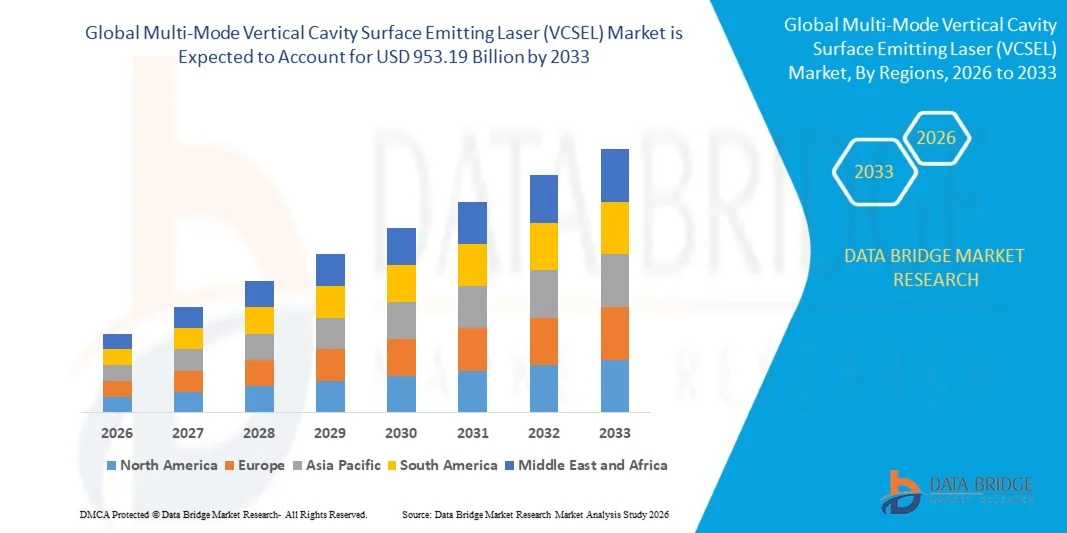
- As per Data Bridge Market Research analysis, the multi-mode vertical cavity surface emitting laser (VCSEL) market was valued at USD 267.77 billion in 2025 and is projected to reach USD 953.19 billion by 2033, growing at a CAGR of 17.20% from 2026 to 2033.
- The market is experiencing consistent growth driven by increasing demand for high-speed data communication, optical sensing, 3D sensing, and compact laser technologies, along with expanding adoption across data centers, consumer electronics, automotive, healthcare, and industrial applications.
- The rapid expansion of data centers and high-speed optical networks, combined with growing adoption of 3D sensing, automotive LiDAR, and advanced consumer-electronics applications, is encouraging manufacturers to deploy multi-mode VCSELs. Their high-speed transmission, compact size, energy efficiency, and suitability for short-range optical links are supporting their replacement of conventional laser technologies across emerging applications.
Market Size & Forecast
- Global Market Value (2025): USD 267.77 Billion
- Expected Market Value (2033): USD 953.19 Billion
- Forecast CAGR (2026–2033): 17.20%
- Leading Region in 2025: North America
- Fastest Growing Region: Asia Pacific
What are the Major Takeaways of the Multi-Mode Vertical Cavity Surface Emitting Laser (VCSEL) Market?
- North America dominated the multi-mode vertical cavity surface emitting laser (VCSEL) market with the largest revenue share of 44.0% in 2025, supported by advanced data-center infrastructure, high-speed optical networks, strong demand for optical connectivity, and the presence of major VCSEL manufacturers.
- Asia-Pacific is expected to be the fastest-growing region at a CAGR of 19.4% from 2026 to 2033, fueled by expanding consumer electronics manufacturing, 5G deployment, increasing data-center investments, and growing adoption of VCSELs
- The gallium arsenide (GaAs) segment led the market with a 60% share in 2025, driven by its mature manufacturing ecosystem, high optical efficiency, and strong suitability for 850 nm VCSELs used in short-reach optical communication
- Gallium nitride (GaN) are the fastest-growing material type, projected to register a CAGR of 10%, reflecting the surge in research into high-power and emerging-wavelength VCSEL applications.
- The time-of-flight (ToF) segment dominated the technology category with a 40% revenue share in 2025, led by widespread deployment of VCSELs in three-dimensional sensing and depth-measurement applications.
- Near infrared (NIR) accounted for 65% of the market share in 2025, preferred by extensive deployment at wavelengths such as 850 nm and 940 nm.
- The sensing segment is the fastest-growing application category, with a CAGR of 13%, driven by expanding adoption of three-dimensional sensing, facial recognition, LiDAR, and machine vision.
Report Scope and Multi-Mode Vertical Cavity Surface Emitting Laser (VCSEL) Market Segmentation
|
Attributes |
Multi-Mode Vertical Cavity Surface Emitting Laser (VCSEL) Key Market Insights |
|
Segments Covered |
|
|
Countries Covered |
North America
Europe
Asia-Pacific
Middle East and Africa
South America
|
|
Key Market Players |
|
|
Market Opportunities |
|
|
Value Added Data Infosets |
In addition to the insights on market scenarios such as market value, growth rate, segmentation, geographical coverage, and major players, the market reports curated by the Data Bridge Market Research also include in-depth expert analysis, geographically represented company-wise production and capacity, network layouts of distributors and partners, detailed and updated price trend analysis and deficit analysis of supply chain and demand. |
What is the Key Trend in the Multi-Mode Vertical Cavity Surface Emitting Laser (VCSEL) Market?
- Multi-mode VCSELs are increasingly being optimized for AI-driven data-center networks, where higher bandwidth, lower power consumption, and short-reach optical connectivity are becoming critical for GPU and high-performance computing clusters.
- For instance, in March 2025, Keysight and Coherent demonstrated 200G-per-lane multimode VCSEL technology at OFC 2025, targeting higher-speed optical connectivity for next-generation data-center networks and AI infrastructure.
- The transition toward 800G and 1.6T optical transceivers is accelerating VCSEL innovation, with manufacturers developing higher-speed devices capable of supporting 200 Gbps per lane for next-generation multimode links.
- Advanced VCSEL architectures are increasingly improving bandwidth, reliability, aperture control, and energy efficiency, enabling multi-mode solutions to remain competitive for short-distance optical interconnects.
- The growing deployment of 3D sensing, robotics, machine vision, and autonomous systems is expanding VCSEL applications beyond conventional data communication and consumer electronics.
- For instance, in March 2024, Coherent demonstrated a 200 Gbps-per-lane VCSEL technology designed to support next-generation 1.6 Tbps multimode optical transceivers, addressing the growing bandwidth requirements of AI and high-performance computing data-center networks.
- Manufacturers are also investing in larger wafer platforms and vertically integrated production, helping improve manufacturing scale, yield, cost efficiency, and supply reliability for high-volume VCSEL applications.
What are the Key Drivers of the Multi-Mode Vertical Cavity Surface Emitting Laser (VCSEL) Market?
- The rapid expansion of AI and machine-learning data centers is significantly increasing demand for high-speed optical interconnects capable of transferring large volumes of data between GPUs, switches, and servers.
- For instance, in March 2025, Broadcom introduced its Sian2M 200G-per-lane DSP with integrated VCSEL drivers, specifically designed for low-power, short-reach multimode-fiber links in AI clusters, supporting the growing demand for high-bandwidth optical connectivity in AI infrastructure.
- Growing deployment of 400G, 800G, and emerging 1.6T transceivers is increasing demand for high-bandwidth multi-mode VCSELs optimized for short-reach data-center connections.
- VCSELs offer advantages including low power consumption, compact size, high modulation speed, and relatively low cost, making them suitable for short-distance optical links below approximately 100 meters.
- For instance, in April 2025, Coherent demonstrated a 1.6T-SR8 optical transceiver incorporating 200G VCSELs and photodiodes, with eight 200G optical lanes, targeting the increasing bandwidth requirements of AI and high-performance computing data-center networks.
- Increasing adoption of 3D sensing and machine-vision technologies across consumer electronics, robotics, industrial automation, and automotive systems is creating additional demand for VCSEL arrays and infrared illumination.
Which Factors are Challenging the Growth of the Multi-Mode Vertical Cavity Surface Emitting Laser (VCSEL) Market?
- Advanced multi-mode VCSELs require complex epitaxial growth, precise wafer fabrication, specialized packaging, and stringent testing, increasing production costs and limiting economies of scale.
- For instance, in August 2025, Coherent reported that its highly complex manufacturing processes require technologically advanced equipment and continuous process modifications to improve yields and performance, while manufacturing difficulties can reduce yields, disrupt production, and increase manufacturing costs
- Manufacturing yield remains a challenge because small variations in layer thickness, wavelength uniformity, oxidation, and defect density can affect optical performance and increase wafer-level losses.
- Thermal management becomes increasingly difficult as VCSEL power and emitter density rise, potentially affecting reliability, wavelength stability, and performance in demanding automotive and industrial environments
- For instance, in June 2026, Reuters reported that China’s restrictions on indium phosphide exports had disrupted the global photonics supply chain, with the average price of 6-inch InP wafers rising by approximately 250% to USD 5,000, increasing costs and creating supply constraints for optical-chip manufacture
- VCSELs also face competition from silicon photonics and other laser technologies, particularly for longer-reach data-center links where multimode VCSELs have limitations in transmission distance
How is the Multi-Mode Vertical Cavity Surface Emitting Laser (VCSEL) Market Segmented?
The multi-mode vertical cavity surface emitting laser (VCSEL) market is segmented on the basis of material, technology, wavelength, application, and end-user.
- By Material
On the basis of material, the multi-mode VCSEL market is segmented into gallium arsenide (GaAs), indium phosphide (InP), gallium nitride (GaN), and others. The gallium arsenide (GaAs) segment dominated the market with 60% share in 2025, owing to its mature manufacturing ecosystem, high optical efficiency, and strong suitability for 850 nm VCSELs used in short-reach optical communication. GaAs-based devices provide high-speed modulation and reliable performance for data-center optical links. They are also widely used in near-infrared sensing applications because of their established semiconductor fabrication processes. The availability of mature epitaxial-growth technology and high-volume manufacturing further supports the segment.
The gallium nitride (GaN) segment is projected to register the fastest growth at 10% CAGR during the forecast period, driven by increasing research into high-power and emerging-wavelength VCSEL applications. GaN offers high thermal stability and a wide bandgap, making it attractive for demanding optical applications. Its material characteristics can support higher power densities and operation in challenging environments. Growing development of GaN-based semiconductor lasers is expanding its potential applications beyond conventional GaAs devices. Automotive, industrial, and advanced sensing applications could provide additional opportunities for GaN-based VCSELs.
- By Technology
On the basis of technology, the market is segmented into dot projector, time-of-flight (ToF), and flood illuminator. The time-of-flight (ToF) segment dominated the market with 40% share in 2025, supported by widespread deployment of VCSELs in three-dimensional sensing and depth-measurement applications. ToF systems use emitted infrared light to calculate the distance of objects, making them suitable for facial recognition, proximity sensing, and spatial mapping. VCSEL arrays provide compact, efficient, and controllable illumination for these systems. Consumer electronics manufacturers have increasingly incorporated ToF capabilities into advanced devices. Automotive and industrial applications are also expanding the addressable market for ToF sensing.
The flood illuminator segment is projected to register the fastest growth at 11% CAGR during forecast period, driven by increasing requirements for broad-area infrared illumination. Flood illuminators provide uniform infrared light across a field of view and are widely suited to proximity and facial-recognition systems. Their compact architecture enables integration into smartphones, wearables, automotive cabins, and smart devices. Growing adoption of driver-monitoring and occupant-monitoring systems is creating additional opportunities. Industrial machine vision and robotics are also increasing demand for efficient infrared illumination
- By Wavelength
On the basis of wavelength, the market is segmented into red, near infrared (NIR), and short wave infrared (SWIR). The near infrared (NIR) segment dominated the market with 65% share in 2025, supported by extensive deployment at wavelengths such as 850 nm and 940 nm. NIR VCSELs are widely used for short-reach optical communication, particularly in data centers using multimode fiber. They are also important in facial recognition, depth sensing, proximity detection, and infrared illumination. NIR technology benefits from a mature manufacturing ecosystem and established component supply chains. The combination of high efficiency, reliability, and broad application compatibility strengthens its market position
The short wave infrared (SWIR) segment is projected to register the fastest growth at 12% CAGR during forecast period, as VCSEL technology expands into advanced sensing and industrial applications. SWIR wavelengths can provide useful information in applications where visible and conventional NIR sensing have limitations. Emerging applications include industrial inspection, robotics, machine vision, spectroscopy, and advanced automotive sensing. Increasing demand for high-resolution sensing in challenging environments is supporting research into SWIR VCSELs. Improvements in semiconductor materials and fabrication techniques are also increasing commercialization potential.
- By Application
On the basis of application, the market is segmented into data communication, sensing, infrared illumination, pumping, and industrial heating. The data communication segment dominated the market with 42.6% share in 2025, driven by extensive use of multi-mode VCSELs in short-reach optical links. Data centers use VCSEL-based transceivers to connect servers, switches, storage systems, and accelerators. Their high modulation speed, low power consumption, compact form factor, and cost efficiency support large-scale deployment. The expansion of cloud computing and artificial-intelligence infrastructure is increasing demand for high-bandwidth optical connectivity. Growing adoption of 400G and 800G optical links is further strengthening demand.
The sensing segment is projected to register the fastest growth at 13% CAGR during forecast period, supported by expanding adoption of three-dimensional sensing, facial recognition, LiDAR, and machine vision. VCSEL arrays provide compact infrared illumination for depth measurement and object detection. Automotive manufacturers are increasingly evaluating VCSELs for driver monitoring, in-cabin sensing, and advanced LiDAR systems. Industrial automation and robotics are also creating demand for accurate three-dimensional perception. Consumer electronics continue to provide high-volume opportunities for VCSEL-based sensing.
- By End-User
On the basis of end-user, the market is segmented into data center, consumer electronics, automotive, industrial, healthcare, and military. The data center segment dominated the market with 43% share in 2025, supported by the extensive use of multi-mode VCSELs in high-speed short-distance optical interconnects. Data centers require large numbers of optical connections between servers, switches, GPUs, and networking equipment. Multi-mode VCSELs provide high bandwidth while maintaining relatively low power consumption and compact dimensions. The growth of hyperscale and cloud data centers is increasing demand for optical transceivers. AI workloads are further increasing the volume and speed of data exchanged within computing clusters.
The automotive segment is projected to register the fastest growth at 14% CAGR during forecast period, driven by increasing integration of VCSEL-based sensing into advanced vehicles. VCSELs can provide infrared illumination for LiDAR, driver-monitoring systems, occupant monitoring, and other ADAS functions. Increasing vehicle automation is creating demand for multiple optical sensing systems within individual vehicles. Automotive manufacturers are also seeking compact and energy-efficient components that can operate reliably in demanding environments. Expansion of ADAS from premium vehicles into higher-volume vehicle categories is widening the addressable market.
Which Region Holds the Largest Share of the Multi-Mode Vertical Cavity Surface Emitting Laser (VSEL) Market?
- North America dominated the multi-mode vertical cavity surface emitting laser (VCSEL) market with the largest revenue share of 44.0% in 2025, supported by advanced data-center infrastructure, high-speed optical networks, strong demand for optical connectivity, and the presence of major VCSEL manufacturers.
- The region also benefits from the presence of leading technology and optical component manufacturers, increasing deployment of AI-driven data centers, and growing adoption of VCSELs across data communication, sensing, and automotive applications. Increasing investments in AI infrastructure, next-generation optical interconnects, and advanced sensing technologies continue to strengthen North America’s leadership position in the global multi-mode VCSEL market.
U.S. Multi-Mode Vertical Cavity Surface Emitting Laser (VCSEL) Market Insight
The U.S. multi-mode VCSEL market is witnessing strong growth due to rising investments in advanced optical communication infrastructure, data centers, and high-speed networking technologies. The country’s mature semiconductor and technology ecosystem, along with increasing adoption of AI-powered data centers and high-bandwidth optical interconnects, is driving demand across data communication, sensing, and automotive applications. In addition, growing deployment of VCSEL-based 3D sensing, facial recognition, and autonomous vehicle technologies is accelerating market adoption across consumer electronics, automotive, and industrial sectors.
Asia-Pacific Multi-Mode VCSEL Market Insight
The Asia-Pacific multi-mode VCSEL market is expected to witness rapid growth, driven by expanding semiconductor manufacturing, increasing data center investments, and rising demand for high-speed optical communication technologies across countries such as China, Japan, South Korea, and Taiwan. Growing adoption of VCSELs in consumer electronics, automotive sensing, and industrial applications is supporting regional market expansion. In addition, the growing presence of electronics manufacturers, increasing investments in AI infrastructure, and rapid development of advanced sensing technologies are accelerating multi-mode VCSEL adoption across the region.
Japan Multi-Mode VCSEL Market Insight
The Japan multi-mode VCSEL market is witnessing consistent growth due to rising investments in semiconductor technologies, optical communications, and advanced sensing solutions. Electronics manufacturers, automotive companies, and technology research institutes are increasingly adopting multi-mode VCSELs for data communication, 3D sensing, and automotive applications. Moreover, increasing integration of VCSEL technology into consumer electronics, robotics, and industrial automation, along with Japan’s focus on advanced semiconductor innovation, is further contributing to market growth.
China Multi-Mode VCSEL Market Insight
The China multi-mode VCSEL market is growing rapidly, driven by increasing investments in data center infrastructure, semiconductor manufacturing, and high-speed optical communication networks. Growing adoption of VCSEL-based technologies across consumer electronics, automotive sensing, industrial automation, and telecommunications is significantly boosting market demand. In addition, rising investments in AI infrastructure, increasing domestic semiconductor capabilities, and rapid technological advancements are positioning China as one of the fastest-growing markets for multi-mode VCSEL technology globally.
U.K. Multi-Mode VCSEL Market Insight
The U.K. multi-mode VCSEL market is experiencing steady growth, supported by rising adoption of optical communication technologies, data center infrastructure, and advanced sensing applications. Increasing investments in high-speed networking, artificial intelligence infrastructure, and semiconductor research are contributing to market growth. Furthermore, integration of VCSELs into data communication, automotive sensing, healthcare, and industrial applications is improving technology adoption, positioning the U.K. as an important innovation hub in the multi-mode VCSEL industry.
Germany Multi-Mode VCSEL Market Insight
The Germany multi-mode VCSEL market is expanding steadily due to the country’s strong automotive manufacturing base, advanced industrial capabilities, and increasing adoption of next-generation optical technologies. Automotive companies, data centers, industrial manufacturers, and research institutions are increasingly utilizing multi-mode VCSELs for sensing, optical communication, automation, and vehicle-related applications. Continuous advancements in semiconductor manufacturing, AI-enabled sensing, and high-speed optical connectivity, along with Germany’s strong focus on industrial innovation, are further driving market growth.
Which are the Top Companies in Multi-Mode Vertical Cavity Surface Emitting Laser (VCSEL) Market?
The mode vertical cavity surface emitting multi laser (VCSEL) industry is primarily led by well-established companies, including:
- Coherent Corp. (U.S.)
- Lumentum Operations LLC (U.S.)
- TRUMPF SE + Co. KG (Germany)
- Broadcom (U.S.)
- ams-OSRAM AG (Austria)
- VERTILAS GmbH (Germany)
- Vertilite Co., Ltd. (China)
- Sony Semiconductor Solutions Corporation (Japan)
- ROHM Co., Ltd. (Japan)
- IQE PLC (U.K.)
- Hamamatsu Photonics K.K. (Japan)
- Santec Holdings Corporation (Japan)
- Sumitomo Electric Industries, LTD. (Japan)
- NEC Corporation (Japan)
- Thorlabs, Inc. (U.S.)
- HLJ Technology Co., Ltd. (Taiwan)
- RayIR Co., LTD. (South Korea)
- ACE PHOTONICS Co., Ltd. (China)
- Inphenix (U.S.)
- BRIGHTLASER LIMITED (Hong Kong)
What are Latest Developments in Multi-Mode Vertical Cavity Surface Emitting Laser (VCSEL) Market?
- In April 2025, Coherent demonstrated its 1.6T-SR8 optical transceiver at OFC 2025, incorporating advanced 200G-per-lane VCSELs and photodiodes produced by the company. The multimode transceiver was designed for short-reach data-center connectivity and addresses the rapidly increasing bandwidth requirements generated by artificial intelligence and machine-learning workloads. Coherent highlighted that VCSEL-based multimode links offer cost and power advantages for data-center applications. This development underscores the continued advancement of multi-mode VCSEL technology toward higher-speed AI data-center networks.
- In March 2024, Coherent announced a significant advancement in VCSEL performance, demonstrating a path toward 200 Gbps per lane and future 1.6 Tbps multimode optical transceivers. The company developed lithographic-aperture VCSELs with approximately 45 GHz bandwidth, compared with the approximately 27 GHz bandwidth of existing oxide-aperture VCSELs used in 100G-per-lane applications. The technology was targeted at short-reach connectivity in AI, high-performance computing, and data-center networks. The development marked a major technological step toward increasing the transmission capacity of multimode VCSEL-based optical interconnects.
- In March 2023, Coherent announced a demonstration of an 800G optical transceiver using 200G-per-lane technology, supporting the transition toward higher-speed data-center interconnects. The demonstration featured an OSFP module with 200G PAM4 optical lanes and was designed for next-generation high-capacity Ethernet switching applications. Coherent also highlighted a co-packaged 800G multimode optical engine, reinforcing the role of multimode VCSEL technology in short-reach data-center connectivity. The development demonstrated the industry’s progression from 100G optical lanes toward higher-speed 800G and future 1.6T networking solutions.
- In January 2022, TRUMPF presented its expanded VCSEL portfolio at Photonics West, including both single-mode and multimode VCSEL solutions for advanced industrial and consumer sensing applications. The company highlighted applications including oxygen sensing and face recognition, demonstrating the broadening use of VCSEL technology beyond conventional optical communications. TRUMPF also introduced a new single-mode VCSEL for highly precise time-of-flight sensing and showcased its VCSEL with integrated backside optics. These developments demonstrated continued innovation in VCSEL architectures and expanding opportunities for sensing applications.
- In November 2021, Lumentum launched high-performance 1D and 2D addressable VCSEL arrays designed for long-range LiDAR, automotive, consumer, and industrial 3D-sensing applications. The new multi-junction VCSEL technology enabled individual rows or segments of an array to be controlled and illuminated, supporting more precise and power-efficient sensing. The development expanded VCSEL capabilities for advanced LiDAR and 3D-sensing systems, particularly where controlled illumination is required. This launch highlighted the increasing integration of VCSEL arrays into automotive sensing and next-generation perception technologies.

- Interactive Data Analysis Dashboard
- Company Analysis Dashboard for high growth potential opportunities
- Research Analyst Access for customization & queries
- Competitor Analysis with Interactive dashboard
- Latest News, Updates & Trend analysis
- Harness the Power of Benchmark Analysis for Comprehensive Competitor Tracking
Global Multi Mode Vertical Cavity Surface Emitting Laser Market, Supply Chain Analysis and Ecosystem Framework
To support market growth and help clients navigate the impact of geopolitical shifts, DBMR has integrated in-depth supply chain analysis into its Global Multi Mode Vertical Cavity Surface Emitting Laser Market research reports. This addition empowers clients to respond effectively to global changes affecting their industries. The supply chain analysis section includes detailed insights such as Global Multi Mode Vertical Cavity Surface Emitting Laser Market consumption and production by country, price trend analysis, the impact of tariffs and geopolitical developments, and import and export trends by country and HSN code. It also highlights major suppliers with data on production capacity and company profiles, as well as key importers and exporters. In addition to research, DBMR offers specialized supply chain consulting services backed by over a decade of experience, providing solutions like supplier discovery, supplier risk assessment, price trend analysis, impact evaluation of inflation and trade route changes, and comprehensive market trend analysis.
Data collection and base year analysis are done using data collection modules with large sample sizes. The stage includes obtaining market information or related data through various sources and strategies. It includes examining and planning all the data acquired from the past in advance. It likewise envelops the examination of information inconsistencies seen across different information sources. The market data is analysed and estimated using market statistical and coherent models. Also, market share analysis and key trend analysis are the major success factors in the market report. To know more, please request an analyst call or drop down your inquiry.
The key research methodology used by DBMR research team is data triangulation which involves data mining, analysis of the impact of data variables on the market and primary (industry expert) validation. Data models include Vendor Positioning Grid, Market Time Line Analysis, Market Overview and Guide, Company Positioning Grid, Patent Analysis, Pricing Analysis, Company Market Share Analysis, Standards of Measurement, Global versus Regional and Vendor Share Analysis. To know more about the research methodology, drop in an inquiry to speak to our industry experts.
Data Bridge Market Research is a leader in advanced formative research. We take pride in servicing our existing and new customers with data and analysis that match and suits their goal. The report can be customized to include price trend analysis of target brands understanding the market for additional countries (ask for the list of countries), clinical trial results data, literature review, refurbished market and product base analysis. Market analysis of target competitors can be analyzed from technology-based analysis to market portfolio strategies. We can add as many competitors that you require data about in the format and data style you are looking for. Our team of analysts can also provide you data in crude raw excel files pivot tables (Fact book) or can assist you in creating presentations from the data sets available in the report.













