


Multi-Omics Platforms in Rare Disease Research Market Size
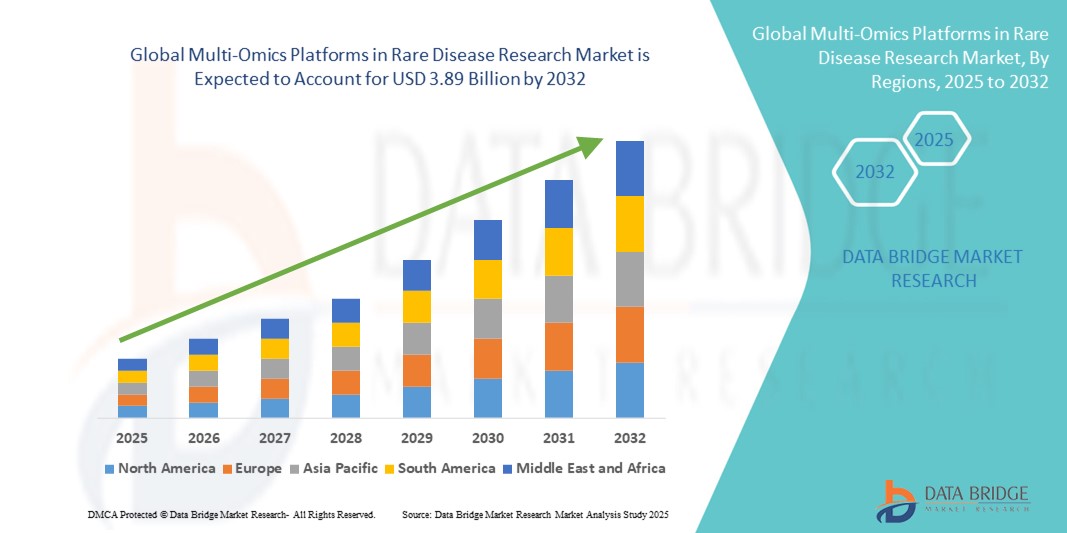
- The global multi-omics platforms in rare disease research market size was valued at USD 1.18 billion in 2024 and is expected to reach USD 3.89 billion by 2032, at a CAGR of 16.00% during the forecast period
- The market growth is largely fueled by the growing adoption and technological progress within genomics, transcriptomics, proteomics, metabolomics, and other omics technologies, leading to increased digitalization and integration in rare disease research across both academic and clinical settings
- Furthermore, rising demand for precise, data-rich, and integrative platforms to understand the complex biological mechanisms of rare diseases is establishing multi-omics approaches as a critical pillar of modern biomedical research. These converging factors are accelerating the uptake of multi-omics platforms in rare disease research solutions, thereby significantly boosting the industry's growth
Multi-Omics Platforms in Rare Disease Research Market Analysis
- Multi-Omics Platforms are becoming increasingly vital tools in rare disease research, offering integrated insights from genomics, transcriptomics, proteomics, and metabolomics to enable more precise diagnosis, disease understanding, and personalized treatment strategies. Their adoption is transforming how rare genetic conditions are identified and managed across research and clinical settings
- The escalating demand for multi-omics approaches in rare disease research is fueled by rising prevalence of rare genetic disorders, expanding next-generation sequencing (NGS) capabilities, and growing support from government agencies, academic consortia, and pharmaceutical companies for data-rich, multi-dimensional research methodologies
- North America dominated the multi-omics platforms in rare disease research market with the largest revenue share of 38.0% in 2024, driven by strong R&D infrastructure, increasing funding for precision medicine, and the presence of key genomics and bioinformatics companies. The U.S. continues to lead regional growth, supported by initiatives like the rare diseases clinical research network (RDCRN) and widespread adoption of omics technologies in clinical genomics and translational research
- Asia-Pacific is expected to be the fastest growing region in the multi-omics platforms in rare disease research market during the forecast period, registering a CAGR of 17.8% from 2025 to 2032, due to expanding healthcare infrastructure, rising investments in omics-based diagnostics, and increasing prevalence of rare diseases in countries like China, India, and Japan
- Multi-omics dominated dominated the multi-omics platforms in rare disease research market with a market share of 42.7% in 2024, due to its ability to provide a comprehensive systems biology view by integrating genomic, proteomic, transcriptomic, and other data layers. It is highly favored in understanding the multifactorial nature of rare diseases
Report Scope and Multi-Omics Platforms in Rare Disease Research Market Segmentation
|
Attributes |
Multi-Omics Platforms in Rare Disease Research Key Market Insights |
|
Segments Covered |
|
|
Countries Covered |
North America
Europe
Asia-Pacific
Middle East and Africa
South America
|
|
Key Market Players |
|
|
Market Opportunities |
|
|
Value Added Data Infosets |
In addition to the insights on market scenarios such as market value, growth rate, segmentation, geographical coverage, and major players, the market reports curated by the Data Bridge Market Research also include in-depth expert analysis, pricing analysis, brand share analysis, consumer survey, demography analysis, supply chain analysis, value chain analysis, raw material/consumables overview, vendor selection criteria, PESTLE Analysis, Porter Analysis, and regulatory framework. |
Multi-Omics Platforms in Rare Disease Research Market Trends
Enhanced Convenience Through Integrated Omics Technologies
- A significant and accelerating trend in the global multi-omics platforms in rare disease research market is the integration of multiple omics layers—such as genomics, transcriptomics, proteomics, epigenomics, and metabolomics—into unified platforms. This integrative approach is enhancing researchers’ ability to uncover complex disease mechanisms and biomarkers with greater accuracy and depth
- For instance, multi-omics platforms enable the simultaneous analysis of genetic mutations, gene expression patterns, protein interactions, and metabolic changes in patients with rare diseases. This comprehensive data fusion helps in identifying novel therapeutic targets and personalized treatment pathways
- The ability to extract multi-dimensional biological insights from limited patient samples is particularly critical in rare disease research, where cohort sizes are small and data scarcity is common. These platforms optimize sample utilization while providing a holistic view of disease biology
- Multi-omics integration is also improving predictive modeling and hypothesis generation in translational research, allowing scientists to understand disease heterogeneity and progression more effectively. Cloud-based platforms and bioinformatics pipelines are further simplifying data analysis, enabling real-time collaboration and data sharing across global research networks
- This trend toward converged, high-throughput omics platforms is fundamentally reshaping the rare disease research landscape. It empowers pharmaceutical and biotech companies to accelerate drug discovery timelines, improve clinical trial design, and develop more effective diagnostics
- The demand for integrated, scalable, and automation-ready multi-omics platforms is growing rapidly across academic institutions, research hospitals, and biotech firms, as they seek to unlock deeper insights into rare and ultra-rare genetic disorders
Multi-Omics Platforms in Rare Disease Research Market Dynamics
Driver
Growing Need Due to Rising Prevalence of Rare Diseases and Demand for Precision Medicine
- The increasing global burden of rare diseases, coupled with rising demand for personalized and precision medicine, is a key driver accelerating the adoption of multi-omics platforms in rare disease research. These platforms allow for a comprehensive understanding of disease mechanisms by integrating genomic, transcriptomic, proteomic, and metabolomic data
- For instance, in April 2024, Thermo Fisher Scientific launched a new integrated omics solution designed specifically for rare disease researchers, combining next-generation sequencing with advanced data analytics to accelerate diagnostic and therapeutic discoveries. Such strategic advancements by key market players are expected to significantly boost the growth of the Multi-Omics Platforms in Rare Disease Research market during the forecast period
- As researchers and clinicians seek more accurate diagnostic tools and targeted therapeutic approaches, multi-omics technologies offer powerful solutions by uncovering complex molecular signatures associated with rare conditions. This is helping reduce diagnostic delays and increase the likelihood of successful treatment development
- Furthermore, increasing government and private funding for rare disease research initiatives, combined with international collaborations such as the Rare Diseases Clinical Research Network (RDCRN), are expanding access to multi-omics capabilities in both academic and clinical settings
- The integration of AI, machine learning, and cloud computing into multi-omics platforms is also enabling faster and more accurate data interpretation, further driving adoption among pharmaceutical companies, CROs, and academic research institutions focused on orphan diseases
Restraint/Challenge
Data Integration Complexity and High Operational Costs
- The integration of multiple omics layers—genomic, transcriptomic, proteomic, and metabolomic—into a single platform presents significant technical and analytical challenges. These include data heterogeneity, variability in sample quality, and the need for standardized bioinformatics pipelines, all of which can impede wide-scale adoption
- For instance, researchers often struggle with the volume and complexity of multi-omics data, which requires advanced computational infrastructure, skilled bioinformaticians, and robust storage systems—resources that may not be readily available in all institutions
- Addressing these challenges requires improved data harmonization techniques, interoperable platforms, and continued investment in bioinformatics training and infrastructure. Companies like Qiagen and Illumina are increasingly investing in software solutions that simplify omics data integration to support clinical applications in rare diseases
- In addition, the high operational cost of multi-omics research—including reagents, sequencing instruments, and skilled labor—poses a barrier to entry for smaller research institutions and facilities in low- and middle-income countries. While costs are expected to decline with technological advancement, affordability remains a critical concern
- Overcoming these restraints through collaborative research models, scalable cloud-based omics platforms, and open-access datasets will be key to democratizing multi-omics research and unlocking its full potential in addressing rare disease challenges
Multi-Omics Platforms in Rare Disease Research Market Scope
The market is segmented on the basis of platform type, data integration approach, omics category, and application.
- By Platform Type
On the basis of platform type, the multi-omics platforms in rare disease research market is segmented into genomics platforms, proteomics platforms, transcriptomics platforms, metabolomics platforms, epigenomics platforms, and others. The genomics platforms segment dominated the market with the largest revenue share of 34.5% in 2024, driven by its widespread use in sequencing rare disease genes, detecting mutations, and enabling early diagnosis. Genomics remains foundational in rare disease research, powering both clinical and discovery pipelines.
The proteomics platforms segment is expected to grow at the fastest CAGR of 12.4% from 2025 to 2032, due to increasing focus on understanding protein-level expression, functional impacts of mutations, and biomarker identification in rare diseases. Proteomic data complements genomic insights, making it crucial for deeper mechanistic understanding.
- By Data Integration Approach
On the basis of data integration approach, the multi-omics platforms in rare disease research market is segmented into integrated multi-omics analysis, correlation-based analysis, network-based integration, machine learning-based integration, modular/layered approach, and others. Integrated multi-omics analysis held the largest market share of 38.9% in 2024, as researchers increasingly adopt holistic approaches that combine multiple omics layers to derive comprehensive biological insights. It supports more accurate disease modeling and therapeutic target identification.
The machine learning-based integration segment is projected to grow at the fastest CAGR of 13.1% from 2025 to 2032, driven by advancements in AI and computational biology that enhance pattern recognition, predictive modeling, and automated interpretation of complex omics data.
- By Omics Category
On the basis of omics category, the multi-omics platforms in rare disease research market is segmented into single-omics, dual-omics, and multi-omics. Multi-omics dominated with the largest market share of 42.7% in 2024, due to its ability to provide a comprehensive systems biology view by integrating genomic, proteomic, transcriptomic, and other data layers. It is highly favored in understanding the multifactorial nature of rare diseases.
Dual-omics is expected to record the fastest CAGR of 11.6% from 2025 to 2032, particularly driven by cost-conscious research models and studies focusing on linked omics such as genomics + transcriptomics or proteomics + metabolomics for specific disease pathways.
- By Application
On the basis of application, the multi-omics platforms in rare disease research market is segmented into rare genetic disorder diagnosis, biomarker discovery, drug development & target identification, personalized medicine, prenatal & neonatal screening, research & academic use, and others. Rare genetic disorder diagnosis led the market with the largest revenue share of 30.8% in 2024, supported by the urgent need for accurate diagnostics in early-stage, undiagnosed, and complex rare conditions. Multi-omics enables precision diagnostics through deep molecular profiling.
Personalized medicine is anticipated to grow at the fastest CAGR of 12.8% from 2025 to 2032, as researchers and clinicians increasingly utilize omics data to tailor treatments based on individual patient profiles. This trend is especially prominent in rare disease subtypes with heterogeneous phenotypes.
Multi-Omics Platforms in Rare Disease Research Market Regional Analysis
- North America dominated the multi-omics platforms in rare disease research market with the largest revenue share of 38.0% in 2024, driven by strong research infrastructure, substantial government and private funding for precision medicine, and a high concentration of leading genomics and bioinformatics companies
- The region also benefits from early adoption of advanced omics technologies and a well-established ecosystem for translational and clinical research into rare genetic conditions
- The expansion of collaborative research networks, including the Rare Diseases Clinical Research Network (RDCRN), and integration of omics platforms into diagnostic workflows have further solidified North America's position as a leader in rare disease innovation and discovery
U.S. Multi-Omics Platforms in Rare Disease Research Market Insight
The U.S. multi-omics platforms in rare disease research market captured the largest revenue share of 83% in the North America Multi-Omics Platforms in Rare Disease Research market in 2024. This is largely attributed to the country’s active investment in next-generation sequencing, single-cell analysis, and other omics-based technologies across NIH-supported initiatives and academic medical centers. The growing prevalence of rare diseases, coupled with favorable regulatory pathways such as FDA's Orphan Drug Designation program, is accelerating research and development efforts. In addition, the presence of major biotech hubs and startups specializing in genomics, proteomics, metabolomics, and transcriptomics is fueling continuous innovation and commercialization of multi-omics platforms.
Europe Multi-Omics Platforms in Rare Disease Research Market Insight
The Europe multi-omics platforms in rare disease research market is expected to witness steady growth throughout the forecast period, driven by pan-European rare disease programs, early diagnostic initiatives, and strong support from public health institutions. Increasing collaboration among EU member states through projects like the European Joint Programme on Rare Diseases (EJP RD) is improving data integration and accessibility. Nations such as Germany, the U.K., and France are investing in omics-driven population health studies and rare disease screening programs, supporting robust market expansion.
U.K. Multi-Omics Platforms in Rare Disease Research Market Insight
The U.K. multi-omics platforms in rare disease research market is anticipated to grow at a significant CAGR during the forecast period, supported by initiatives such as Genomics England and the 100,000 Genomes Project, which aim to revolutionize rare disease diagnosis using whole-genome sequencing. The National Health Service (NHS) is actively integrating omics platforms into clinical pathways, and research institutions are engaging in international partnerships to enhance rare disease data collection and precision therapies. This strong focus on omics infrastructure continues to drive demand across academic and clinical settings.
Germany Multi-Omics Platforms in Rare Disease Research Market Insight
The Germany multi-omics platforms in rare disease research market is positioned as a key contributor to the European multi-omics market, with growth driven by robust funding for life sciences research, a high-quality healthcare system, and leading bioinformatics capabilities. Government-backed programs supporting rare disease awareness, biobanking, and integration of AI in omics data analysis are further encouraging adoption. Additionally, collaborations between academic institutions and industry players are advancing translational research efforts in rare disease treatment.
Asia-Pacific Multi-Omics Platforms in Rare Disease Research Market Insight
The Asia-Pacific multi-omics platforms in rare disease research market is expected to be the fastest growing region, with a projected CAGR of 17.8% from 2025 to 2032. The region is witnessing increased adoption of omics platforms in rare disease research due to rising healthcare investments, growing awareness, and the implementation of national genomics projects in countries like China, India, and Japan. Government-led precision medicine initiatives, partnerships with global pharma companies, and the increasing burden of undiagnosed rare conditions are accelerating the need for early and accurate diagnostics using multi-omics tools.
Japan Multi-Omics Platforms in Rare Disease Research Market Insight
The Japan multi-omics platforms in rare disease research market is gaining traction, fueled by high R&D investment, strong government backing, and a rapidly aging population, which increases the urgency for early detection of genetic disorders. National programs such as the Japan Initiative for Global Research Network on Rare Diseases (J-RDNet) promote data sharing and omics integration, positioning Japan as a leader in East Asia for multi-omics innovation in rare disease discovery and diagnostics.
China Multi-Omics Platforms in Rare Disease Research Market Insight
The China multi-omics platforms in rare disease research market accounted for the largest revenue share in the Asia-Pacific Multi-Omics Platforms in Rare Disease Research market in 2024. This growth is propelled by expanding genomic sequencing infrastructure, local manufacturing of omics technologies, and increasing collaborations between hospitals and biotech firms. The country's focus on national health registries and precision health initiatives is leading to broader adoption of integrated omics in both research and clinical settings, particularly for pediatric and inherited rare diseases.
Multi-Omics Platforms in Rare Disease Research Market Share
The multi-omics platforms in rare disease research industry is primarily led by well-established companies, including:
- Thermo Fisher Scientific Inc. (U.S.)
- Illumina Inc. (U.S.)
- QIAGEN (Germany)
- 10x Genomics (U.S.)
- Bio-Rad Laboratories Inc. (U.S.)
- Agilent Technologies Inc. (U.S.)
- Bruker (U.S.)
- BGI Genomics Co., Ltd. (China)
- F. Hoffmann-La Roche Ltd (Switzerland)
- PerkinElmer (U.S.)
- Danaher Corporation (U.S.)
- Pacific Biosciences of California Inc. (U.S.)
- Genentech (U.S.)
- Waters Corporation (U.S.)
- Oxford Nanopore Technologies plc (U.K.)
Latest Developments in Global Multi-Omics Platforms in Rare Disease Research Market
- In August 2024, the German Human Genome-Phenome Archive (GHGA) launched its national metadata catalog and archive to facilitate FAIR-compliant access to human omics datasets across multiple German institutions. This development is expected to significantly support integrated multi-omics research for rare diseases by improving data discoverability and interoperability within Europe’s omics infrastructure
- In May 2025, MGI Tech unveiled its new high-throughput multi-omics instruments—DNBSEQ-T1+ and DNBelab C-YellowR 16—at the European Society of Human Genetics (ESHG) 2025 Conference in Milan. These tools streamline single-cell and multi-omics workflows with minimal manual intervention, accelerating large-scale rare disease investigations and multi-layered biological data integration
- In May 2025, GenomeArc launched the “Resolving the Unresolved” consortium in partnership with clinical institutions and academic groups to address undiagnosed rare disease cases. By leveraging integrative omics datasets, the initiative aims to identify novel disease mechanisms and improve personalized treatment strategies for complex patients
- In July 2025, researchers introduced BioNeuralNet, a powerful graph neural network-based framework for analyzing multi-omics networks. This open-source tool enables accurate biomarker identification and disease modeling in rare diseases by embedding multi-omics data into efficient graph representations
- In December 2024, the GREGoR Consortium (Genomics Research to Elucidate the Genetics of Rare Diseases) made significant progress by sharing anonymized genomic and multi-omics data from over 3,000 families. Public access via the AnVIL platform accelerates collaborative research and supports diagnostic efforts for undiagnosed rare disease cases globally

- Interactive Data Analysis Dashboard
- Company Analysis Dashboard for high growth potential opportunities
- Research Analyst Access for customization & queries
- Competitor Analysis with Interactive dashboard
- Latest News, Updates & Trend analysis
- Harness the Power of Benchmark Analysis for Comprehensive Competitor Tracking
Data collection and base year analysis are done using data collection modules with large sample sizes. The stage includes obtaining market information or related data through various sources and strategies. It includes examining and planning all the data acquired from the past in advance. It likewise envelops the examination of information inconsistencies seen across different information sources. The market data is analysed and estimated using market statistical and coherent models. Also, market share analysis and key trend analysis are the major success factors in the market report. To know more, please request an analyst call or drop down your inquiry.
The key research methodology used by DBMR research team is data triangulation which involves data mining, analysis of the impact of data variables on the market and primary (industry expert) validation. Data models include Vendor Positioning Grid, Market Time Line Analysis, Market Overview and Guide, Company Positioning Grid, Patent Analysis, Pricing Analysis, Company Market Share Analysis, Standards of Measurement, Global versus Regional and Vendor Share Analysis. To know more about the research methodology, drop in an inquiry to speak to our industry experts.
Data Bridge Market Research is a leader in advanced formative research. We take pride in servicing our existing and new customers with data and analysis that match and suits their goal. The report can be customized to include price trend analysis of target brands understanding the market for additional countries (ask for the list of countries), clinical trial results data, literature review, refurbished market and product base analysis. Market analysis of target competitors can be analyzed from technology-based analysis to market portfolio strategies. We can add as many competitors that you require data about in the format and data style you are looking for. Our team of analysts can also provide you data in crude raw excel files pivot tables (Fact book) or can assist you in creating presentations from the data sets available in the report.













