What is the Multilayer Flexible Packaging Market Size and Growth Rate?
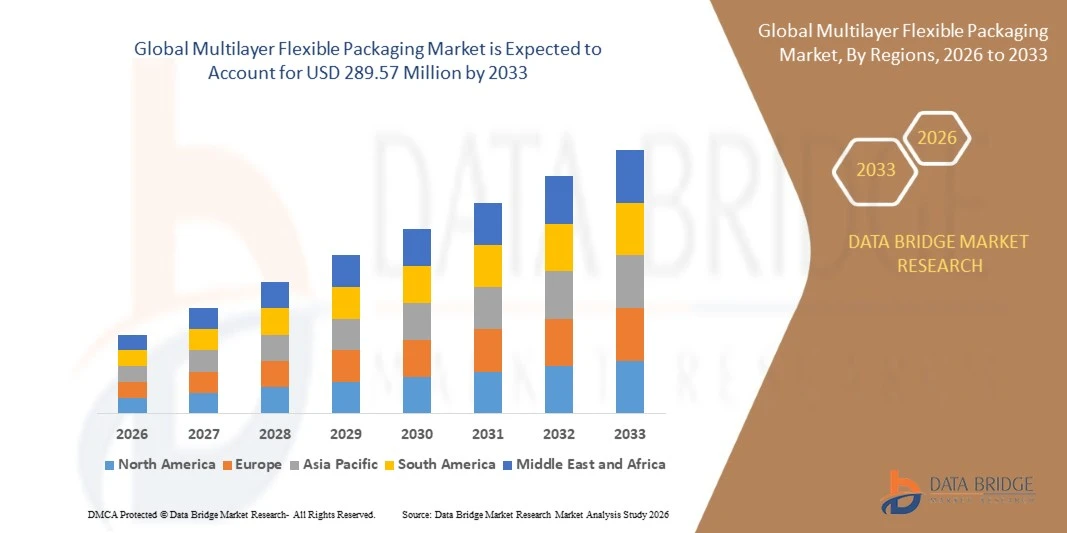
- As per Data Bridge Market Research analysis, the multilayer flexible packaging market was valued at USD 202.08 million in 2025 and is projected to reach USD 289.57 million by 2033, growing at a CAGR of 4.60% from 2026 to 2033.
- The market is experiencing consistent growth driven by rising demand for lightweight and durable packaging solutions, advancements in multilayer film technologies, and expanding applications across food and beverages, pharmaceuticals, personal care, and industrial products.
- The growing need for extended shelf life, product protection, moisture and oxygen barriers, and efficient packaging formats, coupled with increasing demand for convenient and sustainable packaging solutions, is encouraging the adoption of multilayer flexible packaging. These packaging materials combine different polymers, barrier layers, and protective coatings to preserve product quality, prevent contamination, and improve packaging performance across diverse end-use industries.
Market Size & Forecast
- Global Market Value (2025): USD 202.08 Million
- Expected Market Value (2033): USD 289.57 Million
- Forecast CAGR (2026–2033): 4.60%
- Leading Region in 2025: North America
- Fastest Growing Region: Asia Pacific
What are the Major Takeaways of the Multilayer Flexible Packaging Market?
- North America dominated the multilayer flexible packaging market with the largest revenue share of 32.5% in 2025, supported by strong demand for packaged food, established pharmaceutical manufacturing, and advanced flexible packaging technologies.
- Asia Pacific is expected to be the fastest-growing region at a CAGR of 6.2% from 2026 to 2033, fueled by expanding food processing industries, rising urbanization, increasing consumption of packaged products, and growing demand for convenient packaging solutions.
- The polyethylene segment led the material category with a 35.0% share in 2025, driven by its flexibility, moisture resistance, durability, and widespread use in multilayer packaging applications.
- Polypropylene is expected to be among the fastest-growing materials, projected to register a CAGR of 5.8% from 2026 to 2033, reflecting increasing demand for lightweight, heat-resistant, and cost-effective packaging solutions.
- The pouches and sachets segment dominated the product type category with a 38.0% revenue share in 2025, supported by convenience, efficient material usage, and suitability for food, beverages, personal care, and pharmaceutical products.
- The food and beverages segment accounted for a 45.0% market share in 2025, driven by the widespread use of multilayer flexible packaging to preserve freshness, extend shelf life, and protect products from moisture, oxygen, and contamination.
- The pharmaceuticals segment is expected to be among the fastest-growing application categories, with a CAGR of 6.5% from 2026 to 2033, driven by rising demand for protective packaging, product integrity, contamination prevention, and high-barrier packaging solutions.
Report Scope and Multilayer Flexible Packaging Market Segmentation
|
Attributes |
Multilayer Flexible Packaging Key Market Insights |
|
Segments Covered |
|
|
Countries Covered |
North America
Europe
Asia-Pacific
Middle East and Africa
South America
|
|
Key Market Players |
|
|
Market Opportunities |
|
|
Value Added Data Infosets |
In addition to the insights on market scenarios such as market value, growth rate, segmentation, geographical coverage, and major players, the market reports curated by the Data Bridge Market Research also include import export analysis, production capacity overview, production consumption analysis, price trend analysis, climate change scenario, supply chain analysis, value chain analysis, raw material/consumables overview, vendor selection criteria, PESTLE Analysis, Porter Analysis, and regulatory framework. |
What is the Key Trend in the Multilayer Flexible Packaging Market?
- Manufacturers are increasingly focusing on advanced multilayer flexible packaging to improve product protection, extend shelf life, enhance moisture and oxygen barriers, and support reliable packaging performance across food and beverage, pharmaceutical, personal care, and industrial applications.
- For instance, in April 2023, Huhtamaki introduced its blueloop flexible packaging innovations in paper, polyethylene (PE), and polypropylene (PP) retort formats, designed to combine product protection, recyclability, and affordability, highlighting the industry's shift toward resource-efficient packaging solutions.
- High-performance multilayer packaging enables manufacturers to combine different materials to achieve barrier protection, sealing performance, durability, and product preservation across food, healthcare, and consumer product applications.
- Packaging manufacturers and consumer goods companies are prioritizing flexible packaging solutions that balance product safety, material efficiency, shelf-life extension, and evolving sustainability requirements.
- For instance, in March 2024, Dow and Procter & Gamble announced a joint development agreement to develop recycling technology targeting hard-to-recycle plastic waste, including flexible and multilayer packaging, reflecting growing industry efforts to improve packaging circularity and recover valuable plastic materials.
- As packaging manufacturers increasingly require effective product protection, material efficiency, and improved recyclability, advances in multilayer flexible packaging are expected to support continued demand for high-barrier films, pouches, sachets, and other flexible packaging formats.
What are the Key Drivers of the Multilayer Flexible Packaging Market?
- The growing need for extended shelf life, product safety, and reliable barrier protection across food and beverage, pharmaceutical, and personal care applications is increasing demand for multilayer flexible packaging capable of protecting products from moisture, oxygen, light, and contamination.
- For instance, in October 2023, the ICAR-National Meat Research Institute signed a memorandum of understanding with Sealed Air Packaging Materials (India) LLP to develop packaging interventions for chilled and superchilled meat and poultry, demonstrating the importance of packaging innovation in improving product quality and shelf life.
- Food manufacturers, pharmaceutical companies, and consumer goods producers are adopting advanced flexible packaging structures to improve product preservation, reduce material usage, enhance transportation efficiency, and maintain packaging integrity throughout distribution.
- For instance, in April 2023, Huhtamaki introduced its blueloop portfolio featuring paper, PE, and PP retort flexible packaging solutions designed to provide product protection while improving recyclability, supporting demand for packaging that balances functional performance with sustainability objectives.
- With increasing requirements for product protection, packaging convenience, extended shelf life, and resource efficiency across food, healthcare, and consumer goods applications, multilayer flexible packaging will continue to serve diverse packaging requirements across global end-use industries.
What Factors are Challenging the Growth of the Multilayer Flexible Packaging Market?
- Multilayer flexible packaging can require complex material combinations, specialized converting processes, and advanced adhesive or barrier technologies to achieve the required sealing strength, product protection, and packaging performance.
- For instance, in March 2024, Dow and Procter & Gamble announced a joint development agreement focused on recycling hard-to-recycle plastic waste, including multilayer packaging, highlighting the technical challenges associated with recovering materials from complex packaging structures.
- These technical requirements can increase production and recycling costs and limit adoption among cost-sensitive manufacturers, smaller packaging converters, and applications where simpler packaging materials can meet product protection requirements.
- The availability of recyclable mono-material films, paper-based packaging, and alternative packaging formats creates competitive pressure and can discourage the adoption of conventional multilayer structures when recyclability, regulatory compliance, and end-of-life waste management are major purchasing considerations.
- For instance, in April 2023, Huhtamaki introduced its blueloop™ flexible packaging solutions designed to provide product protection while using recyclable mono-material paper, PE, and PP retort structures, reflecting the industry's efforts to address the recyclability challenges associated with conventional complex packaging materials.
- These cost constraints, recycling challenges, and competing packaging technologies continue to challenge market expansion, particularly in applications where manufacturers must balance high-barrier performance, affordability, material efficiency, and recyclability.
How is the Multilayer Flexible Packaging Market Segmented?
The multilayer flexible packaging market is segmented on the basis of material, product type, layer structure, application, and end-user vertical.
- By Material
On the basis of material, the multilayer flexible packaging market is segmented into polyethylene, polypropylene, polyamide, polyethylene terephthalate, aluminium foil, and others. The polyethylene segment is estimated to dominate the market with a 35.0% share in 2025, supported by its flexibility, moisture resistance, durability, and widespread use in flexible packaging structures. Polyethylene provides effective sealing performance and helps protect products from external moisture. Its compatibility with other packaging materials supports the production of multilayer films for food, personal care, and industrial applications. Its versatility and cost-effectiveness further support its widespread adoption.
The polypropylene segment is projected to register strong growth at a CAGR of 5.8% from 2026 to 2033, driven by increasing demand for lightweight packaging materials with good heat resistance and mechanical performance. Polypropylene is used in flexible packaging films, laminated structures, and food packaging applications. Its suitability for heat-sealable and high-performance packaging formats supports its adoption across various end-use industries. Continued advancements in film processing and material engineering are further supporting demand.
- By Product Type
On the basis of product type, the multilayer flexible packaging market is segmented into pouches and sachets, bags, films and wraps, rollstock films, and others. The pouches and sachets segment is estimated to dominate the market with a 38.0% share in 2025, supported by convenience, lightweight construction, and efficient material utilization. These formats are widely used for packaged food, beverages, personal care products, and household goods. Multilayer structures provide barrier protection against moisture, oxygen, and other external factors. Their suitability for single-use, refill, and portion-controlled packaging further supports their adoption.
The rollstock films segment is projected to register strong growth at a CAGR of 5.6% from 2026 to 2033, driven by increasing demand for automated packaging operations and high-speed manufacturing processes. Rollstock films support efficient form-fill-seal packaging and enable manufacturers to produce packages in different sizes and configurations. Their compatibility with automated production equipment helps improve packaging efficiency and reduce material waste. Increasing demand for packaged food and ready-to-eat products is further supporting the adoption of rollstock films.
- By Layer Structure
On the basis of layer structure, the multilayer flexible packaging market is segmented into 2-layer, 3-layer, 4-layer, and 5-layer and above. The 3-layer segment is estimated to hold a significant share of the market in 2025, supported by its ability to combine structural strength, sealing performance, and barrier protection. Three-layer packaging structures can integrate different materials to meet specific product preservation requirements. They are used in food, personal care, and industrial packaging applications. Their balance between functional performance and material costs supports their adoption across a range of packaging requirements.
The 5-layer and above segment is projected to register strong growth at a CAGR of 6.1% from 2026 to 2033, driven by increasing demand for enhanced barrier performance and specialized packaging solutions. These structures can combine multiple functional layers to improve resistance to oxygen, moisture, light, and other external factors. They are suitable for products requiring extended shelf life and additional protection during storage and transportation. Growing demand for high-performance pharmaceutical, food, and industrial packaging is supporting the development of more complex multilayer structures.
- By Application
On the basis of application, the multilayer flexible packaging market is segmented into food and beverages, pharmaceuticals, personal care and cosmetics, industrial products, electronics, and others. The food and beverages segment is estimated to dominate the market with a 45.0% share in 2025, supported by extensive use of flexible packaging for product preservation, freshness retention, and contamination prevention. Multilayer packaging materials provide protection against moisture, oxygen, and other environmental factors that can affect product quality. Pouches, bags, films, and wraps are widely used for snacks, processed foods, frozen products, and other packaged food categories. Increasing demand for convenient and shelf-stable food products further supports segment growth.
The pharmaceuticals segment is projected to register strong growth at a CAGR of 6.5% from 2026 to 2033, driven by increasing demand for protective packaging and reliable product integrity. Multilayer flexible materials are used in pharmaceutical sachets, medical product packaging, and selected high-barrier packaging applications. Their ability to provide moisture protection and support product stability makes them suitable for products with specific storage requirements. Increasing pharmaceutical production and demand for reliable packaging solutions are further supporting segment growth.
- By End-User Vertical
On the basis of end-user vertical, the Multilayer Flexible Packaging market is segmented into food and beverage, healthcare, personal care and cosmetics, consumer goods, industrial, and other end-user verticals. The food and beverage segment is estimated to dominate the market with a significant revenue share in 2025, supported by extensive use of multilayer flexible packaging for product protection, shelf-life extension, and efficient distribution. Food and beverage manufacturers use multilayer structures to package products ranging from snacks and confectionery to frozen foods and processed ingredients. The combination of barrier protection, flexible design, and lightweight construction supports packaging efficiency and product quality.
The healthcare segment is projected to register strong growth at a CAGR of 6.5% from 2026 to 2033, driven by increasing demand for protective packaging for pharmaceutical products, medical supplies, and healthcare-related goods. Multilayer packaging can provide the barrier properties and sealing performance required for selected healthcare applications. Growing emphasis on product integrity, contamination prevention, and reliable storage conditions is encouraging manufacturers to adopt specialized packaging structures. Continued developments in high-barrier materials and healthcare packaging technologies are further supporting segment growth.
Which Region Holds the Largest Share of the Multilayer Flexible Packaging Market?
- North America dominated the multilayer flexible packaging market with the largest revenue share of 32.5% in 2025, supported by strong demand for packaged food, pharmaceutical products, and advanced flexible packaging solutions.
- The region also benefits from established food processing industries, high consumption of packaged products, and increasing demand for packaging that extends shelf life and protects product quality. The presence of major packaging companies, including Amcor, Sealed Air Corporation, and Berry Global Group, strengthens North America's position in the market. Continued investment in high-barrier films, convenient packaging formats, and material-efficient packaging solutions is expected to support regional market growth.
U.S. Multilayer Flexible Packaging Market Insight
The U.S. multilayer flexible packaging market is witnessing steady growth due to rising demand for packaged food, pharmaceutical products, and convenient consumer packaging. The country's established food processing industry, advanced packaging infrastructure, and strong demand for product preservation are driving the adoption of multilayer films, pouches, bags, and wraps. In addition, increasing emphasis on packaging efficiency, extended shelf life, and recyclable material structures is supporting the development of advanced flexible packaging solutions.
Asia-Pacific Multilayer Flexible Packaging Market Insight
The Asia Pacific multilayer flexible packaging market is expected to witness rapid growth, driven by expanding food processing industries, rising urbanization, and increasing consumption of packaged products across countries such as China, India, and Japan. Growing demand for convenient food packaging, personal care products, and pharmaceutical packaging is supporting regional market expansion. In addition, the growth of e-commerce, expanding manufacturing capabilities, and increasing investment in packaging technologies are encouraging the adoption of multilayer flexible packaging across diverse end-use industries.
Japan Multilayer Flexible Packaging Market Insight
The Japan multilayer flexible packaging market is witnessing consistent growth due to demand for high-quality packaging, product preservation, and efficient packaging formats. Food manufacturers, pharmaceutical companies, and consumer goods producers are increasingly adopting multilayer packaging solutions to protect product quality and improve storage performance. Moreover, advancements in packaging materials, automation, and lightweight packaging designs, along with growing emphasis on material efficiency and waste reduction, are supporting market development in Japan.
China Multilayer Flexible Packaging Market Insight
The China multilayer flexible packaging market is growing rapidly, driven by expanding food and beverage production, rising demand for packaged consumer goods, and increasing pharmaceutical manufacturing. Growing consumption of processed foods, snacks, and ready-to-eat products is supporting demand for flexible packaging formats with effective barrier properties. In addition, the expansion of e-commerce, domestic packaging manufacturing, and investments in advanced film-converting technologies are strengthening China's position in the multilayer flexible packaging market.
U.K. Multilayer Flexible Packaging Market Insight
The U.K. multilayer flexible packaging market is experiencing steady growth, supported by demand for convenient packaging, product protection, and improvements in packaging sustainability. The country's established food manufacturing industry, pharmaceutical sector, and consumer goods market are contributing to the adoption of flexible packaging solutions. Furthermore, increasing investment in recyclable packaging structures, lightweight materials, and packaging waste reduction is supporting the development of innovative multilayer flexible packaging applications across food, healthcare, and personal care industries.
Germany Multilayer Flexible Packaging Market Insight
The Germany multilayer flexible packaging market is expanding steadily due to the country's strong food processing industry, established manufacturing base, and demand for high-performance packaging materials. Food manufacturers, pharmaceutical companies, and industrial producers are adopting multilayer flexible packaging to improve product protection, transportation efficiency, and storage performance. Continuous advancements in barrier films, packaging automation, and material engineering, along with growing emphasis on recyclability and resource efficiency, are further supporting market growth in Germany.
Which are the Top Companies in Multilayer Flexible Packaging Market?
The multilayer flexible packaging industry is primarily led by well-established companies, including:
- Amcor plc (Australia)
- Dow (U.S.)
- Bemis Company, Inc. (U.S.)
- WestRock Company (U.S.)
- Sealed Air Corporation (U.S.)
- DS Smith (U.K.)
- Huhtamaki Oyj (Finland)
- Berry Global Group, Inc. (U.S.)
- Ball Corporation (U.S.)
- Genpak, LLC (U.S.)
- Union Packaging (U.S.)
- Robert Bosch GmbH (Germany)
- Tetra Pak International S.A. (Switzerland)
- Coesia S.p.A. (Italy)
- Marchesini Group S.p.A. (Italy)
- OPTIMA packaging group GmbH (Germany)
- Müller LCS (U.S.)
- ISHIDA CO., LTD. (Japan)
- GEA Group Aktiengesellschaft (Germany)
What are Latest Developments in Multilayer Flexible Packaging Market?
- In March 2024, Amcor plc collaborated with packaging machinery supplier PFM to develop AmPrima recycle-ready packaging for mozzarella. The lightweight, mono-polyethylene (PE) packaging was designed to provide barrier protection, puncture resistance, and seal strength while supporting recyclability. This development highlights innovation in flexible packaging structures that balance product freshness and sustainability.
- In June 2024, Dow announced the launch of two REVOLOOP recycled plastic resin grades for shrink films, including one containing 100% post-consumer recycled material and another containing up to 85%. The development supports the use of recycled plastics in non-food-contact packaging applications and reflects efforts to improve circularity in flexible film packaging.
- In March 2024, Dow and Procter & Gamble announced a joint development agreement to create recycling technology that converts hard-to-recycle plastic packaging into recycled polyethylene. The initiative specifically targets difficult waste streams, including flexible and multilayer packaging, highlighting industry efforts to improve the recyclability of complex packaging materials.
- In April 2023, Huhtamaki Oyj announced its blueloop flexible packaging innovations using paper, polyethylene, and polypropylene retort formats. The mono-material technologies were developed to combine product protection and affordability with improved recyclability, demonstrating advances in sustainable flexible packaging solutions.
- In December 2024, Berry Global Group, Inc. reported a 36% year-on-year increase in post-consumer recycled polyethylene use across its European flexible films for industrial, consumer, and agricultural applications. The company incorporated an additional 4,386 tonnes of recycled material into these products, highlighting the growing adoption of recycled content in flexible film packaging.
- In September 2020, Amcor plc and Nestlé introduced a recyclable flexible retort pouch for wet pet food using Amcor’s AmLite HeatFlex Recyclable solution. The high-barrier pouch was developed to withstand packaging and product-preservation requirements while improving recyclability, illustrating innovation in multilayer-style flexible packaging applications that require strong protective properties.
- Interactive Data Analysis Dashboard
- Company Analysis Dashboard for high growth potential opportunities
- Research Analyst Access for customization & queries
- Competitor Analysis with Interactive dashboard
- Latest News, Updates & Trend analysis
- Harness the Power of Benchmark Analysis for Comprehensive Competitor Tracking
Global Multilayer Flexible Packaging Market, Supply Chain Analysis and Ecosystem Framework
To support market growth and help clients navigate the impact of geopolitical shifts, DBMR has integrated in-depth supply chain analysis into its Global Multilayer Flexible Packaging Market research reports. This addition empowers clients to respond effectively to global changes affecting their industries. The supply chain analysis section includes detailed insights such as Global Multilayer Flexible Packaging Market consumption and production by country, price trend analysis, the impact of tariffs and geopolitical developments, and import and export trends by country and HSN code. It also highlights major suppliers with data on production capacity and company profiles, as well as key importers and exporters. In addition to research, DBMR offers specialized supply chain consulting services backed by over a decade of experience, providing solutions like supplier discovery, supplier risk assessment, price trend analysis, impact evaluation of inflation and trade route changes, and comprehensive market trend analysis.
Data collection and base year analysis are done using data collection modules with large sample sizes. The stage includes obtaining market information or related data through various sources and strategies. It includes examining and planning all the data acquired from the past in advance. It likewise envelops the examination of information inconsistencies seen across different information sources. The market data is analysed and estimated using market statistical and coherent models. Also, market share analysis and key trend analysis are the major success factors in the market report. To know more, please request an analyst call or drop down your inquiry.
The key research methodology used by DBMR research team is data triangulation which involves data mining, analysis of the impact of data variables on the market and primary (industry expert) validation. Data models include Vendor Positioning Grid, Market Time Line Analysis, Market Overview and Guide, Company Positioning Grid, Patent Analysis, Pricing Analysis, Company Market Share Analysis, Standards of Measurement, Global versus Regional and Vendor Share Analysis. To know more about the research methodology, drop in an inquiry to speak to our industry experts.
Data Bridge Market Research is a leader in advanced formative research. We take pride in servicing our existing and new customers with data and analysis that match and suits their goal. The report can be customized to include price trend analysis of target brands understanding the market for additional countries (ask for the list of countries), clinical trial results data, literature review, refurbished market and product base analysis. Market analysis of target competitors can be analyzed from technology-based analysis to market portfolio strategies. We can add as many competitors that you require data about in the format and data style you are looking for. Our team of analysts can also provide you data in crude raw excel files pivot tables (Fact book) or can assist you in creating presentations from the data sets available in the report.