


Multimodal Large Language Model (LLM) Market Overview
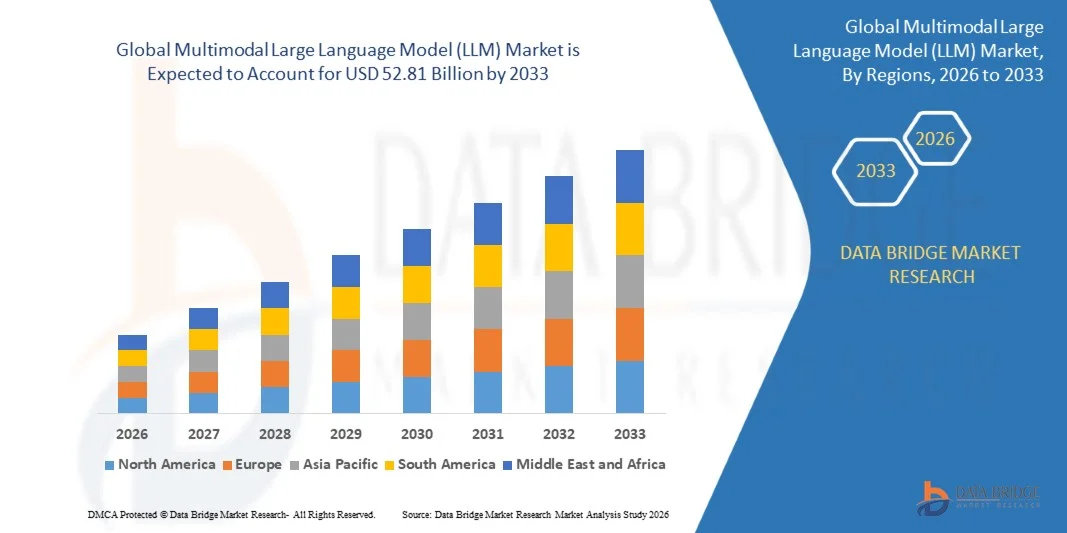
As per Data Bridge Market Research Analysis the Multimodal Large Language Model (LLM) Market was valued at USD 8.94 billion in 2025 and is projected to reach USD 52.81 billion by 2033, growing at a CAGR of 24.9% from 2026 to 2033. The market is experiencing rapid growth driven by increasing adoption of generative AI technologies, rising demand for human-like AI interactions, and expanding deployment of multimodal AI systems across enterprise, healthcare, automotive, media, and government applications.
The increasing need for AI systems capable of processing and understanding multiple data formats such as text, images, audio, video, and sensor inputs is compelling enterprises and technology providers to invest heavily in multimodal LLM infrastructure and software platforms. Cloud-based AI environments, GPU acceleration technologies, and advanced transformer architectures are increasingly replacing traditional single-modality AI systems in many industries, offering scalable, intelligent, and context-aware AI capabilities for enterprise automation, content generation, and real-time decision-making applications.
Market Size & Forecast
- Global Market Value (2025): USD 8.94 Billion
- Expected Market Value (2033): USD 52.81 Billion
- Forecast CAGR (2026–2033): 24.9%
- Leading Region in 2025: North America
- Fastest Growing Region: Asia-Pacific
Key Market Trends & Insights
- North America dominated the Multimodal Large Language Model (LLM) Market with the largest revenue share of 38.64% in 2025, supported by advanced AI infrastructure, strong investments in generative AI technologies, and the presence of leading AI technology companies.
- The Software Platforms segment led the market with a 36.81% share in 2025, driven by increasing enterprise adoption of multimodal AI platforms for automation, content generation, and intelligent workflow management.
- Asia-Pacific is expected to be the fastest-growing region at a CAGR of 26.7% from 2026 to 2033, fueled by rapid digital transformation, increasing AI infrastructure investments, and growing adoption across China, India, Japan, and South Korea.
- Text-Image-Audio Models are the fastest-growing model type, projected to register a CAGR of 25.8%, reflecting the surge in demand for interactive, context-aware AI applications across enterprise and consumer environments.
- The BFSI segment dominates the end-user category with a 21.74% revenue share in 2025, led by increasing use of multimodal AI for fraud detection, intelligent customer support, document analysis, and financial automation.
- Cloud-Based deployment accounts for 61.42% of the market, preferred by enterprises and AI developers that require scalable infrastructure, high-performance computing, and flexible AI model deployment environments.
- The Generative AI Agents segment is the fastest-growing technology category, with a CAGR of 26.1%, driven by demand for autonomous AI systems capable of multimodal reasoning, workflow execution, and adaptive decision-making.
Report Scope and Multimodal Large Language Model (LLM) Market Segmentation
|
Attributes |
Multimodal Large Language Model (LLM) Key Market Insights |
|
Segments Covered |
|
|
Countries Covered |
North America
Europe
Asia-Pacific
Middle East and Africa
South America
|
|
Key Market Players |
|
|
Market Opportunities |
|
|
Value Added Data Infosets |
In addition to the insights on market scenarios such as market value, growth rate, segmentation, geographical coverage, and major players, the market reports curated by the Data Bridge Market Research also include import export analysis, production capacity overview, production consumption analysis, price trend analysis, climate change scenario, supply chain analysis, value chain analysis, raw material/consumables overview, vendor selection criteria, PESTLE Analysis, Porter Analysis, and regulatory framework. |
Multimodal Large Language Model (LLM) Market Trends
Trend: Growth in AI-Powered Multimodal Virtual Assistants & Enterprise Automation
Enterprises are increasingly adopting multimodal large language models to improve customer engagement, automate workflows, and enable intelligent decision-making across digital platforms. The integration of text, image, audio, and video processing capabilities enables advanced AI assistants to understand complex user interactions and provide context-aware responses across enterprise applications. Technology providers and enterprises are similarly leveraging multimodal AI systems to support healthcare diagnostics, customer service automation, content generation, and autonomous operations, while generative AI and neural reasoning technologies create highly interactive environments that closely replicate human communication and analytical capabilities.
Multimodal Large Language Model (LLM) Market Dynamics
Key Market Driver: Increasing Adoption of Generative AI Across Enterprise Applications
The rapid adoption of generative AI technologies across industries has created substantial demand for multimodal large language models capable of processing and understanding multiple forms of data simultaneously. Enterprises, cloud providers, and AI technology companies are deploying multimodal LLMs as a core component of digital transformation strategies to improve automation, customer engagement, operational intelligence, and content generation capabilities. The integration of advanced transformer architectures, GPU acceleration, and cloud-based AI infrastructure is reducing deployment complexity, accelerating innovation cycles, and improving enterprise productivity.
Key Restraint/Challenge: High Infrastructure and AI Training Costs
A significant restraint in the Multimodal Large Language Model (LLM) Market is the high capital investment required for AI infrastructure, model training, and deployment. Modern multimodal AI systems integrate large-scale GPU clusters, high-performance data center infrastructure, advanced neural networks, and massive datasets, demanding substantial investment in compute resources, energy consumption, and ongoing optimization. The total cost of ownership extends to AI model fine-tuning, cybersecurity, cloud deployment, and skilled workforce management, making adoption difficult for smaller enterprises and cost-sensitive organizations.
The rapid expansion of AI supercomputing infrastructure and next-generation GPU deployments across North America, Europe, and Asia-Pacific illustrates the scale of capital commitment required for advanced multimodal AI development, reflecting the broader challenge of scalable AI adoption beyond large technology enterprises.
Key Market Opportunity: Integration of AI and Autonomous Vehicle Validation Platforms
The integration of multimodal AI agents and autonomous reasoning systems presents a significant market opportunity. AI-enabled multimodal platforms can generate dynamic content, process cross-modal information, provide real-time analytics, and support intelligent automation across enterprise environments. The development of industry-specific multimodal foundation models, edge AI deployment frameworks, and cloud-based generative AI ecosystems is further democratizing access to advanced AI technologies, opening growth opportunities across healthcare, retail, manufacturing, BFSI, and government sectors globally.
Multimodal Large Language Model (LLM) Market Scope
The Multimodal Large Language Model (LLM) Market is segmented on the basis of component, modality type, deployment mode, model size, application, end user, industry vertical, training approach, integration type, and support & services.
- By Component
On the basis of component, the Multimodal Large Language Model (LLM) Market is segmented into software, hardware, and services. The software segment dominated the market with a share of 46.38% in 2025 due to the widespread adoption of multimodal AI platforms, foundation models, inference engines, and orchestration frameworks across enterprise and government applications. Growing demand for advanced natural language understanding, image-text reasoning, video analytics, and generative AI workflows is accelerating software deployment across industries.
The services segment is expected to witness the fastest CAGR of 24.8% from 2026 to 2033, driven by increasing enterprise demand for consulting, implementation, model customization, training, governance, and AI integration services to support large-scale multimodal AI adoption.
- By Modality Type
On the basis of modality type, the Multimodal Large Language Model (LLM) Market is segmented into text & image models, text-audio models, text-video models, and fully multimodal models. The text & image models segment dominated the market with a share of 39.84% in 2025 due to extensive deployment in enterprise productivity, document intelligence, healthcare diagnostics, and customer engagement applications. Enterprises are increasingly leveraging image-text reasoning models for workflow automation, content generation, and knowledge extraction.
The fully multimodal models segment is expected to witness the fastest CAGR of 26.1% from 2026 to 2033, driven by rising demand for AI systems capable of simultaneously processing text, voice, image, and video inputs for advanced reasoning and autonomous decision-making applications.
- By Deployment Mode
On the basis of deployment mode, the Multimodal Large Language Model (LLM) Market is segmented into on-premise and cloud-based. The cloud-based segment dominated the market with a share of 61.47% in 2025 due to the scalability, computational flexibility, and cost efficiency offered by hyperscale cloud infrastructure providers. Cloud deployment enables enterprises and government agencies to rapidly deploy multimodal AI workloads without heavy upfront infrastructure investment.
The on-premise segment is expected to witness the fastest CAGR of 23.9% from 2026 to 2033, driven by growing concerns regarding sovereign data governance, national security, regulatory compliance, and confidential enterprise data management.
- By Model Size
On the basis of model size, the Multimodal Large Language Model (LLM) Market is segmented into small multimodal models, medium multimodal models, and large multimodal foundation models. The large multimodal foundation models segment dominated the market with a share of 52.66% in 2025 due to superior reasoning capabilities, advanced contextual understanding, and broader enterprise-grade deployment across defense, healthcare, and financial services applications.
The small multimodal models segment is expected to witness the fastest CAGR of 25.3% from 2026 to 2033, driven by increasing demand for lightweight, edge-deployable AI solutions optimized for mobile devices, embedded systems, and low-latency enterprise applications.
- By Application
On the basis of application, the Multimodal Large Language Model (LLM) Market is segmented into content generation, virtual assistants & chatbots, document intelligence, healthcare diagnostics, autonomous systems, cybersecurity, and video & image analytics. The virtual assistants & chatbots segment dominated the market with a share of 31.94% in 2025 due to rising enterprise adoption of conversational AI platforms for customer service automation, employee support, and digital engagement.
The healthcare diagnostics segment is expected to witness the fastest CAGR of 27.2% from 2026 to 2033, driven by increasing use of multimodal AI for medical imaging interpretation, clinical documentation, patient interaction analysis, and diagnostic decision support systems.
- By End User
On the basis of end user, the Multimodal Large Language Model (LLM) Market is segmented into enterprises, government agencies, research institutions, healthcare organizations, and defense organizations. The enterprises segment dominated the market with a share of 44.81% in 2025 due to rising investments in AI-powered automation, digital transformation initiatives, and intelligent workflow optimization across global organizations.
The government agencies segment is expected to witness the fastest CAGR of 25.9% from 2026 to 2033, driven by increasing deployment of sovereign AI infrastructure, national AI strategies, public sector automation, and secure multimodal intelligence systems.
- By Industry Vertical
On the basis of industry vertical, the Multimodal Large Language Model (LLM) Market is segmented into BFSI, healthcare, retail & e-commerce, manufacturing, media & entertainment, defense & security, IT & telecommunications, and education. The IT & telecommunications segment dominated the market with a share of 28.42% in 2025 due to large-scale adoption of AI copilots, intelligent automation systems, and multimodal analytics platforms across enterprise communication ecosystems.
The healthcare segment is expected to witness the fastest CAGR of 27.0% from 2026 to 2033, driven by rising investments in AI-assisted diagnostics, patient engagement systems, and multimodal clinical intelligence applications.
- By Training Approach
On the basis of training approach, the Multimodal Large Language Model (LLM) Market is segmented into supervised learning, reinforcement learning, self-supervised learning, and federated learning. The self-supervised learning segment dominated the market with a share of 36.75% in 2025 due to its ability to efficiently train large multimodal models using vast unstructured datasets without extensive human labeling requirements.
The federated learning segment is expected to witness the fastest CAGR of 26.4% from 2026 to 2033, driven by increasing demand for privacy-preserving AI training frameworks across government, defense, healthcare, and financial sectors.
- By Integration Type
On the basis of integration type, the Multimodal Large Language Model (LLM) Market is segmented into API integration, edge AI integration, enterprise workflow integration, and hybrid AI integration. The API integration segment dominated the market with a share of 40.63% in 2025 due to rapid enterprise adoption of multimodal AI APIs for seamless integration into CRM systems, enterprise software platforms, and digital services.
The edge AI integration segment is expected to witness the fastest CAGR of 25.7% from 2026 to 2033, driven by rising deployment of multimodal AI capabilities across autonomous systems, industrial IoT, surveillance systems, and edge computing environments.
- By Support & Services
On the basis of support & services, the Multimodal Large Language Model (LLM) Market is segmented into consulting services, deployment & integration, maintenance & upgrades, training & education, and managed AI services. The deployment & integration segment dominated the market with a share of 33.57% in 2025 due to increasing enterprise demand for customized multimodal AI deployment, workflow integration, and infrastructure optimization services.
The managed AI services segment is expected to witness the fastest CAGR of 26.2% from 2026 to 2033, driven by rising preference for outsourced AI lifecycle management, continuous monitoring, governance, compliance management, and model optimization services.
Multimodal Large Language Model (LLM) Market Regional Analysis
North America dominated the multimodal large language model (LLM) market and accounted for the largest revenue share of 38.64% in 2025, supported by strong investments in artificial intelligence infrastructure, presence of major AI technology providers, and rapid enterprise adoption of multimodal generative AI solutions. The region benefits from advanced cloud ecosystems, strong R&D capabilities, and widespread deployment of AI copilots, intelligent assistants, and multimodal analytics platforms across enterprise and government sectors. Increasing investments in sovereign AI capabilities and advanced AI safety frameworks continue to strengthen North America’s leadership position in the global market.
U.S. Multimodal Large Language Model (LLM) Market Insight
The U.S. multimodal large language model (LLM) market is witnessing rapid growth due to strong investments in generative AI infrastructure, increasing enterprise AI adoption, and growing demand for intelligent automation platforms. The country’s robust cloud computing ecosystem, advanced semiconductor capabilities, and presence of leading AI companies are accelerating multimodal AI deployment across healthcare, finance, defense, and enterprise productivity applications. In addition, rising government focus on AI governance, cybersecurity, and sovereign AI capabilities is further driving market expansion.
Europe Multimodal Large Language Model (LLM) Market Insight
The Europe multimodal large language model (LLM) market remains a major contributor to global revenue, driven by increasing investments in sovereign AI infrastructure, strong data privacy regulations, and rising enterprise adoption of secure generative AI systems. European organizations are increasingly deploying multimodal AI platforms for industrial automation, smart manufacturing, digital public services, and enterprise workflow optimization. Additionally, government initiatives supporting trustworthy and ethical AI development are enhancing market growth across the region.
U.K. Multimodal Large Language Model (LLM) Market Insight
The U.K. multimodal large language model (LLM) market is experiencing strong growth, supported by rising investments in AI research, cloud infrastructure, and enterprise automation technologies. Financial institutions, healthcare providers, and public sector organizations are increasingly adopting multimodal AI systems for customer engagement, analytics, and decision-making applications. Furthermore, growing collaboration between AI startups, universities, and technology providers is positioning the U.K. as a major innovation hub in the multimodal AI industry.
Germany Multimodal Large Language Model (LLM) Market Insight
The Germany multimodal large language model (LLM) market is expanding steadily due to the country’s strong industrial base, advanced manufacturing ecosystem, and increasing focus on AI-driven digital transformation. Enterprises are increasingly utilizing multimodal AI solutions for industrial automation, predictive analytics, intelligent robotics, and enterprise workflow management. Continuous investments in sovereign cloud infrastructure, AI research programs, and industrial AI applications are further accelerating market growth in Germany.
Asia-Pacific Multimodal Large Language Model (LLM) Market Insight
The Asia-Pacific multimodal large language model (LLM) market is expected to witness rapid growth, driven by expanding digital infrastructure, rising government AI investments, and increasing enterprise adoption of generative AI technologies across countries such as China, India, Japan, and South Korea. Growing demand for AI-powered customer engagement, multilingual AI systems, and intelligent automation platforms is supporting regional market expansion. Additionally, the increasing presence of hyperscale cloud providers and AI startups is accelerating multimodal AI deployment across commercial and public sectors.
Japan Multimodal Large Language Model (LLM) Market Insight
The Japan multimodal large language model (LLM) market is witnessing consistent growth due to rising investments in robotics, enterprise automation, and AI-powered industrial solutions. Japanese enterprises are increasingly adopting multimodal AI technologies for smart manufacturing, healthcare analytics, customer service automation, and intelligent robotics applications. Moreover, strong government support for advanced AI innovation and digital transformation initiatives is further contributing to market growth.
China Multimodal Large Language Model (LLM) Market Insight
The China multimodal large language model (LLM) market is growing rapidly, driven by strong government-backed AI initiatives, expanding cloud infrastructure, and increasing adoption of multimodal generative AI across enterprise, defense, and public sector applications. Chinese technology companies are heavily investing in sovereign AI ecosystems, large-scale foundation models, and intelligent automation systems. In addition, rapid advancements in AI chips, edge computing, and multimodal model development are positioning China as one of the fastest-growing markets for multimodal LLM technologies globally.
Multimodal Large Language Model (LLM) Market Share
The Multimodal Large Language Model (LLM) industry is primarily led by well-established companies, including:
- NVIDIA Corporation (U.S.)
- Microsoft Corporation (U.S.)
- Alphabet Inc. (U.S.)
- Amazon Web Services, Inc. (U.S.)
- OpenAI (U.S.)
- Anthropic PBC (U.S.)
- Meta Platforms, Inc. (U.S.)
- IBM Corporation (U.S.)
- Oracle Corporation (U.S.)
- Hewlett Packard Enterprise Development LP (U.S.)
- Dell Technologies Inc. (U.S.)
- Intel Corporation (U.S.)
- Advanced Micro Devices, Inc. (AMD) (U.S.)
- Cohere Inc. (Canada)
- Mistral AI (France)
- Aleph Alpha GmbH (Germany)
- Baidu, Inc. (China)
- Alibaba Cloud (China)
- Tencent Holdings Ltd. (China)
- SenseTime Group Inc. (China)
- SAP SE (Germany)
- Fujitsu Limited (Japan)
- NEC Corporation (Japan)
- Tata Consultancy Services Limited (India)
- Infosys Limited (India)
- Wipro Limited (India)
- SambaNova Systems, Inc. (U.S.)
- Cerebras Systems (U.S.)
- Palantir Technologies Inc. (U.S.)
- Hugging Face, Inc. (U.S.)
Latest Developments in Multimodal Large Language Model (LLM) Market
- In October 2025, OpenAI introduced an upgraded multimodal enterprise AI platform capable of processing text, image, audio, and video inputs within a unified architecture, enhancing enterprise automation, advanced reasoning, and real-time collaboration capabilities. The platform includes improved enterprise-grade security controls, lower-latency inference, and expanded multilingual support, strengthening OpenAI’s position in the multimodal large language model market by enabling more scalable and secure AI deployment across government and enterprise environments.
- In September 2025, Google Cloud expanded its multimodal generative AI capabilities through enhancements to its Gemini AI ecosystem, enabling enterprises to deploy advanced image, video, and speech understanding models across cloud infrastructure. The upgraded platform improves contextual reasoning, workflow automation, and enterprise search functionality while supporting secure sovereign AI deployments. This development strengthens Google Cloud’s competitive position in enterprise-grade multimodal AI solutions.
- In August 2025, Microsoft Corporation expanded its Azure AI infrastructure with new multimodal AI services optimized for enterprise and government applications. The updated ecosystem integrates advanced copilots, document intelligence systems, and multimodal reasoning engines capable of processing text, audio, image, and video data simultaneously. This initiative enhances Microsoft’s enterprise AI portfolio while accelerating adoption of multimodal LLMs across regulated industries.
- In May 2024, NVIDIA Corporation introduced next-generation AI inference and training platforms designed to accelerate deployment of large multimodal AI models across enterprise and sovereign AI environments. The platform improvements support faster multimodal reasoning, lower power consumption, and optimized AI model scalability for generative AI applications. This advancement strengthens NVIDIA’s role as a critical infrastructure provider in the multimodal LLM ecosystem.
- In February 2024, Anthropic launched enhanced multimodal AI capabilities for its enterprise AI assistant platform, enabling advanced document analysis, image interpretation, and conversational reasoning across enterprise workflows. The upgraded model architecture improves contextual accuracy, AI safety controls, and enterprise compliance management, supporting wider adoption of multimodal LLMs in highly regulated sectors such as healthcare, finance, and government services.

- Interactive Data Analysis Dashboard
- Company Analysis Dashboard for high growth potential opportunities
- Research Analyst Access for customization & queries
- Competitor Analysis with Interactive dashboard
- Latest News, Updates & Trend analysis
- Harness the Power of Benchmark Analysis for Comprehensive Competitor Tracking
Data collection and base year analysis are done using data collection modules with large sample sizes. The stage includes obtaining market information or related data through various sources and strategies. It includes examining and planning all the data acquired from the past in advance. It likewise envelops the examination of information inconsistencies seen across different information sources. The market data is analysed and estimated using market statistical and coherent models. Also, market share analysis and key trend analysis are the major success factors in the market report. To know more, please request an analyst call or drop down your inquiry.
The key research methodology used by DBMR research team is data triangulation which involves data mining, analysis of the impact of data variables on the market and primary (industry expert) validation. Data models include Vendor Positioning Grid, Market Time Line Analysis, Market Overview and Guide, Company Positioning Grid, Patent Analysis, Pricing Analysis, Company Market Share Analysis, Standards of Measurement, Global versus Regional and Vendor Share Analysis. To know more about the research methodology, drop in an inquiry to speak to our industry experts.
Data Bridge Market Research is a leader in advanced formative research. We take pride in servicing our existing and new customers with data and analysis that match and suits their goal. The report can be customized to include price trend analysis of target brands understanding the market for additional countries (ask for the list of countries), clinical trial results data, literature review, refurbished market and product base analysis. Market analysis of target competitors can be analyzed from technology-based analysis to market portfolio strategies. We can add as many competitors that you require data about in the format and data style you are looking for. Our team of analysts can also provide you data in crude raw excel files pivot tables (Fact book) or can assist you in creating presentations from the data sets available in the report.













