


What is the Multiple Sclerosis Market Size and Growth Rate?
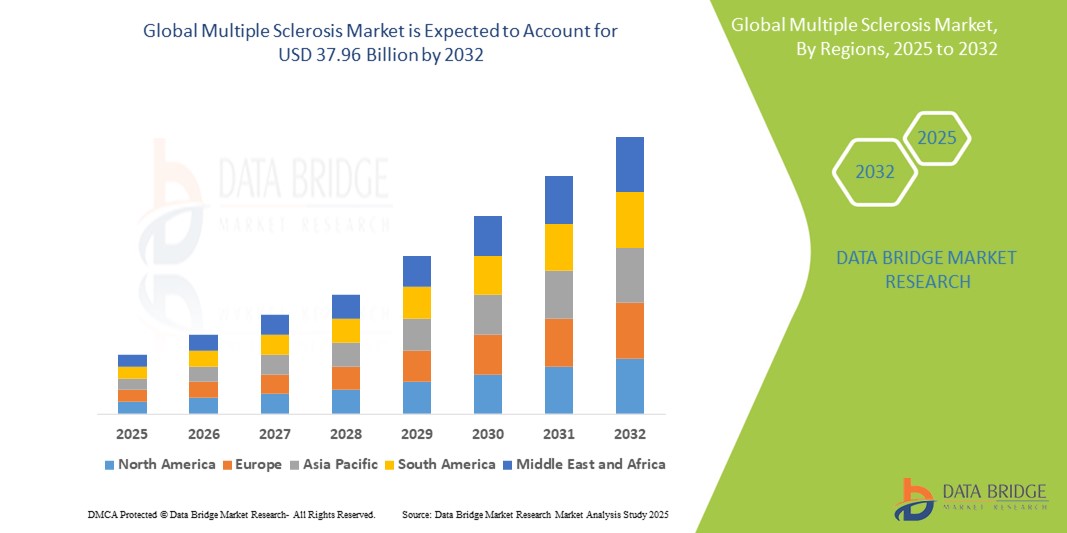
- As per Data Bridge Market Research Analysis the global multiple sclerosis market was valued at USD 28.28 billion in 2024 and is expected to reach USD 37.96 billion by 2032
- During the forecast period of 2025 to 2032 the market is likely to grow at a CAGR of 3.75%, primarily driven by the anticipated launch of new therapies and advancements in treatment options
- This growth is supported by factors such as the increasing prevalence of multiple sclerosis globally, advancements in medical technology, and the rising awareness about early diagnosis and treatment options
Market Size & Forecast
Global Market Value (2024): USD 28.28 billion
Expected Market Value (2032): USD 37.96 billion
Forecast CAGR (2025–2032): 3.75%
What are the Major Takeaways of Multiple Sclerosis Market?
- Multiple sclerosis (MS) is a chronic autoimmune disorder that affects the central nervous system, leading to disability. The demand for MS treatments is significantly driven by the increasing prevalence of the disease and advancements in therapeutic options. For example, the number of MS cases in countries like the U.S., Canada, and European nations such as Sweden and Norway have been rising steadily due to greater awareness, improved diagnostic techniques, and better healthcare systems
- The demand for MS therapies is primarily driven by the need for disease-modifying therapies (DMTs), which aim to reduce the frequency and severity of relapses, slow disease progression, and manage symptoms
- For instance, advancements in DMTs is the approval of oral medications like Gilenya (fingolimod) and Tecfidera (dimethyl fumarate), which offer convenient alternatives to injectable treatments and have shown promising results in reducing MS relapses.
- Globally, disease-modifying therapies (DMTs) remain the cornerstone of the MS treatment market, followed by therapies aimed at symptom management. The development of oral medications and biologic therapies, such as monoclonal antibodies, has further improved treatment options for patients
Report Scope and Multiple Sclerosis Market Segmentation
|
Attributes |
Multiple Sclerosis Key Market Insights |
|
Segments Covered |
|
|
Countries Covered |
North America
Europe
Asia-Pacific
Middle East and Africa
South America
|
|
Key Market Players |
|
|
Market Opportunities |
|
|
Value Added Data Infosets |
In addition to the insights on market scenarios such as market value, growth rate, segmentation, geographical coverage, and major players, the market reports curated by the Data Bridge Market Research also include in-depth expert analysis, patient epidemiology, pipeline analysis, pricing analysis, and regulatory framework. |
What is the Key Trend in the Multiple Sclerosis Market?
“Increasing Focus on Personalized Medicine and Targeted Therapies”
- One prominent trend in the global multiple sclerosis (MS) market is the increasing focus on personalized medicine and targeted therapies
- Advances in genomics, biomarker discovery, and patient-specific data are enabling the development of tailored treatments that address the unique needs of MS patients, improving treatment efficacy and minimizing side effects
- For instance, genetic profiling and molecular testing allow healthcare providers to identify specific MS subtypes, enabling more precise targeting of therapies like Ocrevus (ocrelizumab), which is designed to treat both relapsing and primary progressive forms of MS
- Personalized treatment approaches also involve the customization of disease-modifying therapies (DMTs) based on an individual’s response to medication, optimizing long-term management of the disease
- This trend is transforming MS management by providing more effective, individualized care, leading to improved patient outcomes and driving the demand for innovative therapies in the market
Multiple Sclerosis Market Dynamics
Driver
“Increasing Prevalence of Multiple Sclerosis (MS)”
- The rising prevalence of multiple sclerosis (MS) is significantly contributing to the increased demand for MS treatments, diagnostic tools, and therapies
- As the global population grows and the awareness of MS improves, the number of diagnosed cases continues to rise, especially in countries with better diagnostic capabilities such as the U.S., Canada, and European nations
- MS is more commonly diagnosed in individuals aged 20-50, with women being more affected than men, and this demographic shift further drives the need for effective therapeutic solutions
- The ongoing advancements in the development of disease-modifying therapies (DMTs), including oral medications, biologics, and targeted treatments, are directly addressing the growing number of MS patients, leading to improved disease management and patient outcomes
- With the aging population and increasing risk factors, there is a significant demand for both early-stage diagnostic tools like MRI and innovative treatments to manage MS progression
For instance,
- In 2021, a study published by the World Health Organization (WHO) highlighted that MS is becoming more prevalent worldwide, with an estimated 2.8 million people affected globally. This growing prevalence acts as a key driver for the global MS market, increasing the need for specialized treatment options and diagnostic tools to manage the disease
- In 2020, the National Multiple Sclerosis Society (NMSS) reported that the prevalence of MS in the U.S. had risen, particularly in women and in individuals diagnosed with the disease at a younger age, further fueling demand for therapies and medical interventions tailored to the specific needs of MS patients
- As a result of the rising prevalence of MS, there is a significant increase in demand for disease-modifying therapies, symptom management solutions, and diagnostic technologies, driving the growth of the global MS market
Opportunity
“Emerging Opportunities in Digital Health and AI Integration for MS Management”
- The integration of artificial intelligence (AI) and digital health technologies into multiple sclerosis (MS) management presents significant market opportunities. AI-powered platforms and digital tools can enhance early diagnosis, optimize treatment plans, and improve patient outcomes
- AI algorithms can analyze patient data, including MRI scans and genetic profiles, to detect early signs of MS progression and predict individual disease trajectories. This enables more personalized treatment strategies and better management of the disease
- Digital health tools, such as mobile apps and wearables, are providing real-time monitoring of MS symptoms, allowing for continuous tracking of disease progression and treatment efficacy. This helps physicians make timely adjustments to treatment plans, ensuring better disease control
For instance,
- In March 2024, a study published in The Lancet Neurology highlighted the growing role of AI in assessing MS lesion activity through advanced MRI imaging. AI-driven solutions can analyze large datasets of MS lesions to identify patterns that might otherwise go unnoticed, providing valuable insights for clinicians to adjust treatment early
- In August 2023, a report by the National MS Society stated that digital health platforms are now being used to monitor patients remotely, track relapse events, and even predict relapses through machine learning models. These tools are helping to manage MS more efficiently by improving patient engagement and providing continuous care
- The integration of AI and digital health technologies in the MS market offers the opportunity to improve diagnosis, optimize treatments, and support personalized care, leading to enhanced patient outcomes and significant market growth
Restraint/Challenge
“High Treatment Costs and Limited Accessibility to Advanced Therapies”
- The high cost of multiple sclerosis (MS) treatments poses a significant challenge for the market, particularly affecting patients' access to newer, more advanced therapies, especially in developing regions
- Disease-modifying therapies (DMTs), biologics, and other advanced treatments for MS can cost tens of thousands of dollars annually, creating a substantial financial burden for patients and healthcare systems
- These high costs can limit access to the latest medications for individuals in lower-income or middle-income countries, where healthcare budgets are constrained, resulting in delays in treatment or reliance on older, less effective therapies
For instance,
- In March 2024, a report published by the National Multiple Sclerosis Society highlighted that the annual cost of MS treatments in the U.S. can range from $60,000 to $100,000, making it unaffordable for many patients without adequate insurance coverage. This high cost limits the accessibility of life-changing treatments, leading to disparities in disease management.
- Consequently, such financial barriers can result in uneven access to cutting-edge treatments, ultimately hindering the overall growth of the MS market and affecting patient outcomes, particularly in regions with lower healthcare spending
How is the Multiple Sclerosis Market Segmented?
The market is segmented on the basis of type, treatment, drug class, diagnosis, route of administration, end-users, and distribution channel
|
Segmentation |
Sub-Segmentation |
|
By Type |
|
|
By Treatment |
|
|
By Drug Class |
|
|
By Diagnosis |
|
|
By Route of Administration |
|
|
By End User |
|
|
By Distribution Channel |
|
Which Region Holds the Largest Share of the Multiple Sclerosis Market?
“North America is the Dominant Region in the Multiple Sclerosis Market”
- North America dominates the multiple sclerosis (MS) market, driven by advanced healthcare infrastructure, high adoption of innovative treatment options, and a strong presence of key pharmaceutical companies
- The U.S. holds a significant share of the market due to the high prevalence of MS, increased awareness, and a large number of MS-specific treatment centers. The country's robust healthcare system and access to cutting-edge therapies further contribute to its market leadership
- The availability of well-established reimbursement policies, strong research and development investments from leading pharmaceutical companies, and extensive insurance coverage make access to MS treatments more widespread in the region
- Additionally, the increasing number of MS diagnoses, improved early detection rates, and a growing focus on personalized medicine are fueling market growth in North America
“Asia-Pacific is Projected to Register the Highest Growth Rate”
- The Asia-Pacific region is expected to witness the highest growth rate in the multiple sclerosis market, driven by expanding healthcare infrastructure, rising awareness of MS, and increased availability of MS treatment options
- Countries like China, India, and Japan are emerging as key markets due to growing healthcare investments, increased access to diagnostic tools, and a rising prevalence of MS
- Japan, with its advanced medical technology and high adoption of innovative therapies, continues to be a leader in MS care. The country’s strong healthcare system and expanding patient population contribute significantly to market growth
- China and India, with their large populations and improving healthcare access, are seeing a rise in MS diagnoses and an increasing demand for effective treatment options. Expanding government initiatives and private sector investments in MS awareness and healthcare infrastructure are further boosting the market in these countries
Which are the Top Companies in Multiple Sclerosis Market?
The market competitive landscape provides details by competitor. Details included are company overview, company financials, revenue generated, market potential, investment in research and development, new market initiatives, global presence, production sites and facilities, production capacities, company strengths and weaknesses, product launch, product width and breadth, application dominance. The above data points provided are only related to the companies' focus related to market.
The Major Market Leaders Operating in the Market Are:
- Biogen Inc. (U.S.)
- Novartis International AG (Switzerland)
- Roche Holding AG (Switzerland)
- Sanofi S.A. (France)
- Merck KGaA (Germany)
- Bayer AG (Germany)
- Teva Pharmaceutical Industries Ltd. (Israel)
- Eisai Co., Ltd. (Japan)
- Mylan N.V. (U.S.)
- Genzyme Corporation (U.S.)
- Johnson & Johnson (U.S.)
- AbbVie Inc. (U.S.)
- Celgene Corporation (U.S.)
- Abbott Laboratories (U.S.)
- Zydus Cadila (India)
- GSK (GlaxoSmithKline) (U.K.)
- UCB S.A. (Belgium)
- Acorda Therapeutics, Inc. (U.S.)
- Alexion Pharmaceuticals, Inc. (U.S.)
- Almirall S.A. (Spain)
What are Latest Developments in Multiple Sclerosis Market?
- In March 2024, Juvisé Pharmaceuticals, a prominent French pharmaceutical company, has secured the global commercial rights (excluding the United States and Canada) for Ponvory (ponesimod), a treatment for adults with active forms of relapsing multiple sclerosis (RMS), through an acquisition from Actelion Pharmaceuticals Ltd., a subsidiary of Johnson & Johnson. This strategic acquisition underscores Juvisé Pharmaceuticals' expansion into the global multiple sclerosis treatment market, allowing the company to leverage Ponvory’s potential to address the growing demand for effective disease-modifying therapies
- In February 2024, Roche Pharma India introduced Ocrevus (ocrelizumab), a monoclonal antibody drug, as a disease-modifying therapy (DMT) for both relapsing multiple sclerosis (RRMS) and primary progressive multiple sclerosis (PPMS) in India. This launch marks a significant milestone in Roche Pharma India’s commitment to advancing treatment options for multiple sclerosis (MS) patients
- In October 2023, Biogen released positive Phase 3 clinical trial results for their investigational drug, BIIB098, highlighting significant efficacy in reducing disease activity and slowing disability progression in individuals with relapsing forms of multiple sclerosis (MS). These findings represent a substantial advancement in MS treatment, offering new hope for patients and clinicians alike. The implications of this breakthrough are also highly relevant to the global Multiple Sclerosis Market. As the need for more effective treatment options grows, BIIB098’s potential to address critical gaps in managing relapsing MS may contribute to the expansion of the market
- In November 2022, Roche introduced a subcutaneous formulation of Ocrevus (ocrelizumab) in the United States for the treatment of relapsing forms of multiple sclerosis (MS) and primary progressive MS, offering patients an additional method of administration for this widely used therapy. This development holds significant relevance to the global Multiple Sclerosis Market. By providing patients with more flexible administration options, Roche’s new formulation of Ocrevus is expected to enhance patient adherence and satisfaction, potentially driving greater market penetration
- In August 2020, Novartis announced the launch of Kesimpta (ofatumumab) following its approval by the U.S. Food and Drug Administration (FDA). Kesimpta is the first and only self-administered, targeted B-cell therapy for individuals with relapsing multiple sclerosis (RMS). Combining robust efficacy with a favorable safety profile, Kesimpta offers the added benefit of at-home self-administration, addressing a critical need in the treatment of RMS. This development holds considerable significance for the global Multiple Sclerosis Market. By providing an innovative treatment option that enhances patient convenience and adherence, Kesimpta is poised to drive further growth in the MS therapeutic landscape

- Interactive Data Analysis Dashboard
- Company Analysis Dashboard for high growth potential opportunities
- Research Analyst Access for customization & queries
- Competitor Analysis with Interactive dashboard
- Latest News, Updates & Trend analysis
- Harness the Power of Benchmark Analysis for Comprehensive Competitor Tracking
Data collection and base year analysis are done using data collection modules with large sample sizes. The stage includes obtaining market information or related data through various sources and strategies. It includes examining and planning all the data acquired from the past in advance. It likewise envelops the examination of information inconsistencies seen across different information sources. The market data is analysed and estimated using market statistical and coherent models. Also, market share analysis and key trend analysis are the major success factors in the market report. To know more, please request an analyst call or drop down your inquiry.
The key research methodology used by DBMR research team is data triangulation which involves data mining, analysis of the impact of data variables on the market and primary (industry expert) validation. Data models include Vendor Positioning Grid, Market Time Line Analysis, Market Overview and Guide, Company Positioning Grid, Patent Analysis, Pricing Analysis, Company Market Share Analysis, Standards of Measurement, Global versus Regional and Vendor Share Analysis. To know more about the research methodology, drop in an inquiry to speak to our industry experts.
Data Bridge Market Research is a leader in advanced formative research. We take pride in servicing our existing and new customers with data and analysis that match and suits their goal. The report can be customized to include price trend analysis of target brands understanding the market for additional countries (ask for the list of countries), clinical trial results data, literature review, refurbished market and product base analysis. Market analysis of target competitors can be analyzed from technology-based analysis to market portfolio strategies. We can add as many competitors that you require data about in the format and data style you are looking for. Our team of analysts can also provide you data in crude raw excel files pivot tables (Fact book) or can assist you in creating presentations from the data sets available in the report.












