


Mushroom Packaging Market Overview
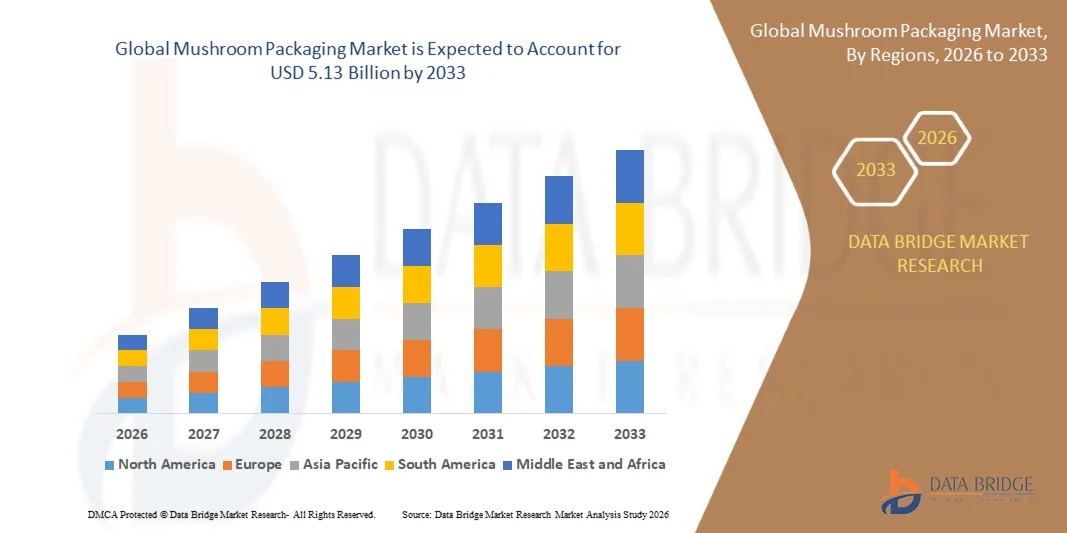
The Mushroom Packaging Market was valued at USD 1.6 Billion in 2025 and is projected to reach USD 5.13 Billion by 2033, growing at a CAGR of 15.70% from 2026 to 2033. The market is experiencing consistent growth driven by rising demand for sustainable and biodegradable packaging solutions, increasing regulatory pressure on single use plastics, and growing adoption of circular economy practices across packaging industries. Expanding use of mushroom-based materials in protective packaging applications such as cushioning, bracing, and void fill is further supporting market expansion across e commerce, electronics, and consumer goods sectors.
The increasing global shift toward eco-friendly packaging alternatives, combined with growing corporate sustainability commitments and consumer preference for plastic free products, is significantly accelerating market adoption. Advancements in mycelium-based material processing and scalable manufacturing technologies are enabling wider commercialization of mushroom packaging solutions across diverse end use industries, strengthening its position as a viable replacement for conventional plastic foam packaging materials.
Key Market Trends & Insights
- North America dominated the Mushroom Packaging Market with the largest revenue share of 35% in 2025, supported by strong sustainability regulations, high adoption of eco-friendly packaging solutions, and rapid shift toward plastic free materials across key industries
- The cushioning segment led the market with a 46% share in 2025, driven by strong demand for protective and sustainable packaging solutions across fragile goods transportation
- Asia-Pacific is expected to be the fastest-growing region at a CAGR of 11.3% from 2026 to 2033, fueled by rapid industrialization, expanding e commerce activities, and increasing adoption of sustainable packaging solutions
- Online is the fastest-growing distribution channel type, projected to register a CAGR of 15.5% from 2026 to 2033, supported by the rapid expansion of e-commerce platforms and digital procurement systems
- The offline segment dominated the distribution channel category with a 42% revenue share in 2025, led by strong procurement from industrial buyers, packaging distributors, and direct B2B supply contracts
- Electronics & electricals accounted for 38% of the market in 2025, preferred by increasing need for high-performance protective packaging for sensitive devices and components
- The void fill segment is the fastest-growing application category, with a CAGR of 14.2% from 2026 to 2033, driven by increasing demand for lightweight, compostable alternatives to synthetic fillers in logistics and retail packaging
Market Size & Forecast
- Global Market Value (2025): USD 1.6 Billion
- Expected Market Value (2033): USD 5.13 Billion
- Forecast CAGR (2026–2033): 15.70%
- Leading Region in 2025: North America
- Fastest Growing Region: Asia-Pacific
Report Scope and Mushroom Packaging Market Segmentation
|
Attributes |
Mushroom Packaging Key Market Insights |
|
Segments Covered |
|
|
Countries Covered |
North America · U.S. · Canada · Mexico Europe · Germany · France · U.K. · Netherlands · Switzerland · Belgium · Russia · Italy · Spain · Turkey · Rest of Europe Asia-Pacific · China · Japan · India · South Korea · Singapore · Malaysia · Australia · Thailand · Indonesia · Philippines · Rest of Asia-Pacific Middle East and Africa · Saudi Arabia · U.A.E. · South Africa · Egypt · Israel · Rest of Middle East and Africa South America · Brazil · Argentina · Rest of South America |
|
Key Market Players |
· Ecovative Design LLC (U.S.) · Sealed Air Corporation (U.S.) · Magical Mushroom Company (U.K.) · Interpack (Germany) · Thermo Packer (U.S.) · Merck Forest (U.S.) · Costa Group (Australia) · CMP Mushroom (China) · Shroom Labs (U.S.) · Paradise Packaging Company (India) · Steelcase Inc. (U.S.) · MycoWorks (U.S.) · Grown.bio (Netherlands) · BioFab Technologies (U.S.) · Mushroom Packaging Ltd (U.K.) · Unilever Packaging Innovation Hub (U.K.) · Dell Technologies Packaging Division (U.S.) · DS Smith Plc (U.K.) · Mondi Group (U.K.) |
|
Market Opportunities |
· Expansion in E Commerce Protective Packaging Demand · Growing Applications in Electronics and Fragile Goods Packaging · Rising Use in Premium Eco Friendly Branding and Luxury Packaging |
|
Value Added Data Infosets |
In addition to the insights on market scenarios such as market value, growth rate, segmentation, geographical coverage, and major players, the market reports curated by the Data Bridge Market Research also include import export analysis, production capacity overview, production consumption analysis, price trend analysis, climate change scenario, supply chain analysis, value chain analysis, raw material/consumables overview, vendor selection criteria, PESTLE Analysis, Porter Analysis, and regulatory framework. |
Mushroom Packaging Market Trends
Trend: Increasing Adoption of Mycelium Based Sustainable Packaging Solutions
The mushroom packaging market is witnessing a strong shift toward mycelium based sustainable packaging solutions as industries replace plastic foams with biodegradable alternatives. Demand is rising across electronics, cosmetics, and e commerce packaging where cushioning, bracing, and void fill applications require high protective performance with low environmental impact. Mycelium materials offer compostability and reduced carbon footprint, aligning with global sustainability targets and corporate ESG commitments.
Companies such as Ecovative Design LLC are actively scaling mycelium packaging platforms, while brands such as Dell Technologies have adopted mushroom based protective packaging for electronics shipping, reinforcing real world commercial viability.
Mushroom Packaging Market Dynamics
Key Market Driver: Rising Regulatory Pressure on Single Use Plastic Materials
The increasing global enforcement of bans and restrictions on single use plastics is significantly driving demand for mushroom based packaging solutions. Governments across Europe, North America, and Asia Pacific are mandating reductions in plastic waste, encouraging adoption of biodegradable and compostable materials in industrial and consumer packaging. This is accelerating replacement of polystyrene foam and synthetic fillers with mycelium-based alternatives across logistics and retail supply chains.
For instance, the European Union’s Single-Use Plastics Directive is pushing manufacturers to adopt sustainable packaging formats, while companies such as Sealed Air Corporation are expanding eco-friendly packaging portfolios to align with regulatory compliance requirements.
Key Restraint/Challenge: High Production Costs and Limited Large Scale Manufacturing Scalability
A major challenge in the mushroom packaging market is the high cost of production and limited scalability of mycelium-based manufacturing processes. Controlled growth conditions, longer cultivation cycles, and specialized processing requirements increase operational costs compared to conventional plastic packaging materials. In addition, scaling consistent quality production for mass industrial demand remains complex, restricting widespread adoption across price sensitive markets.
Companies such as Magical Mushroom Company are working on expanding production capacity to improve scalability, but commercial output is still limited compared to traditional foam packaging manufacturers, highlighting a key barrier to rapid global expansion.
Key Market Opportunity: Growing Applications in Electronics and Fragile Goods Packaging
The increasing demand for protective and sustainable packaging in electronics and fragile goods transportation is creating strong growth opportunities for mushroom packaging. Mycelium based materials provide excellent shock absorption and structural strength, making them suitable for high value electronics, glass products, and precision components. Rapid expansion of global e commerce and cross border logistics is further increasing demand for lightweight, biodegradable protective packaging solutions.
For instance, companies such as IKEA have adopted mushroom based packaging materials in select product lines, demonstrating growing acceptance of eco-friendly cushioning solutions in large scale retail and consumer goods distribution networks.
Mushroom Packaging Market Scope
The mushroom packaging market is segmented on the basis of application, end use industry, and distribution channel.
- By Application
On the basis of application, the Mushroom Packaging Market is segmented into cushioning, bracing, and void fill. The Cushioning segment dominated the market with the largest share of 46% in 2025, driven by strong demand for protective and sustainable packaging solutions across fragile goods transportation. Mushroom-based cushioning materials are increasingly replacing plastic foams due to their biodegradability, shock absorption capacity, and cost efficiency in bulk packaging applications. Growing adoption in e-commerce and electronics shipping further strengthens demand for molded protective packaging formats. Rising sustainability regulations and corporate commitments to plastic reduction continue to reinforce segment leadership.
The Void Fill segment is projected to register the fastest growth at a CAGR of 14.2% from 2026 to 2033, driven by increasing demand for lightweight, compostable alternatives to synthetic fillers in logistics and retail packaging. Mushroom-based void fill solutions are gaining traction due to their ability to reduce product movement during transit while maintaining environmental compliance. Expanding use in direct-to-consumer shipping models is accelerating adoption across global supply chains. Continuous innovation in mycelium processing technology is further improving scalability and cost competitiveness.
- By End Use Industry
On the basis of end use industry, the Mushroom Packaging Market is segmented into electronics & electricals, wine shippers, cosmetics & personal care, homecare, and automotive components. The Electronics & Electricals segment dominated the market with a share of 38% in 2025, driven by increasing need for high-performance protective packaging for sensitive devices and components. Mushroom packaging offers superior shock resistance and thermal stability, making it suitable for safeguarding delicate electronic goods during long-distance transportation. Rising demand for sustainable packaging in consumer electronics supply chains further strengthens adoption. Major manufacturers are increasingly integrating eco-friendly packaging standards to comply with global environmental norms.
The Cosmetics & Personal Care segment is projected to register the fastest growth at a CAGR of 13.8% from 2026 to 2033, driven by strong sustainability branding initiatives and premium product positioning. Brands are increasingly shifting toward biodegradable packaging solutions to enhance consumer perception and reduce environmental footprint. Mushroom-based packaging supports luxury and eco-conscious product presentation, improving shelf appeal in retail environments. Expanding organic and natural cosmetics markets are further accelerating adoption across global regions.
- By Distribution Channel
On the basis of distribution channel, the Mushroom Packaging Market is segmented into offline and online channels. The Offline segment dominated the market with a share of 42% in 2025, driven by strong procurement from industrial buyers, packaging distributors, and direct B2B supply contracts. Large-scale manufacturers prefer offline channels due to bulk ordering efficiency, customization requirements, and long-term supplier relationships. Established packaging distributors continue to play a key role in supplying eco-friendly packaging materials to diverse end-use industries. Stable industrial demand across manufacturing and logistics sectors further reinforces segment dominance.
The Online segment is projected to register the fastest growth at a CAGR of 15.5% from 2026 to 2033, driven by the rapid expansion of e-commerce platforms and digital procurement systems. Small and medium enterprises are increasingly adopting online channels for cost-effective sourcing and flexible order quantities. Growing availability of customizable mushroom packaging solutions on B2B marketplaces is further boosting accessibility. Advancements in digital supply chain integration are improving transparency and delivery efficiency, accelerating online channel adoption globally.
Mushroom Packaging Market Regional Analysis
North America dominated the mushroom packaging market and accounted for the largest revenue share of 35% in 2025, driven by strong sustainability regulations, high adoption of eco-friendly packaging solutions, and rapid shift toward plastic free materials across key industries. The region benefits from a well-established e commerce ecosystem, advanced logistics infrastructure, and strong presence of packaging innovators focused on mycelium-based materials. Companies across electronics, cosmetics, and food shipping sectors are increasingly adopting mushroom packaging to meet corporate sustainability targets and regulatory compliance requirements. In addition, rising consumer awareness regarding biodegradable packaging alternatives continues to reinforce regional market leadership.
U.S. Mushroom Packaging Market Insight
The U.S. Mushroom Packaging market is witnessing strong growth driven by large scale adoption of sustainable packaging in e commerce, electronics, and consumer goods industries. Enterprises are increasingly replacing plastic foams with mycelium-based solutions to reduce environmental footprint and comply with tightening packaging waste regulations. Strong investment activity in bio-based material startups and packaging innovation hubs is accelerating commercialization of mushroom packaging technologies. In addition, growing corporate ESG commitments and consumer preference for eco-friendly products are further supporting market expansion across the U.S.
Canada Mushroom Packaging Market Insight
The Canada Mushroom Packaging market is experiencing steady growth supported by rising environmental regulations, increasing demand for sustainable packaging in retail and food sectors, and growing awareness of biodegradable alternatives. Businesses are gradually transitioning toward compostable packaging materials to align with national sustainability goals and circular economy initiatives. The presence of a growing e commerce sector and increasing adoption of eco conscious branding strategies are further supporting demand. In addition, government encouragement for reduced plastic usage is strengthening long term market growth in Canada.
Europe Mushroom Packaging Market Insight
The Europe Mushroom Packaging market is expanding steadily due to strict environmental regulations, strong circular economy policies, and high adoption of sustainable packaging across industries. The region benefits from proactive government initiatives aimed at reducing single use plastics and promoting biodegradable packaging alternatives. Companies across automotive components, cosmetics, and electronics industries are increasingly integrating mushroom-based packaging to meet sustainability targets. Rising investment in bio-based material innovation and strong consumer preference for green products continue to drive regional demand.
U.K. Mushroom Packaging Market Insight
The U.K. Mushroom Packaging market is growing steadily, driven by strong e commerce penetration, rising sustainability awareness, and increasing adoption of eco-friendly packaging across retail and consumer goods sectors. Businesses are shifting toward biodegradable packaging solutions to comply with environmental regulations and improve brand sustainability positioning. The presence of a well developed logistics and packaging distribution network is supporting faster adoption of mushroom based materials. In addition, growing corporate focus on reducing plastic waste is further accelerating market expansion in the U.K.
Germany Mushroom Packaging Market Insight
The Germany Mushroom Packaging market is expanding due to strong industrial sustainability initiatives, advanced manufacturing capabilities, and strict environmental compliance frameworks. Automotive, electronics, and industrial packaging sectors are increasingly adopting mushroom-based materials to reduce carbon emissions and improve recyclability. The country’s strong emphasis on circular economy practices is driving innovation in bio-based packaging solutions. In addition, rising investment in sustainable material research and development is further supporting market growth in Germany.
Asia-Pacific Mushroom Packaging Market Insight
The Asia-Pacific Mushroom Packaging market is expected to register the fastest growth with a CAGR of 11.3% from 2026 to 2033, driven by rapid industrialization, expanding e commerce activities, and increasing adoption of sustainable packaging solutions. Rising environmental concerns and government initiatives to reduce plastic waste are significantly boosting demand across the region. Countries such as China, India, Japan, and South Korea are witnessing strong investments in bio-based material manufacturing and packaging innovation. In addition, growing export-oriented industries and increasing consumer preference for eco-friendly products are accelerating regional market expansion.
Japan Mushroom Packaging Market Insight
The Japan Mushroom Packaging market is witnessing steady growth supported by advanced packaging technology adoption, strong environmental awareness, and increasing demand for high quality sustainable materials. Enterprises in electronics, cosmetics, and food packaging sectors are adopting mushroom-based solutions to improve sustainability compliance and brand positioning. The country’s strong focus on innovation and material efficiency is further encouraging bio-based packaging development. In addition, rising demand for premium eco-friendly packaging in retail and e commerce channels is supporting market growth in Japan.
China Mushroom Packaging Market Insight
The China Mushroom Packaging market is growing rapidly due to large scale manufacturing capabilities, expanding e commerce logistics networks, and increasing government focus on sustainable development policies. Companies are increasingly adopting mycelium-based packaging to replace plastic foams in electronics and consumer goods shipments. Strong investment in green materials and circular economy initiatives is accelerating commercialization of mushroom packaging solutions. In addition, rising environmental awareness among consumers and enterprises is further driving market expansion in China.
Mushroom Packaging Market Share
The mushroom packaging industry is primarily led by well-established companies, including:
- Ecovative Design LLC (U.S.)
- Sealed Air Corporation (U.S.)
- Magical Mushroom Company (U.K.)
- Interpack (Germany)
- Thermo Packer (U.S.)
- Merck Forest (U.S.)
- Costa Group (Australia)
- CMP Mushroom (China)
- Shroom Labs (U.S.)
- Paradise Packaging Company (India)
- Steelcase Inc. (U.S.)
- MycoWorks (U.S.)
- bio (Netherlands)
- BioFab Technologies (U.S.)
- Mushroom Packaging Ltd (U.K.)
- Unilever Packaging Innovation Hub (U.K.)
- Dell Technologies Packaging Division (U.S.)
- DS Smith Plc (U.K.)
- Mondi Group (U.K.)
Latest Developments in Mushroom Packaging Market
- In June 2025, The Magical Mushroom Company advanced its mycelium-based packaging portfolio by introducing a scalable solution designed to replace conventional plastic and foam materials such as polystyrene and cardboard in protective packaging applications. This development strengthens the mushroom packaging market by improving commercial viability across electronics, retail, and logistics sectors. The innovation enhances biodegradability performance while reducing dependence on petroleum based packaging materials, supporting broader circular economy adoption. It also accelerates industrial uptake by offering a cost efficient and moldable alternative suitable for mass production requirements
- In May 2025, Ecovative Design expanded its mushroom mycelium material technology by enhancing its application range across packaging and bio-based product manufacturing, positioning mycelium as a multifunctional sustainable material. This advancement positively impacts the mushroom packaging market by increasing material versatility and enabling broader adoption in cushioning, protective packaging, and industrial applications. The innovation contributes to soil regeneration after disposal, strengthening its environmental value proposition. It also supports market expansion by improving performance consistency and scalability of mycelium derived packaging solutions
- In May 2025, Ecovative Company pioneered the transformation of mushroom mycelium into a versatile sustainable material, strengthening its role in modern packaging and product development ecosystems. This innovation supports the mushroom packaging market by providing a high-performance bio-based alternative that reduces reliance on conventional pollution intensive materials. It also enhances environmental sustainability by enabling soil enrichment after decomposition, aligning with circular economy objectives. The development further accelerates adoption across industries seeking eco-friendly packaging substitutes
- In June 2025, The Magical Mushroom Company introduced a groundbreaking solution utilizing mycelium to replace plastic waste, directly substituting traditional plant-based packaging materials such as polystyrene and cardboard. This initiative strengthens the mushroom packaging market by reducing dependency on conventional plastic-based packaging systems. It improves environmental performance through enhanced biodegradability and waste reduction capabilities. The development also supports broader industry transition toward sustainable packaging solutions across global supply chains
- In April 2021, Adidas introduced the Stan Smith Mylo, marking a breakthrough application of mushroom based Mylo material in consumer footwear production and demonstrating the adaptability of mycelium beyond packaging applications. This innovation indirectly supported the mushroom packaging market by validating mycelium as a scalable industrial biomaterial with strong sustainability potential. It increased confidence among manufacturers and investors in bio-based material technologies. The initiative also contributed to accelerating research and commercialization of mushroom derived material systems across industries

- Interactive Data Analysis Dashboard
- Company Analysis Dashboard for high growth potential opportunities
- Research Analyst Access for customization & queries
- Competitor Analysis with Interactive dashboard
- Latest News, Updates & Trend analysis
- Harness the Power of Benchmark Analysis for Comprehensive Competitor Tracking
Global Mushroom Packaging Market, Supply Chain Analysis and Ecosystem Framework
To support market growth and help clients navigate the impact of geopolitical shifts, DBMR has integrated in-depth supply chain analysis into its Global Mushroom Packaging Market research reports. This addition empowers clients to respond effectively to global changes affecting their industries. The supply chain analysis section includes detailed insights such as Global Mushroom Packaging Market consumption and production by country, price trend analysis, the impact of tariffs and geopolitical developments, and import and export trends by country and HSN code. It also highlights major suppliers with data on production capacity and company profiles, as well as key importers and exporters. In addition to research, DBMR offers specialized supply chain consulting services backed by over a decade of experience, providing solutions like supplier discovery, supplier risk assessment, price trend analysis, impact evaluation of inflation and trade route changes, and comprehensive market trend analysis.
Data collection and base year analysis are done using data collection modules with large sample sizes. The stage includes obtaining market information or related data through various sources and strategies. It includes examining and planning all the data acquired from the past in advance. It likewise envelops the examination of information inconsistencies seen across different information sources. The market data is analysed and estimated using market statistical and coherent models. Also, market share analysis and key trend analysis are the major success factors in the market report. To know more, please request an analyst call or drop down your inquiry.
The key research methodology used by DBMR research team is data triangulation which involves data mining, analysis of the impact of data variables on the market and primary (industry expert) validation. Data models include Vendor Positioning Grid, Market Time Line Analysis, Market Overview and Guide, Company Positioning Grid, Patent Analysis, Pricing Analysis, Company Market Share Analysis, Standards of Measurement, Global versus Regional and Vendor Share Analysis. To know more about the research methodology, drop in an inquiry to speak to our industry experts.
Data Bridge Market Research is a leader in advanced formative research. We take pride in servicing our existing and new customers with data and analysis that match and suits their goal. The report can be customized to include price trend analysis of target brands understanding the market for additional countries (ask for the list of countries), clinical trial results data, literature review, refurbished market and product base analysis. Market analysis of target competitors can be analyzed from technology-based analysis to market portfolio strategies. We can add as many competitors that you require data about in the format and data style you are looking for. Our team of analysts can also provide you data in crude raw excel files pivot tables (Fact book) or can assist you in creating presentations from the data sets available in the report.













