


What is the MXenes Market Size and Overview?
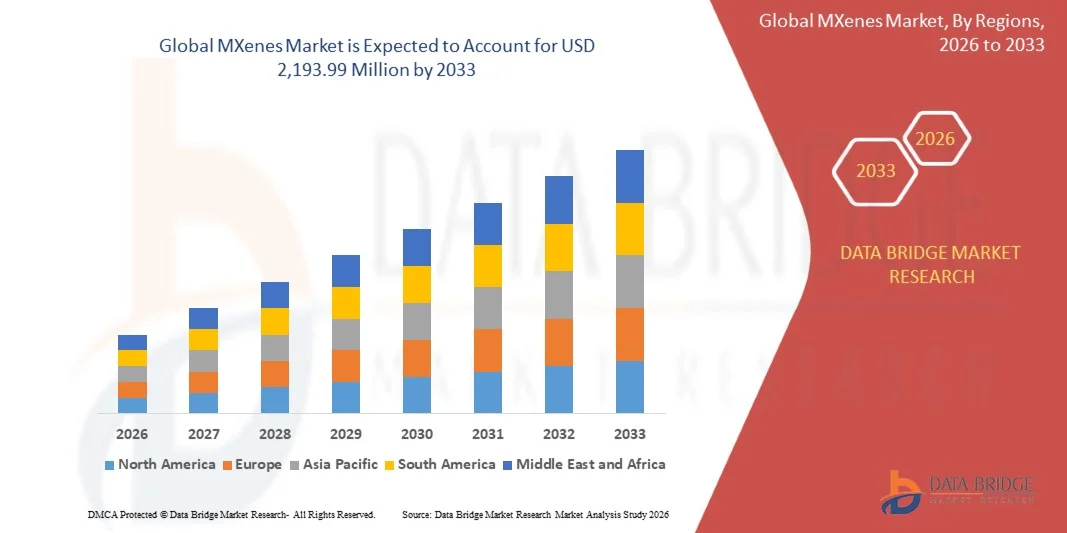
As per Data Bridge Market Research Analysis the MXenes Market was valued at USD 155.64 million in 2025 and is projected to reach USD 2,193.99 million by 2033, growing at a CAGR of 39.20% from 2026 to 2033. MXenes are a novel class of two-dimensional inorganic compounds composed of transition metal carbides, nitrides, or carbonitrides, first discovered in 2011. These materials exhibit unique properties including high electrical conductivity, excellent mechanical strength, tunable surface chemistry, and superior electrochemical performance, making them highly valuable across multiple industries.
Demand for MXenes is driven by growing use in energy storage systems, such as batteries and supercapacitors, due to high electrical conductivity and surface area, alongside rising adoption in EMI shielding, sensors, and advanced electronics. Continuous research and expanding industrial applications across electronics, energy storage, biomedical devices, and electromagnetic shielding are further supporting market growth.
Market Size & Forecast
- Global Market Value (2025): USD 155.64 million
- Expected Market Value (2033): USD 2,193.99 million
- Forecast CAGR (2026–2033): 39.20%
What are the Major Takeaways of MXenes Market?
- Asia-Pacific is the largest market for MXenes, accounting for 40% of the global market share, followed by North America and Europe with shares of 31% and 24%, respectively driven by massive investments in electronic component manufacturing and the rapid adoption of advanced nanomaterials in China, Japan, and South Korea.
- The Energy Storage application holds the largest share, accounting for approximately 41% of the market, driven by the high demand for fast-charging batteries and supercapacitors in the electric vehicle sector.
- Ti-based MXenes represent the largest product segment, accounting for approximately 68% of the global market in 2025, owing to their well-established synthesis protocols and superior electrochemical properties.
- The MXenes Market is projected to grow at a remarkable CAGR, reflecting the rapid commercialization of these advanced materials across multiple industries.
- Recent breakthroughs in c methods, including graphite-assisted ball milling, high-temperature ultrasonic exfoliation, and green electrochemical etching, are enabling kilogram-scale production and reducing manufacturing costs.
- Government-funded research initiatives, including Drexel University's $5 million multinational MXene collaboration and the U.S. Department of Energy's energy storage materials programs, are accelerating the transition from laboratory research to commercial production.
- The development of green synthesis methods, including fluoride-free and electrochemical etching techniques, is addressing environmental concerns and improving the commercial viability of MXene production.
- North America follows with a 31% share, driven by strong research institutions and defense-related applications, while Europe accounts for 24% of the global market.
Report Scope and MXenes Market Segmentation
|
Attributes |
MXenes Key Market Insights |
|
Segments Covered |
|
|
Countries Covered |
North America
Europe
Asia-Pacific
Middle East and Africa
South America
|
|
Key Market Players |
|
|
Market Opportunities |
|
|
Value Added Data Infosets |
In addition to the insights on market scenarios such as market value, growth rate, segmentation, geographical coverage, and major players, the market reports curated by the Data Bridge Market Research also include import export analysis, production capacity overview, production consumption analysis, price trend analysis, climate change scenario, supply chain analysis, value chain analysis, raw material/consumables overview, vendor selection criteria, PESTLE Analysis, Porter Analysis, and regulatory framework. |
What is the Key Trend in the MXenes Market?
Trend: Green Synthesis and Sustainable Production
The development of environmentally friendly synthesis methods is addressing the toxicity concerns associated with traditional hydrofluoric acid-based etching processes. Electrochemical etching is expected to grow at the fastest CAGR during the forecast period due to higher material purity, improved structural control, and reduced use of hazardous chemicals. Fluoride-free etching methods are also gaining traction, supporting safer production and long-term adoption of MXene-based solutions. Sustainable processing aligns with industrial production needs and large-scale commercialization of MXene-based applications. Scientists from Helmholtz-Zentrum Dresden-Rossendorf have developed a new "gas–liquid–solid" triphasic etching strategy that produces ultra-clean MXenes with outstanding electrical performance.
MXenes Market Dynamics
Key Market Driver: Surging Demand for Advanced Energy Storage Solutions
The primary driver of the MXenes market is the increasing demand for advanced energy storage materials driven by the global push toward renewable energy and electric vehicles. MXenes, with their exceptional conductivity and electrochemical properties, have emerged as promising candidates for next-generation batteries and supercapacitors. The energy storage application segment is expected to register the fastest CAGR of 40.6% during the forecast period. Their ability to improve charge/discharge rates while maintaining stability gives them a competitive edge over traditional materials. The electrification of vehicles and the growing adoption of renewable energy systems are creating unprecedented demand for high-performance energy storage materials.
Key Restraint/Challenge: High Production Costs and Scalability Challenges
Despite their remarkable properties, MXenes face significant commercialization barriers primarily related to production economics. Current synthesis methods often require expensive precursors and controlled environments, with production costs ranging 30-50% higher than competing materials. The etching process used to create MXenes from MAX phases remains energy-intensive, with yields sensitive to processing parameters. Additionally, MXenes are vulnerable to oxidative degradation, which can be mitigated by controlling synthesis parameters, selecting optimized MAX phases, and chemically treating the MXenes. The development of scalable manufacturing processes and the reduction of production costs remain critical challenges for market expansion.
Key Market Opportunity: Biomedical and Healthcare Applications
The biomedical and healthcare sector presents significant growth opportunities for MXenes, with recent discoveries of biocompatibility and bacterial inhibition properties for Ti₃C₂Tₓ and Nb₂C MXenes. The healthcare sector's increasing emphasis on nano-enabled devices, minimally invasive diagnostics, and smart access devices is opening new multi-million-dollar sub-markets for functionalized MXene materials globally. The MX-Innovation project aims to achieve industrial production of MXenes by 2028, focusing on water desalination and advanced biomedical analysis applications. MXenes have significant potential in drug delivery, tissue engineering, and sensing due to their biocompatibility and unique physicochemical properties.
How is the MXenes Market Segmented?
The MXenes market is segmented on the basis of product type, form, application, end-user, and synthesis method.
- Product Type:
On the basis of product type, the MXenes Market is segmented into Ti-based MXenes, V-based MXenes, Nb-based MXenes, Mo-based MXenes, and others. Ti-based MXenes accounted for approximately 68% of the global market in 2025, owing to their well-established synthesis protocols and superior electrochemical properties. Titanium-based MXenes such as Ti₃C₂Tₓ dominate due to their high electrical conductivity, excellent mechanical stability, and well-established synthesis routes, making them the most commercially viable MXene variant. The widespread availability of titanium precursors and extensive research on Ti₃C₂Tₓ applications in energy storage, EMI shielding, and sensors further solidify their market leadership. Nb-based MXenes represent the fastest-growing segment, driven by growing interest in high-rate energy storage, superconductivity research, and advanced electronic applications. The unique electronic and optical properties of V-based and Mo-based MXenes are gaining attention for specialized applications in catalysis, optoelectronics, and biomedical devices. The continuous discovery of new MXene compositions, including M₂X, M₃X₂, and M₄X₃ stoichiometries, is expanding the range of available materials and application possibilities.
- Form
On the basis of form, the MXenes Market is segmented into powder, wet paste, and others. The powder form dominated the market with a share of 75.5% in 2025, driven by its versatility across end-use applications and compatibility with established manufacturing processes. Powdered MXene disperses easily into polymers, inks, and slurries, supporting large-scale production of electrodes and coatings for energy storage and electronic applications. The high surface area and tunable surface chemistry of powdered MXenes enhance electrical conductivity and electrochemical performance, making them ideal for battery anodes and supercapacitor electrodes. High-concentration MXene inks have demonstrated superior printability, enabling advanced applications such as infrared stealth coatings, high-efficiency Joule heating devices, and flexible conductive films. The powder form also offers advantages in transportation, storage, and formulation flexibility, reducing overall production costs for manufacturers. Wet paste MXenes are gaining traction in applications requiring immediate dispersion and processing, particularly in research settings and specialized coating applications. Other forms include MXene films and solutions for specialized applications such as transparent conductive electrodes and biomedical sensors. The growing demand for printable electronics and flexible devices is expected to further drive innovation in MXene formulation and processing.
- Application
On the basis of application, the MXenes Market is segmented into energy storage, optoelectronics, electromagnetic interference shielding, sensors, biomedical, environmental, and others. Energy Storage holds the largest share of approximately 41%, driven by the growing demand for high-performance batteries and supercapacitors in the electric vehicle and renewable energy sectors. MXenes are increasingly adopted in lithium-ion batteries, sodium-ion batteries, and supercapacitors due to their high electrical conductivity, large surface area, and rapid ion transport properties, which significantly enhance charge/discharge rates and cycling stability. The exceptional volumetric capacitance (~1,500 F/cm³) of MXenes positions them as superior materials for next-generation energy storage systems. Electromagnetic Interference Shielding is a rapidly growing segment, with MXenes achieving over 90 dB shielding effectiveness at minimal thickness, making them ideal for 5G and IoT devices requiring lightweight, flexible shielding solutions. Biomedical applications include drug delivery, tissue engineering, biosensing, and photothermal therapy, leveraging MXenes' biocompatibility and unique physicochemical properties. Sensors and optoelectronics applications leverage MXenes' tunable optical properties and high sensitivity for detecting various analytes and environmental conditions.
- End-User
On the basis of end-user, the MXenes Market is segmented into research & academic institutes, electronics & semiconductor, energy & power, healthcare, automotive, and aerospace & defense. Research & Academic Institutes represent a significant end-user segment, driving fundamental research and early-stage commercialization of MXene materials, with universities and research institutions being primary consumers of research-grade MXene products. The Electronics & Semiconductor segment is expanding rapidly, driven by demand for MXenes in flexible electronics, transparent conductive films, and EMI shielding applications for 5G technologies and IoT devices. Energy & Power represents the leading commercial end-user segment, with MXenes being integrated into next-generation batteries, supercapacitors, and energy storage systems for electric vehicles and grid-scale applications. The Healthcare segment is emerging as a key growth area, with MXenes being explored for biosensing, drug delivery, diagnostic applications, and photothermal therapy, supported by recent discoveries of biocompatibility and bacterial inhibition properties. The Automotive segment is adopting MXenes for lightweight composites, EMI shielding, and advanced sensor applications, contributing to vehicle electrification and autonomous driving technologies.
- Synthesis Method
On the basis of synthesis method, the MXenes Market is segmented into HF chemical etching, fluoride-free etching, electrochemical etching, and others. The HF chemical etching production method dominated the global MXene market in 2025 due to high material yield and structural precision, establishing it as the most widely used and commercially mature synthesis approach. However, the toxicity and safety concerns associated with hydrofluoric acid are driving the development of alternative, environmentally friendly synthesis methods. Electrochemical etching is expected to grow at the fastest CAGR during the forecast period due to higher material purity, improved structural control, and reduced use of hazardous chemicals, offering a greener and safer alternative for commercial production. Fluoride-free etching methods are gaining traction as environmentally friendly alternatives, including techniques using organic electrolytes and molten salts, supporting safer production and long-term adoption of MXene-based solutions. Supercritical CO₂-assisted fabrication routes have demonstrated kilogram-scale batches with mono/few-layer yields exceeding 60% and better air stability, improving the scalability of MXene production. The choice of synthesis method significantly impacts MXene quality, yield, and cost, with ongoing research focused on scalable and sustainable production techniques that reduce manufacturing expenses.
Which Region Holds the Largest Share of the MXenes Market?
Asia-Pacific MXenes Market Insight
Asia-Pacific is the largest market for MXenes, accounting for approximately 40% of the global market share. The region's dominance is driven by massive investments in electronic component manufacturing and the rapid adoption of advanced nanomaterials in China, Japan, and South Korea. China holds the largest share of the Asia-Pacific MXene market, supported by its strong nanomaterials manufacturing base, advanced research ecosystem, and high concentration of academic institutions active in MXene synthesis. Industrial players are engaged in application development, with large-scale investment in energy storage and electronics manufacturing supporting demand. Government support for advanced materials accelerates commercialization, positioning China as the leading MXene market in the Asia-Pacific region. Asia Pacific is expected to grow at a CAGR of 37.1% during the forecast period.
North America MXenes Market Insight
North America accounted for approximately 31% of the global market share. The region's market is driven by robust investments in nanomaterials research, strong demand for advanced energy storage systems, and a well-established base of academic and industrial research institutions. The United States is at the forefront of MXene development, with the U.S. Department of Energy identifying MXenes as a priority research area. Major players such as American Elements, Alfa Chemistry, and ACS Material are headquartered in the U.S., strengthening the region's market position. Drexel University is leading a three-year, $5 million multinational collaboration to advance MXene nanomaterials for water desalination and medical diagnostics. The region's strong venture capital funding for advanced materials startups and favorable regulatory environment for technology innovation are further accelerating market growth.
Europe MXenes Market Insight
Europe accounted for approximately 24% of the global market share. The region represents a significant market for MXenes, supported by strong research institutions, advanced manufacturing capabilities, and growing demand from the energy storage and electronics sectors. Key players such as Sigma-Aldrich (Merck KGaA) are headquartered in Europe, strengthening the region's market position. The region's focus on sustainability and compliance with environmental regulations is driving the development of green synthesis methods. The European Union's Horizon Europe program and various national research initiatives are providing substantial funding for MXene research and development. The automotive industry's shift toward electric vehicles is also driving demand for MXenes in battery applications.
Latin America MXenes Market Insight
Latin America represents an emerging market for MXenes, with growing demand influenced by increasing investments in advanced materials research and energy storage technologies. Countries such as Brazil and Mexico are gradually adopting advanced materials to support the growing demand for electronics and energy storage applications. The region's expanding research infrastructure and growing awareness of advanced materials are creating opportunities for MXene applications. However, market growth is currently constrained by limited manufacturing infrastructure, higher technology costs compared to developed regions, and fragmented policy support. The development of regional supply chains and partnerships with global MXene technology providers is expected to accelerate market growth.
Middle East & Africa MXenes Market Insight
The Middle East and Africa region represents a nascent market for MXenes, with demand primarily concentrated in the GCC countries. Governments across the region are increasing investments in advanced materials research and technology sectors to diversify their economies. The UAE is emerging as a key player, with Khalifa University's Research & Innovation Center for Graphene and 2D Materials (RIC2D) joining a three-year, $5 million multinational collaboration with Drexel University to advance MXene development for clean water production and biomedical research applications. The project, titled "Commercial MXene manufacturing toward technology innovations in the UAE and beyond" (MX-Innovation), aims to achieve industrial production of MXenes by 2028. Saudi Arabia is also investing in advanced materials research as part of its Vision 2030 initiative.
Which are the Top Companies in MXenes Market?
The MXenes industry is primarily led by well-established companies, including:
- American Elements (U.S.)
- Sigma-Aldrich (Merck KGaA) (Germany)
- Japan Material Technologies Corporation (JMTC) (Japan)
- Alfa Chemistry (U.S.)
- Beike 2D Materials Co., Ltd. (China)
- ACS Material LLC (U.S.)
- Nanjing XFNANO Materials Tech Co., Ltd. (China)
- Beijing Zhongkeleiming Technology Co., Ltd. (China)
- 6Carbon Technology (Shenzhen) Co., Ltd. (China)
- Nanoshel LLC (U.S.)
- Foshan Xinxi Technology Co., Ltd. (China)
- NEO Battery Materials Ltd. (Canada)
- NainTech Co., Ltd. (South Korea)
- Ninetech (South Korea)
- 2D Semiconductors (U.S.)
- Otto Chemie Pvt. Ltd. (India)
- Suzhou Beike Nanotechnology (China)
- Jinan Sanchuan New Material Technology (China)
- Shandong Xiyan New Material Technology (China)
What are Latest Developments in MXenes Market?
- In January 2026, University of Chicago researchers, in collaboration with the University of Illinois Chicago and Vanderbilt University, developed a new MXene synthesis method that significantly lowers production costs while improving material quality. The technique, reported in Nature Synthesis, delivers approximately 90% purity, eliminates hazardous chemicals, and reduces manufacturing costs by more than 100-fold compared with conventional processes.
- In January 2026, researchers from Harbin Institute of Technology and their collaborators developed multifunctional ANF/MXene-enhanced hydrogels for flexible EMI shielding and wearable sensing applications. The innovative hydrogel addresses the long-standing challenge of balancing electrical conductivity and effective EMI absorption in flexible electronic materials, with the research published in Nano-Micro Letters.
- In December 2025, a study presented an efficient strategy to employ a basic high-speed blender to prepare large-sized MXene layers via a cell-wall disruption method. Under high-speed rotation, the blades exerted intense shear force on multilayer MXene, achieving yields of 89.2% for sub-high-speed and 99.1% for ultra-high-speed modes. MXene layers obtained possessed a large average lateral dimension of 7.3 μm.
- In December 2025, a mini-review compared supercritical CO₂-assisted MXene fabrication routes to HF and LiF–HCl systems, demonstrating kilogram-scale batches with mono/few-layer yield of more than 60% and better air stability.
- In August 2025, NEO Battery Materials Ltd. entered into a Joint Development Agreement with NainTech Co., Ltd., a South Korean manufacturer, to co-develop sodium-ion battery technology for energy storage systems and high-performance lithium-ion batteries with MXene additives. For drone applications, NainTech's proprietary titanium-based MXene additives will be incorporated into NEO's silicon anode products to improve electrical conductivity, enabling longer flight times, heavier payloads, and high-power maneuvers.
- In July 2025, Khalifa University's Research & Innovation Center for Graphene and 2D Materials (RIC2D), along with partners at the University of Padua (Italy) and Carbon-Ukraine (Ukraine), joined Drexel University's A.J. Drexel Nanomaterials Institute to launch a three-year research project titled "Commercial MXene manufacturing toward technology innovations in the UAE and beyond" (MX-Innovation). The project, led by Professor Yury Gogotsi, aims to achieve industrial production of MXenes by 2028, focusing on water desalination and advanced biomedical analysis applications.
- In July 2025, Harbin Institute of Technology researchers developed a novel high-temperature ultrasonic exfoliation technique enabling efficient, high-yield production of monolayer MXene. The method achieved 95% yield of monolayer MXene, far surpassing conventional techniques, with rapid processing completed in tens of minutes. The team successfully scaled the process to 100-gram batches with over 90% yield, demonstrating feasibility for mass production.

- Interactive Data Analysis Dashboard
- Company Analysis Dashboard for high growth potential opportunities
- Research Analyst Access for customization & queries
- Competitor Analysis with Interactive dashboard
- Latest News, Updates & Trend analysis
- Harness the Power of Benchmark Analysis for Comprehensive Competitor Tracking
Global Mxenes Market, Supply Chain Analysis and Ecosystem Framework
To support market growth and help clients navigate the impact of geopolitical shifts, DBMR has integrated in-depth supply chain analysis into its Global Mxenes Market research reports. This addition empowers clients to respond effectively to global changes affecting their industries. The supply chain analysis section includes detailed insights such as Global Mxenes Market consumption and production by country, price trend analysis, the impact of tariffs and geopolitical developments, and import and export trends by country and HSN code. It also highlights major suppliers with data on production capacity and company profiles, as well as key importers and exporters. In addition to research, DBMR offers specialized supply chain consulting services backed by over a decade of experience, providing solutions like supplier discovery, supplier risk assessment, price trend analysis, impact evaluation of inflation and trade route changes, and comprehensive market trend analysis.
Data collection and base year analysis are done using data collection modules with large sample sizes. The stage includes obtaining market information or related data through various sources and strategies. It includes examining and planning all the data acquired from the past in advance. It likewise envelops the examination of information inconsistencies seen across different information sources. The market data is analysed and estimated using market statistical and coherent models. Also, market share analysis and key trend analysis are the major success factors in the market report. To know more, please request an analyst call or drop down your inquiry.
The key research methodology used by DBMR research team is data triangulation which involves data mining, analysis of the impact of data variables on the market and primary (industry expert) validation. Data models include Vendor Positioning Grid, Market Time Line Analysis, Market Overview and Guide, Company Positioning Grid, Patent Analysis, Pricing Analysis, Company Market Share Analysis, Standards of Measurement, Global versus Regional and Vendor Share Analysis. To know more about the research methodology, drop in an inquiry to speak to our industry experts.
Data Bridge Market Research is a leader in advanced formative research. We take pride in servicing our existing and new customers with data and analysis that match and suits their goal. The report can be customized to include price trend analysis of target brands understanding the market for additional countries (ask for the list of countries), clinical trial results data, literature review, refurbished market and product base analysis. Market analysis of target competitors can be analyzed from technology-based analysis to market portfolio strategies. We can add as many competitors that you require data about in the format and data style you are looking for. Our team of analysts can also provide you data in crude raw excel files pivot tables (Fact book) or can assist you in creating presentations from the data sets available in the report.













