


Mycelium-Based Packaging Market Overview
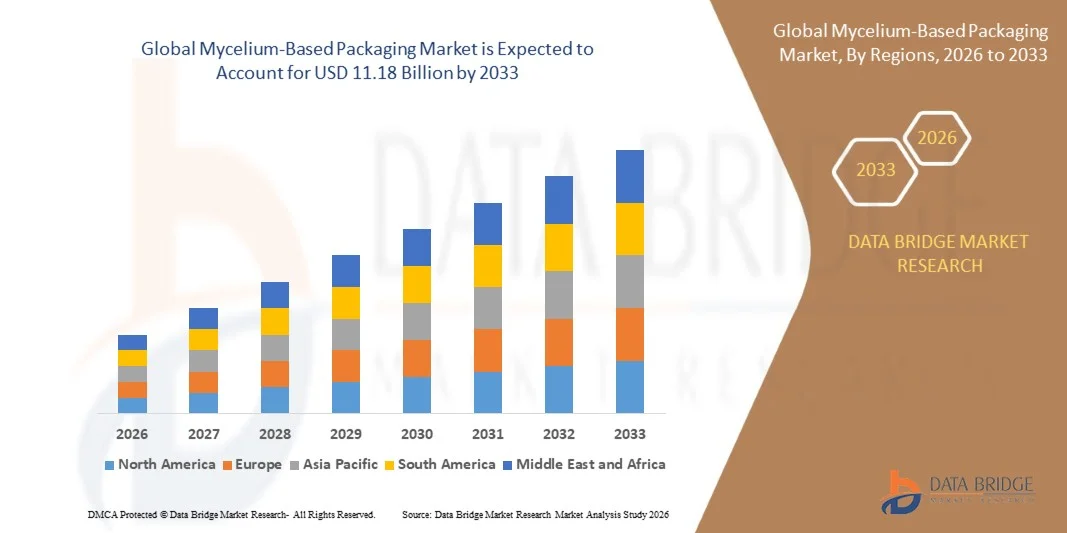
The global mycelium-based packaging market was valued at USD 2.80 billion in 2025 and is projected to reach USD 11.18 billion by 2033, growing at a CAGR of 18.90% from 2026 to 2033. The market is witnessing rapid expansion driven by rising demand for sustainable, biodegradable, and plastic-free packaging alternatives across food & beverage, electronics, personal care, and e-commerce industries. Increasing environmental concerns regarding plastic waste and stringent global regulations on single-use plastics are significantly accelerating the adoption of mycelium-based materials.
The growing shift toward circular economy practices, combined with increasing corporate sustainability commitments and consumer preference for eco-friendly packaging, is further boosting market growth. Mycelium-based packaging offers advantages such as lightweight structure, compostability, and strong cushioning performance, making it an attractive replacement for expanded polystyrene (EPS) and other synthetic packaging materials. In addition, advancements in biotechnology and scalable production processes are improving cost efficiency and expanding commercial applications across global supply chains.
Key Market Trends & Insights
- North America dominated the mycelium-based packaging market with the largest revenue share of approximately 38.6% in 2025, supported by strong adoption of eco-friendly packaging materials, early commercialization of bio-based packaging startups, and high sustainability awareness among consumers and enterprises. The region benefits from strong investments in packaging innovation and increasing adoption across e-commerce and electronics industries.
- Asia-Pacific is expected to be the fastest-growing region, recording a CAGR of approximately 21.4% from 2026 to 2033. Growth is driven by rapid expansion of e-commerce platforms, rising environmental awareness, and increasing government initiatives promoting plastic reduction in countries such as China, India, and Japan. In addition, growing investments in biodegradable material manufacturing and scalable production facilities are accelerating regional market expansion.
- The Mycelium Composite Packaging segment held the largest market revenue share of approximately 46.3% in 2025 driven by its strong mechanical strength, scalability, and widespread use in protective packaging for electronics, furniture, and consumer goods. Composite variants are preferred due to their improved durability, moisture resistance, and cost optimization compared to pure forms. Increasing adoption by e-commerce and electronics companies for shock-absorbing packaging is further supporting segment dominance.
- The Mycelium Foam Packaging segment is projected to register the fastest growth at a CAGR of 19.6% from 2026 to 2033, driven by rising demand for plastic-free cushioning materials across food delivery, retail logistics, and consumer electronics shipping. Growing environmental regulations banning EPS foam in multiple regions, including Europe and parts of North America, are accelerating substitution with biodegradable foam alternatives.
- The Cushioning segment held the largest market revenue share of approximately 52.8% in 2025 driven by its extensive use in protective packaging for fragile products such as electronics, glassware, and cosmetics. Mycelium-based cushioning solutions provide excellent shock absorption while maintaining biodegradability, making them a preferred alternative to synthetic foams. Rising e-commerce shipments globally are further strengthening demand for cushioning applications.
- The Void Fill segment is projected to register the fastest growth at a CAGR of 18.9% from 2026 to 2033, driven by increasing demand for sustainable packaging fillers in logistics and retail supply chains. Companies are increasingly replacing plastic-based fillers with molded mycelium forms to reduce packaging waste and improve sustainability compliance across global distribution networks.
- The Blocks segment held the largest market revenue share of approximately 49.1% in 2025 driven by its wide usage in protective packaging for electronics, industrial components, and furniture shipping. Block formats offer high structural strength and are easily molded into customized protective shapes for different product categories. Increasing demand from e-commerce packaging hubs in North America and Europe is further supporting segment expansion.
- The Sheets segment is projected to register the fastest growth at a CAGR of 20.3% from 2026 to 2033, driven by rising adoption in flexible packaging applications and scalable production formats. Sheets are increasingly used for lightweight wrapping and interlayer protection in food packaging and consumer goods logistics. Expanding innovation in flat molding technologies is improving cost efficiency and production scalability.
- The Consumer Goods segment held the largest market revenue share of approximately 41.6% in 2025 driven by strong adoption of sustainable packaging solutions in electronics, cosmetics, and retail products. Companies such as IKEA and Dell Technologies have already integrated mushroom-based packaging in pilot programs, boosting segment visibility. Increasing consumer preference for eco-friendly packaging is further strengthening demand across global retail chains.
- The Food and Beverage segment is projected to register the fastest growth at a CAGR of 21.1% from 2026 to 2033, driven by increasing restrictions on single-use plastics and rising demand for compostable food packaging solutions. Mycelium-based materials are being increasingly used for trays, protective inserts, and takeaway packaging in Europe and North America. Strong regulatory push from sustainability policies and growing food delivery services are accelerating adoption across the sector.
Market Size & Forecast
- Global Market Value (2025): USD 2.80 Billion
- Expected Market Value (2033): USD 11.18 Billion
- Forecast CAGR (2026–2033): 18.90%
- Leading Region in 2025: North America
- Fastest Growing Region: Asia-Pacific
Report Scope and Mycelium-Based Packaging Market Segmentation
|
Attributes |
Mycelium-Based Packaging Key Market Insights |
|
Segments Covered |
|
|
Countries Covered |
North America
Europe
Asia-Pacific
Middle East and Africa
South America
|
|
Key Market Players |
• Ecovative Design (U.S.) |
|
Market Opportunities |
• Expansion Of Sustainable Packaging In E Commerce Industry |
|
Value Added Data Infosets |
In addition to the insights on market scenarios such as market value, growth rate, segmentation, geographical coverage, and major players, the market reports curated by the Data Bridge Market Research also include import export analysis, production capacity overview, production consumption analysis, price trend analysis, climate change scenario, supply chain analysis, value chain analysis, raw material/consumables overview, vendor selection criteria, PESTLE Analysis, Porter Analysis, and regulatory framework. |
Global Mycelium-Based Packaging Market Trends
Trend: Growth In Sustainable Bio-Based Packaging And Circular Economy Adoption
Increasing demand for biodegradable, compostable, and plastic-free packaging solutions across food & beverage, e-commerce, cosmetics, and electronics industries is accelerating the adoption of mycelium-based packaging globally. Conventional petroleum-based packaging materials such as expanded polystyrene (EPS) and plastic foams are increasingly being restricted due to environmental concerns, landfill accumulation, and microplastic pollution, encouraging industries to shift toward bio-based alternatives.
In the e-commerce sector, companies such as Amazon and IKEA have initiated packaging pilots using mushroom-based cushioning materials for product protection, reducing dependency on synthetic foams and improving sustainability performance. In food packaging applications, mycelium materials are being used for protective trays and containers to replace single-use plastics, particularly in Europe and North America where strict regulations such as the EU Single-Use Plastics Directive are accelerating adoption. In addition, luxury brands and electronics manufacturers are increasingly integrating molded mycelium packaging to enhance eco-friendly brand positioning while maintaining product safety during shipping. The rapid expansion of circular economy initiatives in 2025, including corporate net-zero packaging commitments, is further supporting large-scale commercialization of mycelium-based materials with compostability rates exceeding 90% within 30–45 days under industrial conditions
Global Mycelium-Based Packaging Market Dynamics
Key Market Driver: Rising Ban On Single-Use Plastics And Corporate Sustainability Commitments
Governments and regulatory bodies worldwide are implementing strict policies to reduce plastic waste, driving strong demand for biodegradable packaging alternatives such as mycelium-based solutions. The European Union’s restrictions on single-use plastics, along with similar bans in countries such as Canada and India, are significantly influencing packaging material substitution across industries.
Large multinational corporations in food, retail, and consumer electronics sectors are increasingly adopting sustainable packaging targets under ESG frameworks. Companies such as Dell Technologies and IKEA have already incorporated mushroom-based packaging prototypes to reduce carbon footprint in supply chains. In addition, increasing consumer awareness regarding environmental impact is pushing brands to transition toward compostable packaging solutions that align with sustainability expectations. Industrial adoption trials in the United States during 2024 demonstrated that mycelium packaging can reduce packaging-related carbon emissions by up to 60–70% compared to EPS foam alternatives, reinforcing its commercial viability
Key Restraint/Challenge: High Production Costs And Limited Large-Scale Manufacturing Infrastructure
Despite strong environmental benefits, the mycelium-based packaging market faces challenges related to high production costs and limited industrial-scale manufacturing capacity. Controlled cultivation conditions, longer growth cycles, and specialized processing requirements increase overall production expenses compared to conventional plastic and foam packaging materials.
In addition, scalability remains a major constraint as most production facilities are still in pilot or early commercialization stages, limiting supply availability for large global contracts. Variability in material strength, moisture sensitivity, and standardization challenges also restrict widespread industrial adoption. Cost analysis indicates that mycelium-based packaging can be approximately 2–3 times more expensive than EPS foam at current production scales, limiting adoption in price-sensitive markets such as mass retail and low-margin logistics operations
Key Market Opportunity: Expansion In E Commerce, Electronics, And Sustainable Luxury Packaging
Rapid growth in global e-commerce shipments and increasing demand for eco-friendly packaging materials are creating strong opportunities for mycelium-based packaging manufacturers. The rise of online retail platforms such as Amazon, Alibaba, and Shopify-driven brands is significantly increasing demand for protective and lightweight packaging materials that are both durable and sustainable.
In the electronics industry, companies are exploring molded mycelium inserts for packaging smartphones, laptops, and accessories, replacing synthetic foams while maintaining shock absorption performance. Luxury brands in cosmetics and fashion are also adopting bio-based packaging to enhance brand value and sustainability credentials. In addition, advancements in bio-fabrication technology and scalable fungal growth systems are improving production efficiency and enabling customized packaging designs. Pilot projects in Europe and the U.S. during 2025 demonstrated that mycelium packaging can reduce packaging waste volume by up to 80% compared to conventional plastic packaging systems, highlighting strong future commercialization potential across global supply chains
Global Mycelium-Based Packaging Market Scope
The market is segmented on the basis of type, function type, packaging format, and end-use industry.
• By Type
On the basis of type, the mycelium-based packaging market is segmented into Pure Mycelium Packaging, Mycelium Composite Packaging, Mycelium Foam Packaging, and Others. The Mycelium Composite Packaging segment held the largest market revenue share of approximately 46.3% in 2025 driven by its strong mechanical strength, scalability, and widespread use in protective packaging for electronics, furniture, and consumer goods. Composite variants are preferred due to their improved durability, moisture resistance, and cost optimization compared to pure forms. Increasing adoption by e-commerce and electronics companies for shock-absorbing packaging is further supporting segment dominance.
The Mycelium Foam Packaging segment is projected to register the fastest growth at a CAGR of 19.6% from 2026 to 2033, driven by rising demand for plastic-free cushioning materials across food delivery, retail logistics, and consumer electronics shipping. Growing environmental regulations banning EPS foam in multiple regions, including Europe and parts of North America, are accelerating substitution with biodegradable foam alternatives.
• By Function Type
On the basis of function type, the market is segmented into Cushioning, Bracing, and Void Fill. The Cushioning segment held the largest market revenue share of approximately 52.8% in 2025 driven by its extensive use in protective packaging for fragile products such as electronics, glassware, and cosmetics. Mycelium-based cushioning solutions provide excellent shock absorption while maintaining biodegradability, making them a preferred alternative to synthetic foams. Rising e-commerce shipments globally are further strengthening demand for cushioning applications.
The Void Fill segment is projected to register the fastest growth at a CAGR of 18.9% from 2026 to 2033, driven by increasing demand for sustainable packaging fillers in logistics and retail supply chains. Companies are increasingly replacing plastic-based fillers with molded mycelium forms to reduce packaging waste and improve sustainability compliance across global distribution networks.
• By Packaging Format
On the basis of packaging format, the market is segmented into Blocks, Sheets, and Others. The Blocks segment held the largest market revenue share of approximately 49.1% in 2025 driven by its wide usage in protective packaging for electronics, industrial components, and furniture shipping. Block formats offer high structural strength and are easily molded into customized protective shapes for different product categories. Increasing demand from e-commerce packaging hubs in North America and Europe is further supporting segment expansion.
The Sheets segment is projected to register the fastest growth at a CAGR of 20.3% from 2026 to 2033, driven by rising adoption in flexible packaging applications and scalable production formats. Sheets are increasingly used for lightweight wrapping and interlayer protection in food packaging and consumer goods logistics. Expanding innovation in flat molding technologies is improving cost efficiency and production scalability.
• By End Use Industry
On the basis of end-use industry, the market is segmented into Food and Beverage, Consumer Goods, Healthcare, Construction, and Others. The Consumer Goods segment held the largest market revenue share of approximately 41.6% in 2025 driven by strong adoption of sustainable packaging solutions in electronics, cosmetics, and retail products. Companies such as IKEA and Dell Technologies have already integrated mushroom-based packaging in pilot programs, boosting segment visibility. Increasing consumer preference for eco-friendly packaging is further strengthening demand across global retail chains.
The Food and Beverage segment is projected to register the fastest growth at a CAGR of 21.1% from 2026 to 2033, driven by increasing restrictions on single-use plastics and rising demand for compostable food packaging solutions. Mycelium-based materials are being increasingly used for trays, protective inserts, and takeaway packaging in Europe and North America. Strong regulatory push from sustainability policies and growing food delivery services are accelerating adoption across the sector.
Global Mycelium-Based Packaging Market Regional Analysis
North America Mycelium-Based Packaging Market Insight
North America dominated the mycelium-based packaging market with the largest revenue share of approximately 38.6% in 2025, supported by strong demand for sustainable packaging alternatives, strict regulations on single-use plastics, and high adoption across e-commerce and electronics industries. The region benefits from strong environmental awareness among consumers and increasing corporate sustainability commitments from major retailers and technology companies. Growing investments in biodegradable material innovation and packaging startups are further strengthening market expansion.
U.S. Mycelium-Based Packaging Market Insight
The U.S. mycelium-based packaging market captured the largest revenue share in North America in 2025, driven by rapid adoption of eco-friendly packaging solutions across e-commerce, food delivery, and consumer electronics sectors. Companies such as Amazon and Dell Technologies have conducted pilot programs using mushroom-based packaging for protective cushioning applications. Increasing regulatory pressure to reduce plastic waste and strong ESG commitments from enterprises are accelerating substitution of EPS foam with bio-based materials. In addition, rising consumer preference for sustainable packaging is further boosting market penetration.
Europe Mycelium-Based Packaging Market Insight
The Europe mycelium-based packaging market is expected to witness the fastest growth rate from 2026 to 2033, primarily driven by stringent environmental regulations such as EU plastic reduction directives and strong circular economy initiatives. The region is experiencing high adoption across food & beverage, cosmetics, and retail packaging applications. Increasing bans on expanded polystyrene and single-use plastics are encouraging companies to shift toward biodegradable alternatives. Furthermore, strong government support for sustainable innovation and green packaging startups is accelerating commercialization across the region.
U.K. Mycelium-Based Packaging Market Insight
The U.K. mycelium-based packaging market is expected to witness strong growth from 2026 to 2033, driven by rising demand for sustainable packaging in e-commerce and food delivery sectors. Increasing environmental awareness among consumers and strict government policies targeting plastic waste reduction are encouraging businesses to adopt compostable materials. Retailers and logistics companies are actively transitioning toward bio-based packaging solutions to meet ESG targets. In addition, growth in online retail and premium sustainable branding is further supporting market expansion.
Germany Mycelium-Based Packaging Market Insight
The Germany mycelium-based packaging market is expected to witness significant growth from 2026 to 2033, supported by strong sustainability regulations, advanced industrial infrastructure, and high environmental awareness. Germany’s emphasis on circular economy practices and waste reduction is accelerating adoption of biodegradable packaging solutions across industrial and consumer sectors. Automotive and electronics manufacturers are increasingly exploring mushroom-based protective packaging for component shipping. In addition, government-backed green innovation programs are supporting material research and commercialization.
Asia-Pacific Mycelium-Based Packaging Market Insight
The Asia-Pacific mycelium-based packaging market is expected to witness the fastest growth rate from 2026 to 2033, driven by rapid e-commerce expansion, rising urbanization, and increasing environmental concerns in countries such as China, Japan, and India. The region is experiencing strong demand for low-cost, sustainable packaging alternatives due to growing online retail shipments and government initiatives promoting plastic reduction. Increasing investments in bio-material manufacturing and packaging innovation hubs are further accelerating adoption. In addition, Asia-Pacific is emerging as a key production base for scalable biodegradable packaging solutions.
Japan Mycelium-Based Packaging Market Insight
The Japan mycelium-based packaging market is expected to grow steadily from 2026 to 2033 due to high technological adoption, strong environmental awareness, and demand for premium sustainable packaging. Japanese companies are increasingly focusing on reducing plastic waste and improving packaging recyclability across electronics and consumer goods sectors. The integration of advanced material science with biodegradable packaging solutions is supporting innovation in the country. In addition, Japan’s aging population and strong emphasis on cleanliness and waste reduction are further encouraging eco-friendly packaging adoption.
China Mycelium-Based Packaging Market Insight
The China mycelium-based packaging market accounted for the largest revenue share in Asia-Pacific in 2025, supported by rapid e-commerce growth, strong manufacturing capabilities, and increasing environmental regulations on plastic usage. China is one of the largest producers and consumers of packaging materials, driving significant adoption of sustainable alternatives in logistics, retail, and food delivery sectors. Government initiatives promoting green packaging and carbon reduction targets are further boosting demand. In addition, domestic innovation in bio-material production is strengthening market expansion across the country.
Global Mycelium-Based Packaging Market Share
The Mycelium-Based Packaging industry is primarily led by well-established companies, including:
• Ecovative Design (U.S.)
• GROWN bio (Germany)
• Magical Mushroom Company (U.K.)
• Mycrobez AG (Switzerland)
• Atlast Food Co (U.S.)
• NOVAMED (U.S.)
• MycoTechnology (U.S.)
• EVERY Company (U.S.)
• Rebelly (U.K.)
• MycoWorks (U.S.)
• Deep Branch Technology (U.K.)
• Nature’s Fynd (U.S.)
• All G Foods (Australia)
• Meati Foods (U.S.)

- Interactive Data Analysis Dashboard
- Company Analysis Dashboard for high growth potential opportunities
- Research Analyst Access for customization & queries
- Competitor Analysis with Interactive dashboard
- Latest News, Updates & Trend analysis
- Harness the Power of Benchmark Analysis for Comprehensive Competitor Tracking
Global Mycelium Based Packaging Market, Supply Chain Analysis and Ecosystem Framework
To support market growth and help clients navigate the impact of geopolitical shifts, DBMR has integrated in-depth supply chain analysis into its Global Mycelium Based Packaging Market research reports. This addition empowers clients to respond effectively to global changes affecting their industries. The supply chain analysis section includes detailed insights such as Global Mycelium Based Packaging Market consumption and production by country, price trend analysis, the impact of tariffs and geopolitical developments, and import and export trends by country and HSN code. It also highlights major suppliers with data on production capacity and company profiles, as well as key importers and exporters. In addition to research, DBMR offers specialized supply chain consulting services backed by over a decade of experience, providing solutions like supplier discovery, supplier risk assessment, price trend analysis, impact evaluation of inflation and trade route changes, and comprehensive market trend analysis.
Data collection and base year analysis are done using data collection modules with large sample sizes. The stage includes obtaining market information or related data through various sources and strategies. It includes examining and planning all the data acquired from the past in advance. It likewise envelops the examination of information inconsistencies seen across different information sources. The market data is analysed and estimated using market statistical and coherent models. Also, market share analysis and key trend analysis are the major success factors in the market report. To know more, please request an analyst call or drop down your inquiry.
The key research methodology used by DBMR research team is data triangulation which involves data mining, analysis of the impact of data variables on the market and primary (industry expert) validation. Data models include Vendor Positioning Grid, Market Time Line Analysis, Market Overview and Guide, Company Positioning Grid, Patent Analysis, Pricing Analysis, Company Market Share Analysis, Standards of Measurement, Global versus Regional and Vendor Share Analysis. To know more about the research methodology, drop in an inquiry to speak to our industry experts.
Data Bridge Market Research is a leader in advanced formative research. We take pride in servicing our existing and new customers with data and analysis that match and suits their goal. The report can be customized to include price trend analysis of target brands understanding the market for additional countries (ask for the list of countries), clinical trial results data, literature review, refurbished market and product base analysis. Market analysis of target competitors can be analyzed from technology-based analysis to market portfolio strategies. We can add as many competitors that you require data about in the format and data style you are looking for. Our team of analysts can also provide you data in crude raw excel files pivot tables (Fact book) or can assist you in creating presentations from the data sets available in the report.













