


What is the Mycelium Construction Materials Market Size and Growth Rate?
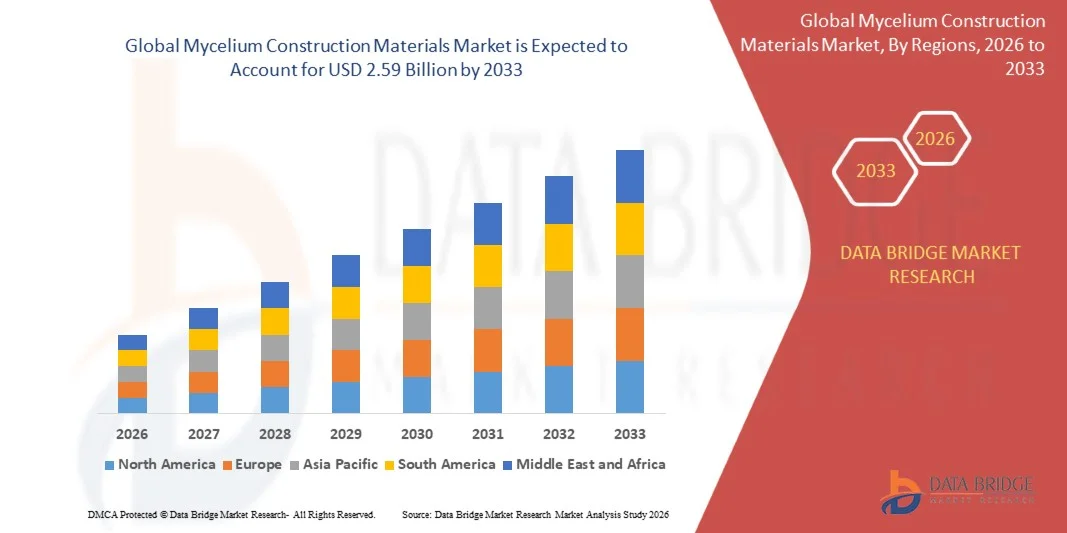
- As per Data Bridge Market Research analysis the mycelium construction materials market was valued at USD 1.01 billion in 2025 and is projected to reach USD 2.59 billion by 2033, growing at a CAGR of 12.50% from 2026 to 2033.
- The market is experiencing consistent growth driven by rising demand for sustainable and biodegradable construction materials, increasing adoption of bio-based building solutions, and growing focus on reducing the environmental impact of the construction industry.
- The increasing emphasis on circular economy practices, combined with advancements in mycelium-based material production and growing investments in green buildings, is encouraging architects, builders, and developers to adopt mycelium construction materials across residential and commercial applications.
Market Size & Forecast
- Market Value (2025): USD 1.01 Billion
- Expected Market Value (2033): USD 2.59 Billion
- Forecast CAGR (2026–2033): 12.50%
- Leading Region in 2025: North America
- Fastest Growing Region: Asia-Pacific
What are the Major Takeaways of the Mycelium Construction Materials Market?
- North America dominated the mycelium construction materials market with the largest revenue share in 2025, supported by growing demand for sustainable building materials, increasing awareness of bio-based construction solutions, and rising investments in green building practices.
- Asia-Pacific mycelium construction materials market is expected to witness the fastest growth rate from 2026 to 2033, supported by rapid urbanization, expanding construction activity, and increasing demand for sustainable building materials. Growing environmental concerns and efforts to reduce the carbon footprint of construction are encouraging the adoption of bio-based alternatives.
- The mycelium composites segment held the largest market revenue share in 2025, driven by its increasing use in wall panels, furniture, modular structures, and lightweight construction components. Mycelium composites are preferred due to their lightweight structure, biodegradability, and ability to be reinforced with materials such as bamboo, hemp, flax, and mineral fibers for improved durability and strength.
- The mycelium-based panels segment is projected to register the fastest growth at a CAGR from 2026 to 2033, driven by increasing demand for lightweight, biodegradable, and versatile construction panels. Growing adoption in walls, partitions, acoustic applications, and interior finishing is expanding the application scope of these panels. Manufacturers are developing panels with improved strength, fire resistance, moisture resistance, and dimensional stability to meet construction requirements. Rising demand for sustainable building materials and green construction practices is further supporting their adoption.
- The insulation panels segment held the largest market revenue share in 2025, driven by increasing demand for lightweight, fire-resistant, energy-efficient, and biodegradable building materials. Mycelium insulation panels are increasingly used in walls and roofing applications because of their thermal insulation properties, low weight, and compatibility with sustainable construction practices.
- The acoustic panels segment is projected to register the fastest growth at a CAGR from 2026 to 2033, supported by rising demand for sustainable sound-absorbing materials in offices, studios, restaurants, residential buildings, and commercial interiors. Growing awareness of indoor acoustic comfort is increasing demand for environmentally responsible noise-control solutions.
Report Scope and Mycelium Construction Materials Market Segmentation
|
Attributes |
Mycelium Construction Materials Key Market Insights |
|
Segments Covered |
|
|
Countries Covered |
North America
Europe
Asia-Pacific
Middle East and Africa
South America
|
|
Key Market Players |
|
|
Market Opportunities |
|
|
Value Added Data Infosets |
In addition to the insights on market scenarios such as market value, growth rate, segmentation, geographical coverage, and major players, the market reports curated by the Data Bridge Market Research also include import export analysis, production capacity overview, production consumption analysis, price trend analysis, climate change scenario, supply chain analysis, value chain analysis, raw material/consumables overview, vendor selection criteria, PESTLE Analysis, Porter Analysis, and regulatory framework. |
What is the Key Trend in the Mycelium Construction Materials Market?
- Construction companies, researchers, and material developers are increasingly focusing on mycelium-based insulation, panels, and composites as low-carbon alternatives to conventional building materials, supported by their lightweight structure, insulation properties, and potential for compostability.
- For instance, in September 2025, researchers from Cornell University published research on shootable mycelium-bound composites, demonstrating a meter-scale mycelium layer using concrete-inspired spray techniques to improve scalability, geometric flexibility, and construction efficiency.
- Manufacturers are increasingly developing mycelium-based insulation and structural panel systems that utilize agricultural and industrial biomass residues, supporting circular construction practices and reducing reliance on fossil-based materials.
- For instance, Mykor offers MykoSIP structural insulation panels for internal and external walls and MykoBead loose-fill insulation, demonstrating the commercialization of mycelium-based construction systems for building applications.
- As architects, researchers, and construction-material manufacturers continue to prioritize low-carbon and circular building solutions, advances in mycelium cultivation, processing, and scalable fabrication are expected to accelerate the adoption of mycelium construction materials.
What are the Key Drivers of the Mycelium Construction Materials Market?
- The growing pressure to reduce construction-related carbon emissions, energy consumption, and waste is significantly increasing demand for renewable bio-based materials that can provide insulation and other building functions with lower environmental impacts.
- For instance, a 2025 Cornell University study noted that the construction industry accounts for approximately 36% of global energy consumption, 37% of CO₂ emissions, and 35% of solid waste, highlighting the need for lower-impact alternatives such as mycelium-bound composites.
- Increasing demand for circular construction is encouraging manufacturers to use agricultural and industrial waste streams as feedstock for mycelium-based materials, enabling waste valorization while producing lightweight building components.
- For instance, Mykor transforms industrial biomass residues that would typically be incinerated or sent to landfill into mycelium-based insulating building systems, supporting material circularity and resource efficiency.
- With construction industries increasingly seeking renewable materials that reduce embodied environmental impacts while providing insulation and functional performance, the growing focus on circularity and low-carbon buildings is expected to remain a major driver of the mycelium construction materials market.
Which Factors are Challenging the Growth of the Mycelium Construction Materials Market?
- Limited large-scale production capacity, material standardization, durability requirements, and building-code acceptance continue to challenge the widespread commercialization of mycelium construction materials.
- These challenges can restrict adoption among mainstream construction companies and developers that require consistent material performance, established certification pathways, long service lives, and reliable supply at competitive costs.
- For instance, research published by the University of Technology Sydney in December 2025 highlighted that improving the durability of mycelium-based materials remains an important research focus for construction applications.
- For instance, Cornell University researchers reported in 2025 that conventional mold-based and limited-scale extrusion fabrication methods constrain efficiency, geometric freedom, and scalability, although their shootable composite approach demonstrated a potential pathway toward larger-scale production.
- The need to overcome durability, certification, scalability, and cost-related barriers continues to slow mainstream adoption, particularly for structural applications, limiting the penetration of mycelium construction materials despite their sustainability advantages.
How is the Mycelium Construction Materials Market Segmented?
The market is segmented on the basis of material type, product type, application, and end-use.
- By Material Type
On the basis of material type, the mycelium construction materials market is segmented into mycelium composites, mycelium foam, mycelium-based panels, mycelium bricks, and others. The mycelium composites segment held the largest market revenue share in 2025, driven by its increasing use in wall panels, furniture, modular structures, and lightweight construction components. Mycelium composites are preferred due to their lightweight structure, biodegradability, and ability to be reinforced with materials such as bamboo, hemp, flax, and mineral fibers for improved durability and strength.
The mycelium-based panels segment is projected to register the fastest growth at a CAGR from 2026 to 2033, driven by increasing demand for lightweight, biodegradable, and versatile construction panels. Growing adoption in walls, partitions, acoustic applications, and interior finishing is expanding the application scope of these panels. Manufacturers are developing panels with improved strength, fire resistance, moisture resistance, and dimensional stability to meet construction requirements. Rising demand for sustainable building materials and green construction practices is further supporting their adoption.
- By Product Type
On the basis of product type, the mycelium construction materials market is segmented into insulation panels, acoustic panels, structural panels, interior finishing materials, packaging materials, and others. The insulation panels segment held the largest market revenue share in 2025, driven by increasing demand for lightweight, fire-resistant, energy-efficient, and biodegradable building materials. Mycelium insulation panels are increasingly used in walls and roofing applications because of their thermal insulation properties, low weight, and compatibility with sustainable construction practices.
The acoustic panels segment is projected to register the fastest growth at a CAGR from 2026 to 2033, supported by rising demand for sustainable sound-absorbing materials in offices, studios, restaurants, residential buildings, and commercial interiors. Growing awareness of indoor acoustic comfort is increasing demand for environmentally responsible noise-control solutions.
- By Application
On the basis of application, the mycelium construction materials market is segmented into residential construction, commercial construction, industrial construction, interior design, and others. The residential construction segment accounted for a significant market revenue share in 2025, supported by increasing adoption of sustainable insulation, wall panels, flooring materials, and interior components in green residential projects. Growing consumer preference for low-carbon and biodegradable construction materials is encouraging builders to incorporate mycelium-based products into energy-efficient homes.
The interior design segment is projected to register the fastest growth at a CAGR from 2026 to 2033, driven by increasing use of mycelium acoustic panels, wall coverings, decorative surfaces, and customized interior elements. Growing interest in natural and biophilic design concepts is encouraging architects and designers to incorporate mycelium-based materials into modern interiors.
- By End Use
On the basis of end use, the mycelium construction materials market is segmented into walls and partitions, roofing and flooring, insulation, furniture and fixtures, and others. The insulation segment held the largest market revenue share in 2025, based on the published roofing and insulation application category, driven by the increasing demand for thermal-efficient, lightweight, and sustainable building materials. Mycelium-based insulation is increasingly incorporated into roofs, walls, and attics to reduce heat transfer while supporting low-carbon construction objectives.
The walls and partitions segment is projected to register the fastest growth at a CAGR from 2026 to 2033 as mycelium composites and panels gain adoption in lightweight interior structures, removable partitions, and sustainable commercial spaces. Increasing demand for flexible and modular workplace layouts is encouraging the use of lightweight partition systems.
Which Region Holds the Largest Share of the Mycelium Construction Materials Market?
- North America dominated the mycelium construction materials market with the largest revenue share in 2025, supported by growing demand for sustainable building materials, increasing awareness of bio-based construction solutions, and rising investments in green building practices.
- The region benefits from strong research and development activities focused on mycelium composites, insulation panels, acoustic panels, and other innovative construction applications. Increasing adoption of low-carbon materials in residential and commercial construction is further supporting market expansion. The availability of advanced manufacturing capabilities and growing interest in circular construction are also encouraging the commercialization of mycelium-based products.
U.S. Mycelium Construction Materials Market Insight
U.S. mycelium construction materials market captured the largest revenue share in North America in 2025, fueled by increasing demand for sustainable insulation and bio-based construction products. The growing emphasis on reducing construction-related environmental impacts is encouraging builders and architects to explore mycelium-based alternatives. Increasing investments in innovative building materials, combined with expanding applications in insulation panels, acoustic panels, and composites, are supporting market growth. The U.S. market is also benefiting from strong research activities and the development of advanced mycelium-based building solutions.
Europe Mycelium Construction Materials Market Insight
Europe mycelium construction materials market is expected to witness strong growth from 2026 to 2033, primarily driven by increasing emphasis on sustainable construction, circular economy practices, and reduction of building-related carbon emissions. Growing regulatory attention toward environmentally responsible construction materials is encouraging the adoption of bio-based alternatives. European architects and designers are increasingly exploring mycelium materials for insulation, acoustic panels, interior applications, and innovative building systems. The region also has an established ecosystem of companies developing commercial mycelium-based construction products. Germany is expected to register a strong growth rate during the forecast period.
U.K. Mycelium Construction Materials Market Insight
U.K. mycelium construction materials market is expected to witness strong growth from 2026 to 2033, driven by increasing demand for low-carbon building materials and growing interest in sustainable construction practices. The country's focus on reducing emissions from the built environment is encouraging developers and architects to investigate renewable and biodegradable material alternatives. Increasing adoption of innovative insulation, acoustic, and interior solutions is further supporting the market. The presence of emerging mycelium material developers and research initiatives is helping expand commercialization opportunities. Growing interest in circular construction and waste-based materials is expected to continue stimulating demand.
Germany Mycelium Construction Materials Market Insight
Germany mycelium construction materials market is expected to witness strong growth from 2026 to 2033, fueled by increasing awareness of sustainable construction and demand for environmentally responsible building materials. Germany's strong manufacturing infrastructure and emphasis on technological innovation support the development and adoption of mycelium-based construction solutions. Increasing investments in energy-efficient buildings and circular construction practices are encouraging the use of bio-based insulation and interior materials. The integration of mycelium products into sustainable residential and commercial projects is also gaining attention.
Asia-Pacific Mycelium Construction Materials Market Insight
The Asia-Pacific mycelium construction materials market is expected to witness the fastest growth rate from 2026 to 2033, supported by rapid urbanization, expanding construction activity, and increasing demand for sustainable building materials. Growing environmental concerns and efforts to reduce the carbon footprint of construction are encouraging the adoption of bio-based alternatives. Countries such as China, Japan, and India are increasingly exploring innovative materials for sustainable buildings and interior applications. The region's large manufacturing base and availability of agricultural residues also provide opportunities for scalable mycelium production.
Japan Mycelium Construction Materials Market Insight
Japan mycelium construction materials market is expected to witness strong growth from 2026 to 2033 due to the country's focus on sustainable architecture, advanced material technologies, and resource-efficient construction. Growing interest in bio-based materials is encouraging the development of mycelium insulation, acoustic panels, composites, and interior products. Japan's advanced manufacturing capabilities and emphasis on innovative building technologies are supporting the commercialization of alternative construction materials. Increasing demand for environmentally responsible materials in residential and commercial buildings is further creating opportunities. The integration of mycelium products with modern architectural and interior design applications is expected to support market expansion.
China Mycelium Construction Materials Market Insight
China mycelium construction materials market accounted for a significant revenue share in Asia Pacific in 2025, supported by rapid urbanization, expanding construction activity, and growing interest in sustainable building materials. The country's large manufacturing base and availability of agricultural residues provide favorable conditions for developing scalable mycelium-based materials. Increasing emphasis on green buildings and lower-carbon construction is encouraging the exploration of bio-based alternatives for insulation, acoustic applications, and interior products. Growing investments in innovative construction technologies are further supporting market development.
Which are the Top Companies in Mycelium Construction Materials Market?
The mycelium construction materials industry is primarily led by well-established companies, including:
- Mykor Ltd. (U.K.)
- Myconom Bio Materials (Turkey)
- MIMBIOSIS (Germany)
- Ecovative Design LLC (U.S.)
- MycoFoundry Inc. (Canada)
- Mogu S.r.l. (Italy)
- COMU Labs Inc. (Portugal)
- BIOHM Ltd. (U.K.)
- MycoTile (Kenya)
- MycoPanel (France)
- MycoWorks, Inc. (U.S.)
- Mycellium Materials (Egypt)
What are Latest Developments in Mycelium Construction Materials Market?
- In May 2026, Mykor, funding expansion, secured EUR 4 million to scale its low-carbon construction systems made from industrial and agricultural waste, including mycelium-based products. The company is going to use the funding to accelerate industrial biofabrication and expand manufacturing capacity. The investment will support the development of scalable insulation and construction systems with lower embodied carbon than conventional materials. This expansion is expected to improve the commercial availability of mycelium-based construction products. The development is likely to strengthen the market by accelerating commercialization and adoption of low-carbon building materials.
- In October 2025, MycoTile, production expansion, expanded the manufacturing of mycelium-based construction panels in Kenya using fungal roots and agricultural waste. The company is producing approximately 3,000 square meters of panels per month for insulation, wall applications, and interior decoration. The products provide a biodegradable and lower-cost alternative to conventional construction materials while utilizing agricultural waste. The expansion is helping address demand for affordable and sustainable building solutions in Kenya. This development is expected to support wider adoption of mycelium panels and strengthen the role of bio-based materials in emerging construction markets
- In September 2025, Cornell University researchers, product development, developed a shootable mycelium-bound composite that can be deposited onto vertical surfaces using concrete-inspired spray techniques. The researchers are going to use this approach to overcome limitations associated with mold-based fabrication and improve the scalability and geometric flexibility of mycelium construction materials. The material demonstrated consistent shootability for more than 50 minutes with less than 10% material loss. The technology could reduce labor requirements and enable faster production of larger and more complex structures. This development is expected to expand the application potential of mycelium composites in scalable construction and architectural fabrication
- In April 2025, Panasonic, building-material demonstration, showcased its Biosensory Dome at Expo 2025 Osaka using mycelium panels as a building material. The company is demonstrating how mycelium panels can be incorporated into architectural spaces while providing natural textures and sensory characteristics. The project highlights the potential of fungi-based materials for sustainable and nature-oriented interior environments. The demonstration is expected to increase awareness of mycelium as an alternative construction material among architects, designers, and technology developers. This development could support further research, product development, and commercialization of mycelium-based architectural applications

- Interactive Data Analysis Dashboard
- Company Analysis Dashboard for high growth potential opportunities
- Research Analyst Access for customization & queries
- Competitor Analysis with Interactive dashboard
- Latest News, Updates & Trend analysis
- Harness the Power of Benchmark Analysis for Comprehensive Competitor Tracking
Global Mycelium Construction Materials Market, Supply Chain Analysis and Ecosystem Framework
To support market growth and help clients navigate the impact of geopolitical shifts, DBMR has integrated in-depth supply chain analysis into its Global Mycelium Construction Materials Market research reports. This addition empowers clients to respond effectively to global changes affecting their industries. The supply chain analysis section includes detailed insights such as Global Mycelium Construction Materials Market consumption and production by country, price trend analysis, the impact of tariffs and geopolitical developments, and import and export trends by country and HSN code. It also highlights major suppliers with data on production capacity and company profiles, as well as key importers and exporters. In addition to research, DBMR offers specialized supply chain consulting services backed by over a decade of experience, providing solutions like supplier discovery, supplier risk assessment, price trend analysis, impact evaluation of inflation and trade route changes, and comprehensive market trend analysis.
Data collection and base year analysis are done using data collection modules with large sample sizes. The stage includes obtaining market information or related data through various sources and strategies. It includes examining and planning all the data acquired from the past in advance. It likewise envelops the examination of information inconsistencies seen across different information sources. The market data is analysed and estimated using market statistical and coherent models. Also, market share analysis and key trend analysis are the major success factors in the market report. To know more, please request an analyst call or drop down your inquiry.
The key research methodology used by DBMR research team is data triangulation which involves data mining, analysis of the impact of data variables on the market and primary (industry expert) validation. Data models include Vendor Positioning Grid, Market Time Line Analysis, Market Overview and Guide, Company Positioning Grid, Patent Analysis, Pricing Analysis, Company Market Share Analysis, Standards of Measurement, Global versus Regional and Vendor Share Analysis. To know more about the research methodology, drop in an inquiry to speak to our industry experts.
Data Bridge Market Research is a leader in advanced formative research. We take pride in servicing our existing and new customers with data and analysis that match and suits their goal. The report can be customized to include price trend analysis of target brands understanding the market for additional countries (ask for the list of countries), clinical trial results data, literature review, refurbished market and product base analysis. Market analysis of target competitors can be analyzed from technology-based analysis to market portfolio strategies. We can add as many competitors that you require data about in the format and data style you are looking for. Our team of analysts can also provide you data in crude raw excel files pivot tables (Fact book) or can assist you in creating presentations from the data sets available in the report.













