


What is the Global Myrica Fruit Wax Market Size and Growth Rate?
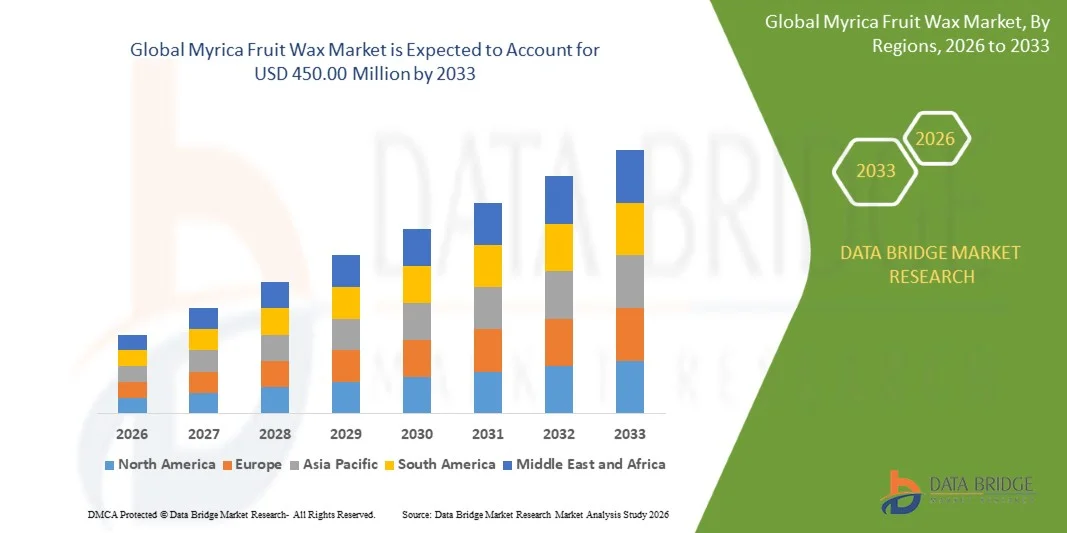
- The global myrica fruit wax market size was valued at USD 273.96 million in 2025 and is expected to reach USD 450.00 million by 2033, at a CAGR of 6.40% during the forecast period
- The increasing use of product for balm, butter and hair styling products owing to great feel to the skin and their high usage for emulsion stabilization for cosmetic products acts as the major factors driving the growth of myrica fruit wax market
- The consumer inclination towards the organic and natural products increases the demand of the fruit wax as it is produced without the use of solvents or additives and the rise in the popularity of the product as it has a low melting point which leads to an extremely smooth texture of the products made with myrica wax further accelerate the myrica fruit wax market
- The capability of the product to make lip balms in a tube or even some stick products such as a facial balm and the use of the wax to reduce the tackiness of water-in-oil emulsions while increasing product stab also influence the myrica fruit wax market
Market Size & Forecast
- Market Value (2025): USD 273.96 Million
- Expected Market Value (2033): USD 450.00 Million
- Forecast CAGR: 6.40%
What are the Major Takeaways of Myrica Fruit Wax Market?
- High usage in wide range of cosmetic applications on skin and hair, change in consumer preference towards vegan products, emphasis on human health and rising environmental concerns and surge in disposable income positively affect the myrica fruit wax market
- Furthermore, research and development projects and innovations in product formulations extend profitable opportunities to the myrica fruit wax market players
- North America dominated the myrica fruit wax market with a 44.2% revenue share in 2025, supported by strong consumer demand for natural, multifunctional, and clean-label wax ingredients across the U.S. and Canada
- Asia-Pacific is projected to register the fastest CAGR of 9.1% from 2026 to 2033, fueled by growing adoption of natural waxes in skincare, haircare, massage bars, and candles in China, Japan, India, and South Korea
- The Alkyl Esters segment dominated the market with a 41.8% revenue share in 2025, driven by its excellent emollient properties, smooth texture, and high stability in skincare, lip care, and dermatology formulations
Report Scope and Myrica Fruit Wax Market Segmentation
|
Attributes |
Myrica Fruit Wax Key Market Insights |
|
Segments Covered |
|
|
Countries Covered |
North America
Europe
Asia-Pacific
Middle East and Africa
South America
|
|
Key Market Players |
|
|
Market Opportunities |
|
|
Value Added Data Infosets |
In addition to the insights on market scenarios such as market value, growth rate, segmentation, geographical coverage, and major players, the market reports curated by the Data Bridge Market Research also include in-depth expert analysis, pricing analysis, brand share analysis, consumer survey, demography analysis, supply chain analysis, value chain analysis, raw material/consumables overview, vendor selection criteria, PESTLE Analysis, Porter Analysis, and regulatory framework. |
What is the Key Trend in the Myrica Fruit Wax Market?
“Rising Demand for Nutrient-Enriched and Multi-Functional Myrica Fruit Wax Formulations”
- The myrica fruit wax market is witnessing significant growth toward nutrient-enriched, multifunctional, and clean-label wax formulations, driven by rising demand for natural, plant-derived ingredients in cosmetics, personal care, and pharmaceuticals
- Manufacturers are developing multi-purpose Myrica Fruit Wax systems that enhance product stability, emollience, texture, and moisture retention across skincare, haircare, lip care, and dermatological products
- Consumers increasingly prefer natural, vegan, and sustainable waxes as alternatives to synthetic and petroleum-derived materials, accelerating adoption in premium beauty and organic cosmetic applications
- For instance, companies such as Koster Keunen, Merck KGaA, Strahl & Pitsch, and Kahl GmbH have expanded their portfolios with functional Myrica Fruit Wax grades used in luxury skincare, lip balms, and eco-friendly formulations
- Growing awareness of plant-based cosmetics, environmental safety, and clean beauty standards is further driving global demand
- As consumers seek natural, multifunctional, and environmentally responsible wax ingredients, myrica fruit wax is expected to play a central role in next-generation cosmetic and personal care product innovations
What are the Key Drivers of Myrica Fruit Wax Market?
- Rising consumer preference for natural, vegan, plant-based, and high-performance waxes is driving strong adoption of myrica fruit wax across cosmetics and personal care applications
- For instance, in 2025, Koster Keunen, Kahl GmbH, and Merck KGaA introduced new myrica wax blends for anti-aging creams, natural emulsions, lip care, and high-melt-point cosmetic formulations
- Increasing demand for sustainable and chemical-free beauty products is boosting the use of myrica fruit wax in the U.S., Europe, and Asia-Pacific markets
- Advancements in extraction processing, purity enhancement, and formulation customization have improved the wax’s sensory performance, stability, and compatibility with other natural ingredients
- Growing interest in organic, cruelty-free, non-GMO, and eco-certified cosmetic products continues to accelerate market expansion worldwide
- With rising investments in R&D, premium product launches, and supply-chain strengthening, the myrica fruit wax market is expected to maintain robust growth over the coming years
Which Factor is Challenging the Growth of the Myrica Fruit Wax Market?
- High production, purification, and processing costs of natural plant waxes, including Myrica Fruit Wax, limit affordability in price-sensitive markets
- For instance, during 2024–2025, variations in raw material availability, harvesting conditions, and supply chain costs affected production volumes among leading wax manufacturers
- Stringent cosmetic ingredient regulations, purity requirements, and certification standards increase operational complexity for manufacturers
- Limited consumer awareness in emerging markets regarding the benefits, applications, and sustainability of Myrica Fruit Wax restricts widespread adoption
- Strong competition from candelilla, carnauba, beeswax, and synthetic wax alternatives creates pricing pressure and affects product positioning
- To address these challenges, companies are focusing on cost-efficient sourcing, process optimization, regulatory compliance, and market education to expand global adoption of premium Myrica Fruit Wax products
How is the Myrica Fruit Wax Market Segmented?
The market is segmented on the basis of component, function, and end use.
• By Component
On the basis of component, the myrica fruit wax market is segmented into Aliphatic Hydrocarbons, Alkyl Esters, Fatty Acids, and Primary & Secondary Alcohols. The Alkyl Esters segment dominated the market with a 41.8% revenue share in 2025, driven by its excellent emollient properties, smooth texture, and high stability in skincare, lip care, and dermatology formulations. Alkyl esters are widely preferred by cosmetic manufacturers due to their compatibility with natural oils, ability to enhance spreadability, and contribution to premium product feel. Their strong performance in creams, lotions, and plant-based emulsions supports large-scale use across personal care categories.
The Fatty Acids segment is projected to grow at the fastest CAGR from 2026 to 2033, supported by rising demand for natural structuring agents, pH-stable ingredients, and biodegradable components in organic and vegan cosmetic formulations. Increasing adoption in moisturizers, balms, and therapeutic creams is fueling segment expansion.
• By Function
On the basis of function, the myrica fruit wax market is segmented into Emulsion Stabilization, Provide Viscosity, and Consistency. The Emulsion Stabilization segment dominated the market with a 46.3% revenue share in 2025, driven by growing use of Myrica Fruit Wax as a natural structuring agent in creams, serums, lotions, and ointments. Its ability to improve texture, enhance product stability, and prevent ingredient separation makes it highly valuable in both skincare and haircare formulations. Manufacturers increasingly prefer Myrica Wax due to its plant-based origin, high melting point, and excellent compatibility with oils, butters, and botanical actives.
The Viscosity & Consistency segment is projected to grow at the fastest CAGR from 2026 to 2033, supported by rising demand for rich, buttery textures in premium cosmetics, solid perfumes, lip balms, and eco-friendly formulations. The segment benefits from consumer preference for dense, luxurious, and long-lasting product feel, particularly in natural and organic beauty ranges.
• By End Use
On the basis of end use, the myrica fruit wax market is segmented into Personal Care Products, Hair Care Products, Candles, and Massage Bars. The Personal Care Products segment dominated the market with a 52.7% revenue share in 2025, driven by widespread use in skincare, lip care, cosmetics, and dermatological formulations. Myrica Fruit Wax offers natural thickening, stabilization, and emollient benefits, making it a preferred alternative to petroleum-based and synthetic waxes. Rising demand for clean-label, vegan, cruelty-free, and plant-derived ingredients has further accelerated its adoption in moisturizers, balms, lotions, and luxury beauty products.
The Massage Bars segment is projected to grow at the fastest CAGR from 2026 to 2033, supported by increasing popularity of solid-format personal care items, zero-waste beauty trends, and demand for natural waxes that melt gently on skin. Its smooth glide, moisturizing properties, and compatibility with essential oils are boosting usage in aromatherapy and spa products.
Which Region Holds the Largest Share of the Myrica Fruit Wax Market?
- North America dominated the myrica fruit wax market with a 44.2% revenue share in 2025, supported by strong consumer demand for natural, multifunctional, and clean-label wax ingredients across the U.S. and Canada. Rising awareness of sustainable, plant-based, and multifunctional ingredients drives adoption in personal care, haircare, cosmetics, and spa products
- Leading players are expanding their Myrica Fruit Wax portfolios through advanced extraction technologies, purification processes, and customized wax blends for creams, balms, lip care, and massage bars. Regulatory support for clean-label, vegan, and eco-friendly certifications further strengthens regional leadership
- High disposable incomes, urbanization, and growing preference for natural, sustainable, and multifunctional waxes over synthetic alternatives fuel strong regional growth.
U.S. Myrica Fruit Wax Market Insight
The U.S. is the largest contributor in North America, driven by high demand for multifunctional waxes in personal care, lip care, haircare, and skincare formulations. Manufacturers are investing in advanced purification, organic-certified Myrica Fruit Wax, and customized blends to enhance product stability, texture, and sensory appeal. Strong retail, specialty store, and e-commerce penetration, coupled with growing consumer focus on clean-label, plant-based, and sustainable ingredients, supports market expansion.
Canada Myrica Fruit Wax Market Insight
Canada contributes significantly, supported by rising demand for natural, vegan, and ethically sourced waxes in personal care and cosmetic applications. Local manufacturers and international brands are expanding product portfolios with Myrica Fruit Wax for creams, lip balms, massage bars, and specialty skincare products. Consumer awareness of sustainability, plant-based wellness trends, and eco-friendly product certifications is driving adoption across retail and digital channels.
Asia-Pacific Myrica Fruit Wax Market Insight
Asia-Pacific is projected to register the fastest CAGR of 9.1% from 2026 to 2033, fueled by growing adoption of natural waxes in skincare, haircare, massage bars, and candles in China, Japan, India, and South Korea. Rising disposable incomes, urbanization, and increasing awareness of multifunctional, plant-derived ingredients are accelerating market penetration. Expansion of e-commerce, digital promotions, and wellness-focused subscription models enhances accessibility and consumer adoption.
China Myrica Fruit Wax Market Insight
China is the largest contributor to Asia-Pacific, driven by strong manufacturing and processing capabilities for Myrica Fruit Wax. Demand is rising for creams, lip balms, massage bars, and cosmetic emulsions that leverage natural, multifunctional waxes. Manufacturers are investing in R&D, eco-friendly extraction, and high-purity wax production to strengthen domestic consumption and support exports.
Japan Myrica Fruit Wax Market Insight
Japan exhibits steady growth, supported by high consumer preference for premium, plant-based waxes in skincare, haircare, and functional cosmetic products. Innovation in purification, formulation stability, and multifunctional wax blends continues to attract health- and beauty-conscious consumers. Established retail networks and regulatory support further drive adoption.
India Myrica Fruit Wax Market Insight
India is emerging as a key contributor, fueled by increasing awareness of natural, multifunctional, and clean-label personal care ingredients. Rising demand for myrica fruit wax in creams, lip balms, massage bars, and haircare products is boosting market penetration. Expansion of e-commerce platforms, social media influence, and growing interest in ethical, plant-based ingredients support rapid adoption.
South Korea Myrica Fruit Wax Market Insight
South Korea contributes significantly, led by strong interest in innovative, multifunctional, and plant-based waxes for skincare, haircare, and massage bars. Influences from K-beauty trends, social media, and health-conscious lifestyles are accelerating consumer adoption. Premium packaging, product differentiation, and digital marketing initiatives further enhance regional growth.
Which are the Top Companies in Myrica Fruit Wax Market?
The myrica fruit wax industry is primarily led by well-established companies, including:
- Soap Makers Store (U.S.)
- Koster Keunen (U.S.)
- alexmo cosmetics (Germany)
- Natural Sourcing, LLC (U.S.)
- TM Kobashi Ltd (Japan)
- Studio Botanic GmbH (Germany)
- SkinChakra (India)
- Merck KGaA (Germany)
- Humblebee & Me (U.S.)
- Katyani Exports (India)
- Bay House Aromatics (U.S.)
- Strahl & Pitsch, Inc. (U.S.)
- Kahl GmbH & Co. KG (Germany)
- Xi’an Best Bio-Tech Co., Ltd. (China)
- Kemie Industries (U.S.)
- Organic Herb Inc (U.S.)
- Greenutra Resource Inc (Canada)
- Qingdao Elites-United Foodstuff Co., Ltd (China)

- Interactive Data Analysis Dashboard
- Company Analysis Dashboard for high growth potential opportunities
- Research Analyst Access for customization & queries
- Competitor Analysis with Interactive dashboard
- Latest News, Updates & Trend analysis
- Harness the Power of Benchmark Analysis for Comprehensive Competitor Tracking
Global Myrica Fruit Wax Market, Supply Chain Analysis and Ecosystem Framework
To support market growth and help clients navigate the impact of geopolitical shifts, DBMR has integrated in-depth supply chain analysis into its Global Myrica Fruit Wax Market research reports. This addition empowers clients to respond effectively to global changes affecting their industries. The supply chain analysis section includes detailed insights such as Global Myrica Fruit Wax Market consumption and production by country, price trend analysis, the impact of tariffs and geopolitical developments, and import and export trends by country and HSN code. It also highlights major suppliers with data on production capacity and company profiles, as well as key importers and exporters. In addition to research, DBMR offers specialized supply chain consulting services backed by over a decade of experience, providing solutions like supplier discovery, supplier risk assessment, price trend analysis, impact evaluation of inflation and trade route changes, and comprehensive market trend analysis.
Data collection and base year analysis are done using data collection modules with large sample sizes. The stage includes obtaining market information or related data through various sources and strategies. It includes examining and planning all the data acquired from the past in advance. It likewise envelops the examination of information inconsistencies seen across different information sources. The market data is analysed and estimated using market statistical and coherent models. Also, market share analysis and key trend analysis are the major success factors in the market report. To know more, please request an analyst call or drop down your inquiry.
The key research methodology used by DBMR research team is data triangulation which involves data mining, analysis of the impact of data variables on the market and primary (industry expert) validation. Data models include Vendor Positioning Grid, Market Time Line Analysis, Market Overview and Guide, Company Positioning Grid, Patent Analysis, Pricing Analysis, Company Market Share Analysis, Standards of Measurement, Global versus Regional and Vendor Share Analysis. To know more about the research methodology, drop in an inquiry to speak to our industry experts.
Data Bridge Market Research is a leader in advanced formative research. We take pride in servicing our existing and new customers with data and analysis that match and suits their goal. The report can be customized to include price trend analysis of target brands understanding the market for additional countries (ask for the list of countries), clinical trial results data, literature review, refurbished market and product base analysis. Market analysis of target competitors can be analyzed from technology-based analysis to market portfolio strategies. We can add as many competitors that you require data about in the format and data style you are looking for. Our team of analysts can also provide you data in crude raw excel files pivot tables (Fact book) or can assist you in creating presentations from the data sets available in the report.













